Frequency based meditation music uses specific sound frequencies, either as musical tunings or as binaural beats layered under a track, to nudge your brain and body towards a particular state. Want calm and focus fast? A short 6 Hz theta binaural session through headphones is the single best-evidenced starting point. Want sleep? Reach for delta-range tracks (around 1 to 4 Hz) played quietly as you wind down. Want relaxed alertness for work? Alpha frequencies (8 to 13 Hz) fit that brief.
None of this needs to be complicated. Fifteen minutes with decent headphones and a well-produced track will tell you more than reading ten more explainer articles.
- Sleep: delta frequencies, low volume, fade-out enabled
- Calm and focus: 6 Hz theta binaural beats, 5 to 20 minutes, headphones required
- Relaxed productivity: alpha frequencies, 20 to 30 minutes, background level
Pro Tip: If you’ve never tried binaural beats before, start with a track that embeds the beat inside pink noise or orchestral texture rather than an isolated tone. A study in 2025 found listeners preferred it that way, and the calming effect held up just as well. A 2025 PLOS One study recorded large effect sizes for exactly this approach.
Key Takeaways
Short theta binaural sessions have the strongest research support of any frequency-based technique, based on available studies, and production quality determines whether listeners actually stick with the practice.
| Point | Details |
|---|---|
| Start with theta | Try a short 6 Hz binaural session with headphones for calm and focus before exploring other bands. |
| Match format to goal | Binaural beats need headphones; monaural or isochronic tones work through speakers for sleep or background use. |
| Embed beats in texture | Layering beats in pink noise or orchestral sound improves comfort without reducing the calming effect. |
| Treat evidence with nuance | Theta effects are well-supported; other bands and long-term claims still need standardised research. |
| Choose well-produced tracks | Orchestralmeditations records at Abbey Road with the National Philharmonic and composers Robert Emery and Moritz Schneider, pairing evidence-aware frequencies with orchestral arrangement quality. |
How frequency bands shape your mental state
Your brain runs on electrical rhythms, and different rhythms correlate with different states of mind. Neuroscientists group these into five bands, and once you know them, the entire frequency-music market starts making a lot more sense.
Delta (0.5 to 4 Hz) dominates deep, dreamless sleep. Theta (4 to 8 Hz) shows up during light meditation, drowsy creativity, and that hypnagogic zone just before you drop off. Alpha (8 to 13 Hz) is relaxed wakefulness, the state you’re in when you’re calmly focused but not stressed. Beta (13 to 30 Hz) is ordinary alert thinking, and gamma (above 30 Hz) is associated with intense concentration and, in some research, peak meditative absorption.

Here’s where it gets confusing for newcomers: brainwave bands and musical tunings are two entirely different things, both marketed under the same “frequency music” umbrella. A brainwave frequency is something happening inside your skull, invisible and unhearable. A tuning like 432 Hz or 528 Hz is simply the pitch a piece of music is composed around, something you hear directly.
The named tunings you’ll see everywhere include:
- 432 Hz — marketed as more “natural” or soothing than the standard 440 Hz tuning, though no clinical evidence separates its physiological effect from any other pleasant piece of music
- 528 Hz — dubbed the “love frequency” or “DNA repair frequency” in wellness circles, a claim with no peer-reviewed backing
- 174 Hz and 1111 Hz — associated with pain relief and spiritual awakening respectively, again based on tradition and anecdote rather than trials
- Solfeggio tones — a set of six historic tones (including 528 Hz) tied to an ancient scale, popular in sound healing but not scientifically validated as a set
None of that makes these tunings pointless. Music you find beautiful will relax you regardless of the number attached to it. Just don’t confuse a pleasant pitch with a proven brainwave effect.
What binaural beats actually do, according to the research
Binaural beats work through a neat trick of perception. Play a 200 Hz tone in your left ear and a 206 Hz tone in your right ear, and your brain doesn’t hear two separate pitches. It perceives a phantom third tone pulsing at the difference between them, in this case 6 Hz. That illusion only happens with headphones, because each ear needs to receive a genuinely different frequency.
The most solid evidence so far centres on that 6 Hz theta range. A 2025 PLOS One study tested self-administered 6 Hz binaural beats across two experiments with roughly 220 participants combined, comparing them against silence and against plain pink noise. The result: reliable increases in self-reported calmness and focus, with large effect sizes (Hedge’s g) above 0.74, which counts as large in psychological research terms.
Participants also preferred the beats when embedded in pink noise rather than presented as an isolated tone, and that preference didn’t cost them any of the calming effect.
That’s a genuinely useful finding for anyone choosing a track: layered, textured audio isn’t just nicer to listen to, it’s arguably the better format.
The wider picture is messier. A systematic review covering 14 studies on binaural beat entrainment found results were heterogeneous, some supporting brainwave entrainment and applied benefits, others contradicting it. The reviewers pointed to inconsistent methodology across studies as a major culprit, not necessarily a dead end for the theory itself. Read that as: short theta sessions have real, replicated support, but treat any claim about other bands or long-term effects with a healthy pinch of scepticism.
How to choose and use frequency-based tracks safely
Pick your goal before you pick a track. That single decision does most of the work.
- Define the goal. Sleep, relaxation, focus, or creative flow each point towards a different band, delta, alpha, alpha again, or theta respectively.
- Match the format to the goal. Binaural beats demand headphones, no exceptions, since the effect depends on each ear receiving a distinct tone. Monaural or isochronic beats, which combine the tones before they reach your ears, work fine through speakers.
- Set the volume sensibly. Keep it well under 85 dB, roughly the volume of a normal conversation across a room. Louder doesn’t mean more effective, and prolonged loud listening risks hearing fatigue.
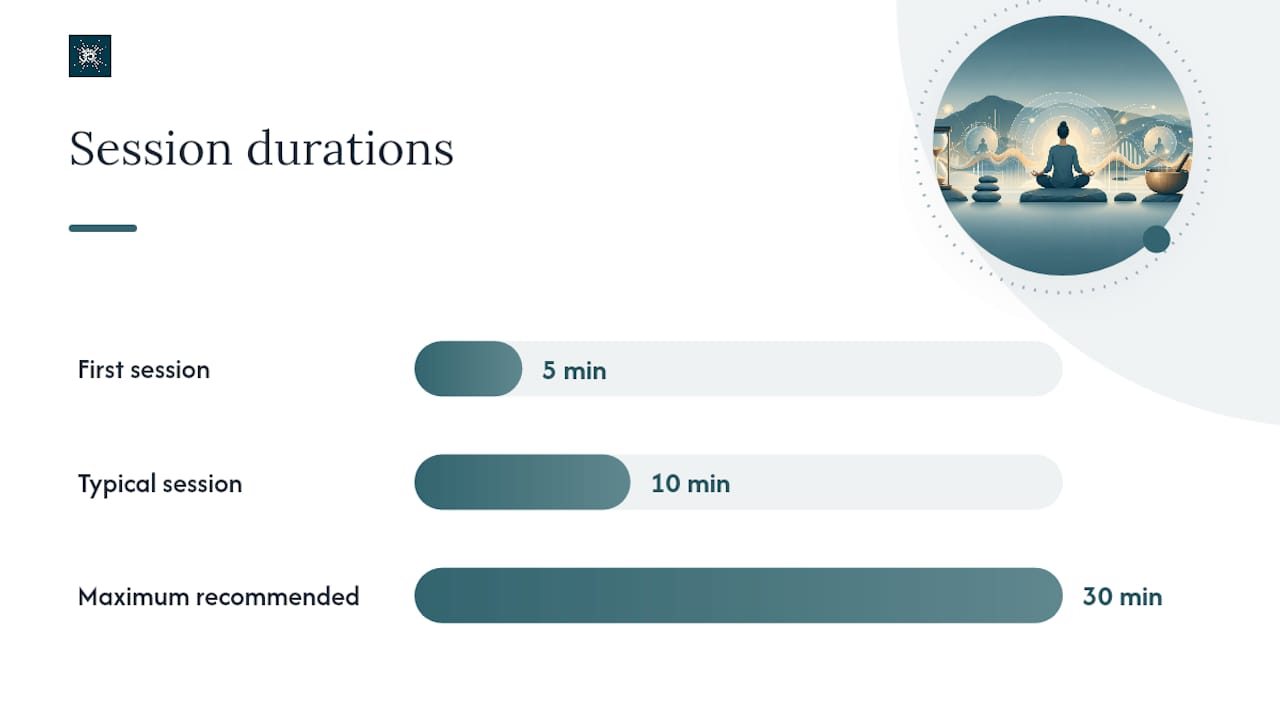
- Start short. Five minutes is plenty for a first theta session. Build up towards 10 to 30 minutes as it becomes a habit.
- Layer for comfort. Music embedded in pink noise or gentle orchestral texture tends to be both more pleasant and, per the PLOS One findings, no less effective than a bare tone.
Pro Tip: If you feel light-headed, anxious, or simply “off” during a session, stop. This is meant to be gentle, not a jolt to the system.
On safety: binaural beats and frequency music are low-risk for most listeners, but they aren’t a substitute for therapy, medication, or clinical care. WebMD’s explainer recommends comfortable listening levels and quality headphones for a reason, poor audio can undercut the whole exercise. People with epilepsy should be particularly cautious, since rhythmic audio-visual stimulation has, in some contexts, been linked to seizure triggers, and anyone with a seizure disorder should check with a doctor before experimenting with entrainment audio.
Sample listening protocols for sleep, focus and calm
You don’t need a dozen apps to get started, just a goal, a track, and a bit of patience with your own ears.
- Quick reset: 5 minutes of 6 Hz theta binaural beats, headphones on, eyes closed. Good before a stressful meeting or after a long call.
- Study session: 20 to 30 minutes of alpha-range audio (8 to 13 Hz) layered under orchestral or ambient texture, played at background level so it supports concentration rather than demanding it.
- Wind-down for sleep: a delta-frequency playlist with a built-in fade-out over 20 to 40 minutes, rather than something looping all night, since an abrupt cut-off partway through deep sleep can be jarring.
- Creative flow: 432 Hz orchestral warmth with a light theta overlay underneath, more mood-setting than clinical, but pleasant enough to hold attention during longer creative work.
A note on mixing your own: guidance from frequency tools like the Solfeggio Player suggests starting with one tone at a low level, only adding a second if it still feels comfortable, and introducing gentle motion or modulation rather than a static drone, which tends to grate on the ear after ten minutes.
Why production quality changes the experience
A binaural beat recorded on a laptop microphone and one recorded at Abbey Road Studios with the National Philharmonic are not the same listening experience, even if the underlying frequency is identical on paper.
Production choices that genuinely change how a track feels:
- Live musicians instead of synthesised pads — real strings and woodwind carry natural harmonic complexity that reduces the flat, fatiguing quality of purely synthetic tones over long sessions
- 3D surround techniques — spatial depth makes it easier to lose yourself in a track rather than notice the mechanics of it
- Careful carrier frequency selection — where the binaural beat sits within the arrangement, rather than bolted on top, so it doesn’t fight the music for attention
Orchestralmeditations builds its catalogue around exactly these principles, with tracks recorded at Abbey Road and performed by the National Philharmonic. Composer and producer Robert Emery, known for large-scale orchestral projects and his work bridging classical performance with broadcast and film scoring, brings the arrangement discipline that keeps a 20-minute theta track from feeling repetitive. Composer Moritz Schneider applies a similarly meticulous approach to layering carrier tones beneath orchestral textures, so the binaural element supports the music instead of sitting awkwardly on top of it.
Composition, listener context, and intention shape whether a frequency actually works for someone, more than any single number on a spec sheet ever will.
That’s not a knock against the science. It’s a reminder that a well-arranged 6 Hz theta track, played through real instrumentation, gives the underlying frequency its best possible chance of landing.
What the research actually tells us to prioritise
Most advice on frequency-based meditation music treats every tuning and every band as equally proven, when the honest picture is far narrower and, frankly, more interesting. The 6 Hz theta finding is real and replicated. Almost everything else, 432 Hz’s supposed superiority, 528 Hz’s “DNA repair,” is closer to folklore dressed in scientific language.
That doesn’t mean the folklore is worthless. It means you should prioritise differently than most guides suggest: pick the format with genuine evidence behind it first (short theta sessions, headphones, embedded in texture), then let personal preference guide the rest, including which named tunings feel good to you. Composition and arrangement matter more than the market admits. A poorly produced binaural track undermines its own frequency by being unpleasant to sit through, while a well-arranged one, the kind built by composers who understand orchestration, gives even the most modest evidence its best shot at working.
The gap between marketing and research isn’t a reason to dismiss this category. It’s a reason to be more selective about where you spend your listening time.
Listen to tracks built on this evidence, not just marketing claims
Orchestralmeditations gives you what most frequency-music libraries don’t: binaural beats and Solfeggio tones recorded with real orchestral musicians at Abbey Road Studios, rather than synthesised tones dropped over stock ambience. That matters directly for the theta sessions covered above, since the PLOS One research found listeners preferred beats embedded in richer, layered sound, and richer, layered sound is exactly what a full orchestra and 3D surround recording deliver.
The catalogue includes tracks composed by Robert Emery and Moritz Schneider, built around theta, alpha, and Solfeggio frequencies for sleep, focus, and relaxation. You can buy individual tracks with a personal or professional licence, or subscribe for ongoing access if you’re building a regular practice, teaching yoga, or scoring wellness content professionally. Have a browse of the Orchestral Meditations shop and try a theta or alpha track tonight to see how a properly produced session compares with anything you’ve streamed before.
Sources
- Effects of self-administered binaural beats on meditative and introspective states | PLOS One
- Systematic review on binaural beat stimulation and brainwave entrainment | PMC / PubMed Central
FAQ
What frequency music is good for meditation?
Theta frequencies around 6 Hz have the strongest research support for calmness and focus, while alpha (8 to 13 Hz) suits relaxed, alert states and delta (below 4 Hz) supports sleep.
Is it good to listen to frequencies while meditating?
Yes, for most people. Short theta binaural sessions showed improvements in calmness and focus in controlled research, though results across other frequency bands remain mixed.
What does 432 Hz actually do?
There’s no clinical evidence that 432 Hz produces a different physiological effect from standard 440 Hz tuning. Any calming effect likely comes from the music itself rather than the specific pitch.
What does 528 Hz do to the human body?
Claims about 528 Hz repairing DNA or healing the body have no peer-reviewed backing. It remains a popular Solfeggio tone valued for its subjective, pleasant tone rather than any proven physical mechanism.