
Use ambient if you need a neutral, background sound that won’t tug at your attention. Use orchestral when you want emotional immersion, texture, and a sense of being guided somewhere. That’s the whole verdict, really, but the details matter, so let’s get into them.
Ambient music was built for exactly this job. Brian Eno conceived it to be “as ignorable as it is interesting,” which is a wonderfully odd design brief when you think about it. Orchestral music does the opposite job well: it holds attention, carries emotional weight, and gives structure to practices like Yoga Nidra or guided visualisation. Orchestral Meditations, which records with the National Philharmonic Orchestra at Abbey Road Studios, sits firmly in that second camp.
- Choose ambient for breath-focused mindfulness, body scans, or any session where you want the mind to settle without being pulled anywhere in particular.
- Choose orchestral for guided visualisation, Yoga Nidra, or sessions where you want the music to actively carry you through emotional shifts.
Key Takeaways
Choosing between orchestral and ambient meditation music comes down to matching sound texture and emotional intensity to your specific practice goal, not picking a permanent favourite.
| Point | Details |
|---|---|
| Ambient supports background focus | Designed to be ignorable, ambient suits breath awareness, body scans, and sleep-focused sessions. |
| Orchestral supports emotional immersion | Dynamic arcs and leitmotifs make orchestral music better suited to Yoga Nidra and guided visualisation. |
| Run the three-session test | Rate attention, emotion, relaxation, and urge to stop across one ambient, one orchestral, and one repeat session. |
| Headphones matter for engineered features | 3D surround and binaural beats only work properly through stereo headphones, not a single speaker. |
| Orchestral Meditations for professional licensing | Recorded at Abbey Road Studios with the National Philharmonic Orchestra, with composer credits from Robert Emery and Moritz Schneider supporting commercial use. |
Orchestral vs ambient meditation: the sound differences
The clearest way to tell these two styles apart isn’t philosophy, it’s your ears. Orchestral meditation music uses strings, brass, and woodwind arranged with dynamic arcs, meaning the volume and intensity rise and fall in a deliberate shape. There’s often a leitmotif, a recurring musical idea that returns and develops, which is exactly the trick film composers use to make you feel something without a single word being spoken.
Ambient music does almost the reverse. Sustained tones, drones, and slowly shifting textures replace melody and harmonic movement almost entirely. Where orchestral music tells a story, ambient music creates weather. Field recordings, room tone, and long reverb tails often stand in for instruments altogether.
Then there’s the engineering layer, which is where things get genuinely interesting. Binaural beats rely on playing two slightly different frequencies in each ear, which the brain perceives as a third, pulsing tone, often used to nudge listeners toward theta brainwave states associated with deep relaxation. Three-dimensional surround production, meanwhile, places instruments in a spatial field around the listener rather than a flat left-right stereo image. Orchestral Meditations builds this into its Abbey Road recordings, which is a very different production challenge to layering a synthesiser pad.
| Sound element | Orchestral style | Ambient style |
|---|---|---|
| Core texture | Strings, brass, woodwind | Pads, drones, sustained tones |
| Harmonic movement | Frequent, expressive | Minimal, slow-changing |
| Structure | Dynamic arcs, leitmotifs | Loops, environmental layers |
| Engineered features | 3D surround, orchestral theta scoring | Binaural beats, field recordings |
- Orchestral tracks tend to build toward emotional peaks, then release.
- Ambient tracks tend to stay level, avoiding peaks that could pull focus.
- Both can incorporate Solfeggio or theta-frequency layers, but orchestral recordings usually blend them beneath a full arrangement rather than as the entire piece.
How does music affect meditation depth and focus?
Ambient music’s real strength is what it doesn’t do. Because it was designed to sit quietly in the background, it rarely competes for attention the way a melody or lyric does. That’s precisely why it suits breath-counting or body-scan practices, where the goal is stillness rather than being moved somewhere emotionally.

Orchestral music works differently, and that’s not a flaw, it’s the point. A string section swelling under a guided visualisation can deepen the sense of narrative, of actually going somewhere in your mind. Instrumental pieces avoid the language-processing load that comes with lyrics, which is one reason instrumental music generally supports meditation better than vocal tracks, but orchestral arrangements still carry enough harmonic movement to stir memory and feeling in a way ambient rarely attempts.
Common patterns worth knowing:
- Ambient tends to support pure breath awareness and can help with falling asleep during Yoga Nidra’s final stage.
- Orchestral tends to evoke memory and emotion, useful for guided visualisation but occasionally distracting during pure concentration practices.
- Both can misfire if the piece is too active or too flat for your current mental state.
Pro Tip: If you notice your mind chasing a melody instead of your breath, that’s not you “failing” at meditation. It’s a sign the piece is too foreground for the practice. Switch to something with less harmonic movement and see if focus returns.
Which style suits which type of meditation?
Matching style to practice isn’t guesswork once you know what each dimension is doing.
| Practice | Best for | Emotional engagement | Distraction tendency | Recommended setup |
|---|---|---|---|---|
| Breath awareness | Ambient | Low, background | Low | Speakers or soft headphones |
| Body scan | Ambient or gentle orchestral | Low to moderate | Low to moderate | Headphones, low volume |
| Guided visualisation | Orchestral | High, foreground | Moderate (by design) | Headphones for 3D detail |
| Yoga Nidra | Orchestral | High, narrative | Moderate | Stereo speakers or headphones |
| Sleep-focused sessions | Ambient (or slow, sparse orchestral) | Low | Low | Speakers, low volume |
Ambient plus breath awareness is the classic, low-friction pairing. Orchestral plus Yoga Nidra works because the narrative arc mirrors the guided script’s own emotional shifts. The exception is tempo: a slower, sparser orchestral arrangement, one closer to drone-based neo-classical writing, can work for concentration practices too, provided the dynamics stay gentle rather than cinematic.
How can you test which style works for you?
A three-session experiment settles this far faster than reading opinions online, including this one.
- Session one, ambient, 10 to 15 minutes. Sit or lie down, play a purely ambient track, and rate afterwards: attention held (1 to 5), emotional response (1 to 5), relaxation (1 to 5), urge to stop early (yes or no).
- Session two, orchestral, 10 to 15 minutes. Same ratings, different music. Notice whether the emotional pull helped you settle or pulled your focus away from the practice itself.
- Session three, your choice, up to 20 minutes. Pick whichever scored higher and repeat it, refining volume or track choice based on what you noticed.
Keep it simple: a notes app or a scrap of paper with four numbers per session is plenty. Short daily sessions, even five to ten minutes, are enough to notice a genuine pattern. If ambient consistently scores higher on relaxation but lower on engagement, that tells you something real about how your mind likes to settle.
What’s the right way to listen for meditation?
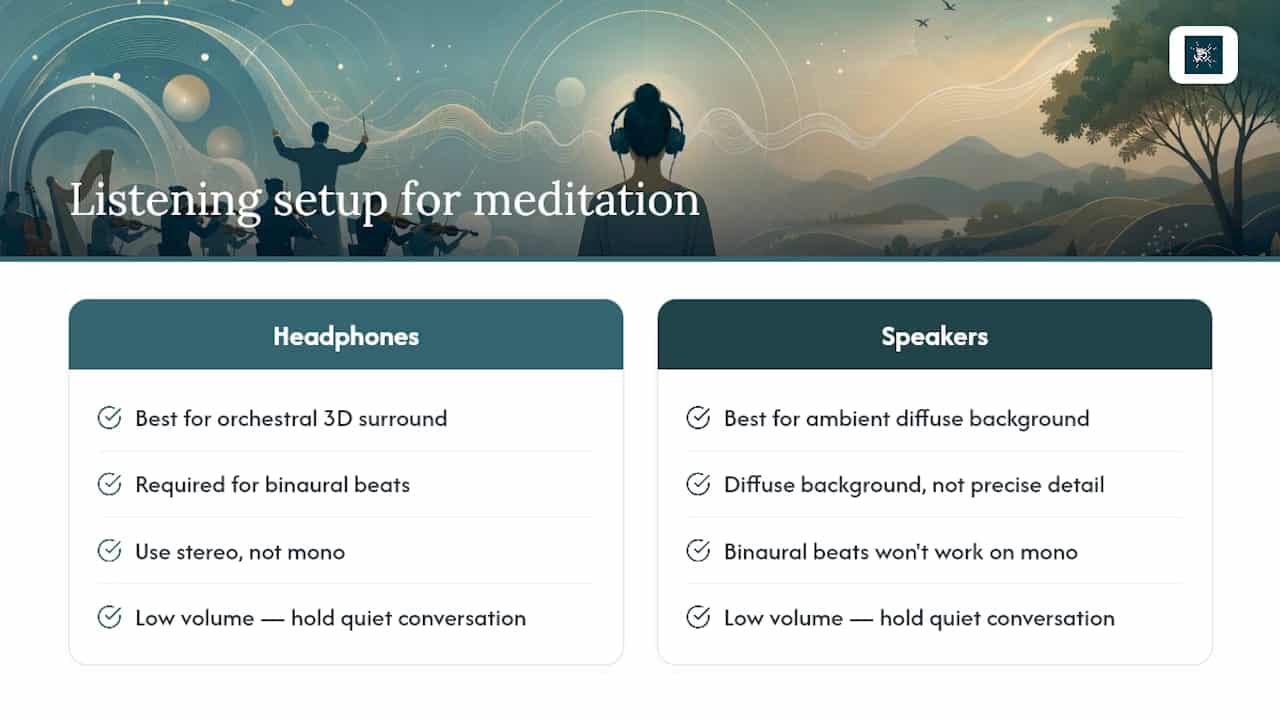
Headphones are worth it for orchestral recordings using 3D surround production, since that spatial placement of instruments only really lands with proper stereo separation close to your ears. Speakers work fine for ambient tracks, where the goal is a diffuse background wash rather than precise detail.
Keep volume low enough that you could hold a quiet conversation over it. Instrumental, lyric-free tracks reduce cognitive load considerably compared with anything containing words, so avoid vocal tracks entirely regardless of which style you pick. Restrained, slow-tempo audio generally demands less attention than highly structured songs, which is the whole logic behind choosing ambient for focus work.
Small rituals help enormously. Use the first thirty seconds of any track as a settling-in period before you start your practice properly, and stick to a consistent handful of tracks so your brain starts associating them with calm rather than novelty — check out these guided meditations for practical examples of music selection and use.
Pro Tip: If a session uses binaural beats, listen through separate left and right channels, meaning proper stereo headphones, not a single mono speaker, or the effect simply won’t work. And if you have a diagnosed seizure disorder, check with a doctor before using pulsing binaural or strongly rhythmic frequency tracks.
Where can you find quality tracks, and what about licensing?
For ambient work, look for restrained, drone-based catalogues built specifically for meditation rather than general “chill” playlists, which often contain beats and melodic hooks that undercut the whole point. Commercial orchestral meditation albums released across streaming platforms show there’s real demand for symphonic soundscapes built specifically for stillness rather than background listening.
Orchestral Meditations occupies that orchestral category directly, with recordings made at Abbey Road Studios with the National Philharmonic Orchestra. Composer and producer Robert Emery and producer Moritz Schneider are named collaborators on the label’s recordings, and that credit isn’t a small detail if you’re a therapist, yoga teacher, or app developer needing defensible professional licensing. Music built by named, credentialed musicians in a documented studio is a very different proposition to an anonymous royalty-free upload.
Before buying or licensing anything, check:
- Whether the licence covers personal listening only, or professional/commercial use (apps, studios, therapy sessions).
- Whether it’s a one-off purchase or a subscription, and which suits your usage volume.
- Whether the track is genuinely royalty-free or requires separate clearance for public playback.
Pro Tip: If you’re a yoga instructor or therapist, always confirm commercial licensing terms before playing purchased tracks in paid sessions. Personal licences almost never cover that use.
What if both styles work for you?
Plenty of people don’t need to pick a permanent lane, and honestly, forcing yourself into one is a bit like insisting you only ever eat one meal for the rest of your life. Mood, time of day, and your current emotional state all shift which style helps more on a given morning.
Practical ways to personalise this:
- Alternate styles through the week: ambient for weekday focus sessions, orchestral for weekend visualisation work.
- Layer ambient drones beneath the quieter passages of an orchestral piece, letting the orchestral crescendos arrive as a deliberate shift rather than the whole session.
- Build a short playlist that moves from ambient into orchestral, background first, immersive second, so the session itself has an arc.
- Keep one fallback ambient track for high-stress days when anything emotionally rich feels like too much.
Why we treat orchestral and ambient as tools, not rivals
Neither style is objectively better, and honestly, treating this as a competition misses what each is actually for. Ambient earns its place by staying out of the way. Orchestral earns its place by doing the opposite, by building something worth being moved by.
What tips the balance for me, professionally, is production quality. There’s a real difference between a synthesiser pad and a full string section recorded properly, and that difference shows up the moment you close your eyes. Recording at Abbey Road Studios with the National Philharmonic Orchestra isn’t a marketing flourish, it’s the reason the dynamic range and spatial depth actually hold up on headphones. Composer credits like Robert Emery’s matter for the same reason a film score credit matters: someone with real compositional training shaped how tension builds and releases across the piece, rather than looping a preset. That’s not a knock against ambient’s minimalism. It’s simply a different craft, aimed at a different outcome.
Start with a curated orchestral library built for exactly this
If you’ve decided orchestral is your style, or even if you’re still testing both, Orchestral Meditations gives you a shortcut past the guesswork of anonymous stock libraries. Every track is recorded at Abbey Road Studios with the National Philharmonic Orchestra, produced with 3D surround and theta or Solfeggio-frequency layers built into the arrangement rather than bolted on afterwards.
You can audition tracks before buying, choose a single download for personal practice, or take out a subscription if you’re building playlists regularly. Therapists, yoga teachers, and app developers can select a professional licence, with composer and producer credits from Robert Emery and Moritz Schneider giving you something concrete to point to if a client ever asks where the music came from. Browse the full meditation music library or start with the best meditation music selection to hear the difference Abbey Road production actually makes.
Sources
- Centre for Research into Inner Experience — ambient music project (Durham University)
- How to practice music meditation | Verywell Mind
- Instrumental music for meditation: what actually works | Ordinary Introvert
FAQ
Is orchestral or ambient music better for meditation?
Neither is universally better. Ambient suits background focus practices like breath awareness, while orchestral suits practices needing emotional depth, such as Yoga Nidra or guided visualisation.
Can ambient music help me fall asleep during meditation?
Yes. Ambient’s sustained tones and lack of melodic peaks make it well suited to sleep-focused sessions, where you want the mind to disengage rather than be moved emotionally.
Do I need headphones for orchestral meditation music?
Headphones are recommended for tracks using 3D surround or binaural beats, since the spatial and stereo effects need separate channels to each ear to work properly.
Who are Robert Emery and Moritz Schneider?
They are the named composer and producer credited on Orchestral Meditations’ recordings, made at Abbey Road Studios with the National Philharmonic Orchestra, supporting the label’s professional licensing credentials.
How long should a first meditation music session be?
Ten to fifteen minutes is a practical starting point, and even five to ten minutes daily can help beginners notice which style genuinely helps them settle.