Yes, most uses of commercially released music in therapy sessions require a licence in the UK. Whether you are playing a Spotify playlist in your waiting room, singing along to a chart track with a client, or posting a session clip online, UK copyright law treats nearly all of those activities as distinct rights that need permission. The AMTA COVID-19 Task Force advisory draws a clear line: private, one-to-one sessions in a secure, non-public location carry lower legal risk, but the moment you record, distribute, or post anything publicly, formal licensing or written permission is required.
Three scenarios to keep in mind right now:
- Licence almost certainly required: playing recorded music in a group session, a waiting room, a reception area, or any space where more than one client can hear it; streaming or posting session content online; distributing guided audio recordings.
- Lower legal risk (but not zero): a private, one-to-one session in a locked clinical room or a closed, secure telehealth platform where no recording is made and nothing is shared beyond the two people in the room.
- Recommended immediate action: use a professional licence from PPL PRS or switch to rights-cleared orchestral tracks that come with a licence certificate, and keep that certificate in your clinical records.
Which licence types apply to therapy session music licensing?
UK music copyright splits into two parallel rights, and most therapy activities touch both of them. TheMusicLicence from PPL PRS bundles them into a single product for businesses, which is why it is the first port of call for most clinicians.
The two core rights:
- PRS for Music administers the composition right: the melody and lyrics written by the songwriter or composer.
- PPL administers the recorded performance right: the specific recording made by the artist and owned by the record label.
Beyond those two, therapy professionals who create products or distribute recordings encounter two further rights:
- Mechanical rights (MCPS): triggered when you reproduce a composition onto a physical or digital medium, for example burning a CD for a client or encoding a track into a downloadable guided meditation.
- Synchronisation (sync) rights: required when you pair music with moving image or a fixed audio-visual product, such as a video of a session or a guided meditation with accompanying visuals.
Here is how those rights map to common therapy activities:
| Therapy activity | Rights triggered | Who to contact |
|---|---|---|
| Playing recorded music in a treatment room or waiting area | Public performance (PRS + PPL) | PPL PRS (TheMusicLicence) |
| Live client singing or improvisation to a recorded backing | Public performance (PRS + PPL) | PPL PRS (TheMusicLicence) |
| Distributing a downloadable guided audio with music | Mechanical (MCPS) + master rights | MCPS / rights holder directly |
| Streaming a session or posting a clip online | Communication to the public (PRS + PPL) + possible sync | PPL PRS + rights holder |
| Including music in a therapy app or video product | Sync + mechanical + master rights | Rights holder / music supervisor |
Healthcare premises playing music in waiting rooms or treatment areas will usually need TheMusicLicence, with fees calculated using factors such as audible area (in square metres), number of seats, and number of therapy chairs or beds served. The tariff is not a flat fee: a solo practitioner with a single small room pays considerably less than a multi-room clinic with a shared reception.
A note on cost: PPL PRS does not publish a universal price list because every premises is different. What they do publish is the methodology: audible area and use type drive the calculation. Have your room dimensions and a description of how you use music ready before you call.
When do you probably not need a licence, and when do you?
The honest answer is that “probably not” is a narrower category than most therapists assume. Here is how the common scenarios break down.
Lower legal risk (but read the caveats):
- A private, one-to-one session in a locked clinical room where no recording is made and the music is not audible outside the room.
- A closed telehealth session on a secure, encrypted platform (think NHS-approved video tools) where no recording is stored or shared, per the AMTA advisory on copyright for music therapists.
Licence required:
- Group therapy sessions, even with paying clients in a private practice, because multiple people hearing the music constitutes public performance under UK law.
- Music playing in a reception or waiting room, regardless of whether it is background or foreground.
- Any session where a recording is made and stored beyond the immediate clinical record.
- Playing music through a personal Spotify, Apple Music, or Tidal account in a clinical setting. Consumer streaming subscriptions are licensed for private, personal listening only and do not cover playback in a business or therapy context, full stop.
The distinction that trips up most therapists is the group session. It feels private because the room is closed and the clients are known to you. UK copyright law does not see it that way: “public” in copyright terms means any gathering beyond a normal circle of family and close friends, which a therapy group clearly is.
Pro Tip: Apply this quick decision rule on the spot: if anyone other than the single client you are treating right now can hear or access the music, treat it as public performance and check your licence status before you press play.
Recording sessions, sending songs, and telehealth: what you need to know
Recording a session is fine for private clinical records, provided the recording stays locked in a secure system and is never distributed. The moment it leaves that system, whether you email it to a colleague, upload it to a shared drive, or post it anywhere online, you need additional permissions and you need client consent.
Technology-mediated interventions require careful attention to platform security and distribution rules; recorded material intended for distribution brings copyright and privacy obligations that sit on top of your standard clinical duties. That is not a reason to avoid recording, it is a reason to have a clear process before you start.
Steps to follow when recording a session that includes music:
- Obtain written informed consent from the client before recording begins, specifying what the recording will be used for and who may access it.
- Document in your clinical notes: the music used, the reason for its use, the licence or rights status of the track, and the consent obtained.
- Store the recording in a GDPR-compliant system with access controls. The UK GDPR requires you to keep personal data secure and to retain it only as long as necessary.
- If you intend to share the recording with a supervisor, colleague, or third party, check whether your existing licence covers that distribution. For most commercial tracks, it will not.
- If you want to distribute a recording containing copyrighted music (even to one other person), contact MCPS or the rights holder directly to request a mechanical licence or written permission.
On the two questions therapists ask most often:
“Can I send my therapist a song?” Yes, a client sharing a personal music recommendation with their therapist is not a copyright act. The client is not reproducing or distributing the work commercially; they are pointing you toward something. Listening to it on your own device for clinical context is private use.
“Can I record my counselling session?” Recording for private clinical records is generally acceptable under UK practice guidance, but you must have client consent and the recording must remain secure. If the session includes copyrighted music, distributing that recording requires separate permissions.
Recordkeeping fields to include in clinical notes when music is used:
- Track title and artist (or catalogue reference if using a rights-cleared library)
- Licence type held and licence certificate reference number
- Whether a recording was made, and if so, the storage location and access controls
- Client consent obtained (date and form reference)
- Clinical rationale for the music choice
For a fuller session workflow that includes privacy and copyright considerations, the step-by-step music therapy session guide is worth bookmarking.
When therapy music becomes a product: apps, guided meditations, and downloads
This is where licensing gets genuinely complicated, and where the stakes are highest. If you are creating a downloadable guided meditation, a therapy app, or any packaged audio product that includes commercial music, you are no longer in public-performance territory. You are in sync and mechanical rights territory, and those rights are negotiated separately from TheMusicLicence.
For clinical-grade products that make medical claims, such as the kind of rehabilitation music used in neurological therapy, the licensing is even more demanding. Partnerships like the Universal Music and MedRhythms collaboration illustrate that bespoke direct agreements with major labels are often required for prescription-level therapeutic products. That is a different world from a private practitioner creating a relaxation download for clients.
For most therapists creating products, the practical options are:
- Commission original music with a clear contractual assignment of all rights to you. This removes ongoing licence obligations but requires upfront investment and a well-drafted agreement.
- Buy a sync and mechanical licence from the rights holder directly. This is possible for independent artists and smaller labels; major labels are rarely willing to grant these for small-scale clinical products.
- Use a rights-cleared catalogue with a professional licence that explicitly covers your intended use (distribution, app inclusion, guided audio). Always read the licence terms: “royalty-free” means no ongoing royalties, not “no licence required.”
- Use Creative Commons tracks where the specific CC licence explicitly permits commercial and derivative use, such as CC BY 4.0. Never assume a CC licence covers your use without checking the exact terms.
A rough comparison of the three main routes for packaged products:
| Route | Upfront cost | Ongoing obligations | Speed | Best for |
|---|---|---|---|---|
| Commission original music | Higher | Minimal if rights assigned | Weeks to months | Bespoke clinical products |
| Buy sync/mechanical licence | Variable | Possible royalties | Weeks | One-off products with specific tracks |
| Rights-cleared professional library | Low to moderate | Read licence terms | Immediate | Guided audio, apps, downloads |
How to get the right music licence in the UK: a step-by-step process
Getting licensed is less painful than most therapists expect, provided you arrive at the conversation prepared. Here is the process from start to finish.
- Identify your use case precisely. Are you playing music in a room? Recording it? Distributing it? Each use triggers different rights, and conflating them leads to the wrong licence.
- Measure your audible area. For TheMusicLicence, PPL PRS calculates fees partly on the square meterage of the space where music is audible. Measure every room where music plays, including waiting areas.
- Count the relevant variables. Note the number of waiting-room seats, therapy chairs, and beds served with music. Minor inaccuracies in these figures can shift you into a different tariff band.
- Contact PPL PRS for public performance. For most clinical settings, TheMusicLicence covers both the composition right (PRS) and the recorded performance right (PPL) in a single application. Apply online at pplprs.co.uk or call their business licensing team.
- Contact MCPS for mechanical rights. If you are reproducing music onto a medium for distribution (CDs, downloads, streaming), contact MCPS directly. MCPS is administered by PRS for Music, so the starting point is prsformusic.com.
- Contact rights holders directly for sync. There is no single collecting society for sync rights in the UK. You need to identify the publisher (for the composition) and the label (for the master recording) and negotiate separately.
- Retain your licence certificate. File it in your clinical records alongside the relevant session notes. If you are ever audited or questioned, the certificate is your evidence.
What to have ready when you call PPL PRS:
- Floor plan or room dimensions (in square metres)
- Number of rooms where music is played
- Number of seats or therapy stations
- Description of how music is used (background, active therapeutic use, group sessions)
- Whether you record or distribute any music
On timelines: TheMusicLicence applications for straightforward clinical premises are typically processed within a few working days once PPL PRS has all the information they need. Delays almost always come from incomplete premises details. Sync and mechanical licences negotiated directly with rights holders can take weeks or longer, particularly with major labels.
A copy-ready checklist and sample consent wording
Print this, paste it into your intake pack, or drop it into your practice management system. It covers the bases for routine clinical use.
Licensing and compliance checklist:
- [ ] Identify the music source (commercial release, rights-cleared library, Creative Commons, commissioned original)
- [ ] Confirm whether public performance applies (group session, waiting room, or any space beyond a single private client)
- [ ] Check platform terms if using a streaming service (personal accounts do not cover clinical use)
- [ ] Secure the appropriate licence or certificate before the session
- [ ] Obtain written client consent if recording the session
- [ ] Document music used, licence reference, and clinical rationale in session notes
- [ ] Store licence certificate in the client file or practice compliance folder
- [ ] Review licence terms annually or when your practice changes
For a more detailed clinical checklist covering music therapy outcomes, the music therapy checklist resource offers a useful companion framework.
Sample consent text (a): recording a session that includes copyrighted music
“I consent to this session being audio-recorded for clinical record purposes. I understand the recording will be stored securely, accessed only by [practitioner name] and relevant supervisors, and will not be shared, published, or distributed without my further written consent.”
Sample consent text (b): sharing a legacy recording with a third party
“I consent to the recording of [date] session being shared with [named third party] for the purpose of [clinical supervision / research / training]. I understand this sharing is subject to confidentiality obligations and the recording will not be further distributed.”
Questions to ask when calling PPL PRS or a rights holder:
- Does this licence cover my specific use (public performance / recording / distribution)?
- What is the tariff for my premises size and use type?
- Does the licence cover all rooms where music is audible, including waiting areas?
- What documentation do I receive, and in what format?
- What happens if my use changes (e.g. I add group sessions or start recording)?
Rights-cleared orchestral tracks: a practical option for busy therapists
The fastest way to remove licence uncertainty from your practice is to use a professional, rights-cleared music library that issues a licence certificate and states permitted uses clearly. That is not a workaround; it is exactly what the collecting societies themselves suggest as a compliant route for practitioners who want to focus on clinical work rather than rights administration.
Orchestralmeditations offers a catalogue of orchestral meditation tracks recorded at Abbey Road Studios with the National Philharmonic, available with professional licensing options designed for therapy and wellness use. The tracks use 3D surround sound, binaural beats, theta frequencies, and Solfeggio-frequency compositions, which makes them genuinely suited to therapeutic contexts rather than being generic background music repurposed for clinical settings.
The composers and producers behind the catalogue matter here; exploring the healing power of music shows how sound can improve your mood and clinical outcomes. Robert Emery, a composer and producer whose work spans orchestral and therapeutic music, and Moritz Schneider, whose production credits include immersive sound design and frequency-based compositions, bring a level of intentionality to these recordings that is relevant when you are justifying clinical music choices. The role of composers in therapeutic music is not a trivial consideration: a track composed with therapeutic intent, using specific frequencies and orchestral textures, is a different clinical tool from a commercial pop song. Knowing who made it and why adds credibility to your clinical rationale.
What Orchestralmeditations offers for therapy professionals:
- Royalty-free orchestral tracks with professional licence options covering therapy, wellness, and guided audio use
- Studio-quality recordings featuring live musicians, binaural beats, and frequency-based compositions
- Individual track purchases and subscription options for ongoing access
- Licence certificates suitable for filing in clinical records
Pro Tip: When you purchase a professional licence from a rights-cleared library, save the licence certificate as a PDF in the same folder as your session notes for that client. If you ever need to demonstrate compliance, it takes ten seconds to find.
For therapists who want to explore the full range of therapeutic applications, the what people use our music for page gives a clear picture of how practitioners are using the catalogue in practice.
Key takeaways: the three most important actions for UK therapists
Therapy session music licensing in the UK requires identifying your use type, securing the right licence before you play, and keeping the certificate in your clinical records.
| Point | Details |
|---|---|
| Identify your use type first | Public performance, recording, and distribution each trigger different rights and different licences. |
| Use TheMusicLicence for clinical premises | PPL PRS covers both composition and recording rights for most routine therapy settings in a single licence. |
| Consumer streaming does not cover clinical use | Personal Spotify or Apple Music accounts are not licensed for therapy sessions; switch to a business or professional licence. |
| Document consent and keep certificates | Store licence certificates and client consent forms in clinical records alongside session notes. |
| Orchestralmeditations reduces licence uncertainty | Rights-cleared professional tracks with licence certificates remove ambiguity for routine therapy and guided audio use. |
Next steps:
- Measure your audible area and count therapy stations, then contact PPL PRS for a quote.
- If you record or distribute music, contact MCPS or the rights holder directly before sharing anything.
- Check platform terms for any streaming service you use in sessions.
- For ambiguous cases, contact PRS for Music, PPL, or MCPS directly; their business licensing teams are used to fielding questions from small practices.
The part of this that most guidance gets wrong
There is a version of this topic that gets written as a dry legal explainer, lists the collecting societies, and then leaves you to figure out what to actually do on Monday morning. That version is not wrong, exactly. It is just not very useful.
What strikes me most, having worked through the evidence on this, is how many therapists are operating in a genuine grey area not out of negligence but out of reasonable confusion. The law is not designed with a solo music therapist in mind. It is designed for broadcasters, venues, and retailers. Applying it to a one-to-one clinical session in a converted spare room requires a level of interpretive effort that most practitioners simply do not have time for.
The conventional advice is “get TheMusicLicence.” That is correct for most clinical premises, but it does not solve the problem for therapists who record sessions, create guided audio products, or use music in telehealth. Those uses require additional steps that TheMusicLicence does not cover, and the gap between “I have a licence” and “I have the right licence for this specific use” is where most compliance failures happen.
What I would prioritise, if I were advising a colleague setting up a new practice, is this: start with a rights-cleared library for all active therapeutic use, keep TheMusicLicence for any commercial recordings you play in shared spaces, and build the consent and recordkeeping habit from day one. The paperwork is not the burden it sounds like once it is part of your intake process. And the alternative, discovering mid-session that your streaming account does not cover clinical use, is considerably more disruptive.
The music itself matters too. A track composed with therapeutic intent, using specific frequencies and orchestral textures by someone like Robert Emery or Moritz Schneider, is a different clinical instrument from a commercial pop song. Choosing music that was made for this purpose, and that comes with clear licensing, is not just a compliance decision. It is a clinical one.
Orchestralmeditations: rights-cleared music built for therapy professionals
The real cost of navigating therapy music licensing alone is not the licence fee. It is the time spent chasing rights holders, interpreting tariff tables, and wondering whether your current setup is actually compliant. Orchestralmeditations offers a direct alternative: a professional library of orchestral meditation tracks, recorded at Abbey Road Studios with live musicians, available with clear professional licensing for therapy, guided audio, and wellness use.
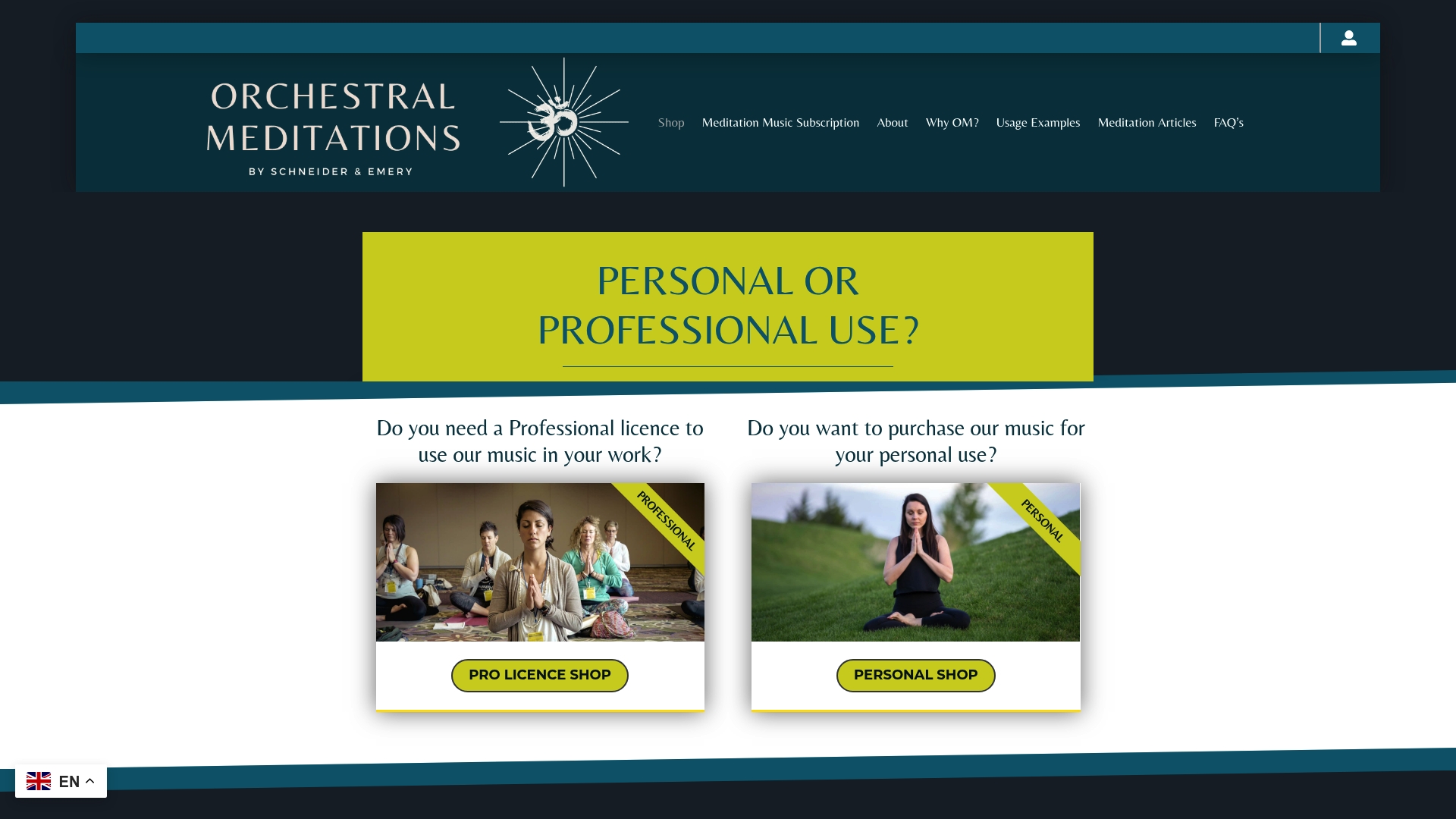
Tracks by composers including Robert Emery and Moritz Schneider are built around therapeutic frequencies (binaural beats, theta, Solfeggio) and 3D surround sound, which means they serve a clinical purpose rather than simply filling silence. The professional licence comes with a certificate you can file in your clinical records, removing the ambiguity that comes with commercial releases. Individual track purchases and a professional subscription are both available, so you can match the model to your practice size.
Browse the full catalogue and check professional licensing options at Orchestralmeditations, or explore the best meditation music tracks to find something suited to your sessions today.
This article is general information, not a substitute for advice from a qualified lawyer. Consult a qualified legal professional about your own circumstances before acting on anything here.
Sources
FAQ
Do I need a licence to play music in a therapy session?
Usually yes, unless the session is a private one-to-one in a secure, non-public location with no recording made. Group sessions, waiting rooms, and any online or recorded use almost always require a licence.
Can I send my therapist a song?
Yes. A client sharing a personal music recommendation is not a copyright act; it is a pointer to a track. The therapist listening to it privately for clinical context is personal use and does not require a licence.
Can I record my counselling session?
Recording for private clinical records is generally acceptable under UK practice guidance, provided you have client consent and the recording is stored securely. If the recording includes copyrighted music and you intend to share or distribute it, you will need additional permissions from the rights holder.
Are session musicians entitled to royalties when their recordings are played in therapy?
Yes. When a commercially released recording is played in a clinical setting that requires TheMusicLicence, the PPL element of that licence distributes royalties to the performers and rights holders of the recording, which includes session musicians registered with PPL.
What is the quickest compliant route for a busy therapist?
Use a rights-cleared professional library such as Orchestralmeditations, which provides licence certificates and clear permitted uses, and obtain TheMusicLicence from PPL PRS for any commercial recordings played in shared clinical spaces.