Your mind frequency is the dominant brainwave pattern your brain produces at any given moment, measured in hertz (Hz) on an EEG. If you want to try frequency-based audio for focus or relaxation, the most practical first step is to put on a good pair of stereo headphones, choose a professionally produced binaural or 3D orchestral recording matched to your goal, and run a short 15–20 minute session in a quiet space.
Pro Tip: Before you press play, rate your current mental state out of ten for focus or calm. Do the same immediately after. Three sessions of that simple before-and-after check will tell you more about your personal response than any frequency chart ever will.
What does “mind frequency” actually mean?
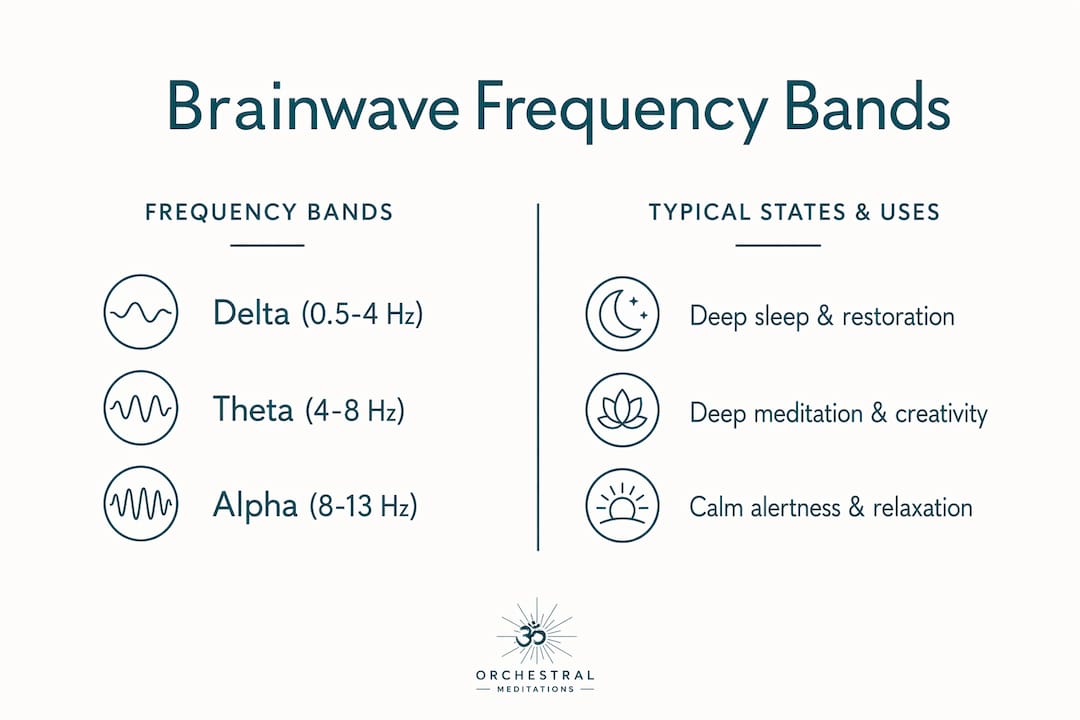
The phrase gets used in two quite different ways, and conflating them causes a lot of confusion. In neuroscience, mind frequency refers to the dominant oscillatory activity of your brain at a given moment, measured by electroencephalography (EEG). According to standard EEG classification, the clinically relevant range runs from roughly 0.5 Hz up to 70 Hz and beyond, divided into five named bands.
In wellness culture, “mind frequency” is often used more loosely to mean a kind of vibrational quality of thought or consciousness. Some commercial tools assign arbitrary Hz values to emotions (peace = 600 Hz, for instance) that bear no relationship to EEG measurement conventions whatsoever. Those are metaphors, not measurements. Useful metaphors, perhaps, but worth keeping separate from the actual neuroscience.
The five EEG frequency bands and their practical relevance:
- Delta (0.5–4 Hz): Deep, dreamless sleep; physical restoration; very low arousal. Used in sleep-support audio.
- Theta (4–8 Hz): Light sleep, deep meditation, creative daydreaming, memory consolidation. The band most associated with hypnagogic imagery and flow states.
- Alpha (8–13 Hz): Relaxed wakefulness, calm alertness, eyes-closed rest. The brain’s default “effortless awareness” state, associated with meditative presence.
- Beta (13–30 Hz): Active thinking, problem-solving, focused attention, mild anxiety at higher sub-bands. The band you are probably in right now.
- Gamma (30–100+ Hz): Peak cognitive processing, cross-modal perception, moments of insight. Associated with heightened sensory integration.
| Band | Hz range | Typical state | Practical use |
|---|---|---|---|
| Delta | 0.5–4 Hz | Deep sleep, unconscious restoration | Sleep-support audio, recovery |
| Theta | 4–8 Hz | Deep meditation, creativity, light sleep | Meditation, creative sessions |
| Alpha | 8–13 Hz | Calm alertness, restful awareness | Relaxation, mindfulness, stress relief |
| Beta | 13–30 Hz | Active focus, analytical thinking | Concentration, study, work |
| Gamma | 30–100+ Hz | Peak cognition, sensory integration | Advanced meditation, cognitive tasks |
One thing worth noting: healthy brain function is not about permanently camping in one band. Clinicians emphasise that each band serves a necessary role, and the real skill is shifting fluidly between states as circumstances demand. Frequency audio helps you practise that shift.
How binaural beats and entrainment actually work
The core mechanism is called the frequency-following response (or auditory entrainment): when your brain is exposed to a rhythmic stimulus, neural activity tends to synchronise with that rhythm. It is a reproducible phenomenon, measurable on EEG, though effect sizes vary considerably between individuals and protocols.

Binaural beats are the most widely discussed delivery method. You hear a slightly different tone in each ear (say, 200 Hz in the left, 212 Hz in the right), and your brain perceives a phantom beat at the difference frequency (12 Hz, which sits in the alpha band). The critical point: binaural beats require stereo headphones. Without them, the two tones mix in the air before reaching your ears and no beat is produced.
Monaural beats and isochronic tones work differently. Monaural beats are created by mixing two tones before they reach the listener, so the amplitude modulation is already in the audio signal. Isochronic tones are single tones switched on and off at a target rate. Both can work through speakers, which makes them more flexible for room-based listening or group sessions.
The carrier material wrapped around the entrainment signal matters more than most guides admit. A raw binaural beat at 10 Hz with no musical context is tolerable for about four minutes before it becomes genuinely irritating. Wrap that same beat inside a professionally recorded orchestral arrangement with careful 3D binaural mixing, and the immersive quality changes the experience entirely. The music holds your attention, reduces cognitive resistance, and makes it far easier to sustain the relaxed, receptive state that entrainment requires.
Pro Tip: To check whether a binaural track is actually producing the intended beat, listen with headphones and focus your attention on the subtle pulsing quality beneath the music. If you cannot hear any rhythmic pulse at all, either the beat frequency is too high to perceive clearly (above ~30 Hz), or the mix has buried it. A well-produced alpha track should produce a gentle, perceptible throb at roughly one pulse per second.
What the science actually supports
The honest summary: modest, task-dependent benefits are supported by controlled research, best understood as a cognitive and attentional aid rather than a medical treatment.
Research on alpha synchrony shows a consistent association between global alpha activity (8–13 Hz) and restful, non-effortful awareness. Meditative states reliably produce alpha synchrony across cortical regions; effortful cognition desynchronises alpha and shifts activity toward faster beta and gamma. This is not a fringe finding. It is one of the more replicated results in EEG research.
The entrainment literature is more mixed. The frequency-following response is real and measurable, but behavioural outcomes (improved focus, reduced anxiety, better sleep) vary considerably depending on protocol, individual baseline, and how rigorously the study was controlled. Small sample sizes and the difficulty of creating a convincing placebo condition (what exactly is a “fake” binaural beat?) make many studies hard to interpret. Neural oscillations spanning the full EEG spectrum are well-established in physiology; the question is how reliably external audio can nudge them in a useful direction.
The alpha-theta interaction is particularly interesting for meditation practitioners. Extended practice alters alpha-theta dynamics in ways that suggest frequency audio is most useful as a training scaffold rather than a one-off fix. Think of it less like taking a painkiller and more like practising scales: the benefit accumulates with repetition.
For brain health and fitness more broadly, frequency audio sits alongside other evidence-supported approaches (exercise, sleep hygiene, mindfulness practice) rather than replacing them. It is a useful tool in a wider toolkit.
This article is general information, not medical or clinical advice. If you have a neurological condition or are considering frequency audio for a health concern, consult a qualified clinician before starting.
Who should be careful with frequency audio
For most healthy adults, frequency audio carries very low risk when used sensibly. That said, specific groups should take real care.
Contraindications and precautions to know:
- Epilepsy or seizure history: Consult a neurologist before use. Rhythmic auditory stimulation carries a theoretical seizure risk in susceptible individuals.
- Pregnancy: Insufficient research exists on the effects of sustained binaural entrainment during pregnancy. Err on the side of caution and seek clinical guidance.
- Recent head injury or concussion: The brain is in a vulnerable state during recovery. Avoid entrainment audio until cleared by a clinician.
- Active driving or operating machinery: Never use binaural or theta-range audio while driving or using equipment. Deep relaxation states and road safety do not mix.
- Certain psychiatric conditions: If you are managing a condition where altered states of consciousness could be destabilising, discuss with your mental health professional first.
- Children: The research base for entrainment in children is thin. Parental discretion and professional guidance apply.
Safe listening checklist:
- Use good-quality closed-back stereo headphones
- Keep volume at no more than 60–70% of your device’s maximum
- Start with sessions of 15–20 minutes; build up gradually
- Listen in a seated or lying position in a safe, quiet environment
- Do not use immediately before tasks requiring sharp alertness (driving, machinery)
How to set up a session that actually works
The setup is simple: choose your goal, match it to the right frequency band, put on headphones, and give yourself an uninterrupted block of time. The details below make the difference between a session that drifts into distraction and one that genuinely shifts your state.
Practical setup checklist:
- Choose closed-back stereo headphones (over-ear preferred for immersion)
- Set device volume to 60–70% maximum
- Find a quiet space where you will not be interrupted
- Rate your current state: focus or calm, out of ten
- Set a timer so you are not clock-watching
- Sit comfortably or lie down, close your eyes
Session templates:
- Focus booster (15–20 minutes): Target 12–15 Hz (SMR/low beta). Use a track with a steady carrier and minimal melodic variation. Good for pre-work or pre-study priming.
- Relaxed alertness (10–20 minutes): Target 8–13 Hz (alpha). Ideal for a mid-afternoon reset or pre-meditation warm-up. Orchestral alpha tracks with relaxing frequencies work particularly well here.
- Deep relaxation or nap support (20–40 minutes): Target 4–8 Hz (theta) with a slow, warm carrier. Allow yourself to drift; do not try to stay alert.
- Sleep aid (30–60 minutes): Target 0.5–4 Hz (delta) with a gradual fade in volume over the final ten minutes. Best used as you settle into bed.
Tracking your response is where most people give up too early. Run the same session three to seven times before drawing conclusions. Keep a brief journal: date, session type, pre-rating, post-rating, any notable observations. Individual variability in EEG signatures is high enough that what works brilliantly for one person may do very little for another, and the only way to find out is a structured personal trial.
Pro Tip: Never schedule a 40-minute theta session immediately before a meeting or task requiring sharp focus. Theta states take time to clear. Build in at least 20–30 minutes of normal activity between a deep relaxation session and anything that demands your full cognitive attention.

Why production quality changes everything
A binaural beat is only as good as the recording it lives inside. Poor production introduces phase errors that corrupt the beat, harsh mastering that causes listening fatigue, and carrier sounds so thin or synthetic that your brain resists relaxing into them. Quality signals to look for:
| Feature | What to look for | Why it matters |
|---|---|---|
| Sample rate and bit depth | — | Preserves the subtle phase relationships binaural mixing depends on |
| Binaural/3D mixing | True binaural processing, not stereo pan | Creates the spatial immersion that supports entrainment |
| Carrier quality | Live instruments or high-quality synthesis | Reduces listening fatigue; live timbre is richer and more engaging |
| Mastering loudness | Conservative; no heavy limiting | Prevents ear fatigue and preserves dynamic range |
| Phase coherency | Verified mono compatibility | Ensures the beat is not corrupted by phase cancellation |
Recording with a professional orchestra at a world-class facility changes the carrier material in ways that matter perceptibly. The acoustic depth, the natural reverb, the harmonic richness of live strings and woodwinds — these qualities create an immersive listening environment that synthetic pads simply cannot replicate. 3D sound meditation using genuine binaural mixing adds a spatial dimension that draws the listener inward rather than leaving them perched on the surface of the sound.
Orchestralmeditations works with composers and producers whose credentials are worth knowing. Robert Emery is a composer and producer with a background in orchestral and cinematic music, bringing formal compositional training to the task of structuring frequency-based audio that holds attention across a full session. Moritz Schneider brings production expertise in binaural and spatial audio, with a focus on the technical precision that professional 3D mixing demands. Their work on the Orchestralmeditations catalogue, recorded with the National Philharmonic at Abbey Road Studios, reflects both the compositional and technical rigour that separates this library from the crowded field of generic meditation audio.
Pro Tip: When evaluating any binaural recording, check the producer credits. A track without named producers or engineers is a track without accountability for the technical decisions that determine whether the binaural effect actually works.
Quick-reference session guide
| Goal | Target band | Session length | Setup note |
|---|---|---|---|
| Deep focus / study | Beta / SMR (12–15 Hz) | 15–20 min | Headphones; minimal distraction; upright seated |
| Calm alertness / reset | Alpha (8–13 Hz) | 10–20 min | Headphones; seated or reclined |
| Deep relaxation / creativity | Theta (4–8 Hz) | 20–40 min | Headphones; reclined; dim lighting |
| Sleep support | Delta (0.5–4 Hz) | 30–60 min | Headphones or pillow speakers; lying down; fade volume |
First-session checklist:
- Closed-back stereo headphones on and connected
- Volume set to 60–70% of device maximum
- Phone on silent; notifications off
- Baseline self-rating noted (focus or calm, out of ten)
- Timer set for chosen session length
- Eyes closed, comfortable position
If you fall into any of the contraindicated groups listed above (epilepsy, pregnancy, recent head injury), consult a clinician before your first session.
Who benefits most and what to try first
Frequency audio is most reliably useful for people who already have a meditation or mindfulness practice and want a structured audio scaffold to deepen it, and for those who struggle to “switch off” from high-beta, effortful thinking and need a concrete tool to practise the transition to alpha or theta. It is less reliably useful as a standalone intervention for people with no prior mindfulness experience, though it can still serve as a useful introduction.
For focus and calm, an alpha-range (8–13 Hz) orchestral binaural track is the most accessible starting point. For sleep support, a theta-to-delta track with a gradual fade is the practical choice. For creative work or deep meditation, theta (4–8 Hz) with a rich orchestral carrier is where the most interesting territory lies.
Next steps:
- Run a 15–20 minute alpha session today and note your pre/post state ratings
- Repeat the same session three to five times across the week before switching tracks
- Explore Orchestralmeditations’ catalogue for tracks matched to your specific goal
- If you are a wellness professional, therapist, or content creator, check the professional licensing options
- Consult a clinician if you fall into any contraindicated group before starting
Pro Tip: Start with one track, not five. The temptation to sample widely is understandable, but you will learn far more about your personal response from seven sessions with the same recording than from one session each with seven different tracks.
Solfeggio frequencies: what they are and why they are controversial
Solfeggio frequencies are a set of specific tones (commonly listed as 174 Hz, 285 Hz, 396 Hz, 417 Hz, 528 Hz, 639 Hz, 741 Hz, 852 Hz, and 963 Hz) that have become widely popular in sound-healing communities. The claim is that each frequency carries a distinct healing or transformative property: 528 Hz is often called the “love frequency” or “DNA repair frequency”; 396 Hz is said to release guilt and fear; 852 Hz is associated with intuition and inner clarity.
Where do these associations come from? The modern Solfeggio system draws on a medieval musical scale and was popularised in the late twentieth century through the work of researchers and authors who proposed numerological and vibrational interpretations of the frequencies; the specific healing claims attached to each tone are not derived from controlled clinical research. There are no peer-reviewed studies demonstrating that 528 Hz repairs DNA or that 396 Hz dissolves emotional trauma in any measurable physiological sense.
What the research does support is more modest and more interesting. Certain frequencies in the Solfeggio range overlap with EEG-relevant carrier frequencies that can support binaural beat production. A track centred on 528 Hz with a 10 Hz binaural offset, for example, is simply an alpha binaural track with a mid-range carrier. The carrier frequency itself may influence the subjective quality of the listening experience (timbre, resonance, perceived warmth) without having the specific metaphysical properties claimed. Solfeggio-based tracks can be genuinely pleasant and effective as meditation audio; the honest position is that their efficacy comes from the entrainment mechanism and the quality of the production, not from the specific numerological properties of the carrier frequency.
The controversy is worth taking seriously. When producers make specific curative claims for Solfeggio frequencies without clinical evidence, they risk misleading people who might otherwise seek appropriate medical or psychological support. The frequencies themselves are not harmful; the overclaiming around them sometimes is. Approach Solfeggio tracks as high-quality meditation audio with interesting carrier properties, and you will get genuine value from them.
Key takeaways
Mind frequency audio works best as a practised, repeatable tool for shifting between cognitive states, not as a one-time fix. The most reliable approach is to match the target brainwave band to your goal, use professionally produced binaural recordings, and track your personal response across multiple sessions.
| Point | Details |
|---|---|
| Match band to goal | Delta for sleep, theta for deep meditation, alpha for calm alertness, beta for focus. |
| Binaural beats need headphones | Without stereo headphones, the binaural effect does not occur; monaural and isochronic tones can work through speakers. |
| Repeat sessions matter | Individual EEG variability is high; run three to seven sessions with the same track before judging its effect on you. |
| Safety first | Avoid frequency audio if you have epilepsy, are pregnant, or are driving; consult a clinician for any neurological concern. |
| Orchestralmeditations | Professionally recorded orchestral binaural tracks by Robert Emery and Moritz Schneider, available for personal and professional use. |
Why I favour orchestral 3D mixes over everything else
There is a version of this conversation where I tell you that any binaural track will do, that the frequency is all that matters, and that you should just pick whatever is cheapest on a streaming platform. I do not believe that, and the evidence does not support it either.
The immersive quality of a well-produced 3D orchestral recording is not a luxury add-on. It is functionally important. Your brain is far more likely to sustain the relaxed, receptive state that entrainment requires when the carrier material is genuinely engaging. A thin, synthetic pad fights your attention; a rich orchestral arrangement with proper binaural depth draws you in and holds you there. That difference shows up in how long you can maintain a session, how quickly you return to the target state after a distraction, and how the experience feels the next morning.
The other thing I care about is production accountability. When a track is recorded at Abbey Road Studios with the National Philharmonic, produced by named composers and engineers like Robert Emery and Moritz Schneider, and released through a platform with transparent licensing, you know exactly what you are getting. The scientific approach to meditation music that Orchestralmeditations takes is not marketing language; it is a production philosophy that shows up in the technical decisions made at every stage of recording and mixing.
Verify composer and producer credits before you buy any frequency audio. If a track has no named producer, no stated recording provenance, and no explanation of how the binaural processing was done, that is a meaningful signal about the care taken in making it.
Orchestralmeditations: professionally produced frequency audio for every goal
If you have read this far and you want to actually try what the article describes, rather than just read about it, Orchestralmeditations is the most direct path to high-quality orchestral binaural recordings matched to specific entrainment goals.
The library covers the full range of frequency targets: delta and theta collections for sleep and deep meditation, alpha-range tracks for calm alertness and stress relief, and Solfeggio-based recordings for those drawn to that tradition. Every track is recorded with live musicians, including sessions with the National Philharmonic at Abbey Road Studios, and mixed using professional 3D binaural techniques by composers and producers including Robert Emery and Moritz Schneider. The result is a catalogue where the production quality is consistent enough to trust for repeated, structured sessions.
For personal use, individual downloads and subscription options are available through the meditation music catalogue. For wellness professionals, therapists, yoga instructors, app developers, and content creators, professional licensing options cover commercial and therapeutic use. Browse the best meditation music collection for a curated starting point, or explore the full library to find tracks matched to your specific goal.
Useful sources
-
Normal EEG Waveforms, StatPearls, NCBI Bookshelf — The authoritative clinical reference for EEG band classification (delta, theta, alpha, beta, gamma). Used throughout this article for band definitions and the frequency table.
-
The Electroencephalographic Brainwave Spectrum, Mindful Meditation, and Awareness: Hypothesis, PMC — Peer-reviewed hypothesis paper linking alpha synchrony to meditative states and effortless awareness. Cited in the science and definition sections.
-
Neural oscillation, Britannica — Encyclopaedia-level overview of neural oscillations, synchrony, and their role in cognition. Background support for the physiology sections.
-
EEG Frequency Bands Explained, Neurosity — Practical guide to EEG bands and the frequency-following response. Used to support the entrainment mechanism explanation.
-
Individual variability in EEG signatures, River Publishers — Research on individual differences in EEG response. Cited in the session tracking guidance.
-
Frequencies and what they do: your complete guide, Orchestralmeditations — Orchestralmeditations’ own deep-dive on brainwave bands and their practical applications. Recommended for readers wanting extended frequency guidance.
-
3D sound meditation: 5 benefits for deeper relaxation, Orchestralmeditations — Explains the production rationale behind 3D binaural mixing and its perceptual benefits.
-
American Music Therapy Association listing — Professional context for music-based therapeutic interventions and clinical standards in music therapy.
FAQ
What is mind frequency?
Mind frequency refers to the dominant brainwave pattern your brain produces at a given moment, measured in hertz (Hz) on an EEG. The five standard bands are delta (0.5–4 Hz), theta (4–8 Hz), alpha (8–13 Hz), beta (13–30 Hz), and gamma (30–100+ Hz), each associated with different mental states.
What does 432 Hz do to your body?
A specific carrier frequency is sometimes used in meditation audio, claimed by proponents to feel warmer or more natural than standard concert pitch. There is no peer-reviewed clinical evidence that any particular tuning produces specific physiological effects; any benefit is likely attributable to the relaxation response from listening to calm music rather than the specific tuning.
What are the seven healing frequencies?
The seven most commonly cited Solfeggio frequencies are 396 Hz, 417 Hz, 528 Hz, 639 Hz, 741 Hz, 852 Hz, and 963 Hz. Specific healing claims attached to each tone are not supported by controlled clinical research; they are culturally popular associations rather than verified physiological effects.
Do binaural beats actually work?
The frequency-following response is a real, measurable phenomenon: the brain can synchronise neural activity to a rhythmic auditory stimulus. Controlled studies show modest, task-dependent benefits for relaxation and attention; effect sizes vary considerably between individuals, and the best results come from repeated sessions rather than a single trial.
Which frequency is best for focus?
For focus and concentration, the SMR and low-beta range (12–15 Hz) is most commonly used in entrainment protocols. A 15–20 minute session with a professionally produced track in this range, using stereo headphones in a quiet environment, is a practical starting point.