
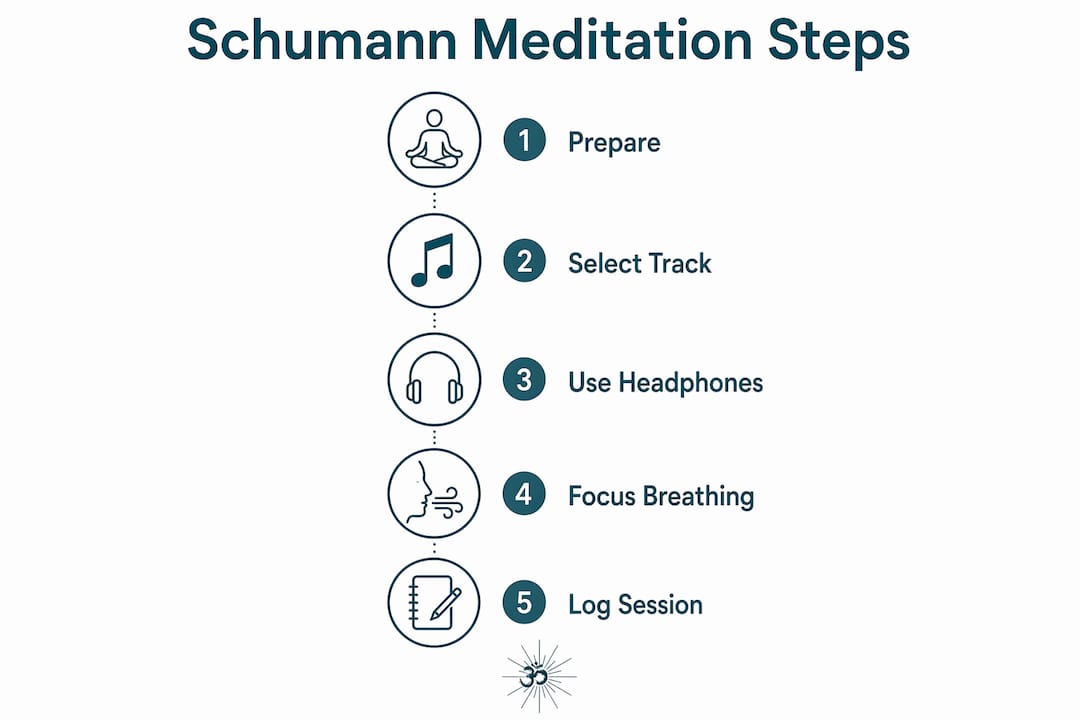
Schumann resonance meditation uses the Earth’s fundamental electromagnetic frequency, 7.83 Hz, as an anchor for relaxation and grounding, typically by listening to audio tracks that embed this frequency via binaural beats or isochronic tones. If you want to try it today: (1) find a 7.83 Hz binaural track, put on headphones, and listen at low volume for 10–20 minutes; (2) pair it with slow breathing, around six breaths per minute; (3) note how the session felt compared to a meditation without frequency audio. Researchers such as McCarty and Gunkelman have explored EEG coupling with Schumann-like harmonics, and platforms like Orchestralmeditations offer professionally produced tracks that make the practice genuinely accessible in the UK.
- What it is: Earth’s 7.83 Hz resonant frequency reproduced via audio as a meditation anchor
- Quickest start: headphones + a 7.83 Hz binaural track + 10–20 minutes
- Breathing pairing: six breaths per minute for heart-rate variability benefit
- Evidence status: promising but not conclusive; consistency matters more than any single session
What is the Schumann resonance, exactly?
The Schumann resonance is a set of extremely low-frequency (ELF) electromagnetic waves that exist in the cavity between the Earth’s surface and its ionosphere. Lightning strikes around the globe continuously pump energy into this cavity, and the cavity’s dimensions cause it to resonate at a fundamental frequency of approximately 7.83 Hz, with harmonics at around 14, 20, 26, and 33 Hz.
The German physicist Winfried Otto Schumann first predicted these resonances theoretically in 1952, and they were measured experimentally shortly after. The frequency is not fixed: it can vary by roughly ±0.2 Hz depending on the time of day, season, and geography, which is why live monitoring charts from observatories such as Tomsk remain popular in meditation communities.
Why do meditators care? The 7.83 Hz fundamental sits right at the boundary between the alpha (8–12 Hz) and theta (4–8 Hz) brainwave bands, the states associated with relaxed awareness and light trance. That numerical overlap gave rise to the poetic label “the Earth’s heartbeat,” and the idea that synchronising with it might deepen meditative states. Whether the natural field is strong enough to cause that synchronisation is a separate, more contested question, which we will come to.
How do Schumann resonance meditation tracks actually work?
Because 7.83 Hz is far below the threshold of human hearing (roughly 20 Hz), you cannot simply play it through a speaker and hear it. Producers use three main techniques to deliver it.
The main audio formats:
- Binaural beats: two slightly different tones are played simultaneously, one in each ear. If your left ear hears 200 Hz and your right ear hears 207.83 Hz, your brain perceives a phantom “beat” at the difference: 7.83 Hz. This beat is not in the audio; it is generated inside your auditory cortex. Headphones are non-negotiable for this to work.
- Isochronic tones: a single tone is switched on and off at 7.83 times per second, creating a rhythmic pulse your brain can follow. These work on speakers, though headphones still improve the effect.
- Ambient layering: the 7.83 Hz signal is embedded via amplitude modulation or low-frequency carriers beneath an audible orchestral or ambient soundscape. The listener hears music; the entrainment signal rides underneath it.
Headphones vs speakers: for binaural beats, headphones are required, full stop. For isochronic or ambient-layered tracks, speakers work, though a good pair of closed-back headphones will always give you cleaner low-frequency reproduction. If you are using a 3D sound meditation recording, headphones also preserve the spatial imaging the producer intended.
| Format | Headphones required? | Audible tone? | Best for |
|---|---|---|---|
| Binaural beats | Yes | No (perceived internally) | Focused solo sessions |
| Isochronic tones | Optional | Yes (rhythmic pulse) | Group settings or speakers |
| Ambient layering | Optional | Music only | Background or sleep use |

Audio entrainment research shows modest but reproducible brainwave shifts when people are exposed to binaural or isochronic beats in the 4–12 Hz range, with short-term relaxation and mood effects the most consistently reported outcomes.
What does the research actually say about the benefits?
Honestly? It is a mixed picture, and anyone telling you otherwise is selling something harder than a meditation track.
On the positive side, EEG entrainment studies by Hendricks, Bengston, and Gunkelman observed harmonic frequency coupling consistent with Schumann resonances in healer-subject EEG pairs, suggesting the brain can synchronise with Schumann-like signals under the right conditions. A comprehensive review concluded that an interaction between the human body and Schumann resonances has been scientifically demonstrated, most significantly with the nervous system, and that the autonomic nervous system appears synchronised with Schumann dynamics. A separate PubMed study exploring ELF frequencies found that human brainwave activity correlates with Schumann resonance signals, and that cellular calcium regulation may be influenced by these fields.
The important caveat: the natural Schumann field is extraordinarily weak, around 1–2 picoteslas. Most measurable entrainment in studies comes from intentional audio stimulation or stronger generated fields, not passive exposure to the background signal. So when you listen to a binaural track, you are not simply “tuning in” to the Earth; you are using audio to deliberately steer your brainwaves toward a similar frequency range. That is a meaningful distinction.
Consistency beats intensity. A large-scale study of digital meditation practice found that practice frequency was a stronger predictor of beneficial outcomes than session duration, with 4–7 sessions per week associated with the best adherence and results. One transcendent session will not rewire your nervous system. Showing up regularly will.
Practitioner communities report easier entry into alpha and theta states, a sense of grounding, and improved subjective clarity. These reports are largely anecdotal, but they are consistent enough to be worth taking seriously as a starting hypothesis for your own practice. For a deeper look at hertz frequency and the human body, the science is more nuanced than most wellness blogs suggest.
How to run your first Schumann resonance session
Getting the setup right takes about three minutes and makes a noticeable difference to the experience.
Setup checklist:
- Closed-back headphones (over-ear preferred for binaural tracks)
- Volume at roughly 40–50% of maximum, low enough to be comfortable for 20 minutes
- Quiet room; phone on aeroplane mode
- Comfortable seated or lying posture
- Optional: eye mask or blackout curtains
Session length options:
- Short reset (5–10 minutes): useful mid-afternoon or before a meeting. Choose a binaural track with minimal musical complexity so the frequency effect is not buried.
- Standard session (10–20 minutes): the sweet spot for most people. Pair with slow breathing at six breaths per minute, which research links to heart-rate variability improvement. Inhale for five seconds, exhale for five.
- Extended practice (30+ minutes): for experienced meditators. Works well with an orchestral ambient layer; the music gives the mind something to rest on without becoming a distraction.
Integrating a guided voice: if you prefer guided meditation, look for recordings where the voice sits above the frequency layer rather than competing with it. The 7.83 Hz element should feel like a floor beneath the guidance, not a battle for attention.
Pro Tip: Keep a short session log: date, track format (binaural/isochronic/ambient), session length, breathing pattern, and a one-word subjective depth rating. After ten sessions you will have personal data that no study can give you.

For broader guidance on frequency meditation techniques, pairing Schumann-range audio with other healing frequencies can extend the practice in interesting directions.
Who should be cautious, and when to stop
Low-frequency audio entrainment is gentle for most people, but a few groups need to pause before pressing play.
Consult a clinician first if you:
- Have a history of photosensitive epilepsy or any seizure disorder
- Use an implanted cardiac device (pacemaker or ICD)
- Are pregnant (the evidence is not alarming, but the precaution is sensible)
- Are currently taking medication that affects seizure threshold
Stop a session immediately if you notice:
- Dizziness or sudden disorientation
- Tinnitus that increases during the track
- Heart palpitations or chest tightness
- Unusual anxiety or agitation
Sit quietly until any symptoms pass. If they persist beyond a few minutes, seek medical advice. For practitioners using these tracks in a clinical or therapeutic context, start with lower amplitude, shorter sessions (five minutes), and avoid pairing with any form of electrical stimulation for clients with medical devices.
Pro Tip: If you are new to binaural beats, try a single 10-minute session before committing to longer ones. Some people find the pulsing sensation mildly disorienting at first; it usually settles within a few sessions.
This article is general information, not medical advice. If you have any of the conditions above, confirm the suitability of audio entrainment with a qualified clinician before starting.
What to look for when choosing a track
Not all 7.83 Hz tracks are created equal. Some are genuinely well-produced; others are a sine wave dropped under a stock piano loop and uploaded in three minutes. Here is how to tell the difference.
Production quality checklist:
- Declared method: does the track state whether it uses binaural beats, isochronic tones, or ambient layering? If the producer cannot tell you, that is a red flag.
- Headphone requirement: clearly stated for binaural tracks; absent or optional for isochronic.
- Track duration: 10 minutes minimum for any meaningful entrainment effect; 20–30 minutes is better.
- Bit-rate and format: 320 kbps MP3 or lossless FLAC preserves the low-frequency detail that cheaper formats compress away.
- Licensing terms: if you are a yoga teacher, therapist, or content creator, check whether the licence covers professional use. Many free tracks on streaming platforms do not.
- Audible music quality: does the orchestral or ambient layer complement the frequency work, or does it grate? Poor mastering at low frequencies can introduce clicks, pops, or phase artefacts that actively disrupt relaxation.
Why composer and producer credits matter: a track credited to a professional composer or producer with verifiable studio work gives you a meaningful quality signal. Robert Emery, for instance, is a composer and conductor whose work spans orchestral film scoring and concert music, bringing genuine arranging craft to meditation productions. Moritz Schneider is a producer and sound designer with a background in studio engineering and psychoacoustic sound design, which is precisely the skill set you want when someone is embedding a 7.83 Hz binaural layer beneath a full orchestral arrangement. When both names appear on a recording, you know the frequency work and the musical layer were handled by people who understand both disciplines. For a broader overview of how sound frequencies support wellbeing, the production approach matters as much as the frequency itself.
Free vs paid: free tracks are worth trying to establish whether the format suits you. For regular practice or professional use, a paid, properly licensed recording with clear metadata and studio provenance is worth the investment.
Why Orchestralmeditations is worth your time
If you have read this far and you are ready to actually try a well-produced Schumann-style track rather than a random upload, Orchestralmeditations is the place to start.
Orchestralmeditations produces royalty-free orchestral meditation music recorded with live musicians, including sessions at Abbey Road Studios with the National Philharmonic. The library includes binaural beat tracks, theta frequency recordings, 3D surround sound compositions, and ambient orchestral layers, all available for individual download or via subscription, with both personal and professional licensing clearly stated. That last point matters enormously if you are a therapist, yoga instructor, or app developer who needs to use tracks commercially without legal ambiguity.
The composers behind the recordings include Robert Emery, an orchestral composer and conductor with extensive credits in film and concert music, and Moritz Schneider, a producer and sound designer whose psychoacoustic expertise ensures the low-frequency embedding is clean, effective, and genuinely pleasant to listen to for extended sessions. That combination of orchestral craft and technical precision is rarer than you might think in the meditation audio space.
Tracks are available in the formats discussed above, with recommended session lengths noted in the product descriptions. You can browse the full library to find a track that suits your preferred session length and format, or explore the curated personal collection if you want a guided starting point.
Key takeaways
Schumann resonance meditation works best as a consistent, well-structured practice using properly produced binaural or isochronic audio, not as a one-off experiment.
| Point | Details |
|---|---|
| The 7.83 Hz frequency | Earth’s fundamental resonance sits at the alpha/theta boundary, making it a natural target for relaxation-focused audio entrainment. |
| Audio delivery method | Binaural beats require headphones; isochronic tones work on speakers; ambient layering suits background or sleep use. |
| Consistency over intensity | Practice frequency predicts outcomes more reliably than session duration; 4–7 sessions per week is the evidence-supported target. |
| Safety first | Those with epilepsy, implanted cardiac devices, or seizure disorders should consult a clinician before using brainwave entrainment audio. |
| Orchestralmeditations | Offers professionally produced binaural and orchestral tracks by Robert Emery and Moritz Schneider, with clear personal and professional licensing for UK users. |
The honest case for music-led Schumann practice
There is a version of this topic that promises cosmic alignment and cellular regeneration, and there is the version that actually helps people sit down, breathe slowly, and feel better at the end of twenty minutes. The second version is the one worth caring about.
What I find genuinely compelling about music-led Schumann practice is that the orchestral layer solves a real problem: most people cannot sustain attention on a bare binaural tone for more than a few minutes before their mind wanders to the shopping list. A well-composed piece of music gives the mind something beautiful to rest on, which means the frequency work gets more time to do its thing. It is a bit like adding a good sauce to medicine; the medicine still works, but you are far more likely to take it.
The research on EEG entrainment is promising rather than conclusive, and I think that is the honest framing. What is not in doubt is that regular, intentional meditation practice improves wellbeing, and that production quality affects how long you will actually keep showing up. That is why the composer and producer credits on a recording matter: Robert Emery’s orchestral craft and Moritz Schneider’s psychoacoustic precision are not marketing copy; they are the reason a track remains listenable on the hundredth session. Try three sessions over one week, keep a brief log, and let your own data guide you from there.
Useful sources and further reading
- The Healing Connection: EEG Harmonics, Entrainment, and Schumann’s Resonances — Journal of Scientific Exploration; the Hendricks, Bengston, and Gunkelman paper on EEG coupling with Schumann-like harmonics.
- Schumann Resonances and the Human Body — comprehensive review of interaction mechanisms, nervous system effects, and cardiovascular links.
- Exploring the influence of Schumann resonance and electromagnetic fields on bioelectricity — PubMed study on ELF frequencies, cellular calcium regulation, and brainwave correlation.
- Dose-response effects of meditation practice on mental health and wellbeing — longitudinal study on practice frequency, duration, and outcomes.
- Schumann resonance in meditation practice — EarthBeat’s community-facing guide to monitoring charts and mindful tracking rituals.
- Orchestralmeditations: meditation music library — full track library with personal and professional licensing for UK users.
- Hertz frequency and the human body: what science says — Orchestralmeditations’s own science-informed overview of frequency interactions.
- Theta frequencies for healing: science and meditation — deeper reading on theta-band work and its relationship to Schumann-adjacent practice.
FAQ
What happens when you listen to the Schumann resonance?
Listening to a 7.83 Hz binaural or isochronic track can encourage your brainwaves to shift toward the alpha/theta boundary, which most people experience as a deepening sense of relaxation and reduced mental chatter. The effect is modest and varies by individual; consistent practice over multiple sessions tends to produce more reliable results than a single listening.
Does Schumann resonance meditation actually work?
The evidence is promising but not conclusive. EEG research shows measurable brainwave coupling with Schumann-like frequencies, and a comprehensive body review confirms the nervous system interacts with these signals. Most practitioners report genuine relaxation benefits, though the mechanism is still being studied.
Is the Schumann resonance currently spiking?
The Schumann resonance amplitude fluctuates naturally with global lightning activity, time of day, and season. Live readings are available from monitoring stations such as Tomsk; community tools like EarthBeat present these in a format meditators can track. Some practitioners time sessions to coincide with quieter periods, though there is no clinical evidence this changes outcomes.
How do I use a Schumann resonance track for the first time?
Put on closed-back headphones, set the volume to a comfortable low level, and choose a binaural or isochronic track of at least 10 minutes. Sit or lie comfortably, breathe at around six breaths per minute, and allow the session to run without checking your phone. A short log note afterwards helps you track subjective changes across sessions.