What is the 741 Hz frequency and why does it matter for healing?
The 741 Hz frequency is the sixth tone in the ancient Solfeggio scale, traditionally called Sol, and it carries a reputation for promoting mental clarity, emotional release, and authentic self-expression. Think of it as the frequency that clears the mental fog so you can actually hear yourself think. Rooted in the Latin hymn line Solve polluti (“cleanse the pollution”), its historical association with dissolving toxins and clearing stagnant energy has shaped how practitioners use it today.
Here is what 741 Hz is consistently linked to:
- Emotional detoxification: releasing stuck emotional patterns through sound-induced relaxation, not medical detox
- Throat chakra resonance: supporting honest communication and the courage to speak your truth
- Mental clarity and creative flow: used by writers, artists, and problem-solvers as a daytime thinking aid
- Stress reduction: activating the parasympathetic nervous system to ease anxiety
- Intuition awakening: quieting mental noise so subtler inner signals become audible
- Aura and biofield cleansing: a spiritual framing for focused attention rituals that reset mood and presence
Preliminary scientific findings back some of these claims. Presley, Stamps, and Alexander (2026), writing in the Journal of Scientific Exploration, found that 741 Hz significantly increased skin conductivity in participants, a direct measure of autonomic nervous system arousal. That is not a cure-all, but it is a meaningful signal that something physiological is happening.
How 741 Hz supports emotional and spiritual healing
The word “detox” gets thrown around a lot in sound healing circles, and it is worth being honest about what it actually means here. When practitioners talk about 741 Hz detoxification, they mean the release of stuck emotional patterns through sound-induced relaxation, not the removal of biological toxins. Your liver is still doing that job, thankfully.
What 741 Hz genuinely offers is a kind of energetic housekeeping. The throat chakra (Vishuddha in Sanskrit) governs communication, self-expression, and the courage to say what you actually mean. When that energy centre feels blocked, people often report a tight throat, fear of public speaking, or a persistent sense that their words never quite land. Listening to this frequency, particularly through tuning forks held near the throat, targets exactly that tension.
- Aura cleansing: sound-induced relaxation resets your energetic presence and clears accumulated stress
- Fear of self-expression: 741 Hz is widely used by practitioners when someone struggles to speak honestly
- Emotional clarity: a calmer nervous system notices subtler feelings, making it easier to process what you are actually experiencing
Pro Tip: Listen with intention rather than passively. Before a session, name one emotional pattern you want to release. That single act of focus dramatically sharpens the effect, turning background music into a genuine practice.
How to listen to 741 Hz meditation music effectively
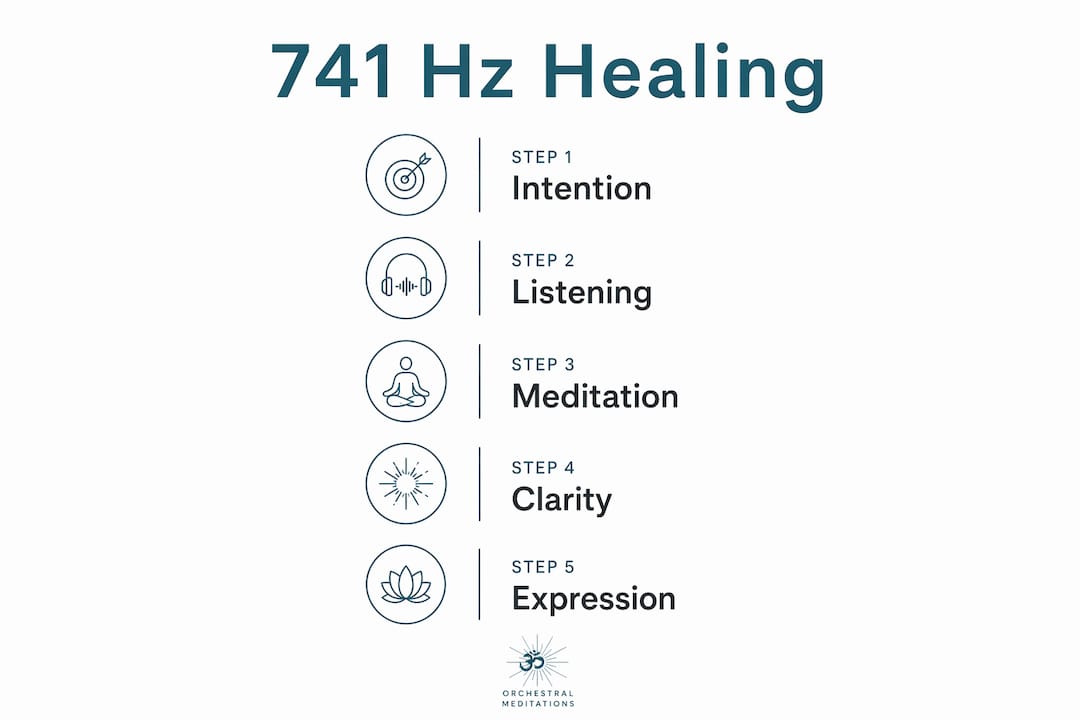
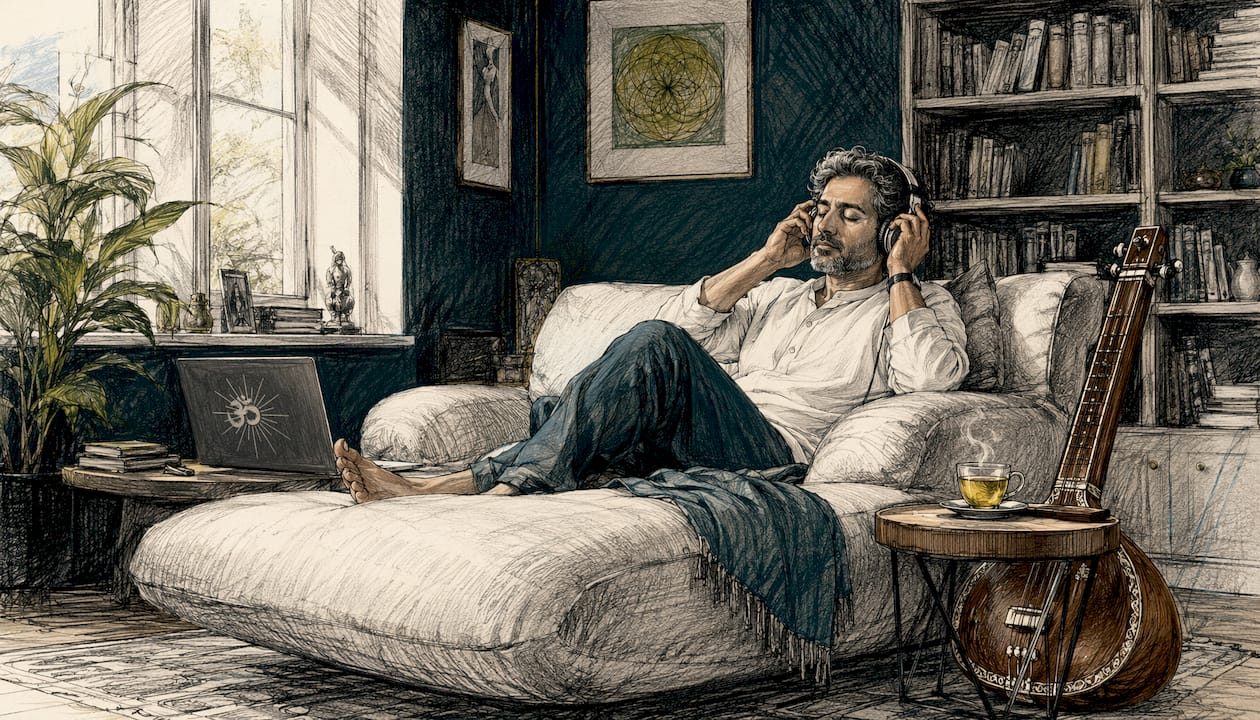
Getting the most from this frequency is less about finding the perfect track and more about how you use it. 741 Hz works best as a daytime mental-work companion rather than a wind-down or sleep aid. If you want deep calm before bed, reach for 528 Hz or 174 Hz instead.
Practical guidance for your sessions:
- Duration: aim for 15–20 minutes minimum per session; sessions of up to 25 minutes are effective for most listeners
- Volume: keep it low and conversational, sitting behind your thinking rather than competing with it
- Timing: use it during writing, journaling, problem-solving, or podcast preparation, not as a passive background hum while scrolling
- Frequency of use: daily short sessions tend to outperform occasional long ones for building clarity over time
- Tuning fork positioning: hold a 741 Hz fork 3–6 inches from the skin when sweeping the biofield, and 1–2 inches from the base of the throat for chakra work; never press it against the eardrum
- Pairing: 741 Hz then 852 Hz is a particularly effective sequence, moving from throat clearing into intuitive listening
For a broader look at how different tones compare, the Solfeggio frequency guide at Orchestralmeditations covers the full spectrum of healing applications.
What science and music theory say about 741 Hz
Here is where things get genuinely interesting for the musically curious. When a recording is tuned to 741 Hz, the entire musical scale shifts so that the note G5 sits at exactly 741 Hz. Every other note moves with it. The reference pitch A4, which standard music tunes to 440 Hz, drops to approximately 415.87 Hz in this system. That is a downward shift of roughly 24 cycles per second, one of the larger movements in the Solfeggio set.
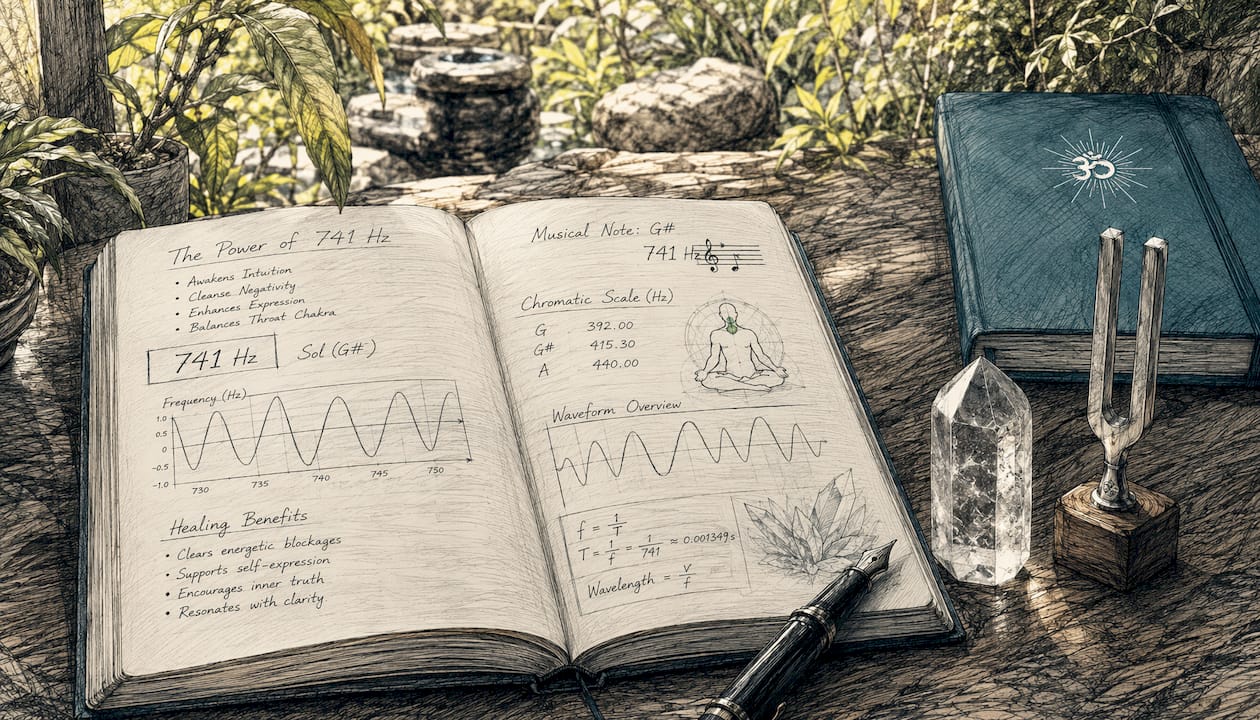
The acoustic result is what listeners describe as “grounded clarity.” The lower-rooted A4 gives the music more body in the mid-range, while the high notes maintain a bright presence. It feels both rooted and articulate, which maps neatly onto the tradition’s association with expression work.
| Tuning | A4 reference | Anchor note |
|---|---|---|
| 440 Hz (standard) | — | A4 = 440 |
| 528 Hz | — | C5 = 528 |
| 639 Hz | — | D#5 = 639 |
| 741 Hz | 415.87 Hz | G5 = 741 |
| 852 Hz | — | A5 = 852 |
The acoustic character of 741 Hz differs noticeably from the uplifting quality of 528 Hz or the warm relational feel of 639 Hz. Where those tones tend to lift, 741 Hz grounds and focuses. For a deeper comparison with 528 Hz specifically, the 528 Hz healing tone guide at Orchestralmeditations is worth reading alongside this one.
The science remains preliminary but promising. Beyond the skin conductivity findings mentioned earlier, studies on background sound suggest specific tonal exposures can support alpha and theta brainwave states linked to relaxed focus and creative insight. The National Center for Complementary and Integrative Health notes that music research in this area is still early, and effects are context-specific. Honest framing matters here: 741 Hz is a supportive tool, not a treatment.
How Orchestralmeditations approaches 741 Hz healing music
Most 741 Hz tracks you find online are sine waves looped for eight hours. They do the job, roughly. What Orchestralmeditations does is categorically different, and the distinction starts with where the music is made.
Orchestralmeditations produces its healing music at Abbey Road Studios with the National Philharmonic, a combination that brings genuine orchestral warmth and acoustic depth to frequencies that most platforms render as flat digital tones. The production team, including composer and producer Robert Emery, brings serious musical credentials to this work. Emery’s background spans orchestral composition and sound design, and his approach treats Solfeggio frequencies not as a gimmick layered onto stock music but as the structural foundation of the entire piece. Moritz Schneider, whose work in sound engineering and meditation music production has shaped the platform’s signature 3D surround sound approach, ensures that the spatial quality of each recording creates genuine immersion rather than mere background noise.
- Binaural beats and theta frequencies are woven into the orchestral texture, deepening the meditative state without overwhelming the listener
- 3D surround sound places the listener inside the music rather than in front of it, which meaningfully changes how the body responds
- Layered healing sequences allow 741 Hz tracks to be combined with 852 Hz or 963 Hz recordings for progressive sessions
Pro Tip: Pair a 741 Hz orchestral track with a simple mental clarity practice before your most demanding creative work of the day. The combination of frequency and intention tends to produce noticeably sharper focus within the first ten minutes.
Are there any side effects or contraindications to know about?
For most healthy adults, 741 Hz is safe when used sensibly. Volume and distance are the two variables that matter most. Keep audio at a comfortable conversational level, and if you are using tuning forks, hold them 3–5 inches from the ear rather than directly against it.
That said, a few groups should exercise caution:
- Epilepsy or seizure history: rhythmic auditory stimulation can trigger seizures in sensitive individuals. Consult a neurologist before using any sustained frequency work.
- Tinnitus or hyperacusis: sustained high-pitched tones can worsen symptoms. Start with very short sessions of two to three minutes and stop immediately if discomfort arises.
- Overstimulation: 741 Hz is an activating frequency. If you feel a headache, dizziness, or heightened anxiety during a session, stop. It is not a sign of failure; it is your nervous system asking for a break.
The sound healing guide at Orchestralmeditations covers safe listening practices across the full range of Solfeggio frequencies, which is worth bookmarking if you plan to work with multiple tones.
Orchestralmeditations: orchestral 741 Hz music worth actually listening to
If you have spent any time with low-quality frequency loops online, you will know the experience: a thin, slightly irritating sine wave that you tolerate rather than enjoy. Orchestralmeditations is the alternative for listeners who want the healing benefits of 741 Hz without sacrificing the listening experience itself.
Produced at Abbey Road Studios with the National Philharmonic, the platform’s meditation music library includes Solfeggio-frequency tracks built on live orchestral recordings, binaural beats, and 3D spatial sound. The result is music that genuinely supports deep meditation and emotional clarity rather than just filling the room with a number. You can browse individual tracks or explore the full curated library to find the session that fits your practice today.
FAQ
How long should you listen to 741 Hz per session?
Sessions of 15–25 minutes are effective for most listeners. Daily shorter sessions tend to build clarity more consistently than occasional long ones.
What happens if you listen to 741 Hz regularly over time?
Regular listeners report improved emotional clarity, reduced mental clutter, and greater ease with self-expression. These effects reflect the frequency’s support for parasympathetic nervous system engagement rather than any direct physiological detox.
What is “God’s frequency” in Hz?
The term is most commonly applied to 963 Hz in Solfeggio traditions, associated with crown-level awareness and connection to higher consciousness. It sits above 741 Hz in the scale and is often used after a 741 Hz clearing session.
What kind of music uses 741 Hz tuning?
Any recorded music can be retuned to 741 Hz by anchoring G5 at 741 Hz, which shifts A4 to approximately 415.87 Hz. Orchestralmeditations produces original orchestral compositions built specifically around this tuning for meditation and sound healing.
Key takeaways
The 741 Hz Solfeggio frequency supports emotional clarity, authentic self-expression, and parasympathetic nervous system engagement, making it most effective as a daytime mental-work and meditation aid.
| Point | Details |
|---|---|
| Sixth Solfeggio tone | 741 Hz is the Sol note, historically linked to cleansing and self-expression via the Latin Solve polluti. |
| Nervous system effect | Presley, Stamps, and Alexander (2026) found 741 Hz significantly increased skin conductivity, a measure of autonomic arousal. |
| Unique tuning | Anchoring G5 at 741 Hz drops the A4 reference from 440 Hz to approximately 415.87 Hz, producing a grounded, clear sonic character. |
| Best use case | 741 Hz suits daytime mental tasks like writing and problem-solving rather than sleep or deep passive meditation. |
| Orchestralmeditations | Produces 741 Hz tracks at Abbey Road Studios with the National Philharmonic, using binaural beats and 3D surround sound for genuine immersion. |