
Meditation subliminal messages are positive affirmations embedded beneath the threshold of conscious hearing, designed to reach the subconscious mind while you are in a deeply relaxed or meditative state. Think of them as whispers your conscious mind never catches but your subconscious quietly files away. They do not override your will or plant alien thoughts. Research confirms that subliminal stimuli act as subtle primers, effective only when aligned with intentions you already hold.
How do meditation subliminal messages actually work?
The mechanism is simpler than it sounds. During meditation, your brainwaves slow from the busy beta range into alpha and theta frequencies. That shift makes the subconscious far more receptive, which is precisely when embedded affirmations can take root most naturally.
Key points worth knowing:
- Subliminal messages are positive affirmations recorded below conscious perception, typically masked by music or nature sounds.
- They work as primers, nudging existing intentions rather than creating new ones from scratch.
- Effectiveness rises during meditation or sleep, when the critical conscious filter relaxes.
- Two main delivery methods exist: traditional masking (affirmations buried under foreground audio) and amplitude modulation (AM) encoding, which shifts speech onto high-frequency carriers above conscious hearing.
- The subconscious registers what the conscious mind misses, then acts on it quietly over time.
What audio techniques and frequencies are used?
Producers use several methods to deliver subliminal affirmations without conscious detection. The most common is masking: affirmations are recorded several decibels below a foreground of orchestral music, ocean surf, or rainfall, so the conscious ear hears only the surface layer.

The second approach is AM encoding, popularised by Oliver Lowery’s 1989 patent. Speech is modulated onto a carrier frequency above 14 kHz, a range largely inaudible to adult ears, so the message travels on a clear channel with no competition from foreground sounds. Audio quality matters enormously here: consumer-grade speakers often cannot reproduce frequencies above 16 kHz faithfully, which limits how effectively the encoded signal reaches the listener.
Alongside these masking techniques, producers layer supportive frequencies:
- Binaural beats: two slightly different tones in each ear, which the brain resolves into a perceived third frequency, nudging brainwaves toward theta or delta states. Explore binaural beat benefits for a deeper look at the science.
- Solfeggio frequencies: specific tones such as 528 Hz (associated with restoration) and 432 Hz (linked to calming resonance), woven into the musical bed.
- Theta wave entrainment: frequencies in the 4–8 Hz range that mirror the brainwave state of deep meditation and light sleep, where subliminal uptake is highest.
Pro Tip: Use high-quality headphones rather than phone speakers when listening to AM-encoded subliminal tracks. The frequency response of good headphones makes a genuine difference to what your subconscious actually receives.
What does the science say about subliminal messages and meditation?
The research here is genuinely exciting, not just wellness-industry optimism. A 2012 study published in Consciousness and Cognition tested 34 experienced Zen meditators against a relaxed control group. The meditation group matched subliminally primed words 6.8 times out of 20 questions on average, compared to just 4.9 for the control group. That is a 39% higher retrieval rate for meditators, which is a striking gap for a single 20-minute session.
Functional MRI studies add another layer: subliminal stimuli activate specific brain regions even when participants have no conscious awareness of them, a finding corroborated in a 2023 meta-analysis on subliminal stimulation.
“Meditation may be best seen as a process that literally expands the space of conscious experience.” — Thomas Metzinger, Johannes Gutenberg University, Mainz
Metzinger’s framing is useful. Meditation does not make you gullible; it makes you more perceptive. The subliminal auditory stimuli research is clear that effects are modest compared to conscious stimuli, and that messages only gain traction when they align with what you already want. No subliminal track will convince you to want something you genuinely do not.
Trusted creators and UK-relevant examples
Orchestralmeditations sits at a different level from the average subliminal upload. Tracks are recorded at Abbey Road Studios with the National Philharmonic, which means the orchestral bed carrying the subliminal layer is genuinely high-fidelity, not a royalty-free loop from a stock library.
Robert Emery is a composer and producer whose work spans orchestral scoring and sound design, bringing formal compositional rigour to the frequency-layering process. Moritz Schneider contributes production expertise in advanced audio engineering, ensuring that theta entrainment and solfeggio frequencies are embedded with technical precision rather than guesswork. Together, their approach treats subliminal audio as a craft, not a shortcut.
Practical examples from the Orchestralmeditations library include:
- Solfeggio frequency tracks built around 528 Hz and 396 Hz, layered with orchestral arrangements for deep relaxation.
- 3D surround sound meditations that use spatial audio to deepen the immersive quality of the session.
- Theta-wave compositions designed for sleep listening, where the subconscious is most receptive.
On the legal side, the UK prohibits subliminal messaging in broadcast advertising, which reflects a sensible ethical line: subliminals in a wellness context you choose are categorically different from hidden commercial manipulation. Choosing a reputable producer with transparent production methods keeps you firmly on the right side of that distinction.
Why use subliminal affirmations in meditation at all?
The purpose is straightforward: meditation quiets the conscious mind’s habit of arguing with every positive statement you try to make. Tell yourself “I am calm and capable” out loud and your inner critic immediately starts listing counterexamples. Deliver the same message subliminally during a theta-state meditation and it slips past that critic entirely, landing in the subconscious where beliefs actually form. Techniques like hypnotherapy work on a similar principle of bypassing conscious resistance to reach deeper mental patterns.
Combining meditation with subliminal affirmations can enhance focus, deepen relaxation, and accelerate personal growth by making the subconscious more receptive to positive change. The two practices reinforce each other rather than competing.
Are there any risks or side effects?
Subliminal meditation audio is generally low-risk when sourced responsibly. A few things are worth keeping in mind:
- Conflicting messages: if the affirmations in a track contradict your actual meditation intention, the mixed signals can create confusion rather than clarity. Always read the track description before you press play.
- Over-reliance: subliminals work best as a complement to regular practice, not a replacement for it. Expecting overnight transformation from passive listening alone sets you up for disappointment.
- Audio quality: poorly produced tracks with clipped frequencies or excessive compression may deliver little beyond background noise. This is where production quality, as with Orchestralmeditations recordings, genuinely matters.
- Psychological sensitivity: anyone working through trauma or a diagnosed mental health condition should speak with a qualified professional before adding subliminal audio to their routine.
There is no credible evidence that well-produced subliminal affirmations cause harm. The scientific consensus is that they bias existing intentions rather than override them, which means the worst-case scenario for a misaligned track is simply that nothing happens.
How to build subliminal messages into your meditation practice
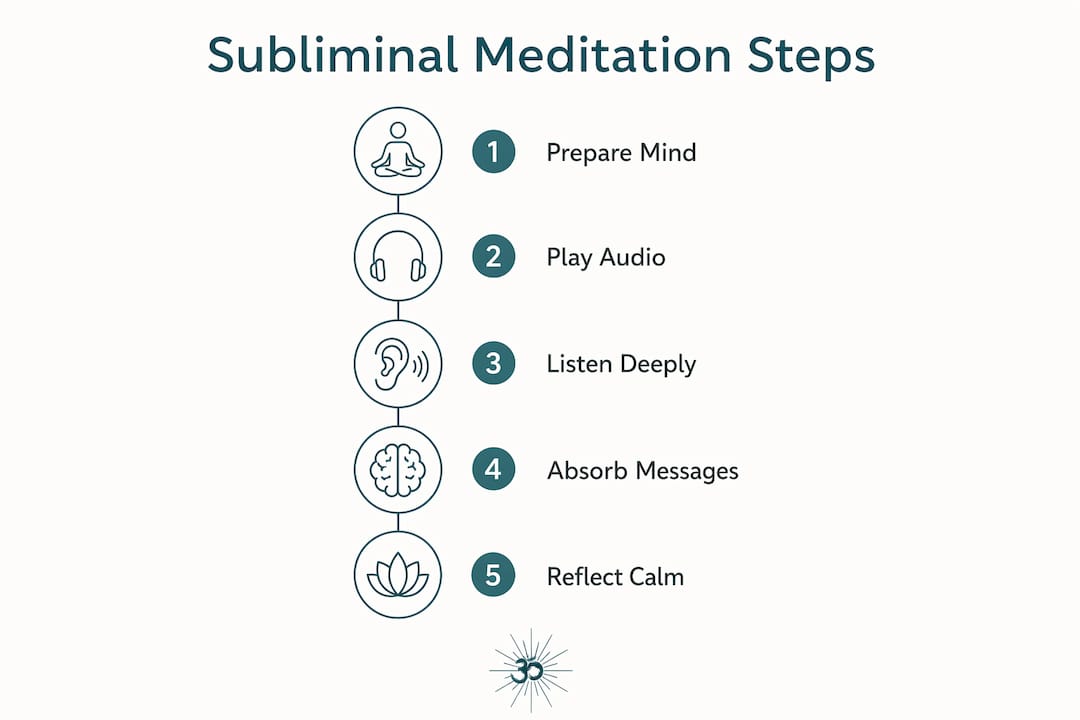
Getting started is less complicated than most guides make it sound. A few practical steps:
- Set a clear intention first. Decide what you want the session to support: stress relief, confidence, better sleep. Then choose a track whose affirmations match that goal, since alignment is what makes subliminals effective.
- Create a consistent environment. A quiet room, comfortable posture, and the same time each day trains your nervous system to drop into a receptive state more quickly. Explore advanced audio techniques to refine your setup further.
- Start with 20 minutes. The Zen meditation study used a single 20-minute session and produced measurable results. You do not need hour-long marathons to begin.
- Use quality headphones. Particularly for binaural and AM-encoded tracks, headphones are not optional; they are how the technique actually works.
- Be patient and consistent. Subliminal priming is cumulative. A week of daily sessions will outperform a single two-hour experiment every time.
Key takeaways
Meditation amplifies subliminal message uptake by shifting brainwaves into theta and alpha states, where the subconscious is most receptive to embedded affirmations.
| Point | Details |
|---|---|
| Subliminals need alignment | They prime existing intentions; they cannot plant goals you do not already hold. |
| Meditation boosts uptake | Zen meditators retrieved subliminally primed words at a 39% higher rate than relaxed controls. |
| Audio quality matters | AM-encoded tracks above 14 kHz require high-fidelity playback equipment to deliver the signal effectively. |
| UK legal context | Subliminal messaging is banned in UK broadcast advertising; wellness audio you choose is a separate, lawful category. |
| Consistency is key | Daily 20-minute sessions produce cumulative results; passive one-off listening rarely does. |
FAQ
Do subliminal messages actually work during meditation?
Research shows they can, particularly for meditators. A 2012 study found Zen practitioners retrieved subliminally primed information at a 39% higher rate than non-meditating controls, suggesting meditation genuinely opens the mind to subconscious input.
Can you meditate while listening to subliminals?
Yes. Playing subliminal audio during meditation is widely practised and the two approaches complement each other well, provided the track’s affirmations align with your session’s intention.
What are examples of subliminal meditation messages?
Common affirmations include phrases such as “I am calm,” “I release stress,” and “I am worthy,” embedded beneath orchestral music or nature sounds so the conscious mind hears only the surface audio.
Which subliminal meditation approach is most effective?
Tracks that combine theta-wave entrainment with high-quality masking or AM encoding tend to perform best, especially when listened to through headphones during or just before sleep, when the subconscious is most active.