Listening to frequencies is the act of consciously engaging with specific sound vibrations, measured in Hertz, to promote mental and physical wellness. The human audible range spans approximately 20 Hz to 20,000 Hz, though most adults experience gradual hearing loss that limits their practical upper range to around 15,000–17,000 Hz. Within that spectrum, seven distinct frequency zones each carry their own physical sensation, emotional quality, and therapeutic potential. Composers like Robert Emery and Moritz Schneider, who produce meditation music for Orchestralmeditations, have spent years shaping these zones deliberately to guide listeners into deep relaxation and mental clarity. This guide explains what those zones are, how to train your ears to recognise them, and how to weave frequency listening into a daily wellness practice.
What are the main frequency zones and how do they affect meditation?
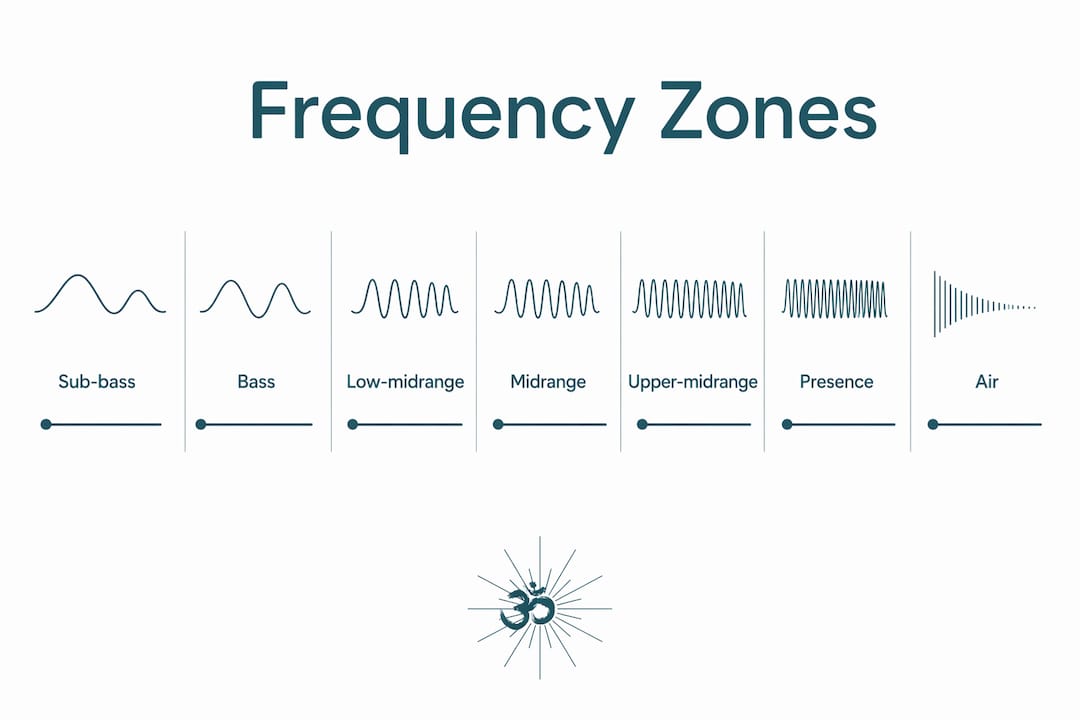
The frequency spectrum divides into seven zones, each with a distinct role in how sound feels and what it does to your state of mind. Understanding them is not just for audio engineers. It is genuinely useful for anyone who wants to get more from a meditation session.

| Frequency zone | Range | Physical sensation | Wellness use |
|---|---|---|---|
| Sub-bass | 20–60 Hz | Deep rumble, felt in the chest | Grounding, body awareness |
| Bass | 60–200 Hz | Warmth, fullness | Calming, physical relaxation |
| Low-mids | 200–500 Hz | Body and presence in sound | Emotional depth, immersion |
| Midrange | 500 Hz–2 kHz | Clarity of voice and melody | Focus, mental engagement |
| Upper-mids | 2–5 kHz | Presence, forward energy | Alertness, attention |
| Sibilance | 5–8 kHz | Crispness, edge | Detail perception |
| Air | 8–16 kHz | Openness, spaciousness | Expansive, meditative states |
Sub-bass frequencies (20–60 Hz) are felt more than heard. They create a grounding sensation that many practitioners associate with body-centred meditation. Bass frequencies (60–200 Hz) add warmth and physical weight to a composition, which is why a well-produced orchestral track feels so much more calming than a thin digital recording.
The low-midrange (200–500 Hz) is where emotional depth lives. Emotional clarity in a listening experience often comes from managing this zone carefully. Too much energy here creates a muddy, cluttered sound that actually raises tension rather than reducing it. Robert Emery’s orchestral arrangements for Orchestralmeditations pay close attention to this zone precisely because it determines whether a piece feels immersive or merely busy.
The upper zones, from the midrange upward, handle clarity, presence, and that sense of spaciousness that makes a recording feel alive. The “air” band (8–16 kHz) is what gives a well-recorded string section its shimmer. Moritz Schneider, who co-produces Orchestralmeditations’ sessions at Abbey Road Studios, uses this zone to create the sense of a large, open acoustic space that supports meditative states.
Pro Tip: When you next listen to a meditation track, try focusing your attention on just one zone at a time. Notice the bass warmth first, then shift your awareness upward toward the midrange clarity. This active listening approach trains your perception and deepens the meditative effect simultaneously.
How do you learn to listen to frequencies actively?
Frequency recognition is a skill built through deliberate, consistent practice, not passive background listening. Think of it like learning to identify individual instruments in an orchestra. At first, everything blurs together. With focused attention over time, you start hearing the cello separate from the viola, the oboe from the clarinet.
The most practical starting point is a frequency sweep test. Free browser-based tone generators let you sweep through the full audible range instantly, without any sign-up or cost. Start at 20 Hz and move slowly upward, pausing at each zone boundary to notice the change in sensation and character.
Waveform type matters too. Sine waves produce a clean, pure tone ideal for testing your frequency response and identifying where your hearing starts to drop off. Square, triangle, and sawtooth waves add harmonics, which makes them useful for training your ear to recognise timbral complexity. This is the kind of nuance that composers like Robert Emery apply when layering orchestral textures to create specific emotional effects.
Here is a practical daily routine for building frequency awareness:
- Morning sweep (5 minutes). Use a free tone generator to sweep from 60 Hz to 8 kHz. Pause at each zone and name the sensation out loud.
- Active listening session (10 minutes). Choose one piece of music and focus on a single frequency zone for the entire track. Repeat with a different zone the next day.
- Comparison exercise (5 minutes). Play the same short melody through different waveform types (sine, then square) and note how the harmonic content changes the emotional feel.
- Reflection note. Write two sentences about what you noticed. This cements the learning and builds a reference library in your memory.
- Guided frequency meditation (15–20 minutes). Use a professionally produced track, such as those in the Orchestralmeditations library, to experience how skilled composers balance zones for therapeutic effect. Explore frequencies for meditation to find tracks suited to each zone.
Pro Tip: Always start your volume near zero when testing high-frequency tones. High-frequency tones above 1 kHz at loud volume can cause ear fatigue or damage surprisingly quickly. Bring the volume up gradually until the tone is just audible, then stop there.
What science says about frequency perception and its effects
Individual hearing varies far more than most people realise. Age, noise exposure history, and even genetics affect which frequencies you perceive most strongly. This means the same meditation track can feel quite different to two people sitting in the same room. That is not a flaw in the music. It is simply the nature of human auditory biology.
One of the most persistent myths in the wellness space is that a specific tuning frequency, such as 432 Hz, carries intrinsic healing power. The evidence does not support this. Relaxation depends more on audio signal quality and consistency than on tuning pitch. A beautifully recorded orchestral piece at standard 440 Hz tuning will produce deeper relaxation than a poorly produced track at any alternative tuning. If you are curious about the debate, the 432 Hz vs 528 Hz comparison is worth reading, but the takeaway is always the same: quality of production matters most.
Here are the key scientific nuances every frequency listener should understand:
- Frequency balance beats frequency value. Effective frequency listening is less about finding a single “miracle frequency” and more about managing the balance across zones and removing auditory clutter.
- Low-mids are the most critical zone for clarity. The 200–500 Hz range determines whether a recording feels immersive or muddy. Poorly managed low-mids raise cognitive load rather than reducing it.
- Ear fatigue is real and cumulative. Extended listening at high volumes, particularly in the upper-mid and sibilance ranges, degrades perception and can cause lasting damage. Safe listening practices require starting volume levels near zero, especially for high-frequency tones.
- Context shapes perception. The same frequency sounds different in a reverberant cathedral versus a dry studio. Environment is part of the listening experience, not a neutral backdrop.
- Passive listening produces weaker results. Research consistently shows that active, focused engagement with sound produces stronger cognitive and emotional responses than background listening.
The sound healing field draws on all of these principles. Moritz Schneider’s production work for Orchestralmeditations applies them practically, using 3D surround sound and binaural techniques to manage frequency balance across the full spectrum in ways that standard stereo recordings simply cannot achieve.
How to apply frequency listening in your meditation routine
The most effective approach to frequency-based meditation is choosing your frequency zone based on the outcome you want, not the one that sounds most impressive on paper. Want physical grounding? Start in the sub-bass and bass range. Need mental clarity before a difficult task? Focus on the midrange and upper-mids. Seeking that expansive, open feeling associated with deep meditation? The air band is your friend.
Consistency matters as much as choice. A ten-minute daily session with focused frequency awareness produces more benefit over a month than an occasional two-hour session. Stress management research consistently shows that regular, brief relaxation practices outperform sporadic long ones for sustained well-being.
Practical steps for building a frequency meditation routine:
- Set your environment first. Use quality headphones or speakers. A poor playback system collapses the frequency zones into a flat, undifferentiated blur. The sub-bass disappears, the air band vanishes, and you lose most of the therapeutic range.
- Choose your target zone. Decide before you press play which zone you want to focus on. This primes your attention and makes the session active rather than passive.
- Pair with breathwork. Slow, diaphragmatic breathing naturally synchronises with bass and sub-bass frequencies. Combining the two amplifies the physical relaxation response.
- Use professionally produced tracks. Robert Emery’s compositions for Orchestralmeditations are recorded with the National Philharmonic at Abbey Road Studios, which means the frequency balance across all seven zones is managed at the highest level of production quality. This is not incidental. It directly affects how deeply the music can guide you into a meditative state.
- Track your response. Keep a brief note after each session. Which zone felt most effective today? Did you notice ear fatigue? Did the session feel active or passive? This builds self-knowledge over time.
For listeners interested in specific therapeutic frequencies, the top healing frequencies guide on the Orchestralmeditations site covers the most well-supported options in accessible detail. If you are working on stress reduction specifically, pairing frequency meditation with broader mental health support strategies produces the most durable results.
Key takeaways
Effective frequency listening combines deliberate zone awareness, quality audio production, and consistent daily practice to produce measurable improvements in relaxation, mental clarity, and well-being.
| Point | Details |
|---|---|
| Seven frequency zones | Each zone from sub-bass to air carries distinct physical and emotional effects relevant to meditation. |
| Quality over tuning | Audio signal quality and frequency balance matter more for relaxation than any specific tuning pitch. |
| Active listening builds skill | Daily focused practice, not passive background listening, develops frequency awareness over time. |
| Safety first | Start volume near zero for high-frequency tones to avoid ear fatigue and hearing damage. |
| Production quality matters | Professionally recorded tracks manage frequency balance across all zones, deepening the meditative effect. |
Why I think most people are listening to meditation music the wrong way
Here is something I have noticed after years of working with sound and meditation: most people treat frequency-based music like a screensaver. They press play, close their eyes, and wait for something to happen. Then they wonder why the results feel inconsistent.
The shift that changes everything is moving from passive to active listening. Not active in the sense of analysing every note (that would defeat the purpose), but active in the sense of directing your attention. Choosing a zone. Noticing when the bass warms up. Feeling the moment the midrange opens into clarity. This is not effort. It is more like the difference between staring at a painting and actually looking at it.
I find the work of Robert Emery particularly instructive here. His orchestral compositions are not just pleasant background music. They are structured frequency journeys, with deliberate movement through zones that guide the listener’s nervous system rather than simply accompanying it. Moritz Schneider’s production choices at Abbey Road reinforce this. The 3D surround sound techniques they use place different frequency zones in different spatial positions, which makes active listening feel almost effortless. Your brain naturally tracks the movement.
The other thing I would push back on is the obsession with specific “healing” frequencies. The 432 Hz debate, the Solfeggio scale, the various numerological claims. None of it holds up when you look at the actual mechanism. What produces relaxation is frequency balance, production quality, and your own attentional engagement. A beautifully balanced orchestral recording will outperform a poorly produced “healing frequency” track every single time. Experiment with different zones. Trust your own nervous system. It knows more than the marketing does.
— ROBERT
Orchestralmeditations: frequency-focused meditation music worth hearing
Orchestralmeditations produces meditation music that takes frequency balance seriously, which is rarer than it should be.
Every track in the library is recorded with the National Philharmonic at Abbey Road Studios, with composers Robert Emery and Moritz Schneider managing the full frequency spectrum from sub-bass grounding to the open shimmer of the air band. The result is music that works across all seven frequency zones, not just the ones that sound impressive on laptop speakers. Binaural beats, theta frequencies, and 3D surround sound techniques are woven into the compositions to support deep meditative states. Whether you are new to sound frequency therapy or refining an existing practice, the Orchestralmeditations meditation music library offers a professionally crafted starting point.
FAQ
What does it mean to listen to frequencies?
Listening to frequencies is the deliberate practice of engaging with specific sound vibrations, measured in Hertz, to influence physical and emotional states. It differs from passive music listening in that attention is directed toward particular frequency zones for therapeutic effect.
Which frequencies are best for relaxation?
Bass and sub-bass frequencies (20–200 Hz) produce the strongest physical relaxation response, while the air band (8–16 kHz) supports open, expansive meditative states. The most effective approach combines quality audio production with active attention rather than relying on a single “best” frequency.
How do I start learning to hear different frequency zones?
Use a free browser-based tone generator to sweep slowly from 20 Hz to 16 kHz, pausing at each zone boundary to notice the change in sensation. Daily five-minute sweep sessions build frequency awareness faster than any passive listening approach.
Is 432 Hz actually better for meditation than standard tuning?
Audio signal quality and frequency balance produce relaxation benefits, not tuning pitch specifically. A well-produced track at standard 440 Hz tuning will deliver deeper relaxation than a poorly produced 432 Hz recording.
How loud should I listen to frequency tones?
Start with your volume near zero and raise it gradually until the tone is just audible. High-frequency tones above 1 kHz at loud volume cause ear fatigue quickly and can produce lasting hearing damage with extended exposure.