Using meditation music for habit formation is an evidence-based method that rewires your brain’s response to new behaviours, making habits easier to establish and far more likely to stick. The technique works by pairing a consistent auditory cue with a desired behaviour, conditioning your nervous system to enter a focused, receptive state on demand. Composers Robert Emery and Moritz Schneider, whose orchestral meditation recordings have been produced at Abbey Road Studios with the National Philharmonic, have spent years crafting music that does exactly this. A 2026 randomised controlled trial with 398 participants confirmed that chills-inducing music deepens emotional breakthroughs and connectedness during meditation. That is not background noise. That is neuroscience working in your favour.
How does meditation music enhance focus and mindfulness to support habit formation?
Habit formation depends on neuroplasticity, the brain’s ability to rewire itself through repeated experience. Music accelerates that process by engaging emotion, memory, and attention at the same time. When those three systems fire together consistently, the neural pathways associated with your new habit strengthen faster.

Cedars-Sinai clinical experts note that meditation rewires the fear response, and music serves as a bridge for people who find silence intimidating. That matters enormously for habit formation, because the biggest obstacle to any new routine is the activation energy required to begin. Music lowers that barrier by making the entry point feel familiar and safe.
The emotional dimension is equally important. The 2026 RCT mentioned above found that music evoking chills produces measurable improvements in mood, self-transcendence, and connectedness. Those emotional states are not incidental. They are the conditions under which the brain is most receptive to forming new associations, which is precisely what habit formation requires.
Research also shows that classical music in meditation programmes increases empathy through metacognitive awareness. Greater self-awareness means you notice your own patterns more clearly, which helps you catch the moments when a habit is slipping and course-correct before it unravels entirely.
Pro Tip: Play the same track at the start of every meditation session for two weeks. Your brain will begin to associate that opening melody with a calm, focused state, and the transition into practice will become almost automatic.
What types of meditation music work best for building habits?
No single genre of music works for everyone. Performance neuroscience is clear on this: individual neurological responses to audio vary based on cognitive patterns, time of day, and task type. What sends one person into a deep meditative state sends another person reaching for their phone.
That said, certain categories of music consistently produce results across a wide range of listeners. Here is a practical breakdown:
- Classical orchestral music. Rich in harmonic complexity, it engages the brain without demanding linguistic processing. Robert Emery’s orchestral compositions, recorded with live musicians at Abbey Road Studios, sit firmly in this category and are specifically designed to facilitate meditative depth.
- Ambient and drone-based music. Minimal melodic movement keeps the mind from latching onto narrative. Useful for longer sessions where sustained attention is the goal.
- Instrumental “work flow” music. A Georgetown University study published in PLOS One found that instrumental focus music improves mood and cognitive performance after just ten minutes. That is a remarkably short runway to a measurable effect.
- Binaural beats and theta frequencies. These use two slightly different tones in each ear to produce a perceived third frequency. Theta frequencies (4–8 Hz) are associated with deep relaxation and heightened creativity. Orchestralmeditations incorporates binaural beats and theta music into several of its recordings, produced by Moritz Schneider, whose background in sound engineering and composition gives these tracks a clinical precision that generic playlists simply cannot match.
- Solfeggio frequency-based tracks. These use specific tonal frequencies historically associated with healing and emotional release. They work particularly well for listeners whose habit goals involve stress reduction or emotional regulation.
The practical advice here is to run a two-week experiment. Track your focus quality with each audio type, note which sessions felt most settled, and let the data guide your choice. Gut feeling is a starting point, not a conclusion.
Once you find two or three tracks that work, resist the urge to keep searching. Rotating 2–3 familiar audio environments satisfies the brain’s need for habituation while avoiding the distraction of novelty. The conditioned response you are trying to build depends on repetition, not variety.
Pro Tip: Moritz Schneider’s 3D surround sound recordings are worth trying if you find standard stereo tracks too flat to hold your attention. The spatial audio creates an immersive quality that many listeners find far easier to settle into.
How to integrate meditation music into your daily routine
The most common reason people fail to build a meditation habit is not lack of motivation. It is lack of structure. Music solves this by acting as a cue, a sensory signal that tells your brain “this is the moment.” Here is a practical framework for making that work.
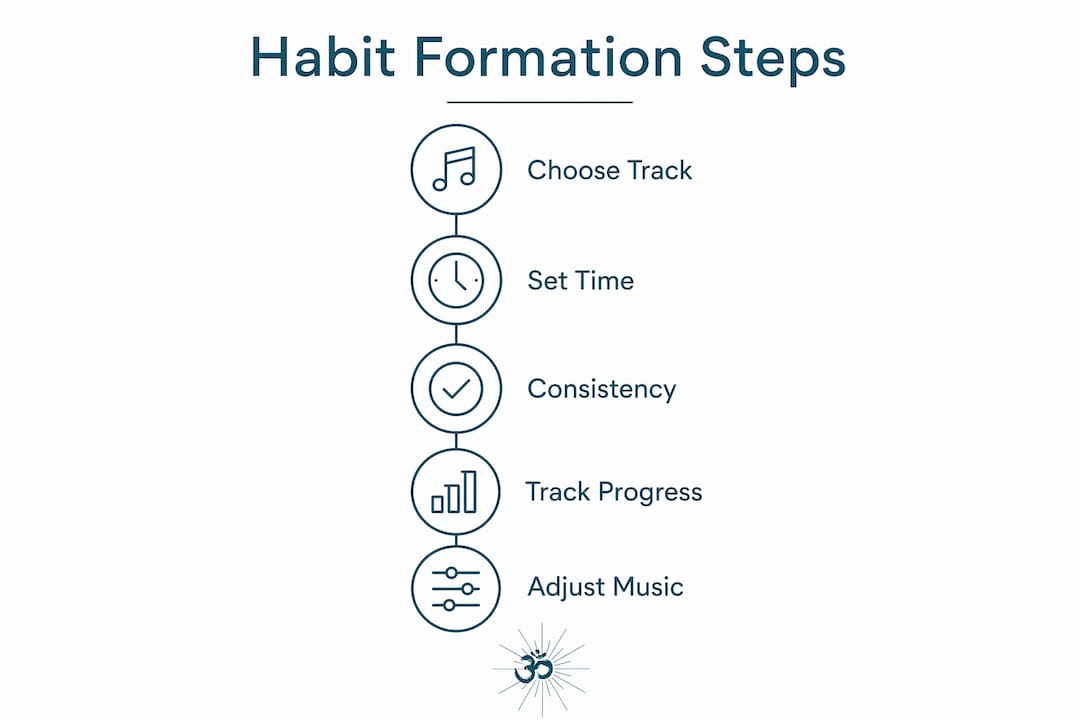
Step-by-step integration guide
-
Choose a fixed time. Morning sessions before the day’s noise accumulates tend to produce the most consistent results. Evening sessions work well for habit goals centred on recovery or sleep. Pick one and protect it.
-
Select your track in advance. Decision fatigue is real. Choosing your music the night before removes one more micro-decision from the morning. Orchestralmeditations offers a curated library that makes this straightforward.
-
Create a physical cue. Sit in the same chair, light the same candle, or put on the same pair of headphones. The physical ritual compounds the auditory cue. Advanced practitioners often use music as a pre-meditation trigger to lower resistance before the session even begins.
-
Set a minimum session length. Ten minutes is enough to produce measurable cognitive benefits. Commit to ten minutes and allow yourself to go longer if the session is flowing. Never negotiate the minimum downward.
-
Log the session immediately afterwards. One sentence in a notebook: how focused did you feel, and what did you notice? This creates a feedback loop that accelerates improvement.
-
Review weekly. After seven sessions, look at your notes. Are certain tracks producing better focus? Are particular times of day yielding deeper sessions? Adjust accordingly.
The table below summarises the key steps and what to watch for at each stage.
| Step | What to do | What to watch for |
|---|---|---|
| Choose a fixed time | Lock in one daily slot | Consistency matters more than timing |
| Select your track | Decide the night before | Avoid novelty; stick to 2–3 familiar tracks |
| Create a physical cue | Same space, same setup | Compound the auditory cue with a physical ritual |
| Set a minimum length | Ten minutes minimum | Do not negotiate this downward |
| Log the session | One sentence immediately after | Note focus quality and emotional state |
| Weekly review | Check notes after seven sessions | Adjust track or timing based on patterns |
Combining daily awe practices with meditation music, such as spending a few minutes in nature before your session, promotes emotional wellbeing and grounds the habit in something larger than the session itself. That sense of meaning is what separates habits that last from habits that fade after a fortnight.
What are common mistakes when using meditation music for habit formation?
Even well-intentioned practitioners make predictable errors. Knowing them in advance saves weeks of frustration.
- Constantly searching for new playlists. This feels productive but actively undermines habituation. Every new track resets the conditioned response you are trying to build. Novelty is the enemy of the neural shortcut you want.
- Relying on music so heavily that silence becomes impossible. Music is a scaffold, not a permanent structure. If you can only meditate with music playing, you have built a dependency rather than a habit. Alternate silent and music sessions once your routine is established.
- Playing music too loudly. Volume above comfortable listening levels activates the stress response rather than suppressing it. Keep the volume low enough that you could hold a whispered conversation over it.
- Skipping sessions when the “right” track is unavailable. The habit is the session, not the music. If your preferred track is inaccessible, use a simpler alternative rather than skipping entirely.
- Ignoring your own feedback. Soft ambient or guided audio can ease the transition into practice for beginners, but what works at week one may feel restrictive at week eight. Revisit your choices regularly.
Journalling is the most underused troubleshooting tool in this space. A single sentence per session, written immediately after, gives you a data set that no app can replicate. Patterns emerge within two weeks that would otherwise take months to notice.
“Music reaches into emotion, memory, and attention simultaneously. That triple engagement is what makes it such a powerful tool for shaping new habits. Used consistently, it does not just accompany the habit. It becomes part of the habit itself.”
If you are curious about how sound technology can extend beyond standard audio into physical resonance, the work being done with implosive sound transducers offers a fascinating parallel to the frequency-based approach that composers like Moritz Schneider use in their recordings.
Key takeaways
Using meditation music for habit formation works because it pairs a consistent auditory cue with a desired behaviour, conditioning the nervous system to enter a focused state on demand, which makes new habits easier to establish and sustain.
| Point | Details |
|---|---|
| Music lowers activation energy | Playing a familiar track signals the brain to shift into a meditative state, reducing resistance to starting. |
| Personalise your audio choice | Run a two-week experiment with different music types and track focus quality to find what works for you. |
| Limit to 2–3 familiar tracks | Habituation requires repetition; constantly switching playlists resets the conditioned response you are building. |
| Structure the session deliberately | Fix your time, create a physical cue, and log each session to accelerate habit formation. |
| Balance music with silence | Use music as a scaffold, then introduce silent sessions to ensure the habit is not dependent on audio alone. |
Why I think most people are using meditation music the wrong way
Here is an uncomfortable truth I have arrived at after years of working with meditation music: most people treat it like wallpaper. They press play, half-listen, and wonder why nothing changes. The music becomes ambient decoration rather than an active tool.
What I have found actually works is treating the opening bars of a track as a genuine signal. The moment Robert Emery’s orchestral strings begin, that is the cue. Not a suggestion. A cue. The same way a starting pistol tells a sprinter to run, the music tells your nervous system to settle. That distinction, between passive listening and active conditioning, is everything.
I have also noticed that people underestimate how much the quality of the recording matters. There is a real difference between a track produced in a professional studio with live musicians and a synthesised loop generated in twenty minutes. Emery and Schneider record with the National Philharmonic at Abbey Road Studios. You can hear it. The harmonic richness of a live orchestra does something to the nervous system that a digital approximation simply does not replicate. I am not being precious about this. It is a practical observation about what actually produces a shift in state.
My honest advice? Commit to one track for thirty days. Not thirty different tracks. One. Let your brain build the association. Then, and only then, consider whether you need anything else. You probably will not.
— ROBERT
Orchestralmeditations: music built for the habits you are trying to build
The recordings at Orchestralmeditations are not produced as background filler. Robert Emery and Moritz Schneider compose and produce each track with specific meditative outcomes in mind, drawing on binaural beats, theta frequencies, Solfeggio tones, and 3D surround sound recorded at Abbey Road Studios.
If you are serious about building habits with music, the Orchestralmeditations English collection is the most direct place to start. Every track in the library is designed to support the kind of consistent, focused practice that habit formation actually requires. You can browse individual meditations or explore the full collection to find the recordings that match your goals.
FAQ
What is the best meditation music for habit formation?
No single genre is universally best. A two-week experiment tracking your focus quality with classical, ambient, binaural, and instrumental tracks will identify the most effective option for your individual neurology.
How long should a meditation music session be for building habits?
Ten minutes is sufficient to produce measurable improvements in mood and cognitive performance. Consistency across sessions matters more than session length.
Can meditation music replace silent meditation?
Meditation music is a scaffold, not a substitute. Once your routine is established, alternating music and silent sessions builds a more resilient habit that does not depend on audio being available.
How does binaural beat music support habit formation?
Binaural beats in the theta range (4–8 Hz) promote deep relaxation and heightened receptivity. Used consistently at the start of a session, they condition the brain to enter a meditative state more quickly over time.
Why do composers like Robert Emery and Moritz Schneider matter for meditation music?
The quality of a recording directly affects its ability to shift your nervous system. Emery and Schneider produce orchestral meditation music with live musicians at Abbey Road Studios, incorporating science-backed sound techniques that generic playlists do not replicate.