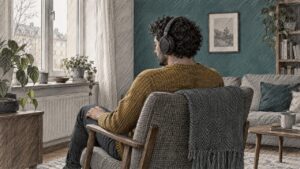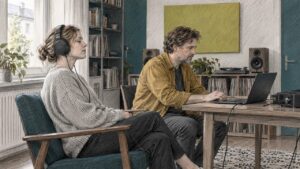
Headphones suit solo sessions, binaural beats and 3D orchestral recordings, because they put the music inside your head and shut out the neighbours’ lawnmower. Speakers suit shared rooms, yoga classes and slow, spacious orchestral pieces, because the sound fills the space around you like a small concert hall. Most practitioners end up using both. The trick is knowing which one a given track was made for, and how loudly to play it.
We record orchestral meditations with live musicians, so we have strong opinions about this. Our music was made to be heard properly, and “properly” depends on the room you are sitting in. Here is how to choose.
TL;DR
- Choose headphones for binaural beats, theta tracks, 3D surround recordings and any session where you are alone and want to disappear into the sound.
- Choose speakers for group practice, yoga, massage and sessions where you want the orchestra to fill the room.
- Research from Berlin describes headphone listening as music “inside” you and speaker listening as music in the space around you.
- Keep personal listening devices below about 60% of maximum volume and take listening breaks, as the WHO advises.
- If you teach or treat clients, the licence matters as much as the hardware: personal and professional licences are different things.
Why the same track feels so different
Play one recording through earbuds and then through a pair of decent speakers, and you will swear it is two different pieces. That is not your imagination (or not only your imagination, which, as every meditator knows, is a busy place).
Researcher Steffen Lepa and colleagues at the Freie Universität Berlin looked at how people experience music emotionally on different playback systems. Their study describes headphone listening as music that becomes part of your own body, often located inside the head. Speaker listening, by contrast, presents the music as part of the surroundings, with the presence of a live concert. Respondents who wanted to relax with classical music preferred speakers, because the music fills the room.
For meditation, that gives you two quite different tools:
- Headphones internalise. The sound sits between your ears. It is intimate, private and very good at taking your attention inward.
- Speakers externalise. The sound is in the room with you. It feels like being in the audience, or better, being inside the orchestra, with the air moving around you.
Neither is more “spiritual”. They simply point your attention in different directions: inward, or outward and then softly inward.
Immersion: where headphones and 3D sound shine
If your aim is to be swallowed whole by the music, headphones have an obvious advantage. They remove the room from the equation. No echo off the bare wall, no clatter from the kitchen, no neighbour practising scales.
There is also emerging academic work on spatial audio. Sylvia Grabe and Annika Neidhardt of Hochschule Mittweida reviewed the field for the 2026 Forum Acusticum. In their paper, binaural 3D versions of audio received higher immersion ratings than stereo and mono versions, and spatial audio can strengthen presence, attention and emotional involvement. They are careful to call it a modulator of therapeutic mechanisms rather than a therapy in itself, and they stress that the value depends on playback technique, sound design, content and the goal of the session.
That last point is the whole game. A 3D recording is a design decision made in the studio. Our recordings feature live musicians and 3D surround sound, and the placement of the instruments is part of the composition. Headphones deliver that placement most precisely, since each ear gets exactly what the mix intends, with no room in between to blur it.
What this means in practice
- For a deep, eyes-closed sit with a 3D orchestral track, put headphones on.
- For a body scan or a sleep session in bed, headphones also keep the sound from spilling over to a partner who wants to watch the rain on the window instead.
- For a first listen to a new piece, headphones let you hear the detail: the bow on the cello, the breath before a flute phrase.
Binaural beats and theta tracks: headphones are part of the recipe
Here the question stops being a matter of taste. Binaural beats work by playing a slightly different tone to each ear. Your brain then perceives a third, pulsing tone that is not in either signal. The Austrian public health portal gesundheit.gv.at describes binaural beats as an auditory illusion that arises when the sounds are delivered through headphones.
Play such a track through speakers and the two tones mix in the air before they reach you. The effect that gives the technique its name disappears, and you are left with a slightly wobbly hum. So for any track built on binaural beats, headphones are the correct choice, full stop.
Theta-range and Solfeggio-frequency tracks are a little different. Many of them are built from layered tones and orchestral textures rather than a strict left-right split, so they sound lovely on both. If a track description mentions binaural, use headphones. If it does not, try both and notice where your attention settles.
Speakers: when the room becomes the instrument
Speakers have a gift headphones cannot offer: they let the music share your space. Low strings in particular are felt as much as heard. The ITU’s guidelines on safe listening devices, Recommendation H.870, note that headphones lack the bodily vibration you perceive at concerts or in clubs. A good speaker setup, with a little bass in the room, brings some of that physical presence back.
Speakers are the natural choice when:
- You lead a group. Ten people on yoga mats cannot all wear headphones, and nobody wants to untangle ten cables before Savasana.
- You give massages or treatments. Earbuds and a face cradle are a poor match, and a clean, unobtrusive sound in the room keeps the client relaxed.
- You practise movement. Yoga, tai chi or gentle stretching with cables is a recipe for a tangle, and a speaker leaves you free.
- You want ambience. A slow orchestral piece playing softly while you read, journal or simply sit makes a room feel different.
The Berlin study fits this: people who wanted to relax to classical music tended to prefer boxes over headphones, precisely because the music fills the space.
Getting the room right
Speakers depend on the room more than headphones do, and rooms differ a lot. A few plain tips:
- Soften the surfaces. A rug, curtains and a sofa absorb the harsh reflections that make an orchestra sound like it is playing in a stairwell.
- Place the speakers at ear height when you sit or lie down, and aim them roughly at where your head will be.
- Give the bass some breathing room. Speakers pushed hard into a corner tend to boom.
- Keep the volume modest. Meditation music should sit under the level of conversation. If you can hardly hear your own breathing, it is too loud.
The Frontiers in Psychology study by Denk, Kohnen, Llorca-Bofí, Vorländer and Kollmeier, with 40 participants in Oldenburg and Aachen, showed that even small differences in room acoustics change how loud headphones sound relative to loudspeakers. In other words, your room really does shape what you hear, so trust your own ears over a spec sheet.
Safe volume: the part everyone skips
Meditation music is quiet by nature, which makes it easy to assume it is harmless. But sessions run long, and you often fall asleep with the music still playing. That is where listening habits matter, especially with headphones.
The WHO’s safe listening tips advise keeping personal audio devices below 60% of maximum volume, taking listening breaks and using noise-cancelling headphones where possible. They also advise seeking medical advice if you have persistent tinnitus.
The WHO and ITU standard for safe listening devices sets the recommended level for recreational sound at below 80 dB for no more than 40 hours a week. The reasoning is the equal-energy principle: the effect on your hearing depends on the total sound energy received, so quiet listening for a long time can add up to the same as very loud listening for a short time. A WHO/ITU document gives an example: 100 dB for 16 minutes equals 80 dB for 40 hours.
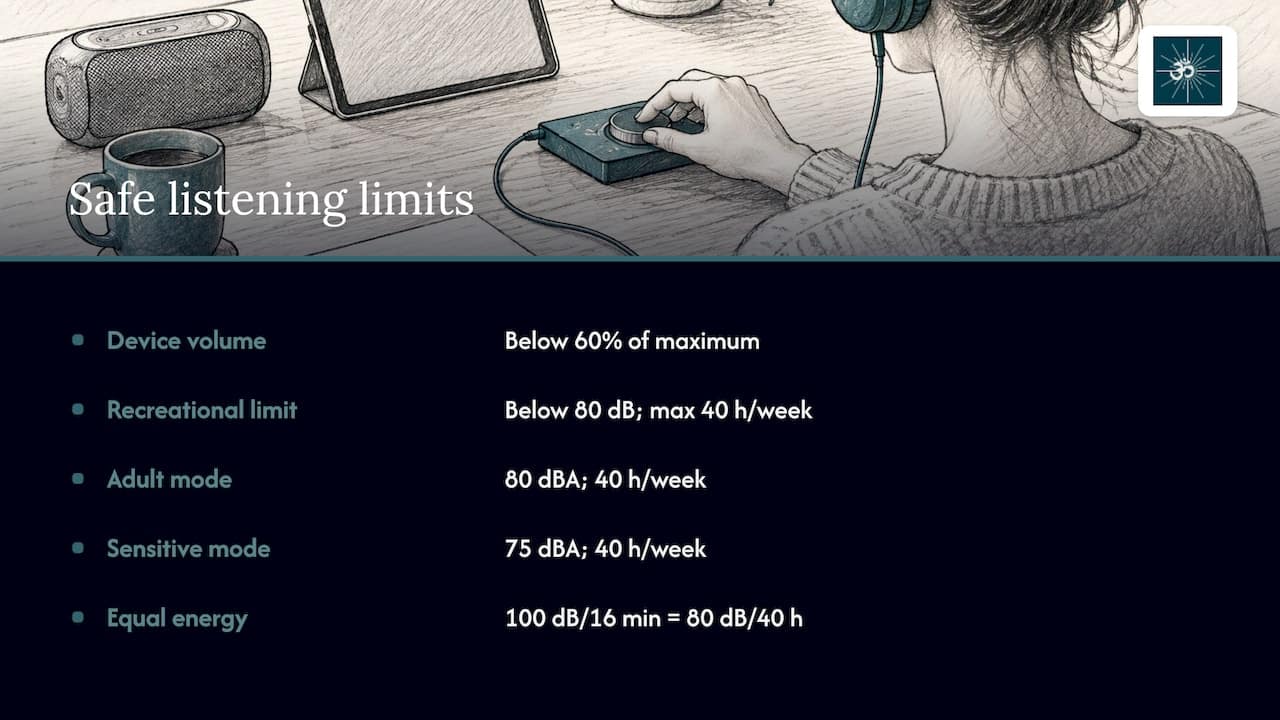
ITU-T H.870 goes a step further and defines two modes for listening devices: 80 dBA for 40 hours a week for adults, and 75 dBA for 40 hours a week for sensitive users such as children.
Why headphones need extra care
The same ITU document points out that headphone listening differs from listening to home speakers. Volume varies a lot between people, and portability raises the risk of long exposure. The Oldenburg and Aachen study found that headphones need around 6 dB more sound pressure at the eardrum than speakers to sound equally loud, especially at low frequencies. Since low strings and deep drones are everywhere in meditation music, it is tempting to nudge the volume up to feel the bottom end.
A simple routine keeps you safe:
- Set the volume while the track is playing its loudest passage, then leave it alone.
- Stay at or below roughly 60% on your device.
- If you fall asleep to music, use a sleep timer so it does not play all night.
- Take a break between long sessions.
- If you notice ringing in your ears that does not go away, see a doctor.
Comfort: the unglamorous deciding factor
The best sound system is the one you forget you are wearing. For meditation, that is a bigger deal than for a commute playlist, because you will sit still for twenty minutes or an hour and the tiniest irritation grows into a major event.
- Weight and clamp. Light, over-ear headphones with soft padding are easier to wear for a long sit than heavy ones. Lying on your side in bed is another matter: a flat-profile sleep headband or very small in-ear buds tend to be more bearable.
- Heat. Closed ear cups warm up. In summer, a long session can feel like wearing two small oven mitts.
- Glasses and hair. Both can interfere with the seal and the comfort of over-ear designs, so check this before a long sit.
- Noise cancelling. As the WHO notes, noise-cancelling headphones let you listen at a lower volume, which is exactly what you want in a noisy flat or on a train.
Speakers have none of these issues, but they bring a different one: you have to be in a space where you are allowed to make sound.
A quick way to choose
| Situation | Better choice | Why |
|---|---|---|
| Solo sit with binaural or theta track | Headphones | Binaural beats arise from a different tone in each ear |
| 3D surround orchestral recording | Headphones | Instrument placement is heard most precisely |
| Yoga class or group meditation | Speakers | Everyone shares the sound without cables |
| Massage or bodywork | Speakers | Nothing to wear, nothing to disturb |
| Falling asleep in bed with a partner | Headphones (low volume, sleep timer) | Keeps the room quiet for two |
| Background ambience while working or reading | Speakers | Music fills the room softly |
| Noisy surroundings, travel | Noise-cancelling headphones | Lets you listen at lower volume |
If you are still undecided, run a simple experiment: play the same five minutes of a slow orchestral piece both ways, with your eyes closed. Notice where the music seems to live, and which version makes your shoulders drop. Your body will vote before your opinions do.
Starting a practice, and setting up your space
If you are new to all this, the equipment question can feel bigger than the practice itself. It is not. A comfortable position, a quiet corner and a track you like are enough, and a guide such as meditation for beginners step by step covers how to build up the habit, from posture and breathing to session length. Choose your playback method afterwards, based on the room you actually have.
Teaching or treating others: speakers, headphones and licences
If you play meditation music for clients, students or an audience, the choice of speakers or headphones comes with a second question: are you allowed to play this music in that setting? A track bought for your own listening is not automatically cleared for your studio, your class or your app.
Our catalogue is royalty-free and available with both personal and professional licensing, for use in meditation, therapy, yoga, apps, guided audio, massage and wellness content. In practice, that means a yoga teacher can play a piece over speakers in class, a therapist can offer headphones to a client during a session, and a content creator can build the music into guided audio, as long as the licence matches the use.
The people behind the music
A playback system can only reproduce what was put into the recording. Our tracks are recorded at Abbey Road Studios with the National Philharmonic, and the music is composed and produced by Robert Emery. That matters for this exact question, because a recording made with live musicians in a world-famous studio carries real room, real bow noise and real dynamic range, and a good pair of headphones or speakers lets you hear all of it.
When the source is rich, the playback choice becomes a pleasure rather than a compromise. Headphones show you the detail, and speakers show you the scale.
Our perspective
When people ask me whether headphones or speakers are “right” for meditation, I usually answer with another question: what are you trying to feel?
If you want to be carried inward, put the headphones on. Our binaural and theta recordings are designed for exactly that, and the 3D surround sound we use places the orchestra around your head instead of in front of you. Each ear receives what the mix intends.
If you want the orchestra to be in the room with you, use speakers. We record live musicians at Abbey Road with the National Philharmonic precisely because real instruments breathe. A slow string passage filling a quiet room is its own kind of meditation, and it needs no instructions.
I would only add one thing, as someone who has spent far too many hours with studio monitors turned up: keep it gentle. Meditation music should feel like warmth, not volume. Set the level, close your eyes and let the music do its quiet work.
The best setup is the one you will actually use every day. Pick it, then make it a habit.
ROBERT
Take the music with you
If you want to try both ways of listening, our library gives you plenty to work with. The personal subscription costs €21 per month and is made for your own daily practice, whether that means headphones in bed or speakers in the living room.
If you teach, treat clients or build apps and guided audio, the professional subscription is €150 per month and comes with professional licensing. Our royalty-free meditation music page explains the professional use of the library.
You can also browse the full library at Orchestral Meditations.
FAQ
Do I need headphones for binaural beats?
Yes. Binaural beats arise when each ear receives a slightly different tone, and the Austrian health portal gesundheit.gv.at describes them as an illusion created via headphones. Through speakers, the tones blend in the air and the effect is lost. Any good pair of stereo headphones will do, from over-ear to in-ear.
Are speakers or headphones better for yoga?
Speakers are usually the better fit. You move freely, there are no cables to catch, and a whole class shares the same sound. Keep the volume low enough that your teacher’s voice carries over the music. If you teach professionally, make sure the music has a professional licence.
Is it safe to fall asleep with headphones on?
It can be, if you keep the volume low and limit the time. The WHO advises staying below about 60% of maximum volume and taking listening breaks. Use a sleep timer so the music stops after you have drifted off, and see a doctor if you notice persistent ringing in your ears.
Why do headphones sound louder than speakers at the same setting?
They do not, quite. A study published in Frontiers in Psychology in 2021 found that headphones need about 6 dB more sound pressure at the eardrum than speakers for the same perceived loudness, particularly at low frequencies. Because deep drones and cellos are common in meditation music, it is worth setting the volume on a loud passage and leaving it there.
Can I use the same meditation music for personal practice and for classes?
Only if the licence covers both. A personal licence is for your own listening, while a professional licence covers use with clients, in classes, in apps and in other commercial content. Choose the licence that matches how you will actually use the track.
Sources
- Emotionale Musikrezeption in unterschiedlichen Wiedergabesituationen, Freie Universität Berlin
- Spatial Audio and Immersive Audio as Modulators of therapeutic mechanisms, Hochschule Mittweida, 2026
- Binaurale Beats, Gesundheitsportal Österreich
- WHO, Tips for safe listening
- WHO-ITU standard for safe listening devices
- WHO-ITU safe listening standard, equal-energy example
- ITU-T Recommendation H.870 (V2), 03/2022
- The “Missing 6 dB” Revisited, Frontiers in Psychology, 2021
- Meditation for beginners step by step