If you play music in sessions with clients in Germany, the track you press play on needs the right permission for that use. A personal streaming account and a download bought for your own headphones are made for private listening, and a treatment room is not your living room. The cleanest answer is music that comes with a professional licence written for therapy, yoga, massage and guided audio. That is what our Professional subscription is built around, at €150 a month.
I’ll walk through the German rules in plain language, show where the usual shortcuts go wrong, and give you a checklist you can keep in your practice folder.
TL;DR
- Playing protected music to clients counts as public use under German copyright law, even if you earn nothing from the music itself.
- GEMA, Germany’s collecting society for music authors, has its own tariffs for background music in practices and for health and fitness classes with music.
- Streaming subscriptions and ordinary downloads are generally meant for private listening, not for professional sessions.
- Music with a professional licence for therapy and wellness use keeps the paperwork simple. Our Professional subscription costs €150 per month.
- Keep your licence documents. GEMA asks for proof when music is declared as GEMA-free.
Why a treatment room is not your living room
I have spent a good chunk of my life around musicians, and I can tell you that most of us only think about licensing after something goes wrong. (Usually a letter. Usually on a Friday.) Therapists are in the same boat. You choose music because it helps a client’s nervous system settle, and the last thing on your mind is a tariff table.
But the law cares about who is listening, not about your intentions. According to GEMA’s information on music in practices, anyone using the GEMA repertoire in a practice needs a licence for it. Background music in a practice falls under tariff M-U, and music in health and fitness classes under tariff WR-KS-F.
That covers a lot of people in our readership: psychotherapists with a waiting room speaker, physiotherapists, massage therapists, yoga teachers running a weekly class, breathwork facilitators, sleep coaches, and music therapists using recorded tracks. The details differ, the principle does not.
When is playing music “public”?
This is the question that trips most people up, so here is the short version from GEMA’s questions and answers page.
Under section 15(3) of the German Copyright Act (UrhG), a performance is public when it is accessible to several people who are not personally connected to each other or to the person organising it. Whether you make money from it is not what decides this. GEMA also says that public use of protected music needs a licence even without any profit motive, while private use among family and the closest circle of friends needs no consent.
Apply that to your week:
- A one-to-one session with a client. The client is not family or a close friend, so treat it as public use rather than private listening.
- A group class or retreat. Several unconnected participants make this clearly public.
- A waiting room. Same logic: patients who do not know each other.
- Your own evening meditation at home. Private. Enjoy it.
There is one more wrinkle. Works whose copyright has expired can be used without a licence in their original form, but a recent arrangement or recording of the same piece may still be protected. A Bach piece is old; the performance you found online may not be.
What the German tariffs look like
GEMA does not charge one flat fee. The tariff depends on how you use the music, how large the venue is, your turnover or scale, and how long and how often music is played, as set out on GEMA’s tariffs page. It points to a price calculator and a tariff overview for the exact sums.
For classes with music, GEMA says the fee depends on the average number of participants, how many times a week the class runs, and what participants pay. For the monthly calculation, weekly hours are multiplied by 4.33 (the GEMA practice guidance explains the method). Classes with music also have to be registered separately under WR-KS-F.
A worked example: a weekly relaxation class
The published WR-KS-F tariff text (the DOSB version of April 2025, rates valid from 1 January 2025) distinguishes courses with monthly fees or free offers from courses with fixed single fees only. For single fees, the fee is 4.46 per cent of net course revenue. The minimum is €0.54 per course hour for up to 10 participants and €0.81 for up to 15, rising by €0.27 for each additional person.
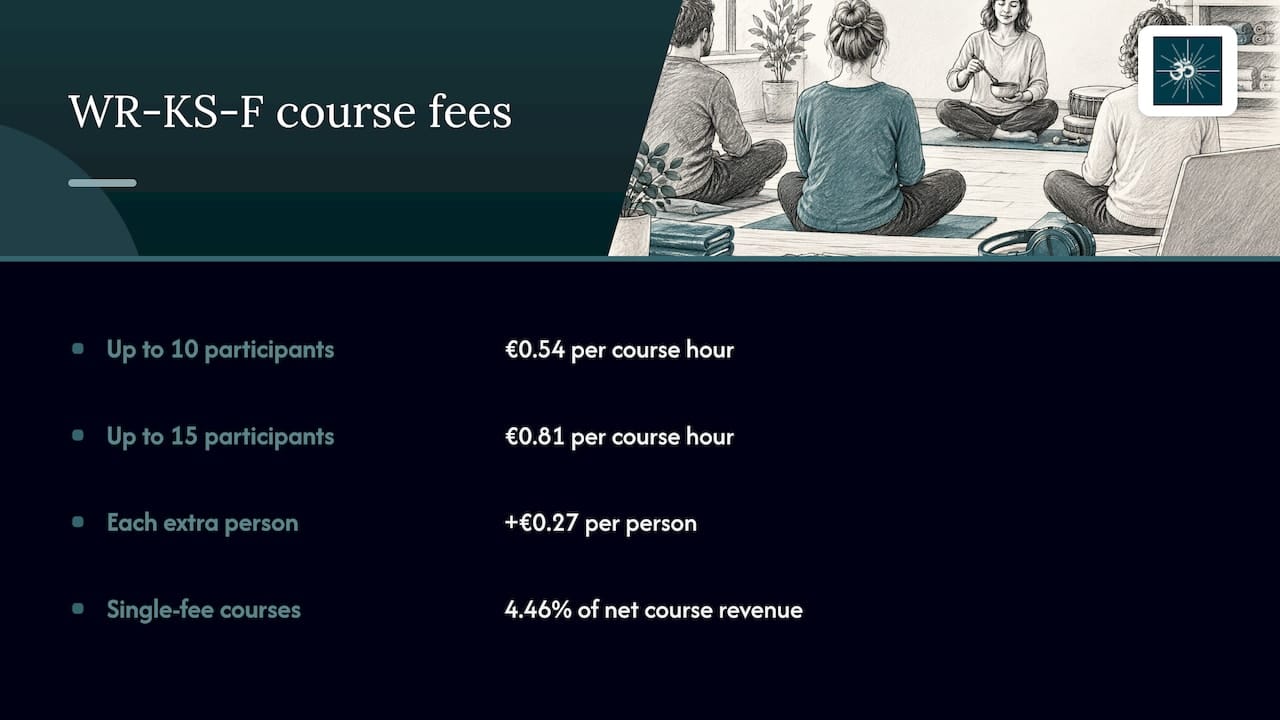
Say you teach a one-hour class for 12 people. The minimum per session would sit at the 15-participant level of €0.81. Small numbers, yes, but they come with registration, reporting and record keeping, and they only cover the GEMA repertoire.
GEMA has also published tariffs for 2027, so the figures above are a snapshot of 2025. Check the current tariff page before you budget.
Streaming, downloads and bought tracks: what they actually cover
This is where well-meaning practitioners get caught. You have a streaming account, you have bought a few albums, so surely you are covered?
Not necessarily. Here is what the sources say.
- GEMA separates the right of making works available to the public (streaming and downloads) from the public performance of broadcasts and recordings. Which rights GEMA manages in a given case depends on the author’s contract with it (GEMA FAQ).
- Consumer streaming services are, by their terms of use, generally meant for private rather than commercial purposes. For in-store radio the provider needs a separate licence, and the GEMA licence for public performance does not cover it (GVL on public performance).
- Online use is itself split by GEMA into free streaming (VR-OD 9), paid streaming (VR-OD 8) and downloads (VR-OD 7) (GEMA online tariffs). Those tariffs are for the services that distribute music, not for you playing it to clients.
A cover version adds another layer: you need to acquire the necessary rights, and changes to the lyrics or composition can require further rights from the author or publisher (GEMA FAQ). So a gentle piano cover of a pop song for your breathwork session is not as innocent as it sounds.
Where royalty-free music fits in

The tidy way out of all this is music that was released for professional use from the start, with a licence that says so. Our Royalty Free Meditation Music range is made for exactly this: meditation, therapy, yoga, apps, guided audio, massage and wellness content, with both personal and professional licensing options.
Two honest points on how this works in practice:
- “Royalty-free” describes the licence model, not the absence of a licence. You still hold a licence. You simply do not pay per play or per class.
- GEMA still wants documentation. Even music declared as GEMA-free has to be registered for review, and GEMA asks for evidence such as a repertoire-check document or a licence certificate (GEMA practice guidance). Its own repertoire search only gives non-binding first hints and is no substitute for proper proof.
So file your licence confirmation the way you file your insurance papers. Where, when and how you use the music is then easy to show.
Choosing music your clients will actually notice
Licensing is the dull half of the subject. The other half is whether the music works in the room.
Our catalogue is recorded with live musicians, including sessions at Abbey Road Studios with the National Philharmonic, rather than assembled from sample packs. The tracks use binaural beats, theta frequencies and Solfeggio frequencies, and many are produced in 3D surround sound. Robert Emery, the composer and conductor behind much of the orchestral writing, and Moritz Schneider, the producer who shapes the frequency-based and meditative side of the sound, are named on the library’s own pages, and their approach is to build the frequency layers beneath the acoustic orchestra rather than on top of it.
A few practical matches between track and setting:
- Sleep and deep relaxation work: Ratri, the theta lullaby meditation, available under a professional licence.
- Body-based and energy work: Samsara, the 528Hz meditation.
- Grounding or release themed sessions: Shambhala, the 396Hz meditation.
Single tracks suit a practitioner who needs one or two pieces. If you run several formats a week, a subscription saves you from re-licensing piece by piece.
A licensing checklist for your practice
Take this through once, then revisit it whenever you add a service or a room.
- List every place music plays. Waiting room, treatment room, group studio, online sessions, recorded guided audio you sell.
- Note who is listening. Unconnected clients or participants mean public use.
- Sort the music by source. Protected repertoire, public domain originals, and professionally licensed library music.
- Match each to its permission. GEMA tariff M-U for background music, WR-KS-F for classes with music, or a professional licence for library music.
- Register where GEMA asks you to. Classes with music are registered separately.
- Keep the paperwork. Licence confirmations, invoices and track lists in one folder.
- Review yearly. Tariffs change; GEMA has already published 2027 figures.
If your case is unusual, such as a clinic with several therapists, a retreat centre or a paid online course, GEMA itself is the body to ask about its tariffs, and a lawyer specialising in copyright is the person to ask about contracts and your own recordings.
Perspective
I started as a musician, not a licensing expert, so I understand the instinct to simply press play and get on with the session. The trouble is that a meditation track is not background wallpaper. It is a tool, and like any tool of your trade it should arrive with the right paperwork.
That is why we record the way we do. Live players at Abbey Road with the National Philharmonic, 3D surround capture, and careful frequency design with Moritz Schneider on the production side, all aimed at music that is made to be used in sessions, not borrowed from a consumer app.
When a therapist tells me their clients stop fidgeting around minute three, that is the best review I can imagine. A licence that lets you use that music openly, in your practice, with your name on the door, simply lets you enjoy it without a nagging worry.
ROBERT
Using our music in your practice
Our Professional subscription is €150 per month and covers professional use of the library. Practitioners who only need music for personal practice can choose the Personal subscription at €21 per month. You can also browse the full Royalty Free Meditation Music range to hear what each track does.

If you would like to see the whole library first, the Orchestral Meditations home page is the place to start.
FAQ
Can I play music in my practice without a licence?
Only if it is genuinely free of GEMA claims and you can show it. GEMA says public use of protected music needs a licence even without profit, and music declared as GEMA-free is still registered and checked. Private use with family and close friends is the exception.
Does my streaming subscription cover sessions with clients?
Consumer streaming services are generally intended for private rather than commercial use, according to their own terms, as GVL notes. For professional sessions, music with a professional licence is the straightforward route.
How much does a GEMA licence for a class cost?
It depends on average participants, how many times a week the class runs, and what participants pay. In the WR-KS-F text valid from 1 January 2025, single-fee courses cost 4.46 per cent of net course revenue, with per-hour minimums. Tariffs for 2027 have been published, so check the live GEMA tariff page.
What should I keep as proof of my licence?
Keep the licence confirmation or certificate and your invoices. GEMA asks for evidence such as a repertoire-check document or a licence certificate when music is declared GEMA-free.
Is a personal licence enough for client work?
A personal licence is for your own listening. Working with clients, running classes or publishing guided audio is professional use, which is what our Professional subscription is for.