
Grief meditation music is calm, slow, mostly instrumental music that you listen to with attention, so that feelings have somewhere safe to go. It does not fix grief, and no honest piece of music will. What it can do is give a hard hour some shape: a steady pulse to breathe with, warm sound to sit inside, a reason to stop and let the tears come. Orchestral Meditations offers a royalty-free library of orchestral meditation music recorded with live musicians, including sessions at Abbey Road Studios with the National Philharmonic, and this guide explains how to pick from a library like that, and how to listen so it supports you rather than catching you off guard.
TL;DR
- Choose music for how it feels to you today, not for a label. Slow, warm, steady and unhurried is a good starting point.
- Listen at a comfortable volume, give the music your attention, and leave time afterwards to sit with whatever came up.
- Research on music in bereavement is encouraging for connection, expression and comfort, but it is not a treatment, so keep your doctor, therapist or a bereavement service in the picture.
- In the first weeks after a loss, short and gentle beats long and deep.
- Live orchestral recordings with a steady, containing sound suit this well, and our library is built around exactly that.
What grief meditation music actually is
People use the phrase for three different things, and it helps to separate them.
The first is music alone: an instrumental piece, often strings, piano or soft pads, that you put on while you sit, lie down, walk or cry. The second is a guided grief meditation, where a voice talks you through breathing and imagery, sometimes with music underneath. The third is music therapy, where a trained therapist uses music within a relationship with you, which is a different thing entirely.
The Oxford Textbook of Music Therapy draws that line clearly. In its chapter on palliative care, clinical music therapy is the professionally informed use of music in a therapeutic relationship, and methods include replaying the music of one’s life, guided relaxation with live or recorded music, and creating a musical legacy. The same chapter stresses that the focus is on the process rather than the musical product, and that you do not need a musical background to benefit.
Meditation music sits in the everyday space around all this. It is something you can reach for at 3 a.m. when no appointment is available. If you want to learn the listening side of it first, our step-by-step guided meditation guide walks through the basics of settling into a session.
What the research says (and what it doesn’t)
Let’s be straight, because grieving people deserve straight. The evidence for music in bereavement is real, but it is modest and mostly comes from clinical settings, not from someone pressing play on a track in their living room.
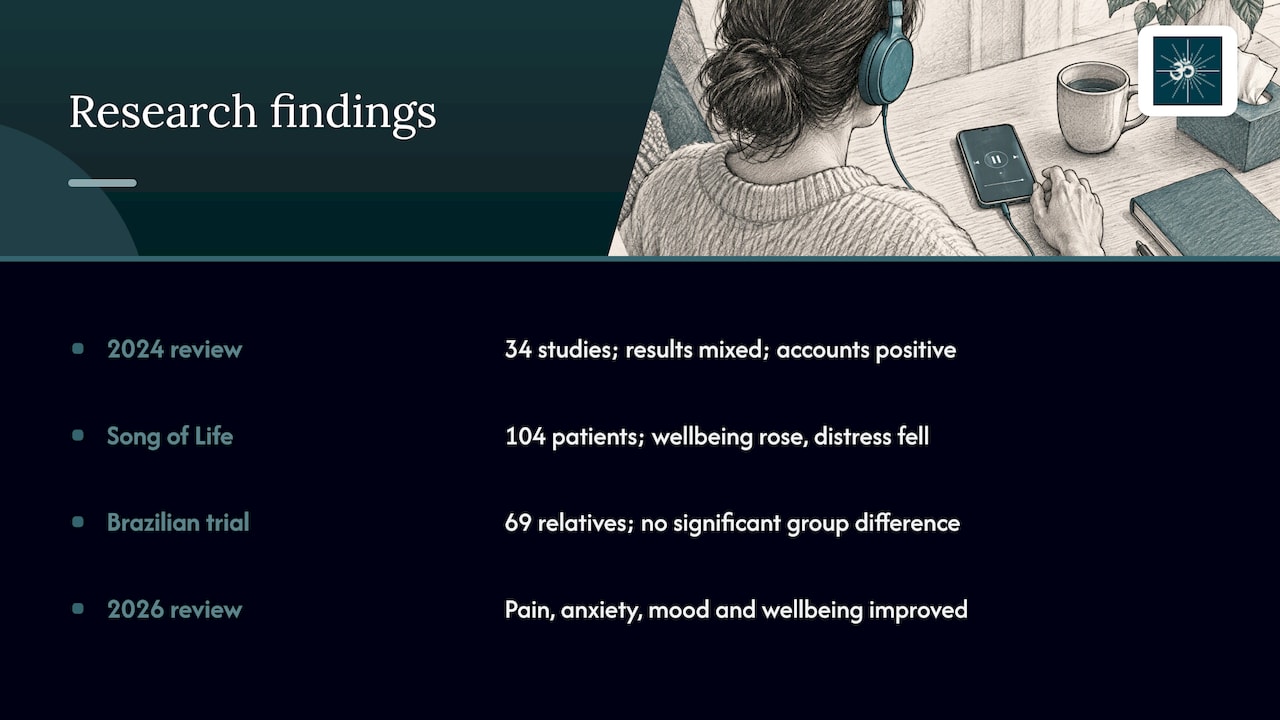
A 2024 systematic review in BMC Palliative Care looked at 34 studies of music therapy for informal carers, meaning the family and friends who look after someone seriously ill. The numerical results on quality of life and mental wellbeing were mixed. The interviews and written accounts, however, pointed to better psychological, spiritual, emotional and social outcomes, with the strongest support before the death rather than after it. The same review reports that group music and singing gave people social contact that eased loneliness, and that music gave a safe channel to feel, process and communicate grief-related emotions.
A German example is the “Song of Life” trial, a multicentre randomised study with 104 palliative-care patients published in 2021. Three sessions built around a song that mattered to the person led to higher spiritual wellbeing and ego-integrity, and lower distress, than a relaxation control. Family members rated the experience highly for meaningfulness. Notice what worked: not generic sound, but music that meant something to the person.
A Brazilian randomised trial with 69 bereaved relatives of cancer patients compared sacred music with vocals, instrumental sacred music and no music. It found no statistically significant difference in spiritual wellbeing between groups, though the authors saw a tendency towards improvement, particularly with vocals, and asked for further studies. The honest reading is that music is one support among several, and that personal fit matters more than any rule.
A 2026 narrative review of music therapy in palliative and end-of-life care reports consistent improvements in pain, anxiety, mood and subjective wellbeing, with biographical and legacy approaches helping spiritual wellbeing.
What does this mean for you at home? Treat music as a companion to grieving, a way to make room for feelings, to feel less alone in them, and to rest between waves. Do not treat it as a switch that turns grief off.
Why the music should feel like company
German psychotherapists have written about this in a way I find useful. The professional association VFP, in an article on being comforted through music, explains that listening activates many brain regions at once, and that the more attention you give and the more you let yourself be carried, the more the music can do. For grief, they suggest music that says, in effect, “I understand you, I carry you, you need not be afraid”. They also prefer stabilising music that helps you get through the situation “for today” over music that goes too deep too quickly.
That is a lovely test. Ask of any track: does this hold me, or does it push me? If it holds, keep it. If it pushes, it may be right another month, but not tonight.
How to choose music for your grief
There is no single best song for grieving, which is why searching for one tends to end in a dozen browser tabs and a sulk. Instead, use a few practical questions.
Pick the mood you need, not the mood you have
Some days you want music that mirrors your sadness, with slow strings and a long, aching melody. Other days you need something that steadies you. Both are legitimate. If you are exhausted, choose steady and warm. If you feel numb and want to feel something safely, a richer, more emotional orchestral piece may help.
Favour slow, steady and uncluttered
Slow tempo, soft dynamics and little sudden change are easiest for a tired nervous system. The “Song of Life” method, for example, uses lullaby-style music in a slow 3/4 or 6/8 rhythm, according to the trial report. A gently rocking pulse is something your breathing can follow without effort.
Instrumental first
Words can pull you into specific memories (the song at the funeral, the one your mother hummed). Instrumental music leaves room for your own thoughts and lets you stay with a feeling without a lyric steering you. Live orchestral instruments, such as strings, add a human warmth that synthetic pads sometimes lack, which is a large part of why we record with real players.
Be wary of tying a loved piece to a painful moment
The Oxford chapter notes that some people can use favourite music to get through something unpleasant without spoiling it later, while others need to avoid that music afterwards. So if a piece is precious to you, think before making it the soundtrack of your hardest nights. New music, with no history attached, is a safe place to start.
Do not choose by frequency claims alone
You will see tracks promising that a particular tone, such as 396 Hz, “heals grief”. Our own approach is to combine carefully designed sound, including binaural, theta and Solfeggio-based work, with live orchestral performance, and to judge a track by how it feels in your body and how well it helps you rest and reflect. Choose what soothes you, and trust that over any label.
How to listen: a gentle routine
This is the part where the VFP article is most practical. It recommends an appropriate volume (check that it feels right for the listener), listening seated with eyes open or closed, moving or dancing, or even painting while the music plays, and it asks for enough time afterwards to reflect and talk, because even apparently harmless pieces can bring up memories.
Here is how that becomes a routine you can actually do.
- Choose a place and a time limit. Ten to fifteen minutes is plenty at first. A chair, a sofa or the floor by a window all work.
- Set the volume lower than you think. Grief makes sensation sharper. You want to be enveloped, not startled.
- Decide how to be with it. Eyes closed, eyes soft on a candle, or hands busy with a sketchbook. Moving gently is fine too.
- Let the music do the leading. If your mind drifts to your loved one, let it. If tears come, let them. You do not have to meditate “correctly”.
- Leave a gap afterwards. Sit quietly for a few minutes. Drink some water. Write a line or two, or tell someone how it went. Do not rush straight into email.
- Notice what helped. Keep a short list of the pieces that held you well. It becomes your own grief library.
For sleep
Sleep is often the worst part of grief, and many people play meditation music at night. Choose very slow, soft music with little change, set it at a low volume, and use a sleep timer if you want. If you wake with vivid feelings, that is normal; keep a notebook by the bed and treat the music as a gentle companion rather than a guarantee of sleep.
The first weeks are different
A 2026 review of mindfulness-based approaches to bereavement by D’Antoni and colleagues (17 studies) found the strongest evidence for structured programmes such as MBSR and MBCT, with improvements in grief-related distress, depressive symptoms and wellbeing, and less rumination. It also notes that the evidence is still preliminary, and that in the very acute phase, generally the first three months, approaches that emphasise containment, stabilisation and support, with brief structured exercises introduced gradually, tend to suit people better than intensive, deep practices.
In practice, that means:
- Weeks one to twelve: short sessions, simple music, and a clear ending. Think of a warm blanket, not a deep dive.
- Later: longer sessions, more open listening, and more emotionally rich music, if you want it.
- Always: the right to stop. If a track makes you feel worse, switch it off, move, drink water, and look at something in the room. That is not failure; it is good judgement.
A 2025 systematic review of 13 studies with 2,097 participants found that mindfulness-based interventions generally reduce depression and PTSD symptoms after bereavement, while findings for prolonged grief symptoms were mixed. The authors reason that such approaches ask less of your thinking than cognitive therapy does, which makes them a sensible complement when other options are not available. Listening practice with music belongs in that family: it asks you to be present, not to argue with your thoughts.
When music is not enough on its own
Grief is not an illness, but it can become overwhelming. Seek help from your GP (Hausarzt), a psychotherapist or a bereavement counselling service if:
- you cannot function at work or home for weeks on end;
- you feel hopeless, or have thoughts of harming yourself;
- your sleep, appetite or physical health are sharply affected;
- the intensity is not easing as time passes.
If you are in immediate danger or thinking of ending your life, call the emergency number 112 in Germany, or the free TelefonSeelsorge line on 0800 111 0 111, at once.
Professional support can also include structured online programmes. A meta-analysis of internet-based grief interventions covering 9 trials and 1,349 people found positive effects on grief, depression and post-traumatic stress, although the quality of evidence was low to moderate. For people who prefer talking face to face, grief and bereavement counselling is offered by practices that combine evidence-based methods with in-person and telehealth sessions; this example is a Texas practice, so in Germany, ask your GP or a local Trauerbegleitung service for someone near you.
Music and counselling work well side by side. Many people find that a short listening session before or after an appointment helps them arrive and settle, or land softly afterwards.
What if you are supporting other people?
Many of our listeners are not grieving themselves, or not only. They are yoga teachers, therapists, hospice volunteers, funeral celebrants, content creators and app developers who want calm, high-quality music to play for others. If that is you, a few thoughts.
- Offer choice. What soothes one person unsettles another. Where you can, let people choose between two or three pieces.
- Check the volume with them. The VFP advice to always ask the listener whether the volume fits is simple and kind.
- Leave time to talk. Do not end a session with a hard stop. Even a gentle piece can open a memory.
- Mind the licence. Playing music in a class, a recording or an app is a commercial use, and needs the right professional licence.
That last point is where a royalty-free library earns its keep, and we cover it below.
Perspective: why live orchestra suits grief
We have made orchestral meditation music for years, and the question we hear most is whether music can really help with something as large as loss. Honestly, it cannot erase loss, and we would never promise that. What it can do is keep you company.
When Moritz Schneider and I compose, and when I produce the recordings, we think about what a tired, sad person needs from a sound. A steady pulse to breathe with. Strings that feel like a person sitting beside you rather than a machine. Space for silence. That is why we work with live musicians, including sessions with the National Philharmonic at Abbey Road Studios, rather than relying on synthetic loops. Real players breathe, and listeners seem to feel it.
The same thinking sits behind our 3D surround sound and our binaural, theta and Solfeggio-based tracks. Our formula is designed to create immersive, containing soundscapes that help you settle, reflect and rest. You do not have to believe anything for that to work. You only have to press play, sit down, and let the music hold the room for a while.
If you take one thing from this article, let it be this: be gentle with yourself, choose music that feels like company, and let it be one part of a wider circle of support.
ROBERT
Where to find the music
If you want a library that was built for this kind of listening, our personal subscription costs €21 per month and gives you access to orchestral meditation music recorded with live musicians, so you can build your own set of pieces for quiet evenings, sleep and reflection. You can find it on the personal subscription page.

If you guide others, for example in yoga, therapy, massage, guided audio or an app, the professional subscription costs €150 per month and carries a professional licence. Our royalty-free meditation music is available with both personal and professional licensing options.
A short starter plan for the first month
If you do not know where to begin, here is a simple plan that fits the research above and your energy, whatever level it is at.
- Days 1 to 7: one short session a day, ten minutes, with one slow instrumental piece. Eyes closed or open, whichever feels safer. Afterwards, drink some water and write one sentence.
- Days 8 to 14: add a second moment in the day if you want it, perhaps a session before bed at low volume. Notice which pieces feel like company and which do not.
- Days 15 to 30: try a slightly longer session, fifteen to twenty minutes. If a track opens up strong feelings, let them come and then close with a few quiet breaths and something grounding, such as a walk or a cup of tea with someone you trust.
None of this is a test. If you miss days, that is human. If you want to skip music altogether on a given day, also fine. Grief keeps its own calendar.
FAQ
What is the best music to listen to when grieving?
There is no single best piece, because grief is personal. Slow, warm, mostly instrumental music with a steady pulse is a good starting point for many people. Try a few pieces, keep the ones that make you feel held, and set aside the ones that push you.
Can I use meditation music if I cry while listening?
Yes. Crying is a natural part of grieving, and research on music in bereavement describes music as a safe channel for feeling and expressing grief-related emotions. Keep the volume comfortable, allow a few quiet minutes afterwards, and talk to someone if the feelings stay intense.
How long should a grief meditation session be?
In the first weeks after a loss, ten to fifteen minutes is a sensible length, since reviews of mindfulness in bereavement suggest introducing practices gently and in short, structured pieces. You can lengthen sessions gradually as you feel ready.
Is meditation music a replacement for therapy?
No. It is a supportive companion, and many people use it alongside counselling, a doctor’s care or a bereavement group. If your grief is overwhelming, lasts without easing, or you feel unsafe, speak to your GP or a psychotherapist, or call 112 in an emergency.
Can I use your music in my grief support sessions or app?
Yes, our library comes with professional licensing options for use in therapy, yoga, guided audio, massage, apps and wellness content. The professional subscription is €150 per month, and the royalty-free music page explains the licence options.
Sources
- Music therapy in palliative care, Oxford Textbook of Music Therapy chapter (2015)
- Music therapy for supporting informal carers of adults, BMC Palliative Care (2024)
- Group music and singing in bereavement, BMC Palliative Care (2024)
- “Song of Life” multicentre randomised trial (2021)
- Effects of sacred music on the spiritual wellbeing of bereaved relatives (2017)
- The role of music therapy in palliative and end-of-life care (2026)
- Getröstet werden durch Musik, Verband Freier Psychotherapeuten (2017)
- Mindfulness-Based Interventions for Bereavement (2026)
- Mindfulness in Adaptation to Bereavement, systematic review (2025)
- Effectiveness and Feasibility of Internet-Based Grief Interventions (2021)
- Grief and bereavement counselling