
You prepare clients for binaural beats by settling five things before the play button is pressed: what the session is for, a quiet room, closed-back stereo headphones at a modest volume, a session of about 20 minutes, and a short, honest explanation of what they might notice. Get those right and the audio gets a fair hearing. Skip them and even a beautifully made track gets blamed for a noisy radiator, a wobbly earbud or a client who spent the first ten minutes wondering whether they were doing it wrong.
I have watched this go wrong in my own studio more often than I care to admit (once, a very serious gentleman held his breath for four minutes because nobody had told him he was allowed to simply listen). This guide is the routine we would hand a colleague: the intake conversation, the room, the numbers that research actually gives us, the walk-through, and the debrief. It is written for meditation teachers, yoga and sleep practitioners, music therapists and wellness coaches who want their clients to arrive at the session relaxed and leave it feeling looked after.
TL;DR
- Start with a two-minute intake: the client’s goal, their experience with meditation, their hearing and anything that makes them uneasy about headphones.
- Use stereo headphones (binaural beats need a different tone in each ear), a quiet room, a comfortable position and a moderate volume. One peer-reviewed study used 60 dB SPL.
- Plan roughly 20 minutes per session. Research on non-clinical use found sessions of 5 to 24 minutes, most often around 20.
- Explain the experience in plain words, promise relaxation support rather than a cure, and tell clients they can take the headphones off at any moment.
- Finish with a quiet debrief and a simple routine for home listening.
Why preparation matters as much as the track
A binaural beat is an auditory illusion. You play one tone in the left ear and a slightly different tone in the right, and the brain perceives a slow pulse at the difference between the two. Play 500 Hz in one ear and 506 Hz in the other, and the listener perceives a 6 Hz pulse that exists in neither channel. That is why the whole effect depends on the hardware and the setting, and why the client’s preparation is part of the method, not an optional extra.
The research agrees that the details matter. A review of non-clinical binaural beat use for stress management, published in 2024 by Platt and Hammond, looked at 12 randomised studies, and 8 of the 12 found at least one significant effect in favour of the intervention. A separate systematic review of music and binaural beat interventions in young adults, published in 2026, reported effect sizes of d = 0.34 to 0.59, with theta beats showing the strongest effect on physiological stress reduction. Those studies controlled how long people listened, what they listened on, and how loud it was. Your clients deserve the same care.
Step 1: The intake conversation
Before anyone puts on headphones, spend a couple of minutes asking four things. It is not a medical history, just a conversation.
- What would you like from this session? Sleep, winding down after work, a deeper meditation, a calmer start to the day. The answer shapes the track you choose. Theta-range tracks (roughly 4 to 8 Hz) are the usual choice for deep relaxation and meditation, while beta-range tracks are associated with alertness and focus.
- How much meditation experience do you have? This is not small talk. In a study by Chaieb and colleagues, 7 Hz theta beats increased delta activity in experienced meditators but not in beginners, while 15 Hz beta beats increased gamma activity more in novices. Prior experience changes how people respond, so a beginner needs a gentler introduction and a more patient expectation.
- How do you feel about headphones and sound? Some people dislike anything over or in their ears. Others have tinnitus or sensitive hearing. Knowing this in advance saves an awkward mid-session adjustment.
- Is there anything you would like me to know before we start? This leaves room for a client to mention a health condition or a bad day.
If a client mentions a history of seizures, a hearing condition, a diagnosed mental health condition or pregnancy, ask them to check with their doctor before trying binaural beats. The 2024 review points out that questions about hearing damage and mental health have been raised in the wider literature, which is a good reason to ask rather than assume. In Germany, that is the client’s Hausarzt or the relevant specialist, and it is their call, not yours.
Step 2: Setting up the room
The room does more work than people expect. The Frontiers in Psychology study by Corona-González and colleagues, which used personalised theta and beta binaural beats, placed participants in a quiet room, in a comfortable seated position with their eyes closed. It is a good template for any practitioner.
Here is the checklist we would use:
- Quiet. Switch off phones, close the window to street noise and put a note on the door. A passing tram is a surprisingly effective way to end a theta session.
- Temperature. Relaxed bodies cool down. Keep a blanket within reach so nobody has to fidget halfway through.
- Position. Seated in a supportive chair or lying down on a mat, whichever the client can hold comfortably for 20 minutes without drifting into a slouch they will regret. Lying down suits sleep-focused work, while an upright seat suits meditation.
- Light. Dim, not dark. Many clients will close their eyes anyway.
- Nothing to do. Tell clients there is no goal during the audio. Not achieving a state is the most common worry.
For home listening, the same list works as a short note you can send along after the session.
Step 3: Headphones, carrier tone and volume
Binaural beats only work if each ear receives its own tone. That means headphones, and it means stereo. Speakers blend the two tones in the room and the effect disappears. Closed-back or noise-isolating headphones are the practical choice because they keep out the world and let the more subtle tones come through. Check the fit before the session: the left and right sides can be worn the wrong way round without harm, but a loose earbud can leak the tone and break the illusion.
Three numbers are worth knowing.
| Setting | What research suggests | Source |
|---|---|---|
| Carrier tone | 450 to 500 Hz, with perception most likely around 500 Hz | Corona-González et al., 2021; Gao et al. |
| Difference between the ears | 30 Hz at most for the beat to be perceived | Gao et al. |
| Sound level | 60 dB SPL, in line with WHO/ITU recommendations (2019) | Corona-González et al., 2021 |
You will not usually set these yourself, because a well-made track has them built in. What you control is the playback volume. Set it at a comfortable, moderate level, lower than you would for ordinary music. A good rule: the client should be able to hear the track clearly but never feel it pressing. Do the volume check together before the session starts, and tell the client that if anything feels too loud, they should lift a hand or take the headphones off.
A small detail that matters in practice: turn off any equaliser, bass boost or spatial-sound setting on the playback device. Those settings reshape the audio and can interfere with the tones the track was made with.
Step 4: How long, and how often
Twenty minutes is the figure that keeps appearing. Platt and Hammond found that single-session studies used total durations from 5 to 24 minutes, most often around 20 minutes. In the same body of work, a 20-minute beta-beat protocol produced stronger reductions in salivary stress markers than a 5-minute one. The Corona-González team also chose 20 minutes and noted that longer listening could lead to mental fatigue.
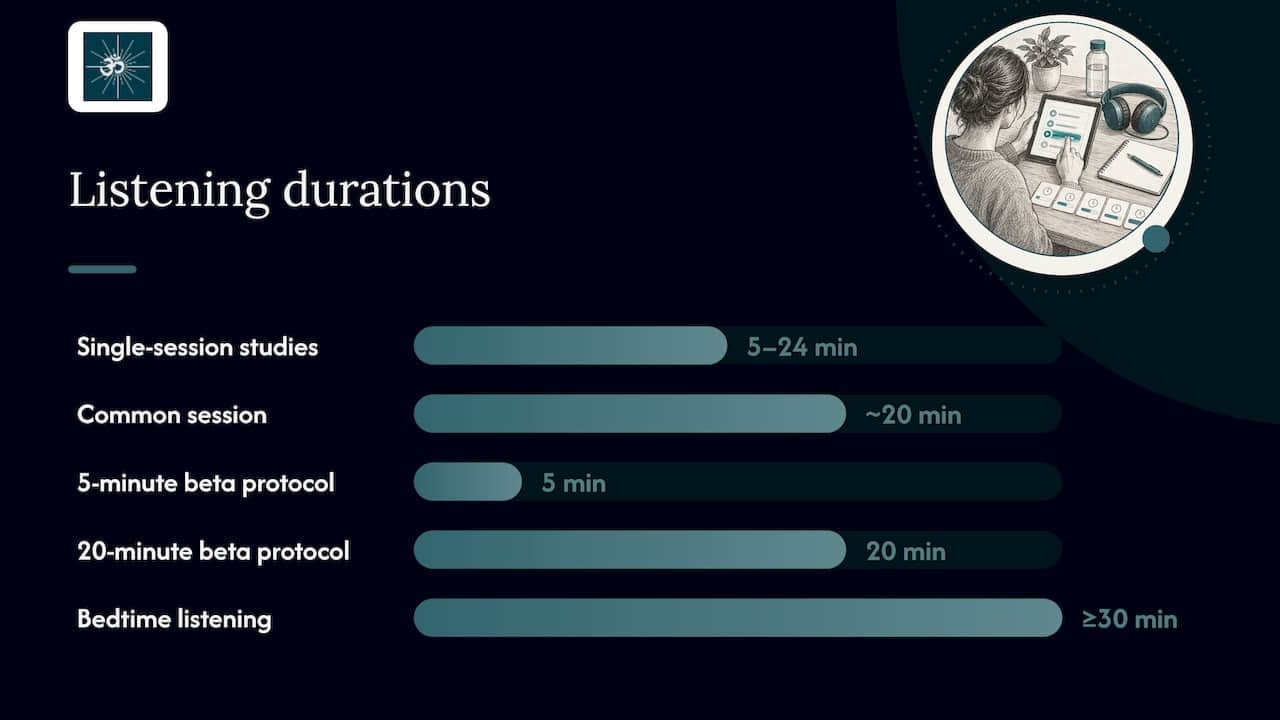
For a first session, 20 minutes is plenty. For a sleep practitioner, longer bedtime listening has its own logic, and in one randomised trial with 74 service members, participants listened to theta-beat music for at least 30 minutes a night on three consecutive nights per week for four weeks. Those participants showed higher parasympathetic and lower sympathetic heart-rate-variability measures and reported less stress in daily diaries than the music-only group. That is a bedtime protocol and a research population, so use it as context, not as a prescription.
On frequency, the 2024 review notes that daily listening seems unnecessary, but exposures should fall within a week of each other to keep stress-protective effects going. A simple pattern for clients: two to four sessions a week, ideally at a similar time of day, so listening becomes a habit rather than a project.
Step 5: Walking the client through the session
Here is the routine, from the moment the client sits down.
- Explain what will happen, in one minute. “You will hear a gentle orchestral track. Underneath it there is a slow pulse your brain creates from two slightly different tones. You do not need to do anything. If your mind wanders, that is normal. Wandering is not failing.”
- Fit the headphones and check the volume. Play the first seconds of the track, ask whether the level is comfortable, then lower it a notch. Quieter beats louder.
- Agree a signal. A raised hand, or simply taking the headphones off, ends the session at any time. Saying this out loud makes most clients relax before the music even starts.
- Settle the body. Two or three slow breaths, shoulders down, jaw loose, eyes closed.
- Start the track and stay quiet. Resist the urge to talk through it. If you are guiding a visualisation, keep it spare and let the audio carry the atmosphere.
- Stay close but out of the way. Notice breathing, posture and restlessness without hovering.
- End gently. Fade the audio out or lower the volume, wait a few breaths, then invite the client to move fingers and toes before opening their eyes.
For beginners, remember the finding that experience shapes the response. Do not push a first-timer toward a particular state. Let the first session be about getting comfortable with the headphones and the format.
Step 6: Setting honest expectations
The most useful thing you can say before a session is also the simplest: this is a listening practice that many people find relaxing, and the experience varies from person to person. The literature itself talks in those terms. The 2026 review concludes that binaural beats may serve as a portable tool for stress regulation and that structured music at bedtime may work as a non-pharmacological sleep aid. It also notes that exposure parameters such as frequency band, duration and delivery vary widely between studies, which is why we describe the practice as supportive and personal rather than prescriptive.
In practice, that means:
- Describe binaural beats as a support for relaxation, focus or sleep routines, not as a treatment for any condition.
- Never ask a client to reduce or stop medication or therapy because of a listening practice.
- Invite clients to notice what they feel, not to judge whether it “worked”. Some will feel calm, some sleepy, some simply rested. All of those are fine.
- Point out that sound is one part of a good routine. Regular sleep, a clear task, a quiet space and regular breaks do a lot of the heavy lifting, and a track sits happily on top.
That last point holds for other wellness technology, too. If your clients are curious about devices beyond sound, realistic expectations for PEMF devices and sleep make a useful companion read on keeping the claims modest and the routine consistent.
A gentle tip for practitioners with a scientific streak: Kahathuduwa and colleagues ran a double-blind, sham-controlled crossover study with 25 healthy adults, in which every participant under EEG-guided binaural beat stimulation reached a dominant EEG frequency below 8 Hz, and relaxation and sleepiness rose in both conditions. The authors call their results preliminary. We find that a rather healthy way to look at it: interesting, promising, and no reason to overpromise to a client.
Step 7: Safety and when to pause
Safety guidance is short, but it is worth saying out loud.
Reported side effects are uncommon. In the 12 trials reviewed by Platt and Hammond, one reported mild headaches, and these occurred in the control group too, and completion rates were above 90%. That is reassuring, and the authors add that side effects were not always reported systematically, so it is sensible to stay attentive anyway.
Stop the session if the client:
- feels dizzy, nauseous or develops a headache,
- finds the sound uncomfortable, too loud or unpleasantly pulsing,
- feels anxious, panicky or emotionally overwhelmed in a way that is not settling,
- asks to stop, for any reason.
If symptoms persist after the session, suggest the client speaks to their doctor. If a client has ever been advised to avoid sensory stimulation or has a history of seizures, check with their doctor before starting, not afterwards.
Volume is the practical safeguard. Keep it moderate, keep it consistent, and encourage clients at home to use a comfortable level rather than turning it up to “feel” the beats. Take regular breaks from headphones in general.
And a note about boundaries: if you are not a licensed therapist, avoid positioning a session as therapy. If you are a music therapist or a psychologist, you already know your own professional framework; binaural audio sits inside it, not outside it.
Step 8: The debrief and the home routine
The five minutes after the audio are where the client turns an experience into a habit.
- Let them come back slowly. A glass of water and a minute of silence beat an instant “so, how was it?”.
- Ask open questions. “What did you notice?” and “How does your body feel compared with when you arrived?” Avoid asking whether they felt a specific effect.
- Normalise the quiet ones. Some clients feel nothing dramatic. That is common, and a second session often feels different from the first.
- Give a simple plan. Two to four sessions a week of about 20 minutes, in a quiet spot, same headphones, same time of day if possible.
- Send the checklist home. Stereo headphones, modest volume, comfortable position, no multitasking, a stop-if-uncomfortable reminder.
If you keep notes, a one-line log after each session (time, track, how the client felt before and after) quickly shows which tracks suit which clients.
Choosing tracks your clients will want to hear again
A beautifully prepared client still needs something pleasant to listen to. This is where the music matters as much as the frequencies. Binaural tones layered under thin synthetic pads can feel clinical. Under a real orchestra, they feel like being held in a very large, very calm room.
That is the idea behind our library. Our recordings were made at Abbey Road Studios with the National Philharmonic, and we mix scientific sound design (binaural beats, theta frequencies and Solfeggio-frequency tracks) with live musicians and 3D surround sound. Robert Emery, the pianist, conductor and orchestrator behind the project, was named music director of the National Philharmonic Orchestra of Great Britain in 2023 and led the Abbey Road sessions, which involved more than 128 musicians and singers. He has also worked with the composer and producer Moritz Schneider on earlier projects, including the 2017 album 4Colors for the Swiss singer SEVEN. Moritz’s focus on frequency-based, meditative orchestral work is part of the reason our tracks are designed to be both musical and functional.
For your clients, that means listening that works as music first. A track people enjoy is a track they come back to, which is exactly the habit the research suggests matters.
Using orchestral meditation music with your clients
If you work with clients regularly, you need a library you can play in sessions, classes or guided audio without worrying about licensing. Orchestral Meditations offers both personal and professional licensing, with individual downloads and subscriptions. The Personal subscription is €21 per month and suits your own practice and home listening. The Professional subscription is €150 per month and is built for practitioners who use the music professionally, in therapy, yoga, massage, apps and guided audio. You can also browse the full royalty-free meditation music library.
If you would like to try it before choosing a plan, the Orchestral Meditations homepage is the place to start.
Our perspective
We make meditation music for a living, so we have strong opinions about what happens before the first note. Preparation is where a session is won.
Early in my career I thought the music would do everything. Then I watched client after client sit down with the wrong headphones, the wrong volume and the wrong idea about what was expected of them. The track was fine. The setup was the problem. (Reader, I once sat through a whole session next to a very audible fridge.)
That is why we record the way we do. When you have a full orchestra in a room built for it, with the National Philharmonic at Abbey Road, you hear how much space there is in sound. Moritz Schneider and I spent a long time deciding how the binaural and theta layers should sit inside that space, so that the frequencies are part of the music and not a gadget bolted on underneath. Our formula is designed to give practitioners something they can press play on with confidence, knowing the clients will actually enjoy listening.
The research gives you sensible guard rails: around 20 minutes, a quiet room, a moderate volume, stereo headphones, a comfortable position. Our job is to give you recordings worth putting those guard rails around. Your job is the human part, the welcome, the explanation, the pause afterwards. Together, that is a session people remember.
If you take away one thing from this guide, let it be this: spend two minutes on preparation and the client will give you twenty minutes of real listening in return.
ROBERT
FAQ
How many minutes should clients listen to binaural beats?
About 20 minutes is the most common length in single-session research, with studies ranging from 5 to 24 minutes. One study found that 20 minutes lowered salivary stress markers more than 5 minutes. For bedtime listening, some trials used at least 30 minutes per night.
How do I use binaural beats effectively with a client?
Use stereo headphones, a quiet room, a comfortable position and a moderate volume, and keep the session around 20 minutes. Explain what to expect, agree a signal to stop, and finish with a calm debrief. Two to four sessions a week, spaced within a week of each other, is a sensible pattern.
Can anyone listen to binaural beats?
Most people can, and the trials reviewed reported few side effects. Clients with a history of seizures, a hearing condition, a mental health diagnosis or pregnancy should check with their doctor first. Anyone who feels dizzy, anxious or uncomfortable should take the headphones off.
Do clients need headphones for binaural beats?
Yes. Each ear must receive a slightly different tone, and speakers mix the two together in the room, which removes the effect. Closed-back stereo headphones are the best choice because they block outside noise and keep the left and right channels separate.
Sources
- Platt and Hammond (2024), non-clinical personal use of binaural beats for stress management
- Elnazer (2026), music and binaural beat interventions for young adults, Acta Neuropsychiatrica
- Elnazer (2026), clinical implications, PMC
- Corona-González et al. (2021), personalised theta and beta binaural beats, Frontiers in Psychology
- Gao et al., EEG activity in response to binaural beats with different frequencies
- Chaieb et al. (2015), auditory beat stimulation, Frontiers in Psychiatry
- Gantt et al. (2017), binaural beat technology and heart rate variability, PubMed
- Kahathuduwa et al. (2025), EEG-guided binaural beat audio, MDPI
- Robert Emery (pianist), Wikipedia