Nature with binaural beats is simply a recording of rain, a forest, a stream or the sea with two slightly different tones, one per ear, hidden underneath. Your brain hears the gap between the tones as a slow pulse. The nature layer gives you something soft and familiar to rest your attention on. Put on stereo headphones, keep the volume modest, and treat it as a gentle companion to meditation, wind-down time or sleep, not a magic switch.
TL;DR
- Binaural beats need stereo headphones, because each ear must receive its own tone. Nature sounds sit on top as the textured, familiar layer.
- Slower beat frequencies (delta, theta, alpha) are the ones usually paired with relaxation, meditation and sleep. Faster ones are associated with alertness.
- Research on nature sounds is encouraging, and research on binaural beats is promising but mixed, so approach it as a supportive tool rather than a cure.
- Keep the volume moderate (the WHO suggests no more than 60% of maximum), and speak to your doctor first if you have epilepsy.
- Start with 20 to 45 minutes in a quiet spot and see how your own body responds.
What nature sounds with binaural beats actually are
Let’s take the two ingredients separately, because they do very different jobs.
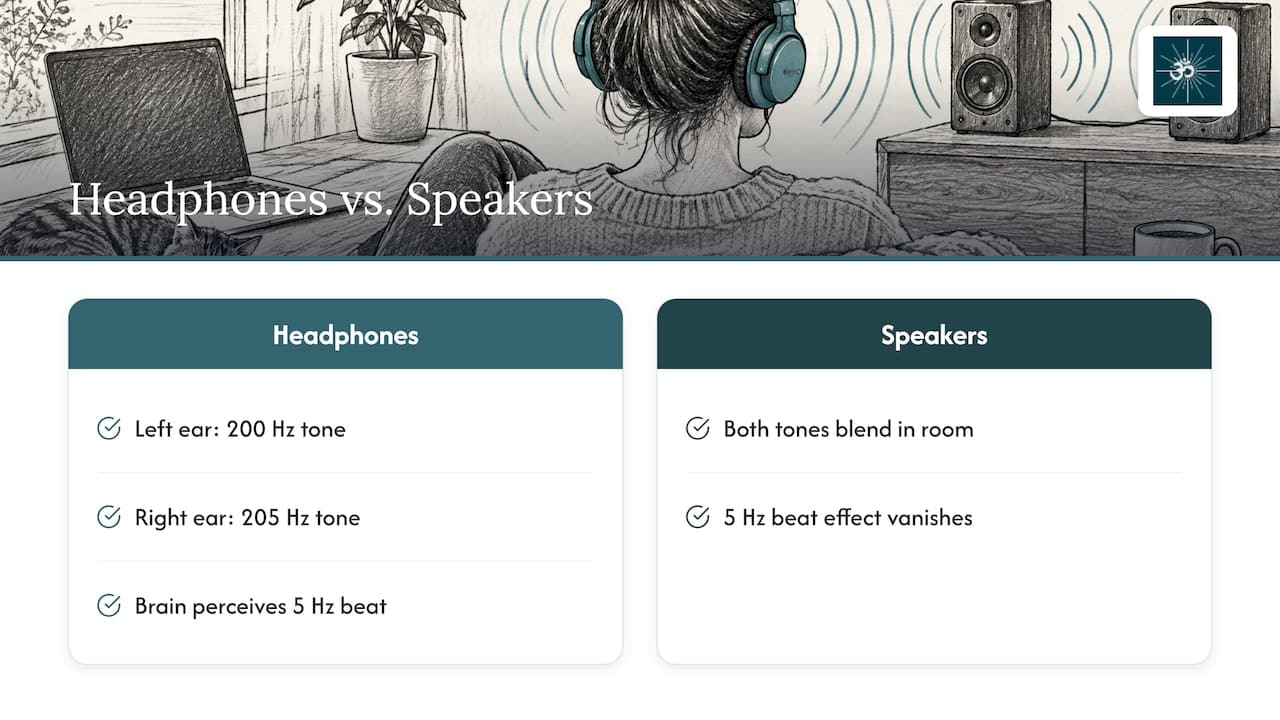
A binaural beat happens when your left ear hears one frequency and your right ear hears another, a few hertz apart. Say 200 Hz on one side and 205 Hz on the other. Your brain perceives a phantom rhythm at the difference, here 5 Hz. No such pulse exists in the air; it is assembled inside your head, which is rather charming when you think about it. That is also why you need headphones: through speakers, the two tones blend in the room and the effect vanishes.
Nature sounds are the easy half. Water, wind, birdsong, a distant thunderstorm. They need no explaining, which is exactly why they work as a bed for the more abstract tones. A bare binaural tone can sound a bit like a fridge that has developed ambitions. Tucked under a waterfall or a woodland dawn chorus, it becomes something you can happily lie beside for forty minutes.
The tracks that rank for this topic are mostly of two kinds: field recordings with a beat quietly mixed in (forest birds with a 5 Hz theta beat, say), and recordings made with binaural microphones, which capture 3D space but contain no binaural beats at all. The names are confusingly close. Binaural recording is about where a sound seems to sit around your head. Binaural beats are about the two-tone trick. A track can have either, both or neither, so read the description.
What the brainwave ranges are meant to do
The usual framework divides beat frequencies into bands. A 2024 review in PMC by Mirmohamadi and colleagues summarises the literature this way: delta beats (0.5 to 4 Hz) during sleep are linked to deeper sleep stages and reduced mild anxiety, theta beats (4 to 7 Hz) to meditation, creativity and REM sleep, alpha beats (7 to 13 Hz) to relaxation and lower anxiety, while beta (13 to 30 Hz) is tied to concentration and alertness, and can raise anxiety too.
In plain terms, that gives you a rough map:
| Band | Approximate range | Typically paired with |
|---|---|---|
| Delta | 0.5 to 4 Hz | Sleep, deep rest |
| Theta | 4 to 7 Hz | Meditation, creative drifting, dreamy states |
| Alpha | 7 to 13 Hz | Calm, relaxed wakefulness |
| Beta | 13 to 30 Hz | Focus, alertness |
| Gamma | 30 to 50 Hz | Sustained arousal |
Examine.com’s evidence summary draws a similar line: lower-frequency beats seem to bring relaxation and pain reduction, higher ones may help memory. Notice the hedged verbs in both. Researchers say “seem” and “may”, and so should we.
Why add nature at all? What the research says
Here the evidence is surprisingly kind to nature sounds, even before beats enter the room.
- In a 2019 Japanese study, just 60 seconds of forest sound, compared with city sound, lowered heart rate and sympathetic nervous activity, and people reported feeling more comfortable and relaxed.
- A 2010 Swedish experiment found that after a stressful mental arithmetic task, skin conductance recovered 9 to 37% faster with nature sounds than with noisy environments.
- A 2025 randomised controlled trial in dental patients found that nature sounds decreased respiratory rate and skin conductance, hinting at a stress-lowering effect.
That is the “why bother with a waterfall” answer. Your nervous system already responds to these sounds.
Where binaural beats and natural sound meet
Researchers have also tried the combination directly. A 2019 Korean study proposed pairing a 6 Hz theta binaural beat with ASMR-style triggers drawn from natural sound to help induce sleep. A ratio of 30 dB beat to 60 dB trigger worked best for theta power and psychological stability, and the authors described the pairing as keeping the strengths of the beat while smoothing over its shortcomings. In other words, the nature layer is not decoration: it is part of what makes the beat easier to live with.
A 2022 trial in Scientific Reports compared ASMR with binaural beats (8 Hz by day, 5 Hz at night) over three weeks. Both reduced stress, with significant improvements in perceived stress, depression, insomnia severity and anxiety, and sleep efficiency rose only in the binaural beat group.
The honest middle
A systematic review of 12 randomised trials found that eight reported at least one significant effect favouring binaural beats for stress reduction, though the authors saw no clear optimal protocol. The 2025 sleep review in Frontiers in Sleep found that music listening consistently shortened the time to fall asleep and improved sleep efficiency, and called binaural beats promising. It also reports one trial where theta-style beats did not beat plain music for sleep quality, yet did shift brain activity and raised daytime alertness in people with mild insomnia symptoms.
Germany’s largest statutory health insurer, AOK, reviewed the EEG studies and notes the findings are mixed, while stating that binaural beats are not dangerous. Cedars-Sinai makes a related point: there is little evidence that listening is harmful provided the volume stays within safe levels, and it cautions against grand claims such as clearing chakras.
So what do we take from all this? Nature sounds have a solid record for calming the body. Binaural beats have a growing, varied record. Putting them together is a reasonable, low-risk way to build a relaxation ritual, and a ritual is, frankly, half the battle. If you would like practical ways to make that ritual work for a busy or restless mind, these practical stress reduction steps pair well with a listening session.
How to listen: a simple setup
I have lain on enough floors with enough headphones to say this: the setup matters more than the track.
- Wear stereo headphones. Both ears must receive separate signals. Closed-back or in-ear models that sit comfortably are ideal, and a pair you can sleep in is worth having if bedtime is your use.
- Pick the beat for the job. Alpha for settling in, theta for meditation, delta for falling asleep. Beta and above for work sessions, not for bedtime.
- Keep the nature layer audible. If the beat dominates, you are listening to a drone. If you can clearly hear the stream or the rain, you are in the right place.
- Lower the volume more than you think. See the next section. Quiet is not weaker; it is simply kinder.
- Give it time. Twenty to 45 minutes is a sensible window. The Frontiers in Sleep review mentions 30 to 45 minutes of listening before bedtime at a comfortable volume as an effective dose for music in general. If you are using it for sleep, this guide to bedtime track length offers a useful way to think about shorter sessions.
- Repeat for a couple of weeks. The studies that saw benefits ran for days or weeks, not one lazy Tuesday.
Meditation, sleep or focus?
For meditation, choose slower theta or alpha beats with a steady natural soundscape such as woodland or a waterfall. Sit or lie down, and use the sound as your anchor. When your mind wanders (it will; mine has opinions about dinner), return to the birds.
For sleep, favour delta or low theta, no abrupt sounds like loud thunder or sudden bird calls, and a sleep timer so the track fades out. For focus, steady rain or a gentle stream under alpha or low beta tends to be easier on the ears than anything with melody.
Volume, hearing and who should be careful
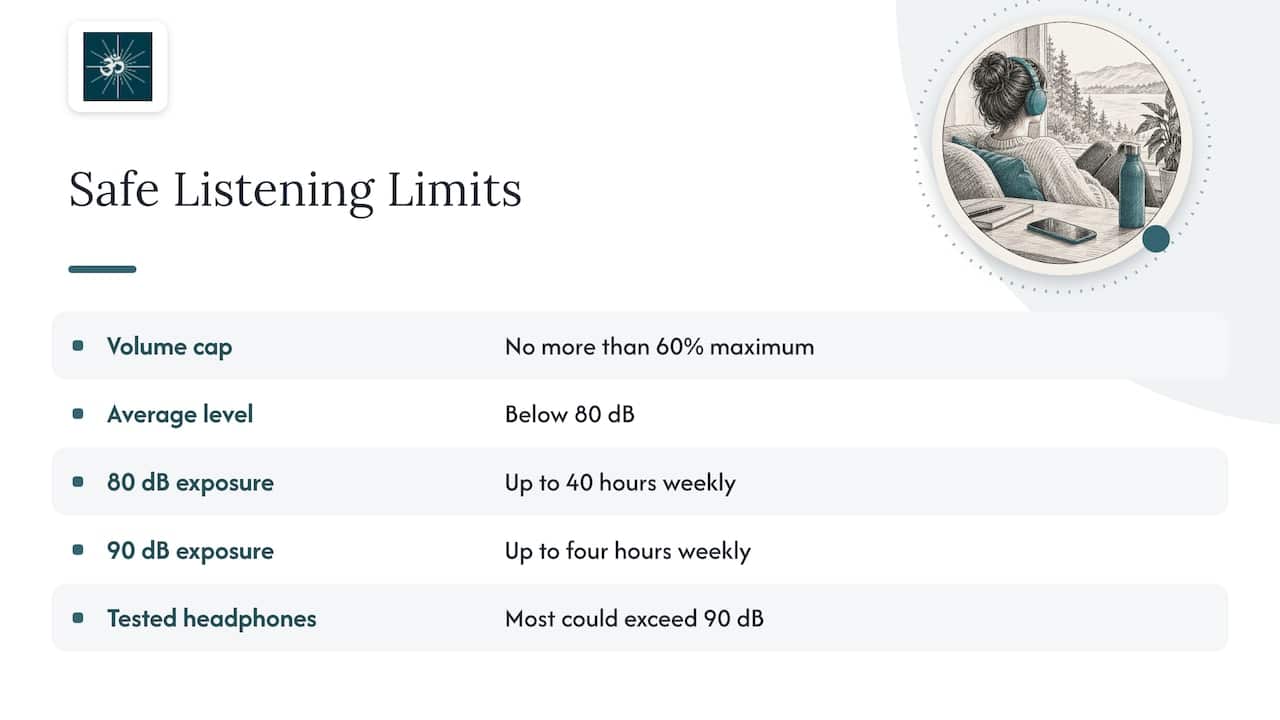
Headphones for an hour a day are fine. Headphones too loud for an hour a day are not. The World Health Organization recommends keeping device volume at no more than 60% of maximum and an average level below 80 dB. At 80 dB, listening up to 40 hours a week is considered safe, but at 90 dB that falls to four hours. It also suggests well-fitted, noise-cancelling headphones, because blocking outside noise means you do not need to turn things up.
The German Federal Environment Agency makes a similar point: earphones on portable players can reach 110 dB(A), and it advises a moderate volume and devices with a built-in limiter. Stiftung Warentest reported in 2024 that most headphones it tested could exceed 90 dB, so a volume limit in your phone settings is a good idea. The Mirmohamadi review likewise suggests staying below 85 dB.
A practical test: the nature sounds should feel like they are in the next room, not on your eardrums. If you could still comfortably talk over it, you are in the right zone.
If you have epilepsy or a medical condition
The 2024 PMC review says people with epilepsy should consult their doctor before trying binaural beats, so please do that first. Examine.com also notes that some kinds of brain damage, such as aphasia after a severe stroke, can impair the response, and older listeners may respond less strongly at higher frequencies. If you are pregnant, are managing a neurological or psychiatric condition, or are unsure, ask your GP or specialist before adding it to your routine. Binaural beats are a relaxation aid, not a treatment, and they do not replace care for insomnia, anxiety or depression.
What makes a good nature and binaural track
Not all tracks are born equal. Here is what we would look for, as listeners first and composers second:
- Clear labelling. The beat frequency in Hz and the intended use should be stated, along with whether headphones are required.
- A natural recording that does not loop obviously. A three-second rain loop will wake the part of your brain that notices patterns, which is the opposite of the plan.
- A beat that sits underneath. If it overwhelms the scene, the mix is wrong.
- Quality of sound. Hiss, compression and clipping are tiring over 40 minutes.
- Considered length and ending. A gentle fade rather than a sudden stop.
- Licensing, if you teach. Yoga teachers, therapists and app makers need clear commercial rights, not a track lifted from a video site.
Our view from the studio
Whenever I am asked about nature and binaural beats, I answer with a slightly awkward confession: the best nature sound I have ever heard was not a field recording. It was a room of live musicians holding one long note on a warm afternoon.
We believe in the power of acoustic instruments played by humans. Digital sounds can be lovely, but strings, harp, celesta and woodwind move air in a room, and your body notices. Orchestral Meditations was built on that belief. Our recordings are made at Abbey Road Studios with the National Philharmonic, and we layer binaural beats, theta frequencies and Solfeggio-based tones into orchestral writing so the science sits inside the music rather than on top of it.
That is why we think of nature sounds and orchestral meditation as friends, not rivals. A stream or a wood gives you the grounding. Live strings give you the emotional arc. Add a carefully designed beat, in 3D sound, and you get a listening experience built for deep rest. Our approach is designed around quality and effectiveness over mass-produced background audio, and our listeners tell us about profound relaxation. If you want to know more about how we think about sound and mindfulness, we have written about science-backed sound and music.
Use headphones, keep the level low, and let the music do the quiet work.
ROBERT
The people behind the music
Behind our catalogue is a composing and producing duo, Robert Emery and Moritz Schneider, who have worked together for around thirteen years and, helpfully for the music, are also close friends. Robert is a composer and conductor who started piano at seven and studied at the Royal College of Music. Moritz is a composer and producer whose focus includes frequency-based and meditative orchestral work. Between them they have worked with major recording artists and orchestras, and they brought that experience to Abbey Road for the meditation sessions.
Why does that matter for you? Because a recording that is composed, conducted and mixed by people who care about how it lands in the body tends to hold up over 40 minutes in a way that a looped sample does not. Their stated conviction is that live acoustic instruments resonate with the body differently from digital ones, and it shapes every session.
Bringing orchestral meditation into your routine
If you like the nature-and-beats idea, here is a way to build it into a week without turning it into homework:
- Morning, 10 minutes: alpha-range track, sitting by an open window. Nature layer first, music second.
- Afternoon slump, 20 minutes: theta-range orchestral track, eyes closed, on a sofa or a yoga mat.
- Evening, 30 to 45 minutes: slow, low-volume track with a timer, lights dimmed, phone away.
Between sessions, take a real walk in a real wood now and then. The recordings are lovely; the original is better.
Take it further with our library
If you would like orchestral meditations with binaural beats, theta and Solfeggio frequencies and 3D sound, our personal subscription costs 21 € per month and gives you access to the library for your own practice.
Teachers, therapists, content creators and app developers can look at the professional subscription at 150 € per month, or at our royalty free meditation music for licensed use in sessions, yoga classes, guided audio and wellness content. You can also start at our homepage and browse.
FAQ
Do I need headphones for nature sounds with binaural beats?
Yes, for the binaural beat itself. Each ear needs its own tone, so speakers will not produce the effect. The nature sounds will still be pleasant through speakers, but you lose the beat.
How long should I listen?
Twenty to 45 minutes suits most people. For sleep, the Frontiers in Sleep review points to 30 to 45 minutes before bed at a comfortable volume for music generally. Use a timer and see how you feel across a couple of weeks.
Is it safe?
For most people, listening at a moderate volume is considered low risk, and AOK describes binaural beats as not dangerous. Keep levels below the WHO’s suggested 80 dB average. People with epilepsy should speak to their doctor first, and anyone with a neurological condition or pregnancy should check with their healthcare professional.
Which beat frequency is best for meditation?
Theta (roughly 4 to 7 Hz) is the range most often linked with meditation, and alpha (7 to 13 Hz) with calm, relaxed wakefulness. Try one band for a week and compare how you feel.
Can I use these tracks in my yoga class or app?
Only with the right licence. Personal listening and commercial use are different, which is why we offer professional licensing options. Check the terms of any track before playing it to clients.
Sources
- A Review of Binaural Beats and the Brain, PMC (2024)
- Examine.com: Binaural Beats evidence summary
- Physiological and psychological effects of forest and urban sounds, PMC (2019)
- Stress recovery during exposure to nature sound, PubMed (2010)
- Visual and auditory relaxation techniques, PMC (2025)
- Binaural beat combined with ASMR, PMC (2019)
- ASMR and binaural beats comparison, Scientific Reports (2022)
- Non-clinical personal use of binaural beats, systematic review (2024)
- Elements of music that work to improve sleep, Frontiers in Sleep (2025)
- AOK: Binaurale Beats, Wirkung, Risiken und Studien
- Cedars-Sinai: Sound therapy and binaural beats
- WHO: Safe listening
- Umweltbundesamt: Gehörschäden
- Stiftung Warentest: Kopfhörerlautstärke begrenzen
- Stress reduction steps
- Bedtime track length