Audio clipping is the harsh, crackly, slightly sandpapery sound you get when a signal is pushed past the loudest level a digital system can hold. In yoga music it shows up as grit on a singing bowl, fizz on strings or a sudden rasp when a track swells. The cure is mostly dull and very effective: leave headroom, trim your clips gently, check the result on more than one speaker, and start from recordings that were never squashed in the first place.
And because “audio clipping yoga music” can mean two things (distortion, or cutting a short audio clip for class), this guide covers both. Grab a cup of tea. I promise it is less technical than it sounds, and there will be only one cartoon-like SPLAT.
TL;DR
-
Clipping is digital distortion caused by levels that are too hot. It sounds like grit, fizz or crackle, and it is most obvious on soft, sustained sounds such as strings, bowls and pads.
-
Keep peaks comfortably below the maximum, never turn a clip up after trimming it without checking, and test the result on a phone, a laptop and earbuds.
-
When you cut a clip for a class, cut at quiet moments and fade in and out, so no abrupt jump reaches the students.
-
In Germany, playing music in a studio or course is public use that has to be registered with GEMA, even if you think the music is “free”.
-
Music recorded live and mastered with plenty of dynamic room gives you far less to fix. That is how we make ours.
What audio clipping actually is (and why yoga is unforgiving)
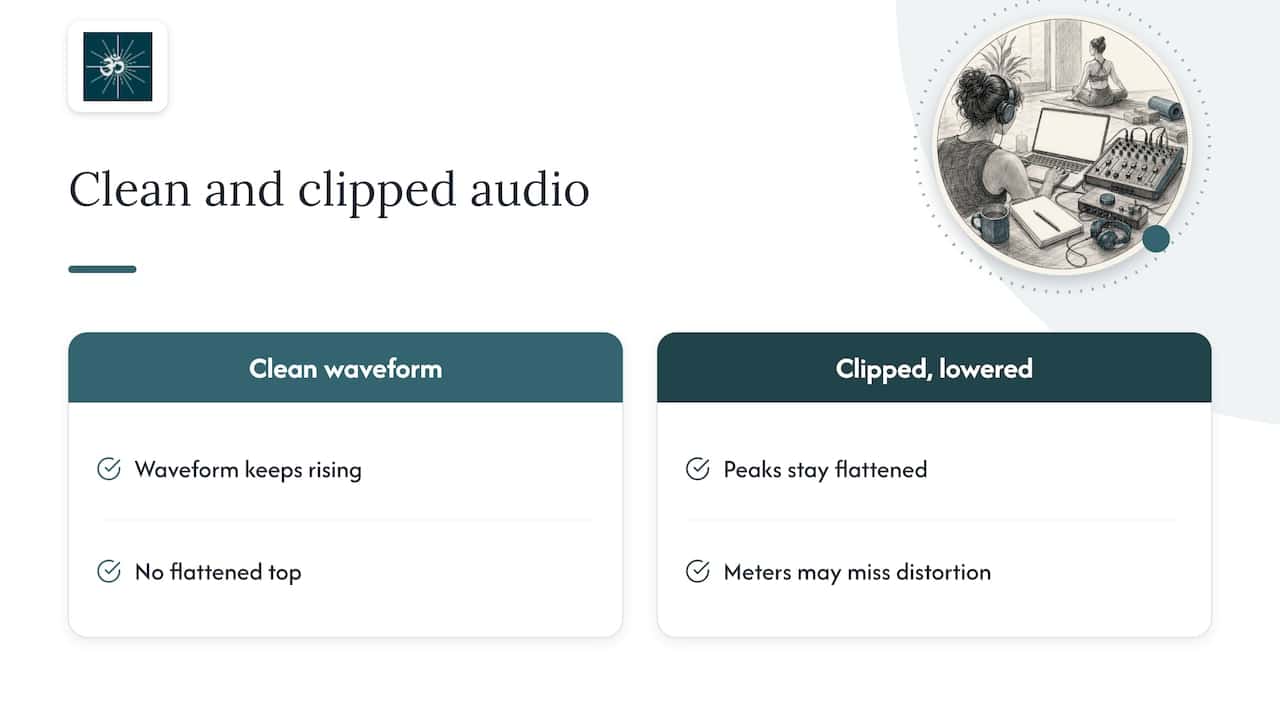
Every digital audio system has a ceiling. Think of a glass being filled with water: once it is full, anything extra simply spills. In audio, the waveform that should have kept rising gets flattened off at the top, and that flat top is a distortion.
The European Broadcasting Union’s technical review explains that digital clipping can create aliasing, which it describes as a perceptually unpleasant artefact. It also points out that clipping followed by turning the level down can slip past sample meters unnoticed, so a file can look fine and still be damaged. The same paper’s author notes that excessive digital levels may not show on studio meters and can cause unpredictable distortion further down the chain.
Why does this matter more for yoga than for, say, a gym playlist? Because of what yoga music is made of. Loud, busy dance tracks hide a lot of sins. Slow, spacious music hides nothing. A long violin note, a bowl ringing out for twenty seconds or a soft pad under a breathing exercise leaves nowhere for distortion to hide, and your students are lying still with their eyes closed, listening very, very closely.
What it sounds like
You will usually notice one of these:
-
A gritty or buzzy edge on loud notes, as if the speaker had a cold.
-
Sharp, tiny clicks or pops, particularly at the start or end of a trimmed clip.
-
A swelling passage that suddenly turns harsh, rather than just louder.
-
Cymbals, bells or high strings that sound “fizzy” instead of shimmering.
If you hear any of these on a recording at a normal volume, the damage is in the file itself and no speaker upgrade will undo it. If you only hear them when you turn the volume up, the culprit may be the playback device, which brings us to the next point.
Where clipping sneaks into a yoga class
In my experience (and I have made most of these mistakes myself, usually at the worst possible moment), clipping arrives from five places.
-
Over-loud exports. Someone normalises a track to the maximum, then converts it to MP3 or AAC, and the conversion pushes a few peaks over the edge.
-
Stacking tracks. Layering a voice-over, a drone and a music bed adds their levels together. Three comfortable tracks can make one overloaded mix.
-
Boosting a quiet clip. You trimmed a section from a track and it sounds quiet, so you raise it. The loudest moment now hits the ceiling.
-
Cheap or overloaded playback. A small Bluetooth speaker pushed to full volume clips in its own amplifier, whatever your file was like. Yamaha’s audio training material notes that every terminal in a signal chain has its own clip level and noise floor, which is why constant monitoring of levels is needed to keep dynamic range intact.
-
Heavily compressed source music. Some streaming-era meditation tracks are mastered to be as loud as possible, with almost no gap between the quietest and loudest moments. There is nothing left to turn down gracefully.
The fifth one is the quiet villain. A track that has been squeezed to sound “big” on a phone is exactly the track that sounds tiring on a studio sound system after twenty minutes.
How to avoid clipping when you prepare a class track
This is the practical part. You do not need a recording studio, just a free audio editor and a bit of discipline.
Set your levels before you edit
Work with peaks that stay clearly below the maximum, so the loudest moment has room to breathe. A sensible habit is to aim for peaks a few decibels short of the top rather than touching it. After any change in volume, play the loudest section again and watch the meter.
Avoid raising the volume of a finished file by a large amount. If a clip is too quiet, the better route is to go back to the original, adjust once, and export once. Every extra round of boosting and re-saving is another chance to flatten something.
Balance volume across the whole track
This one matters for anyone who plays audio through earbuds or a phone speaker, where listeners cannot easily adjust between quiet and loud passages. The editing guide from AudioEdit makes the point that volume should be balanced throughout a meditation recording, precisely because of those devices. A track that whispers for ten minutes and then roars will either be missed at the start or clipped at the end.
Test on more than one device
Export the file, then listen to it on a phone, a laptop and a pair of earbuds. The same guide recommends exactly that check for clipping or distortion. It takes five minutes and it is the cheapest quality control there is. If it crackles on one device only, lower the master level a little and test again.
Keep your voice and music apart
If you talk over the music, lower the music bed rather than raising your voice track to “cut through”. A guided practice with a loud voice on top of loud music is the quickest way to push the combined signal over the line. Music that sits under a voice should be simple: sustained pads, slow strings, nothing that fights for the same space.
How to cut a clean audio clip for a class
Now the other meaning of the keyword. Perhaps you simply want a short clip: a two-minute centring piece, a bell to open the class or a loop to sit under a breathing exercise. A few habits keep that clean.
-
Cut at a quiet point. Look for the gap between phrases or the moment a note has decayed, not the middle of a held chord.
-
Cut where the waveform crosses the centre line. Most editors have a “zero-crossing” option. It stops the tiny click that comes from slicing a wave mid-swing.
-
Add a fade of a second or two at the start and end. Longer for a Savasana track.
-
Crossfade rather than stop and start. One teacher’s tip I like is to fade between songs with crossfade or volume control rather than stopping one and starting another, which keeps the room calm.
-
Export once from the original. Not from a copy of a copy.
If your clip needs to run for a full practice, you may want it to repeat without a bump. We wrote a separate piece on that: loopable meditation music and how to loop it well covers choosing material that repeats without an audible seam.
Match the music to the practice
Clean audio is half the job. The other half is picking music that suits what your students are doing. The International Yoga Conference suggests calm music at around 60 to 80 BPM for slow practice and meditation, with faster, more rhythmic music for dynamic flow, tapering down again before final relaxation. It also advises minimal or non-distracting vocals and a consistent texture: drones, pads, soft percussion or nature sounds.
Here is how that looks in practice.
| Practice | What works | What to avoid |
|---|---|---|
| Yin and restorative | Long ambient pieces with no beat | Obvious rhythms or sudden changes |
| Hatha and gentle flow | Slow, steady instrumental music | Lyrics that pull attention away |
| Vinyasa and power | More rhythm, a clear pulse | Anything harsh at high volume (clipping is easiest to hear here) |
| Meditation and Savasana | Near-ambient sound, or silence | Bright, busy melodies |
The same source also describes a 60-minute class arc: sparse, slow music for centring in the first ten minutes, the most rhythmic tracks around minutes 20 to 40, and near-ambient sound or silence for the last ten. Its general advice is to make a playlist a few minutes longer than the class, so you never run out of music before the class ends.
If you want a deeper look at how mindful movement and training fit together, this piece on bringing mindfulness into a fitness routine is a sensible companion read when you plan the pace of a session.
A small, honest caveat about all those numbers: they come from teaching blogs, not clinical trials, so treat them as a starting point and trust your own ears and your students’ faces.
A note on binaural beats and calming sound
Common meditation music includes nature sounds, ambient music, binaural beats, and chanting or mantras, according to Emotiv’s overview of meditation music. Emotiv also says slow-tempo music can entrain heart rate and encourage a calmer, parasympathetic state, and describes binaural beats as a possible way to influence brainwave activity. Binaural tracks have one practical requirement relevant to this article: they depend on clean left and right channels, so distortion on either side defeats the purpose. If you are curious about the wider field of calming sound, research on vibroacoustic therapy gives a sense of how seriously the relationship between sound and the body is being studied.
Teaching in Germany: the GEMA question
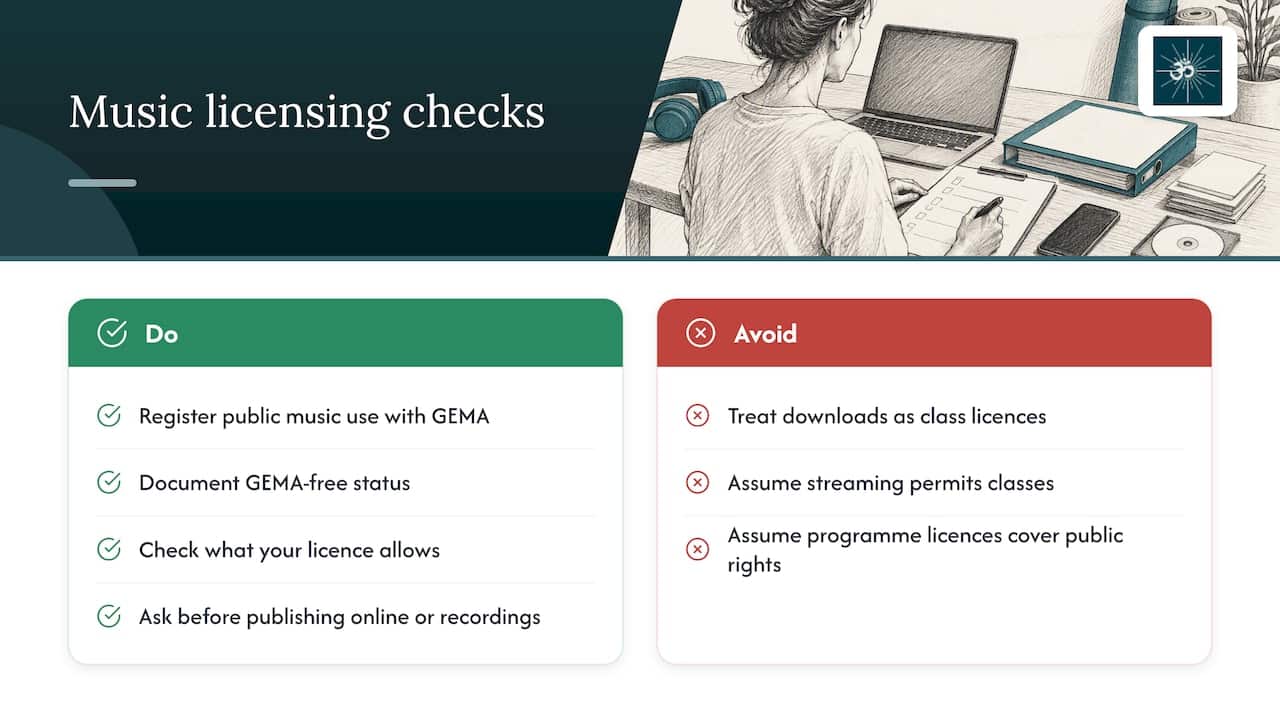
This is the part nobody puts in the mood-board. In Germany, music played in a yoga or fitness studio is generally public use, and that is regulated. GEMA states that fitness studios must register public music use with it, and that even music described as GEMA-free must be registered, with its status documented. Its guidance also notes that a programme licence such as for Zumba or Les Mills does not cover public-performance rights.
The lesson: “I downloaded it” and “it was on a streaming service” are not licences for a class. Before you play any track to paying students, check what your licence actually allows. For your own situation, the right people to ask are GEMA directly or a lawyer who knows music licensing. And if you teach online, or record classes for sale, the rules for those uses are different again, so ask before you publish.
Our royalty-free library comes with personal and professional licensing options, designed for use in meditation, therapy, yoga, apps, guided audio and massage. Check the licence terms on the product page for your exact use, and for German public performance in particular, confirm your registration obligations with GEMA.
Perspective: why we record it live, and leave the room to breathe
We get asked why we bother with live musicians when software can make a perfectly decent pad in an afternoon. The short answer is that your body knows the difference.
Robert Emery, who composes and conducts our music, puts it better than I do: he believes in the power of people making music with acoustic instruments, because digital instruments do not resonate with the body in quite the same way. He studied at the Royal College of Music, and he is Music Director of the National Philharmonic Orchestra of Great Britain, the orchestra we record with at Abbey Road Studios. Moritz Schneider, the other half of our composing and producing duo, has worked alongside him for around thirteen years. They have also been friends the whole time, which I suspect is why the music feels so unhurried. Two people who trust each other do not need to shout.
What does this have to do with clipping? Quite a lot. A live string section, recorded well and mastered gently, keeps its natural dynamic range. The quiet bits stay quiet, the swells stay lovely, and there is room at the top for your teaching voice, your speakers and the odd enthusiastic Bluetooth connection. Music made to be as loud as possible leaves you no room at all.
That is why we design our tracks, including our binaural, theta and Solfeggio-based pieces and our 3D surround recordings, for immersive listening rather than for shouting over a noisy playlist. We believe a calm class deserves music that was never pushed to the edge in the first place.
ROBERT
Choosing clean yoga music: a short checklist
Whether you buy from us or elsewhere, run any track through these questions before it goes near a class.
-
Does it have room to breathe? Quiet and loud passages should be clearly different.
-
Is the format high quality? A high-quality download is a better starting point than a stream converted several times.
-
Is it clean on all your devices? Test on a phone, laptop and earbuds.
-
Does it suit the class? Tempo and texture matched to the practice, with no jarring vocals.
-
Are you licensed to play it? For classes, especially in Germany, this is not optional.
-
Does it repeat well? If you need a long session, choose music that loops without a seam.
Where our library fits
If you teach, run a studio, build an app or simply want something lovely for your own practice, our library is built for exactly this. Every piece is recorded with live musicians, including sessions at Abbey Road Studios with the National Philharmonic, and many are made with binaural, theta or Solfeggio frequencies in mind.
For personal listening, the personal subscription costs €21 per month. For teachers, studios and creators who need commercial rights, the professional subscription costs €150 per month. You can also browse our royalty-free meditation music for professional use, or start at Orchestral Meditations and listen to samples first.
FAQ
What does audio clipping sound like in meditation music?
Usually a gritty, buzzy or fizzy edge on louder notes, sometimes with small clicks or pops. It is most noticeable on sustained sounds such as strings, singing bowls and soft pads. If you hear it at a moderate volume on several speakers, the file itself is probably distorted.
Can I fix a clipped track?
Only partly. Some editors have a declipping tool that can soften the damage, but it is guesswork rather than restoration, because the original peaks are gone. The reliable fix is to go back to the original file, lower the level before exporting and use a clean source.
How do I cut a short clip of yoga music without clicks?
Cut at a quiet point between phrases, snap the edit to a zero-crossing if your editor offers it, and add a fade of a second or two at each end. Export once from the original file, then play it on a phone, laptop and earbuds before class.
Do I need a licence to play music in my yoga class in Germany?
In most cases, yes. GEMA says public music use in fitness studios and courses must be registered, and even music marketed as GEMA-free must be registered and documented. Check with GEMA or a music-licensing lawyer for your exact setup.