
Most people who struggle to sleep are not short on willpower. They are short on a system. A proper sleep meditation checklist gives you exactly that: a repeatable sequence of habits, environment cues, and meditation techniques that your nervous system learns to recognise as the runway to sleep. Not a vague instruction to “just relax” (which, if you have ever lain awake at 2am, you will know is about as useful as telling someone to “just be confident”). This article walks you through everything that belongs on that checklist, from wind-down rituals to progressive muscle relaxation to choosing the right guided sleep meditation format for your lifestyle.
Key takeaways
| Point | Details |
|---|---|
| Wind-down before you meditate | Begin calming activities at least 60 minutes before bed so your nervous system is primed before any meditation starts. |
| Match format to available time | Short breath meditations suit busy nights; yoga nidra requires 30-plus minutes, so plan accordingly. |
| Consistency beats perfection | Eight weeks of daily practice yields lasting sleep benefits, so a simple routine done nightly outperforms an elaborate one done occasionally. |
| PMR pairs well with journaling | Writing worries down before tensing and releasing muscle groups tackles both mental and physical tension simultaneously. |
| Use an if-then exit plan | If you are not asleep within 30 minutes, leave the bed for a quiet activity so your brain stops associating the mattress with wakefulness. |
1. Your sleep meditation checklist: start with a wind-down routine
Before a single meditation technique enters the picture, your environment and behaviour need to set the scene. Think of it like a theatre production. The audience does not walk in mid-performance. There is a whole foyer experience, a programme, some gentle music, and then the lights dim. Your nervous system works the same way.
Starting your wind-down about 60 minutes before bed signals the body to prepare for sleep. That window should include dimming lights in the room, putting the phone face-down (or, ideally, in another room entirely), and switching to calming activities like light reading, a warm bath, or gentle stretching.
The checklist items for this stage look like this:
- Dim the lights by 9pm (or 60 minutes before your intended bedtime)
- Screens off or on night mode at least an hour before bed. Blue light disrupts melatonin, making the whole enterprise harder
- Choose one calming activity: reading fiction, journaling, or gentle stretching
- Set the room temperature between 16 and 18 degrees Celsius
- Lay out anything you need for tomorrow to reduce mental clutter
Pro Tip: Do not start your meditation the moment your head hits the pillow. The wind-down period IS the first act of your meditation routine for sleep. Skipping it and going straight to a body scan while your nervous system is still buzzing from a Netflix thriller is like trying to land a plane without a runway.
2. Only get into bed when you are actually sleepy
This one sounds painfully obvious. It is also the rule most people cheerfully ignore every single night. Going to bed at 10pm because “that is when I should sleep” when you are not remotely tired is a fast route to lying there, staring at the ceiling, and contemplating existential dread.
Getting into bed only when sleepy and leaving if you are not asleep within 30 minutes are two of the most evidence-backed behavioural rules in sleep medicine. The logic is simple: your bed should be a strong mental cue for sleep, not for wakefulness. Every time you lie awake in it for extended periods, you are quietly training your brain to associate that space with frustration and arousal rather than rest.
Add this to your checklist as a firm behavioural rule, not a suggestion. The if-then exit plan works like this: if you are not asleep after 30 minutes, get up, go to a dim room, do something quiet and unstimulating, and return only when you feel genuinely drowsy. It feels counterintuitive at first. It works.
3. Journal before you meditate, not after
Here is something most meditation guides skip: the act of journaling before meditation is not a nice-to-have. It is, for many people, what makes the meditation actually work.
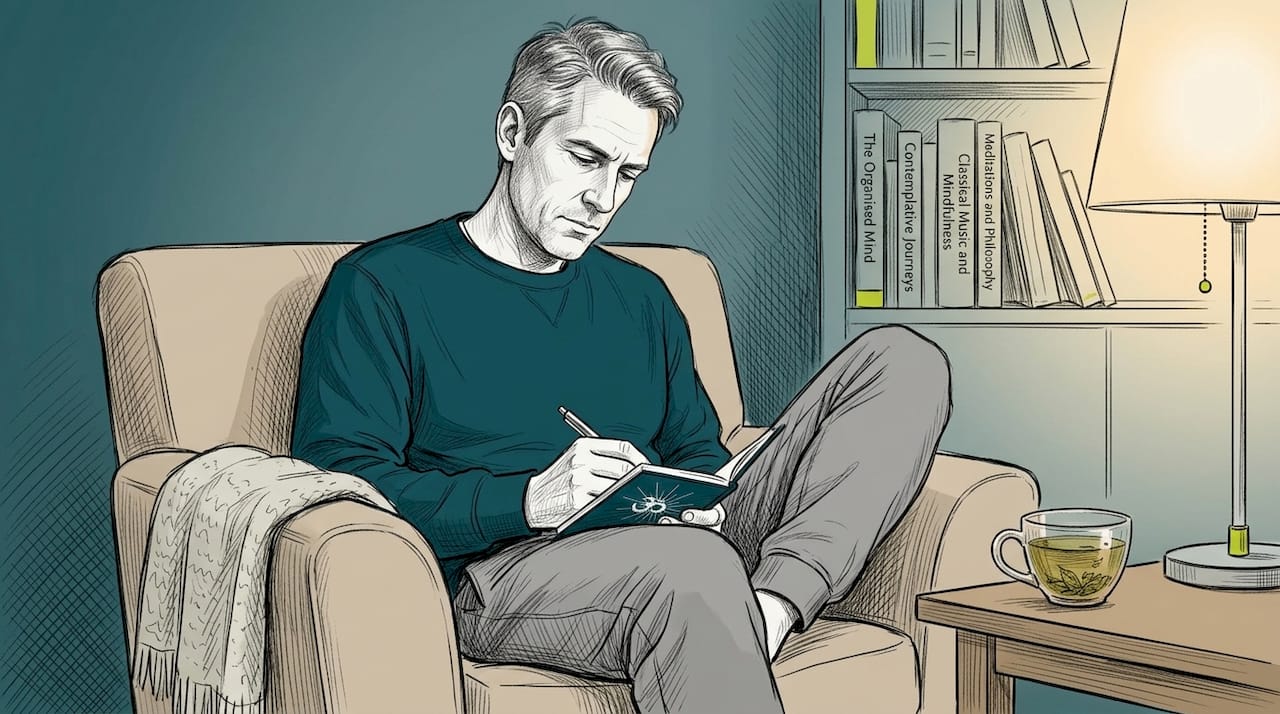
Racing thoughts at bedtime are rarely random. They are usually unfinished business: the email you forgot to send, the awkward conversation you replayed seventeen times, the grocery list your brain has decided is extremely urgent at 11pm. Dumping all of that onto paper before you close your eyes is essentially offloading your mental RAM before the system tries to reboot.
The journaling does not need to be deep or literary. Five minutes of brain-dump writing, a short gratitude list, or a simple “three things I want to remember tomorrow” is enough. Once the thoughts are on paper, they have somewhere to live that is not inside your skull. THEN you start your nightly meditation practices.
4. Progressive muscle relaxation step by step
Progressive muscle relaxation, known as PMR, is one of the most underrated techniques you can put on a sleep meditation checklist. It is physical, it is methodical, and it works even on nights when your mind is too restless for anything more abstract.
Here is how to do it, following NHS Inform guidance:
- Lie down comfortably and close your eyes
- Take three slow, deep breaths to settle in
- Start at your feet. Tense the muscles firmly for about five seconds
- Breathe out and release the tension slowly, noticing how the relaxation feels
- Move to your calves. Tense, hold, release
- Continue up the body: thighs, abdomen, hands, forearms, shoulders, and face
- If any area is painful, skip it entirely
- After completing the full sequence, lie still for a minute and notice the contrast
The genius of PMR is that it teaches you to notice tension early, before it escalates into the full stress spiral that locks you out of sleep. Most of us carry significant muscle tension without ever realising it. PMR makes it visible, and then gives you an immediate way to dissolve it.
Pro Tip: Do your five minutes of journaling before starting PMR. The sequence of writing worries down and then physically releasing tension in the body is a two-step combination that tackles sleep disruption from both directions at once. Think of it as the mental and physical version of wringing out a wet towel.
5. Choose your guided sleep meditation format wisely
Not all guided sleep meditation formats are created equal, and picking the wrong one for a given night is like turning up to a five-course dinner when you have ten minutes for lunch. The format needs to match your available time and current state of mind.
Here are the main options to include on your checklist, with honest notes on each:
- Breath awareness (5 to 10 minutes). You focus attention on the natural rhythm of your breathing, redirecting gently when the mind wanders. Ideal for beginners and nights when time is short. Low effort, highly repeatable.
- Body scan (15 to 20 minutes). A slow, deliberate journey of attention through each part of the body. Bridges the gap between PMR and deeper meditation nicely.
- Loving-kindness relaxation (10 to 15 minutes). Directing warm, gentle thoughts toward yourself and others. Surprisingly effective on nights when anxiety or self-criticism is the main culprit.
- Yoga nidra (30 minutes or more). This is the deep-rest heavyweight. Yoga nidra is done lying down, with awareness remaining active while the body enters a state of profound rest, accessing brainwave patterns similar to the edge of sleep. It is not a quick fix; it is a practice. Do not attempt it on nights when you have fifteen minutes and a 6am alarm.
For beginners especially, managing the mindset around a guided meditation is half the work. Racing thoughts during a body scan do not mean you are failing. They mean you are a human being with a brain that is doing its job. The practice is simply noticing the thought and returning, without drama, to the anchor.
“The goal of meditation is not to stop thoughts. It is to stop letting thoughts stop you.” This reframe alone changes everything about how to meditate for sleep, particularly for people who have tried once, found their mind wandering, and declared themselves meditation failures.
Pairing any of these formats with orchestral meditation music by composers Robert Emery and Moritz Schneider adds a dimension that plain silence or generic app sounds simply cannot replicate. Emery and Schneider have crafted recordings specifically designed to ease the mind into meditative states, and their work forms a significant part of what Orchestralmeditations offers. You can explore sleep-focused meditation tracks that work as a natural accompaniment to any of the above formats.
6. Comparison of key sleep meditation techniques
Choosing between techniques is easier when you can see them side by side. Here is a comparison of the four main options for your checklist:
| Technique | Time needed | Physical element | Mental effort | Best for |
|---|---|---|---|---|
| PMR | 10 to 15 mins | High | Low | Muscle tension, physical restlessness |
| Breath awareness | 5 to 10 mins | None | Low to medium | Beginners, busy nights |
| Body scan | 15 to 20 mins | Low | Medium | General anxiety, racing mind |
| Yoga nidra | 30 or more mins | None (lying still) | Medium | Deep rest, chronic fatigue |
A few additional points worth noting:
- PMR and breath awareness are the most accessible entry points if you are new to sleep relaxation techniques
- Yoga nidra demands a genuine time commitment but offers the most profound rest experience when done correctly
- Consistency matters more than technique selection. Eight weeks of daily practice produces lasting benefits, regardless of which format you favour
- Combining journaling with any body-focused technique consistently outperforms either approach used alone
The Cleveland Clinic notes that meditation and relaxation strategies are among the most effective tools for calming a racing mind before sleep. The research is not saying one technique wins. It is saying that doing something consistently, with genuine intention, is what moves the needle.
7. How to personalise and apply your checklist nightly
Here is where your sleep meditation checklist stops being a list of good ideas and becomes a working system. The goal is to make it so automatic that your nervous system starts winding down the moment you begin the sequence, like Pavlov’s dog but for sleep and with considerably less drooling.
A personalised nightly checklist might look like this:
- 9:00pm: Dim lights, phone away, tomorrow’s tasks written down
- 9:10pm: Five minutes of journaling or brain-dump writing
- 9:20pm: PMR or guided meditation (choose format based on energy level and available time)
- 9:35pm: Into bed only when genuinely drowsy
- If not asleep in 30 minutes: get up, sit quietly with dim light, return when sleepy
Monitoring your response honestly over two to three weeks will tell you a great deal. Do you fall asleep faster after PMR or after a body scan? Does the yoga nidra format leave you feeling refreshed or groggy? Does pairing meditation music with your practice deepen relaxation noticeably?
Pro Tip: Treat the first four weeks as an experiment rather than a test you can pass or fail. The goal is data, not perfection. Adjust based on what you actually notice, not what you think you should be experiencing. Lasting improvements from a meditation routine for sleep typically consolidate after eight weeks of consistent practice, so give it time.
Adjusting the checklist as your life changes is not failure. It is the point. A checklist that serves you in summer when you wake at 6am may need tweaking in winter when your schedule shifts. Think of it as a living document rather than a rigid prescription.
My honest take on building a sleep meditation checklist
I want to share something that took me longer to learn than it should have. For years I approached sleep meditation like a shopping trip: find the best technique, execute it perfectly, get the result. What I actually got was frustration and a growing suspicion that meditation was for people who were already calm.
The thing that changed my sleep more than any single technique was sorting out the wind-down environment first. Once I consistently dimmed the lights an hour before bed and stopped working from the sofa after 8pm, my meditation sessions started working almost immediately. The meditation had not changed. My nervous system had finally arrived at the starting line prepared.
I also spent far too long dismissing PMR as too slow and too physical. Now I consider it the single most reliable technique on a difficult night, partly because it gives an anxious mind something concrete to do rather than just “relax.” Pairing it with five minutes of journaling beforehand, as I mentioned above, is the combination I come back to most reliably.
The music matters more than people expect. Working with recordings composed and produced by Robert Emery and Moritz Schneider, both of whom bring serious musical craft to the meditation space, shifts the quality of a session in a way that generic ambient sound does not. Emery, a composer and producer whose work spans film, television, and wellness, and Schneider, whose expertise in orchestral production informed the Abbey Road sessions, bring an attention to sonic detail that you genuinely feel rather than just hear.
My honest advice: start embarrassingly simple. One technique, done nightly, for four weeks. Resist the urge to overhaul everything at once. And be patient with yourself in a way you probably are not right now.
— ROBERT
Explore orchestral music for your nightly meditation routine
If you have built your checklist and are ready to add a layer of genuine sonic depth to your practice, Orchestralmeditations is worth exploring seriously. The platform offers orchestral meditation music composed and produced by Robert Emery and Moritz Schneider, recorded with live musicians at Abbey Road Studios. This is not background noise generated by a laptop. It is music crafted specifically to support meditative states, using binaural beats, theta frequencies, and 3D surround sound that you feel as much as hear.
For sleep-focused sessions, the English meditation music collection is a strong starting point. The recordings are designed to accompany breath awareness, body scans, or simply the wind-down portion of your checklist. If you want to explore how orchestral sound compares to the generic digital tracks most apps offer, the personal meditation music selections composed by Emery and Schneider give you a clear answer within the first listen.
You can also deepen your technique knowledge with Orchestralmeditations’ step-by-step guided meditation resources, which complement everything covered in this article.
FAQ
What should a sleep meditation checklist include?
A solid sleep meditation checklist includes a 60-minute wind-down period with dim lighting and no screens, a brief journaling session, a chosen meditation technique such as PMR or breath awareness, and a behavioural rule to leave the bed if sleep has not come within 30 minutes.
How long does it take for sleep meditation to work?
Eight weeks of consistent daily practice is the benchmark most research points to for lasting sleep improvement, though many people notice reduced tension and shorter sleep onset within the first two weeks.
Is progressive muscle relaxation good for sleep?
Yes. PMR reduces physical muscle tension and helps you notice early signs of stress before they escalate into sleeplessness. Pairing it with journaling makes it even more effective for quieting an overactive mind.
What is the difference between yoga nidra and a standard body scan?
A body scan typically takes 15 to 20 minutes and involves directing attention progressively through the body. Yoga nidra lasts at least 30 minutes and aims to hold awareness at the threshold between wakefulness and sleep, accessing deeply restorative brainwave states.
Can meditation music improve my sleep meditation checklist?
Music composed with theta frequencies and binaural beats, such as the orchestral recordings produced by Robert Emery and Moritz Schneider for Orchestralmeditations, can deepen relaxation during meditation by guiding brainwave activity toward restful states, making it a worthwhile addition to any nightly practice.