
Most people who sit down to meditate genuinely want to go deeper, but end up wondering if they’re doing it wrong. The thoughts keep coming, the silence feels uncomfortable, and the profound stillness everyone talks about seems permanently out of reach. If that sounds familiar, you’re not failing at meditation. You’re just missing a few enhancements that make an enormous difference. This guide covers how to enhance spiritual meditation through breathwork, mantra, mindful environment, and the surprisingly powerful influence of music, including orchestral compositions crafted by celebrated composers Robert Emery and Moritz Schneider, whose work is specifically designed to open the door to deeper meditative states.
Key takeaways
| Point | Details |
|---|---|
| Set up your space intentionally | A consistent, comfortable environment reduces resistance and signals the mind that stillness is coming. |
| Use breath as your foundation | Even one minute of focused breathing calms the nervous system and sharpens your attention before you begin. |
| Pair mantra with your breath | Synchronising a mantra like “So-Hum” to your inhale and exhale creates a natural rhythm that anchors focus. |
| Choose orchestral music thoughtfully | Instrumental soundscapes without lyrics support spiritual openness far more than synthetic or lyric-heavy tracks. |
| Prioritise consistency over perfection | A short daily practice will take you further than occasional marathon sessions. |
How to enhance spiritual meditation: starting with setup
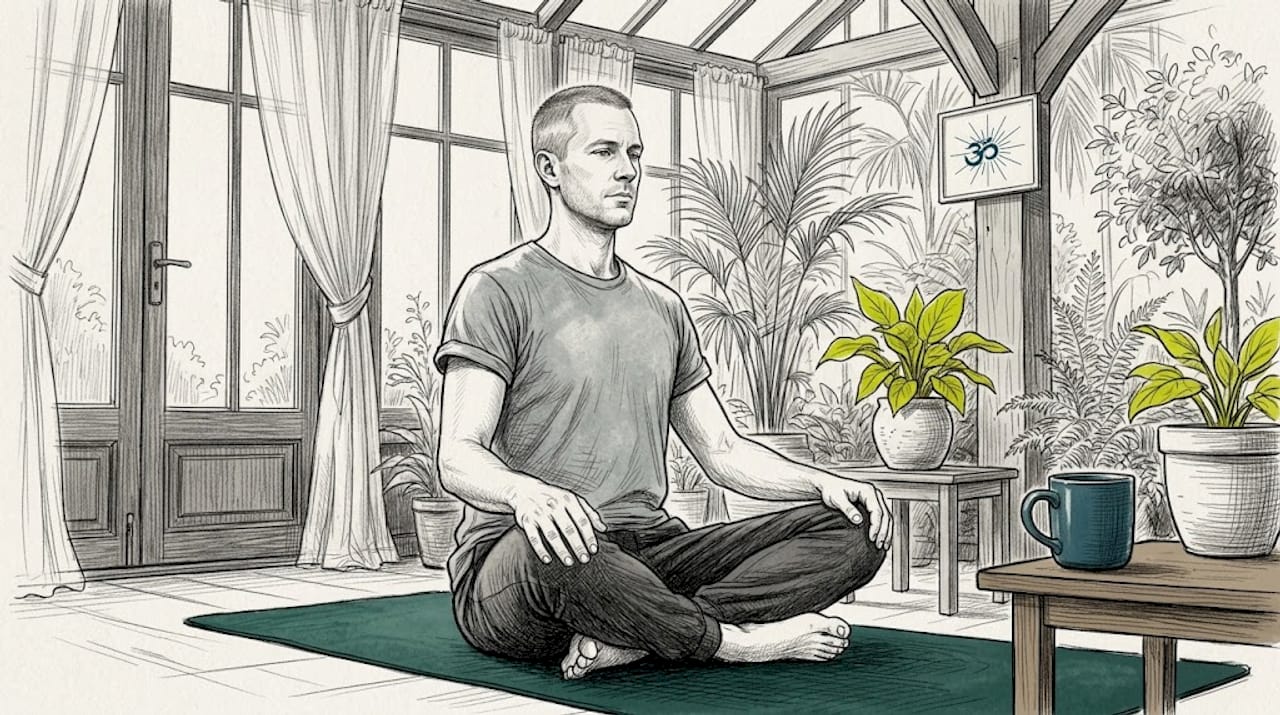
Before you try any fancy technique, the single most underrated thing you can do is sort out your environment. Most people just sit wherever they happen to be and hope for the best. (I’ve meditated on a pile of laundry before. It was not transcendent.) The physical space you choose sends a direct message to your nervous system, and that message either says “you’re safe to let go” or “you’re in the same spot where you scroll Twitter at midnight.”
Choosing your surroundings carefully and matching your meditation form to what actually sustains regular practice matters enormously, according to Cleveland Clinic. That guidance is less obvious than it sounds. It means you don’t have to meditate cross-legged on the floor if that position makes your knees scream. Comfort serves the practice, not the other way around.
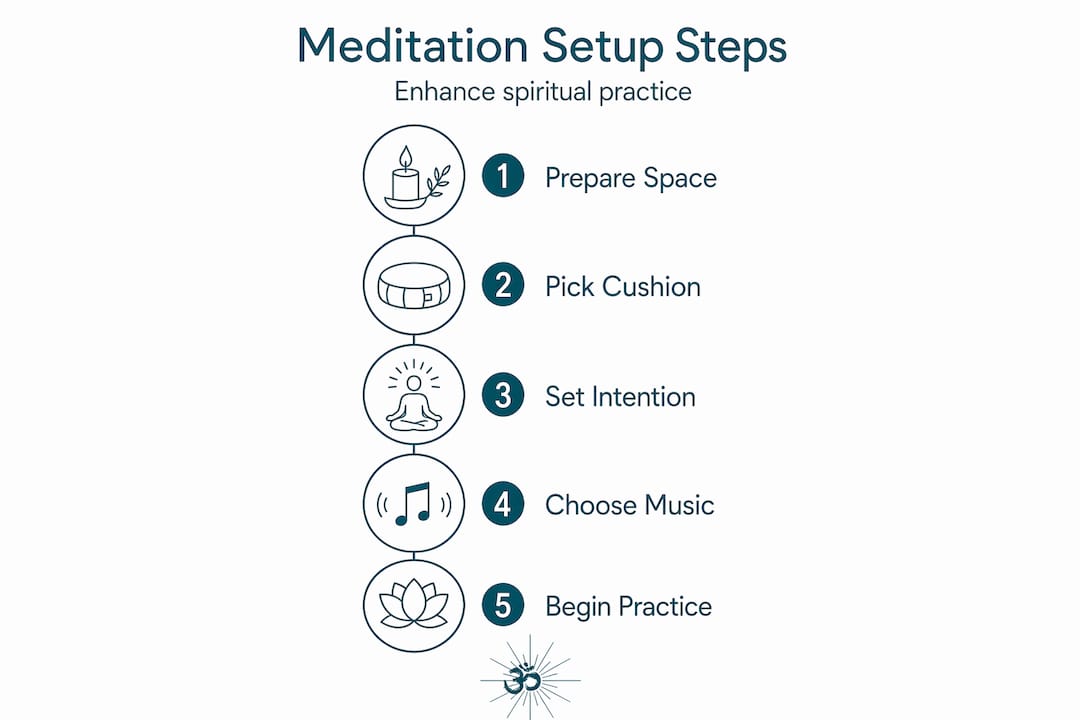
Here’s a practical overview of tools worth having before you begin:
| Tool | Purpose | Notes |
|---|---|---|
| Meditation cushion or chair | Supports posture without causing distraction | Choose what genuinely feels comfortable |
| Quality headphones | Delivers music and soundscapes with full effect | Crucial for binaural and 3D audio |
| Timer | Removes clock-watching | Even a phone on silent works |
| Meditation music | Provides aural environment for focus | Orchestral compositions work particularly well |
| Scent (optional) | Incense or diffuser signals ritual | Keep it subtle, not overpowering |
Beyond the physical kit, the mindset you bring in matters just as much. Setting a simple intention before you sit, something as brief as “I am here to be present,” shifts your inner orientation from passive to deliberate. Consistent meditation with devotion nourishes spiritual growth in ways that halfhearted sessions simply cannot, as the Science of Spirituality notes.
This is also where the aural environment becomes genuinely exciting. Composers Robert Emery and Moritz Schneider have dedicated their work to creating orchestral meditation music that functions almost like a container for your practice. Emery, a conductor and composer with a career spanning concert halls and recording studios, and Schneider, whose background straddles classical composition and sound healing, both understand that what you hear shapes what you can feel internally. More on that shortly.
Pro Tip: Light a candle or use the same cushion every time you sit. Rituals like these trigger what psychologists call contextual cueing, which means your brain starts to associate that specific environment with relaxation. Over time, the act of sitting down in that spot alone begins to slow your mind.
Breathwork techniques that deepen your practice
If meditation is the house, breath is the foundation. You could have the most exquisite cushion, perfect lighting, and a stunning playlist, but if you sit down with a shallow, anxious breath, you will meditate with a shallow, anxious mind. The two are that connected.
The good news is that focused breathing for even one minute can reduce stress and improve mental clarity, according to Mayo Clinic. One minute. That’s not a huge ask. Here’s a simple sequence to begin with:
- Sit comfortably with your spine gently upright, neither rigidly stiff nor slumped over like you’ve given up on the day.
- Close your eyes and bring your attention to the natural rhythm of your breath. Don’t try to change it yet.
- Begin deep belly breathing: inhale through your nose for a count of four, feeling your abdomen rise rather than your chest.
- Hold gently for one or two counts (not so long that you feel any strain).
- Exhale slowly for a count of four, gently contracting your abdomen as the breath leaves.
- Repeat this for three to five minutes before transitioning into your meditation proper.
A note on safety: if you feel lightheaded or dizzy at any point, stop the timed breath cycle and return to normal breathing. This is common with beginners and nothing to worry about, but it’s a signal to ease off the counts and let the breath find its own pace.
“Breath is the bridge which connects life to consciousness, which unites your body to your thoughts.” — Thich Nhat Hanh
The reason breath works so well as an anchor is that it gives the wandering mind something concrete to return to. Breath as an anchor reduces distraction and creates a repeatable structure, particularly helpful in the early stages of improving your meditation practice. Every time your attention drifts, you simply notice it and return to the breath. No self-criticism required. That noticing and returning is not a failure. It is the actual practice.
Pro Tip: Try three to five minutes of belly breathing before you even close your eyes to meditate. Think of it as pre-heating the oven. The session that follows will start from a calmer baseline, and you’ll spend less of your actual meditation time just trying to calm down.
Mantra and mindfulness for spiritual enrichment
If breathwork is the foundation, mantra meditation is the architecture built on top of it. And it’s considerably more approachable than people expect. You don’t need a guru, a Sanskrit dictionary, or a white linen wardrobe. You need a word or phrase, your breath, and some patience.
The classic starting point is the mantra “So-Hum,” a Sanskrit phrase often translated as “I am that.” You silently repeat “So” on the inhale and “Hum” on the exhale, allowing the mantra to ride the natural rhythm of your breath. What this does is remarkable. Synchronising a mantra to breath rhythm prevents over-monitoring the mind and helps maintain focus naturally, acting almost like a metronome for your attention. Rather than trying to force thoughts away (which, if you’ve ever tried it, is about as effective as telling yourself not to think about pink elephants), the mantra simply gives attention somewhere better to land.
Here’s how to approach mantra meditation practically:
- Set a timer for around 20 minutes so you’re not sneaking glances at the clock.
- Find a comfortable, upright position in your prepared space.
- Take five deep breaths to settle, then begin silently repeating your mantra in sync with your breath.
- When your mind drifts, and it will, notice it without frustration and return to the mantra.
- At the end of your session, sit quietly for two minutes before opening your eyes.
The key reframe here is this: mantra meditation isn’t about eliminating thoughts but about widening your awareness to observe them without getting swept away. You’re not trying to empty your mind. You’re practising not being hijacked by it. That distinction alone can save you months of unnecessary frustration.
Mindfulness meditation works alongside mantra beautifully. Where mantra gives attention a focal object, mindfulness asks you to stay open and present without judgment. You notice sounds, sensations, and thoughts as they arise, acknowledging them and releasing them. When used together, these spiritual meditation techniques create a depth of awareness that either approach alone can’t quite reach.
One thing worth saying plainly: progress is not always linear. Some sessions feel luminous. Others feel like you spent 20 minutes arguing with your own to-do list. Both are normal. Accepting mind drifting as training progress actually reduces frustration and enhances spiritual mindfulness over time. The practice is still working even when it doesn’t feel like it.
Using music and soundscapes to deepen meditation
Here’s something most meditation guides won’t tell you: the music you choose might matter as much as the technique you use. Not because it’s a magic solution, but because the auditory environment your brain sits in fundamentally shapes what it can do during meditation.
There is a meaningful difference between synthetic digital music and fully orchestrated live recordings. Orchestral instruments engage deeper emotional and spiritual resonance than their digital counterparts, as Robert Emery and Moritz Schneider have specifically explored in their compositional work. Live strings, woodwinds, and brass carry overtones and micro-variations that digital instruments simply don’t replicate. Your nervous system responds to these nuances even when your conscious mind isn’t tracking them.
| Music type | Spiritual meditation suitability | Why it matters |
|---|---|---|
| Orchestral live recordings | Excellent | Rich overtones support emotional and spiritual depth |
| Binaural beats (orchestral) | Excellent | Theta frequencies support deep meditative states |
| Synthesised ambient | Moderate | Functional but lacks organic resonance |
| Lyric-based songs | Poor | Language processing competes with inner silence |
| Pop or rhythmic music | Poor | Activates rather than calms the nervous system |
The practical guidance here is to choose music without lyrics and without strong emotional associations. A song from your wedding or a track that reminds you of heartbreak is going to pull your attention outward, which is the opposite of what you’re trying to do. Music frequencies that support spiritual growth work by creating an internal resonance, not by demanding your attention.
Robert Emery, whose work spans decades of orchestral composition and conducting, brings a composer’s precision to the emotional architecture of each piece. Moritz Schneider contributes a deep understanding of how specific frequencies interact with the brain’s meditative states. Together, their recordings manage to feel both spacious and deeply intentional, which is a genuinely difficult balance to strike.
Pro Tip: Use headphones rather than speakers whenever possible for meditation music. The immersive effect of 3D or binaural audio is significantly reduced through room speakers, and the spatial depth that makes orchestral meditation music so effective gets flattened. Think of it as the difference between watching a film in the cinema versus on a laptop with the sound turned down.
For those who want to explore holistic wellness practices alongside music-supported meditation, combining complementary modalities can amplify the benefits of each.
Common challenges and how to work through them
Let’s be honest: if enhancing spiritual meditation were effortless, everyone would be walking around looking profoundly enlightened. The reality is that most people hit at least one of the following obstacles, usually within the first few weeks.
-
Mind-wandering feels relentless. This is universal. The mind is not malfunctioning when it wanders. It is doing exactly what untrained minds do. Each return to the breath or mantra is a genuine repetition, like a curl at the gym, building the mental muscle of focused awareness.
-
Restlessness or physical discomfort. If your body is constantly fidgeting or aching, adjust your position without guilt. There is no single correct way to meditate, as Cleveland Clinic confirms, and forcing yourself to sit in physical pain is counterproductive to achieving inner peace.
-
Sessions feel too long. Start shorter than you think you should. Five minutes done consistently beats 30 minutes done resentfully. Consistency and regularity outweigh length or perfection in building a meditation practice with lasting spiritual benefits.
-
Emotional responses arise unexpectedly. Deep meditation sometimes surfaces feelings you didn’t realise were waiting. This is not a sign that something has gone wrong. It’s a sign the practice is working. If the intensity feels overwhelming, open your eyes, breathe normally, and consider working with step-by-step guided meditation to pace the experience more gently.
-
Maintaining regular practice feels impossible. Use your wellness checklist for meditation as a practical framework to anchor consistency without making the whole thing feel like another item on an already impossible to-do list.
One helpful mindset shift: treat meditation like oral hygiene rather than a performance. You don’t judge the quality of your teeth-brushing. You just do it. The spiritual and mental benefits accrue through the habit, not through any individual session being particularly brilliant.
You might also find that exploring yoga and meditation together provides a supportive structure that makes consistency far easier to maintain.
My honest take on deepening spiritual meditation
by Robert
I’ll be honest with you: the first year of my meditation practice was mostly me sitting still while mentally composing shopping lists. I kept expecting some obvious shift, a light from above, a sudden absence of internal noise, something cinematic. It didn’t come. What came instead was subtler and, I’d argue, far more interesting.
The moment things genuinely changed for me was when I started treating the aural environment as seriously as the technique itself. Putting on a proper orchestral recording, specifically some of the compositions that Robert Emery and Moritz Schneider have produced, felt like the difference between trying to concentrate in a noisy café versus settling into a quiet library. The architecture of the music gave my mind something to rest against rather than spin away from.
What I’ve learned, slowly and sometimes with considerable stubbornness, is that the enhancements discussed in this article aren’t shortcuts. They’re not ways to bypass the difficult internal work. They’re conditions that make the difficult work more possible. Breath gives you a foundation. Mantra gives your attention something kind to do. Good music gives your nervous system permission to let go.
The other thing I’d say is this: be patient with yourself in a way you’d probably be patient with a friend. If a friend told you they’d been practising meditation for three weeks and weren’t yet enlightened, you’d laugh warmly and tell them to give it time. Offer yourself the same generosity.
These practices are not a destination. They’re a direction. Keep heading that way, and the depth comes on its own schedule.
— ROBERT
Discover orchestral meditation music for your practice
If you’re ready to explore what the right music can do for your spiritual meditation practice, Orchestralmeditations is worth your time. The library of orchestral meditation recordings includes compositions recorded at Abbey Road Studios with the National Philharmonic, featuring the work of composers Robert Emery and Moritz Schneider. Emery’s conducting background gives each piece an emotional coherence that synthetic music rarely achieves, while Schneider’s expertise in frequency-based sound design means these recordings work on both an emotional and neurological level.
Whether you prefer long ambient sessions or shorter focused tracks, the curated selection at Orchestralmeditations includes binaural beats, theta frequency compositions, and 3D surround soundscapes that complement every spiritual meditation technique covered in this guide. You can explore individual pieces from the best meditation music collection, or browse by session length, mood, and purpose. The benefits of guided meditation are well documented, and pairing that guidance with professional orchestral sound elevates the entire experience. It’s the kind of difference you feel in the first session.
FAQ
What is the quickest way to enhance meditation focus?
Start with three to five minutes of belly breathing before your session. Pre-meditation breathing acts as a physical and mental reset, meaning your actual meditation begins from a calmer baseline rather than spending the first half of your session just settling down.
Does meditation music really make a difference?
Yes, particularly orchestral music recorded with live instruments. Orchestral soundscapes engage deeper resonance than digital alternatives, supporting the emotional and spiritual openness that deeper meditative states require. Avoid anything with lyrics, which pulls the language centres of the brain into active processing.
How long should I meditate to see spiritual benefits?
Consistency matters more than duration. Even a five to ten minute daily session, practised with genuine presence, builds spiritual awareness more effectively than infrequent hour-long sessions. Start small, build gradually, and prioritise showing up every day over perfecting any single session.
What is “So-Hum” and why is it recommended for beginners?
“So-Hum” is a Sanskrit mantra often translated as “I am that.” It’s recommended because it synchronises naturally with breath rhythm, with “So” on the inhale and “Hum” on the exhale, giving attention a gentle, repeatable focus without requiring any prior experience with mantra practice.
Is mind-wandering during meditation a sign of failure?
Not at all. Every time you notice your mind has wandered and return your attention to the breath or mantra, you are performing the actual exercise of meditation. Accepting mind drifting as part of the process reduces frustration and, over time, genuinely deepens your capacity for spiritual mindfulness.