
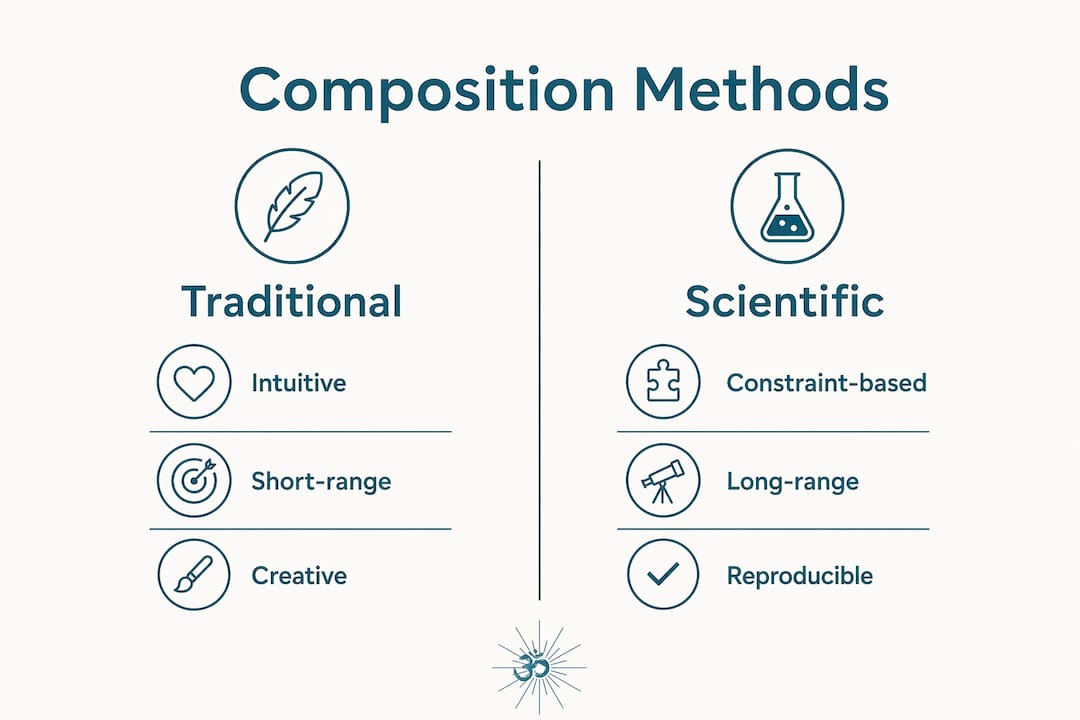
Scientific music composition is the practice of creating music by applying scientific principles, computational models, and neuroscience research to achieve controlled, measurable musical structures. Rather than relying purely on intuition or tradition, this approach treats composition as a discipline where harmony, rhythm, and form can be designed with the same rigour you might bring to an experiment. Think of it as the difference between painting freehand and using a ruler, a protractor, and a colour wheel simultaneously. You still make art. You just know why it works. Composers like Robert Emery and producers like Moritz Schneider have pushed this territory forward, building music that is not only emotionally resonant but grounded in verifiable acoustic and neurological principles.
What is scientific music composition and how does it work?
Scientific music composition integrates research-grounded methods such as constraint-based composition and neural networks to generate musically coherent sequences. The term “scientific composition” is not yet a single standardised industry label. Practitioners and researchers also call it algorithmic composition, AI-assisted composition, or computational musicology, depending on which tools they emphasise. All of these sit under the same broad umbrella: using formal, empirically grounded methods to make compositional decisions that would otherwise be left to gut feeling.
The core idea is that musical elements like pitch, duration, mode, key, and harmonic progression are not mystical. They are variables. Once you treat them as variables, you can apply mathematical constraints, machine learning models, and perceptual psychology to shape them deliberately. The result is music that does not just sound good by accident. It sounds good because the composer understood the mechanism behind the effect.
This matters enormously for therapeutic and meditative music, where the difference between a track that genuinely slows your heart rate and one that merely sounds pleasant can be traced back to specific compositional choices. Orchestralmeditations, for instance, builds its library on precisely this kind of intentional design, using frequency-based and orchestral techniques informed by scientific principles to support relaxation and mindfulness.
How do scientific methods and computational models shape music composition?
The most direct entry point into scientific approaches to music is constraint-based composition. Here, a composer formalises musical rules as explicit constraints: no parallel fifths, maintain a particular mode, resolve tension within four bars. A constraint solver then generates pitch variables and maintains both local and global musical relations automatically. This is not the machine composing instead of you. It is the machine enforcing the rules you set, so you can focus on higher-level creative decisions.

The NeuralConstraints framework takes this further by combining a neural generative model with a constraint solver in a single pipeline. The neural network learns statistical patterns from existing music, while the constraint layer ensures the output respects explicit musical theory. The practical benefit is significant: purely statistical models tend to drift harmonically over long passages, producing music that feels coherent bar by bar but loses its sense of direction over time. NeuralConstraints addresses this by anchoring generation to explicit inputs including mode, key, and seed notes.
Here is what that looks like in practice when a composer sets up a scientific generation session:
- Mode and key are specified as conditioning inputs before generation begins, so every note exists within a defined tonal context.
- Seed notes (often tonic chords) anchor the opening phrase and constrain what follows, preventing the model from wandering into unrelated tonal territory.
- Rhythmic and repetition constraints are formalised as rules, so the output maintains structural patterns rather than generating random rhythmic noise.
- Local and global relations are maintained simultaneously, meaning the model checks both the immediate melodic interval and the broader harmonic arc.
The advantage over purely intuitive composition is not that the machine is more creative. It is that the machine is more consistent. A human composer working on a 20-minute orchestral piece will inevitably make small inconsistencies. A constraint-based system will not.
Pro Tip: If you are exploring scientific composition for the first time, start with a constraint solver like OpenMusic or the NeuralConstraints framework before touching neural networks. Learning to formalise your musical instincts as explicit rules is the most transferable skill in this entire field.
What neuroscience research informs scientific music composition?
Neuroscience has given composers something genuinely useful: a model of why music affects us the way it does. Neural resonance theory explains how neural oscillations and brain-body dynamics embody musical structure, shaping perception and musical expectations. In plain terms, your brain does not passively receive music. It actively synchronises with it, predicting what comes next and responding physically when those predictions are confirmed or violated.
This has direct compositional implications. If you know that rhythmic patterns at certain tempos entrain neural oscillations more reliably than others, you can compose with that target in mind. If you know that harmonic tension activates specific predictive mechanisms in the auditory cortex, you can engineer the arc of tension and release rather than guessing at it. People embody musical structure physically via brain-body dynamics, which means scientific composition can engineer timing and expectation beyond pitch content alone.
A 2026 study in Scientific Reports demonstrated this with striking clarity. Researchers built a brain-inspired spiking neural network that uses tonic chords as seed notes to initiate generation, conditioned on both mode and key. The model achieves key profile alignment and maintains melodic diversity simultaneously. What makes this neuroscientifically interesting is that the architecture mirrors how the brain itself processes tonal hierarchies, treating Western tonal theory as schema-like knowledge that guides the network’s learning dynamics.
The practical outputs of neuroscience-informed composition include:
- Timing and expectation engineering: composing rhythmic patterns that reliably entrain neural oscillations at target frequencies, such as theta (4 to 8 Hz) for meditative states.
- Affect targeting: using harmonic progressions whose tension and resolution profiles match empirically measured emotional responses.
- Mode-conditioned generation: selecting modes (Dorian, Lydian, Phrygian) based on their documented perceptual and emotional effects rather than stylistic convention alone.
- Structural predictability: calibrating how often the music confirms versus violates listener expectations, since both extremes (total predictability and total surprise) reduce engagement.
“The brain is not a passive receiver of music. It is a prediction machine that synchronises with sound, and a composer who understands that is working with the listener’s neurology, not against it.”
Robert Emery, whose orchestral work for Orchestralmeditations draws on precisely these principles, has spoken about the importance of understanding the listener’s neurological response as a compositional parameter in its own right. His tracks are not simply beautiful. They are built to do something specific to the listener’s state of mind, which is a fundamentally scientific ambition. You can explore how this therapeutic music approach translates into practice across Orchestralmeditations’ catalogue.
How does network science reveal the structure of musical compositions?
One of the more surprising scientific methods in music is treating a composition as a network. Researchers model compositions as weighted directed networks of note transitions, where each note is a node and each melodic or harmonic step is a directed edge with a weight reflecting how frequently that transition occurs. The resulting network has measurable topological properties: density, clustering, path length, and entropy.
An analysis of 20,000 MIDI pieces revealed genre differences and a simplification trend in Western music over centuries. Classical and jazz compositions show greater structural diversity and complexity in their note-transition networks than contemporary pop, which tends toward denser but less varied networks. This is not a value judgement. It is a quantitative finding, and it has real implications for composers who want to understand where their work sits in the broader landscape of musical structure.
| Genre | Network complexity | Structural diversity | Historical trend |
|---|---|---|---|
| Classical | High | High | Stable complexity over centuries |
| Jazz | High | Very high | Increasing harmonic diversity |
| Pop | Moderate | Low | Marked simplification since 1980s |
| Electronic | Variable | Moderate | Emerging complexity in experimental subgenres |
The limitation worth acknowledging is that these analyses depend heavily on MIDI representations, which strip out timbre, dynamics, and performance nuance. Scientific claims from quantitative models depend on the representation layer and input data style, meaning a finding about “melodic complexity” in MIDI may not fully capture what a listener experiences in a live performance. This is not a reason to dismiss network science approaches. It is a reason to interpret their outputs carefully.
Pro Tip: When using network science tools to analyse your own compositions, compare your note-transition network against a reference corpus in your target genre. The comparison tells you whether your harmonic language is richer or sparser than the genre norm, which is far more useful than an abstract complexity score.
What advances are solving long-range structure in scientific composition?
The most persistent problem in AI-assisted and scientific composition is long-range coherence. A model that generates convincing four-bar phrases can still produce a 64-bar piece that feels like a sequence of unrelated ideas stitched together. This is because most autoregressive models rely on implicit statistical patterns learned from training data, with no explicit representation of the piece’s overall form.
The CAST framework (Cascaded Skeleton-to-Texture) addresses this directly by separating macro-harmonic planning from micro-texture generation. The skeleton layer first establishes the harmonic and structural arc of the entire piece, then the texture layer fills in melodic and rhythmic detail within that pre-planned framework. The results are measurable: structural error reduced from 0.58 to 0.22 and chord accuracy increased to 96% in sequences up to 1,000 tokens.
| Approach | Long-range coherence | Chord accuracy | Composer control |
|---|---|---|---|
| Autoregressive models (e.g., GPT-style) | Low to moderate | Variable | Indirect, via prompting |
| Constraint-based solvers | High | High | Direct, via explicit rules |
| CAST skeleton-to-texture | High | 96% | High, via skeleton planning |
| Spiking neural networks (mode/key conditioned) | Moderate to high | High | Moderate, via conditioning inputs |
Long-form musical coherence does not emerge reliably from next-token prediction alone. Explicit skeleton-based planning is what separates a scientifically composed piece with genuine structural integrity from one that merely sounds plausible moment to moment. For composers working on extended meditation or therapeutic music tracks, where a 20-minute piece needs to sustain a coherent emotional arc, this distinction is not academic. It is the difference between a track that holds the listener’s attention and one that quietly loses them at the eight-minute mark.
Moritz Schneider, the producer behind several of Orchestralmeditations’ most immersive recordings, approaches long-form structure with exactly this kind of deliberate planning. His sessions at Abbey Road Studios begin with a structural map of the emotional journey, specifying where tension builds, where release occurs, and how the orchestral texture shifts to support each phase. That is skeleton-to-texture thinking applied in a live recording context, which is rather elegant when you think about it.
Key takeaways
Scientific music composition works because it replaces guesswork with measurable, reproducible methods grounded in music theory, neuroscience, and computational modelling.
| Point | Details |
|---|---|
| Definition and scope | Scientific music composition uses constraint solvers, neural networks, and neuroscience models to generate music with measurable structure. |
| Neuroscience as a tool | Neural resonance theory enables composers to engineer timing, expectation, and emotional affect based on brain-body dynamics. |
| Network science insights | Modelling compositions as note-transition networks reveals genre complexity differences and long-term simplification trends in Western music. |
| Long-range coherence | The CAST framework reduces structural error from 0.58 to 0.22 by separating harmonic planning from texture generation. |
| Practical application | Composers like Robert Emery and producers like Moritz Schneider apply these principles in therapeutic and meditative orchestral music. |
Why I think scientific composition is the most exciting thing happening in music right now
I will be honest with you: when I first encountered the phrase “scientific music composition,” I pictured a laboratory full of people in white coats arguing about whether a C major chord was statistically significant. It sounded about as warm as a spreadsheet. I was wrong, and I am glad I kept reading.
What changed my mind was spending time with the NeuralConstraints research and, separately, with the work coming out of Orchestralmeditations. The thing that struck me was not the technology. It was the intention behind it. Robert Emery does not use scientific principles because he wants to remove the human element from music. He uses them because he wants to be certain that the human element lands. There is a profound difference between those two motivations.
The spiking neural network research from 2026 particularly fascinated me, because it mirrors something I have always believed intuitively: that Western tonal theory is not an arbitrary set of rules but a codified map of human auditory perception. When a model embeds that theory as schema-like knowledge and uses it to guide generation, it is not constraining creativity. It is giving creativity a nervous system.
My honest concern is that the field risks splitting into two camps that talk past each other. On one side, you have composers who see scientific methods as a threat to artistic authenticity. On the other, you have technologists who treat music as a data problem. The most interesting work, including what Moritz Schneider does in the studio and what the CAST framework achieves algorithmically, lives in the space between those camps. It treats science as a servant of artistic intent, not a replacement for it.
The therapeutic applications are where I think this gets genuinely important. If we can compose music that reliably induces theta-wave states, reduces cortisol, or supports specific mental health outcomes, then scientific composition stops being an academic curiosity and becomes a public health tool. That is worth taking seriously.
— ROBERT
Explore scientifically crafted meditation music from Orchestralmeditations
If reading about the science behind music composition has made you curious about what it actually sounds like in practice, Orchestralmeditations is a good place to start.

Every track in the Orchestralmeditations library is built on the principles discussed in this article: frequency-based design, neuroscience-informed structure, and long-form harmonic planning. Recordings made at Abbey Road Studios with the National Philharmonic bring live orchestral warmth to scientifically designed soundscapes, including binaural beats, theta frequencies, and Solfeggio-based compositions. Whether you are new to meditation music or looking for something more intentional than a generic ambient playlist, the meditation music library offers a curated collection built for genuine results. For a more personal recommendation, the best meditation music selection is a strong starting point.
FAQ
What is the definition of scientific music composition?
Scientific music composition is the practice of creating music using empirically grounded methods including constraint-based algorithms, neural networks, and neuroscience models to achieve measurable control over harmony, rhythm, and structure. It is also referred to as algorithmic or computational composition depending on the tools used.
How does music theory fit into scientific composition?
Music theory provides the explicit knowledge base that scientific composition systems use as input. Mode, key, tonic chords, and harmonic rules are formalised as conditioning variables or constraints, giving neural networks and solvers a structured tonal framework to work within rather than learning purely from statistical patterns.
What is the NeuralConstraints framework?
NeuralConstraints is a tool that integrates a neural generative model with a constraint solver, allowing composers to specify musical rules explicitly while the neural network handles pattern-based generation. It gives composers direct creative control over symbolic music output.
Why does long-range structure matter in scientific composition?
Long-range structure determines whether a piece feels coherent over its full duration or simply strings together convincing short phrases. The CAST framework demonstrated that explicit skeleton-based planning reduces structural error significantly compared to autoregressive models that rely on implicit statistical learning alone.
How does neuroscience inform the way composers write music?
Neuroscience research, particularly neural resonance theory, shows that the brain synchronises with musical patterns through oscillation and prediction. Composers can use this to engineer timing and expectation deliberately, targeting specific neurological states such as theta-wave relaxation or heightened emotional engagement. This is especially relevant in therapeutic and meditative music contexts, where the connection between therapy techniques and sound-based interventions is increasingly well-documented.