
Consciousness raising is defined as the deliberate effort to increase an individual’s knowledge and concerned awareness of social, political, and personal issues. It is not passive learning. It is the kind of awareness that shifts how you see the world and, crucially, how you act within it. Whether you encounter it through feminist organising, community activism, or the quiet interior work of meditation and music, the process follows the same arc: perceive, interpret, act. This guide walks you through what consciousness raising actually means, where it came from, and how you can practise it today.
What is consciousness raising and why does it matter?
Consciousness raising is the effort to increase an individual’s knowledge and concerned awareness of social or political issues. That definition, clean as it is, only scratches the surface. The real power of consciousness raising lies in what happens after awareness arrives: people begin to connect their private struggles to public structures, and that connection is where change begins.
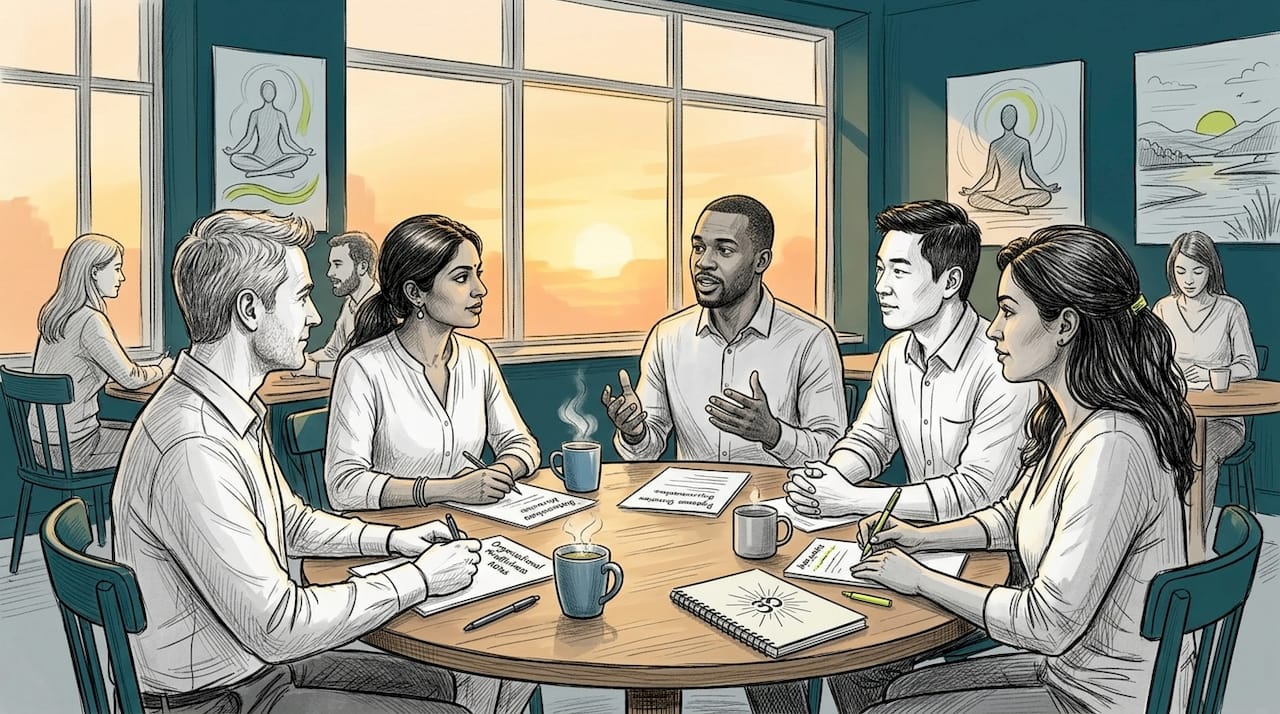
The importance of consciousness raising cannot be overstated for anyone working in personal development, social activism, or psychological growth. It converts isolated frustration into shared understanding. It turns “why does this keep happening to me?” into “why does this keep happening to us?” That shift from personal to collective is the engine of every meaningful social movement in modern history.
Robert Emery and Moritz Schneider, the composers behind Orchestralmeditations, represent a contemporary strand of this tradition. Their orchestral meditation music, recorded at Abbey Road Studios with the National Philharmonic, is designed to deepen inner awareness, which is the personal foundation from which any broader consciousness raising must grow. You cannot see the world clearly if you cannot first sit quietly with yourself.
Where did consciousness raising come from?
The term entered common usage through the Women’s Liberation Movement of the late 1960s and early 1970s. Feminist consciousness-raising groups were small, informal gatherings where women met regularly to share personal experiences and, through that sharing, identify the systemic structures behind them. The genius of the model was its simplicity: no expert at the front of the room, no prescribed reading list, just honest conversation among equals.
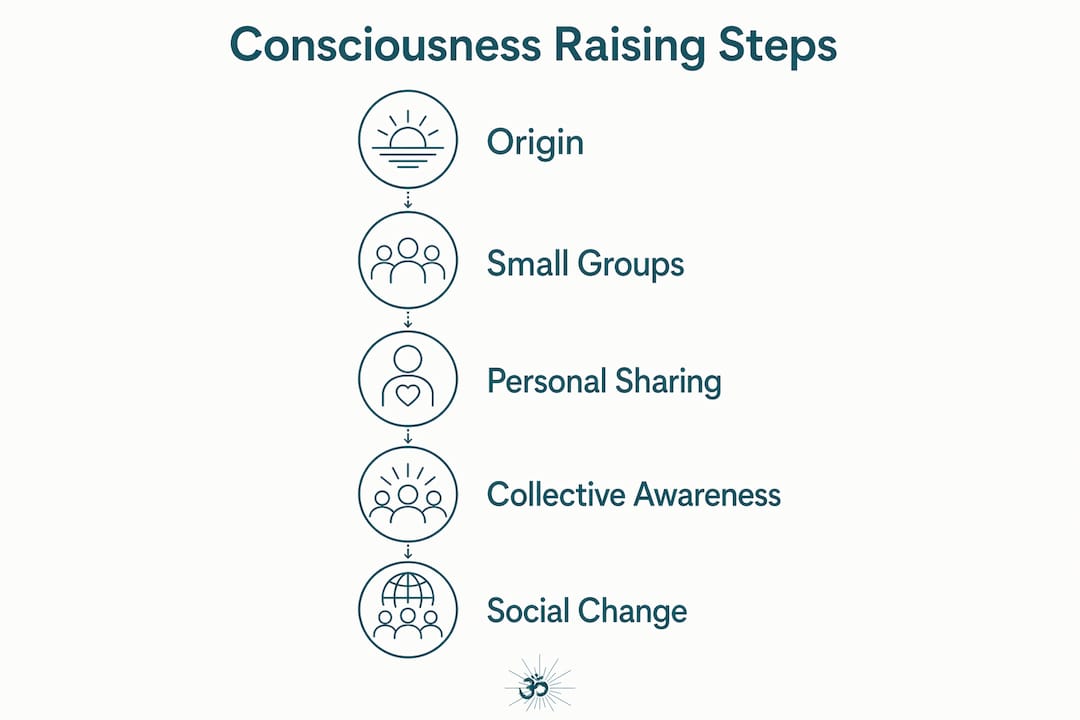
These groups drew significant inspiration from the Civil Rights Movement and from Marxist traditions of political organising, particularly the idea that ordinary people, through collective reflection, could develop a sophisticated understanding of power. The phrase itself is often attributed to Kathie Sarachild, a founding member of New York Radical Women, who argued in 1968 that personal testimony was a form of political research.
The structure of these groups was deliberate and worth noting:
- Groups typically kept to around 12 participants to maintain intimacy and trust.
- Discussions rotated speaking turns so every voice received equal time.
- Topics moved from the personal outward: relationships, work, the body, money, and eventually law and policy.
- Abstract theorising was actively discouraged. The focus stayed on lived experience.
- Sessions often began with icebreaker exercises to establish vulnerability and openness.
This last point is critical. Successful consciousness-raising groups avoid abstract theorising and keep discussion anchored in participants’ direct, lived experiences. That is what converts personal issues into collective political awareness. Theory without experience is just noise.
Pro Tip: If you are forming a new group, begin your first session by asking each person to share one moment when they felt their experience was dismissed or misunderstood. This simple exercise establishes the trust and vulnerability that make deeper conversations possible.
The influence of these groups spread rapidly through the 1970s, shaping not just feminist politics but environmental activism, disability rights organising, and LGBTQ+ liberation movements. Each adapted the core method: small group, personal testimony, collective reinterpretation.
How does consciousness raising actually work?
Understanding the mechanics of consciousness raising requires grasping what scholars call socio-critical consciousness. This is defined as the capacity to perceive, interpret, and act on material social reality. It is not enough to notice that something is unfair. You must be able to interpret why it is unfair and then act on that interpretation. Those three steps, perceiving, interpreting, acting, form the full cycle.
Consciousness raising is a practical, relational process where participants learn to perceive and act on material reality, connecting personal experience to systemic understanding. This means the process is never purely intellectual. It is developmental. You move through stages, and each stage requires the previous one.
Here is how that developmental arc typically unfolds:
- Personal recognition. You notice a pattern in your own life: repeated exclusion, unequal treatment, or a persistent sense that the rules were written for someone else.
- Shared testimony. You discover, through conversation with others, that your experience is not unique. This is often described as the most emotionally powerful moment in the process.
- Critical reinterpretation. The group reframes individual experiences as evidence of structural conditions rather than personal failings. “I am not bad at this” becomes “the system was not designed for people like me.”
- Collective action. The group identifies what can be done, individually and collectively, to challenge the conditions they have named.
“Socio-critical consciousness develops through confronting contradictions in experience and acting collectively, not mere exposure to information.” This is why reading a book about inequality rarely produces the same transformation as a well-facilitated group conversation.
Lived experience alone is not sufficient, and this is a point that trips people up. You can have decades of experience with injustice and still interpret it as personal bad luck. Socio-critical consciousness emerges from active, reflective social engagement, enabling individuals to perceive contradictions and act strategically. The reflection and the social engagement are both required. Neither works without the other.
Intersectionality and frameworks like it work best when shaped by lived experience, which is precisely why personal narrative sits at the heart of effective consciousness raising. Abstract frameworks become meaningful only when tested against real stories.
What is consciousness raising music and how does it work?
Music has served as a tool for consciousness raising across cultures and centuries, from the griots of West Africa carrying oral histories through song, to protest folk traditions in the United States and United Kingdom, to contemporary activist hip-hop. Music is frequently used as a pragmatic tool for consciousness raising, sharing facts and modelling social relations well beyond its entertainment function. That is a significant claim. It means music does not just accompany social movements; it actively teaches and organises.
The concept of prefigurative activism is useful here. It describes creative practices where the method of making the work embodies the values the work promotes. Music used in activism is most impactful when its organisation reflects values of care and collaboration. A choir that makes decisions collectively, pays its members fairly, and performs in community spaces is not just singing about solidarity. It is practising it.
| Musical tradition | Consciousness-raising function | Example context |
|---|---|---|
| West African griot tradition | Preserves collective memory and social critique through oral song | Community gatherings, rites of passage |
| Protest folk (1960s onward) | Translates political analysis into emotionally accessible narrative | Civil Rights Movement, anti-war rallies |
| Activist hip-hop | Names systemic injustice through personal testimony and rhythm | Urban communities, youth organising |
| Orchestral meditation music | Deepens inner awareness as a foundation for outward engagement | Mindfulness practice, personal development |
Robert Emery, the composer and producer behind much of Orchestralmeditations’ catalogue, brings a background in orchestral composition and sound design that makes his work particularly suited to this last function. His collaborator Moritz Schneider, a composer and producer with expertise in frequency-based audio and binaural sound engineering, has developed tracks that use theta frequencies and Solfeggio tones to guide listeners into states of deep reflective awareness. This is not background music. It is music that supports mental health and inner clarity, which is the personal prerequisite for any meaningful engagement with the world outside.
Art activism is most effective when the method of creation reflects the social values it promotes, ensuring authenticity and solidarity. Emery and Schneider’s decision to record with live musicians at Abbey Road Studios, rather than relying on digital synthesis, is itself a statement about the value of human presence and craft in an age of automation.
Pro Tip: When using music for consciousness raising, choose pieces that invite active listening rather than passive background listening. Set aside 20 minutes, remove distractions, and listen with the specific intention of noticing what thoughts and feelings arise. This transforms listening into a reflective practice.
How to raise consciousness: practical approaches for today
Consciousness raising is not a relic of 1970s feminism. It is a living practice, and the methods available today are broader than ever. Whether you want to work on your own awareness or facilitate a group, the following approaches are grounded in what actually works.
Forming a consciousness-raising group
- Keep the group small. Effective groups maintain around 12 participants and rotate speaking turns to preserve inclusivity. Larger groups fragment into cliques; smaller ones can feel too exposed.
- Choose topics that move from the personal outward. Begin with experiences before moving to analysis. “Tell us about a time you felt powerless at work” is a better opening than “let’s discuss labour rights.”
- Meet regularly and consistently. Trust builds over time, not in a single session.
- Resist the urge to problem-solve too quickly. The goal of early sessions is understanding, not action plans.
Integrating consciousness raising into daily life
- Keep a reflective journal focused specifically on moments when your experience felt shaped by forces outside your control. Over weeks, patterns emerge that are invisible in the moment.
- Read and listen widely, but always bring what you encounter back to your own experience. Ask: where have I felt this? Where have I seen this?
- Use healing music and guided meditation as a daily practice to cultivate the inner stillness that makes honest self-reflection possible.
- Engage with community organisations, local activist groups, or online forums where personal testimony is centred. The digital space has genuine limitations for consciousness raising (it lacks the physical presence and trust of a room), but it can sustain connections between in-person gatherings.
Using creative approaches to deepen awareness
- Attend or participate in theatre, spoken word, or music events that explicitly engage with social themes. Notice not just the content but the form. How is the work made? Who is in the room?
- Create something yourself, even privately. Writing, drawing, or composing about your own experience is a powerful form of consciousness raising that does not require an audience.
- Explore frequency-based audio, such as the theta and binaural recordings produced by Orchestralmeditations, as a tool for deepening the meditative states in which self-awareness grows most readily.
Key takeaways
Consciousness raising works because it connects personal experience to collective understanding, and that connection is what motivates lasting change rather than temporary awareness.
| Point | Details |
|---|---|
| Core definition | Consciousness raising increases awareness of social, political, and personal issues to motivate understanding and action. |
| Historical roots | Feminist groups of the 1960s pioneered the small-group, personal-testimony model that remains the gold standard today. |
| Developmental process | Awareness alone is insufficient. Effective consciousness raising moves through perception, critical reinterpretation, and collective action. |
| Music as a tool | Music raises consciousness by sharing facts, modelling social values, and deepening the inner awareness that supports outward engagement. |
| Practical starting point | Small, trust-based groups anchored in lived experience are the most reliable vehicle for genuine consciousness raising. |
Why consciousness raising still surprises me
I have spent years working with music as a medium for inner transformation, and the thing that still catches me off guard is how physical the moment of raised consciousness feels. It is not a gentle intellectual nudge. It is more like the cartoon-like SPLAT of a realisation landing squarely in the chest. You knew something vaguely before; now you know it in your bones.
What I find most underappreciated about consciousness raising is the role of silence and stillness in preparing the ground for it. We talk a great deal about the conversations, the groups, the testimonies. We talk less about the inner work that makes those conversations land rather than slide off. This is where I think composers like Robert Emery and Moritz Schneider are doing something genuinely significant. Emery’s orchestral compositions, built on decades of classical training and a deep understanding of how sound shapes emotional states, create the kind of sustained, attentive listening that is almost meditative in itself. Schneider’s work with binaural frequencies and theta-state audio takes this further, using the science of brainwave entrainment to guide listeners into the reflective states where self-awareness deepens most naturally.
The uncomfortable truth I have come to is this: you cannot raise your consciousness about the world if you are perpetually distracted from yourself. The outer work of social activism and the inner work of personal awareness are not separate projects. They are the same project, approached from different ends. The feminist groups of the 1960s understood this intuitively. They did not begin with policy. They began with “tell me about your life.” That is still the right place to start.
Cultural competence in therapy and intersectional frameworks remind us that awareness is always shaped by lived experience, which is why no amount of reading substitutes for honest, embodied reflection. The music helps. The group helps. But the willingness to sit with what you actually feel, without immediately explaining it away, is the irreducible core of the whole practice.
— ROBERT
Deepen your awareness with orchestral meditation music
If consciousness raising begins with inner stillness, then the quality of the sound you use to reach that stillness matters more than most people realise.

Orchestralmeditations offers a curated library of orchestral meditation recordings composed and produced by Robert Emery and Moritz Schneider, recorded with live musicians at Abbey Road Studios. These are not generic ambient tracks. They are precision-crafted soundscapes using binaural beats, theta frequencies, and 3D surround sound to guide you into the deep reflective states where genuine self-awareness grows. Whether you are new to meditation or looking to deepen an existing practice, exploring personal meditation music from Orchestralmeditations is a natural complement to any consciousness-raising work you are doing, alone or in a group.
FAQ
What is the consciousness raising definition?
Consciousness raising is the deliberate effort to increase an individual’s knowledge and concerned awareness of social, political, and personal issues. It connects personal experience to systemic understanding and motivates collective action.
What are the main consciousness raising techniques?
The most established techniques include small-group testimony sessions, reflective journalling, critical reinterpretation of personal experience, and the use of artistic mediums such as music, theatre, and spoken word to make social realities emotionally accessible.
What is consciousness raising music?
Consciousness raising music is any music used to share social facts, model community values, or deepen inner awareness as a foundation for outward engagement. This spans protest folk, activist hip-hop, and orchestral meditation music designed to cultivate reflective states.
How many people should a consciousness raising group have?
Effective consciousness-raising groups maintain around 12 participants and rotate speaking turns to preserve inclusivity. Groups larger than this tend to lose the intimacy that makes honest personal testimony possible.
What are the benefits of consciousness raising?
The core benefits include greater self-awareness, the ability to connect personal experience to structural conditions, stronger community bonds, and the motivation to take collective action on shared issues. These benefits compound over time with consistent practice.