
There are days when your mind feels like a browser with forty-seven tabs open, each one playing a different tune at full volume. You know the ones. The mental chatter is relentless, the to-do list is laughing at you, and the idea of simply sitting quietly feels about as realistic as climbing Everest in flip-flops. Here’s the thing, though: guided meditation is not some mystical art reserved for monks on mountain tops. It is a practical, step-by-step tool that anyone can use to genuinely reclaim a sense of calm. This article walks you through everything you need to prepare, what to actually do when the session starts, how to sidestep the most common traps, and why the soundtrack you choose matters far more than you might expect.
Key Takeaways
| Point | Details |
|---|---|
| Preparation matters | Setting up your environment and mindset makes meditation more effective. |
| Follow clear steps | A structured guided meditation helps maximise focus and relaxation. |
| Avoid common mistakes | Let go of perfectionism and simply observe your experience. |
| Choose your soundtrack | Orchestral soundscapes can deepen immersion and emotional benefits. |
Essentials for your guided meditation journey
Now that you understand the value of guided meditation, let’s look at how to prepare for a truly beneficial experience. Preparation might sound boring, but getting it right is what separates a session that genuinely shifts your state from one where you spend twenty minutes wondering whether you left the oven on.
Physical space and comfort

Your space does not need to be a purpose-built zen retreat (though if you have one, please do invite us round). You simply need somewhere you can sit or lie down without being interrupted. A comfortable chair, a yoga mat, even a firm sofa cushion all work perfectly well. Wear loose, non-restrictive clothing. Dim the lights if you can, or draw the curtains. Following natural relaxation steps like these small environmental tweaks genuinely helps signal to your nervous system that it is time to downshift.
Here is a quick checklist of what to have ready before you begin:
- A quiet, comfortable spot where you will not be disturbed for the session duration
- Loose, comfortable clothing (no constricting waistbands, please, your diaphragm will thank you)
- A blanket if you tend to feel cold when still
- Headphones or a decent speaker for your audio
- A timer or a pre-set track with a gentle ending tone
- Water nearby for after your session
Digital setup and orchestral soundscapes
Your audio device matters more than people realise. A tinny phone speaker playing a recording engineered for immersive 3D sound is a bit like watching a blockbuster film on a postage stamp. If you can use over-ear headphones, do. They allow the full spatial range of orchestral soundscapes, binaural beats, and theta frequencies to wrap around you rather than just sit on top of you.
As one of our own guides notes, creating a distraction-free environment optimises meditation effectiveness, and a great deal of that comes from your audio setup rather than the room itself.
Mindset readiness
This one trips people up. Many newcomers arrive at their meditation session carrying an expectation, a demand, almost, that they will feel serene within the first ninety seconds. Setting a gentle intention rather than a rigid goal works far better. Something like, “I am giving my mind permission to rest” rather than “I will achieve deep meditation today or else.” Check out our wellness meditation checklist for a fuller picture of how to prime yourself before each session.
| Resource | Role in your meditation |
|---|---|
| Comfortable seating or mat | Supports posture and physical ease |
| Over-ear headphones | Maximises immersive soundscape quality |
| Orchestral audio track | Anchors attention and deepens emotional shift |
| Gentle timer or natural track ending | Closes session without jarring the nervous system |
| Loose clothing | Prevents physical distraction during stillness |
| Gentle intention | Focuses the mind without creating performance pressure |
Pro Tip: Adding orchestral music to your session is not mere decoration. The layered harmonic textures give your mind something purposeful to follow, meaning your attention has an anchor rather than drifting towards the neighbour’s lawnmower.
Step by step: How to follow a guided meditation
Once your essentials are ready, you can start your guided journey by following these step-by-step instructions. Think of this as your roadmap rather than a rigid rulebook. Adapt it as you go.
-
Settle your posture. Sit upright with your spine gently supported, or lie flat with your arms slightly away from your body. You want alertness without tension. Imagine someone has placed a very light book on your head, not to balance it frantically, but just enough to find a natural lift in the spine.
-
Begin conscious breathing. Take three slow, deliberate breaths before anything else. Inhale for four counts, hold gently for two, exhale for six. This simple pattern begins to activate the parasympathetic nervous system, shifting your body from reactive to receptive.
-
Start your audio. Press play on your chosen guided track. If you are unsure which approach suits you, reading about guided vs self meditation first helps you make the right call. Guided sessions structure your experience in a way that supports both complete beginners and experienced practitioners alike.
-
Follow the voice and the sound. Let the guide’s voice and the orchestral layers carry your attention. You are not trying to do anything at this stage. You are listening, following, allowing. If your mind wanders (and it will, because minds are professionally trained wanderers), simply notice it and return to the voice without fuss.
-
Enter guided visualisation. Many sessions will invite you into a visual scene, a forest, a vast open sky, a warm interior space. Go with it, even if your inner critic insists it feels a bit theatrical. The imagery serves as a cognitive anchor, giving your busy brain a gentle occupation that is far more restful than replaying that awkward conversation from 2019.
-
Close the session intentionally. When the guide brings you back, resist the urge to leap straight up and check your phone. Sit quietly for one to two minutes. Notice how your body feels. This is where the real integration happens. Our deep relaxation guide goes into helpful detail about closing rituals that seal in the benefits.
A word of caution: Do not force relaxation. Actively trying to relax is the fastest route to tension. Approaches like step by step hypnotherapy agree on this point: the mind releases when it trusts, not when it is commanded.
Pro Tip: A ten-minute session done with genuine, focused attention will outperform a forty-minute session where you are half-planning dinner. Quality of presence beats quantity every single time.
Avoiding common pitfalls in meditation practice
Now that you know the practical steps, it is vital to recognise and avoid the most common meditation mistakes. Because, honestly, most people do not fail at meditation because they lack discipline. They fail because nobody warned them what to expect.
The perfection trap
Feeling impatient or expecting instant peace can actively make meditation less effective. This is one of those genuinely counter-intuitive things about the practice. The more you demand results, the further away they retreat, like a cat that only comes to you when you stop chasing it. Approach each session as an experiment rather than a performance review.
Common pitfalls and their antidotes
- Multitasking during the session trying to fold laundry or check messages. Antidote: phones on silent, in another room if possible.
- Overthinking the instructions trying to execute each step perfectly rather than feeling it. Antidote: read the steps once, then simply let the guide lead.
- Skipping sessions when busy which is precisely when you need them most. Antidote: anchor your session to an existing habit, like directly after your morning coffee.
- Judging the quality of each session and deciding you are either good or bad at meditating. Antidote: all sessions have value, even the restless ones.
- Using background noise as an excuse believing you need total silence. Antidote: quality relaxation music tips show that the right soundscape can actually outperform silence for many people.
Missing regularity is perhaps the single biggest culprit behind people feeling meditation does not work for them. Practising three times a week consistently will do far more for you than one heroic two-hour session on a Sunday. The nervous system responds to repetition, not marathon effort. There are plenty of natural ways to relax that complement a regular practice, and building them into your routine amplifies the benefits considerably.
“Let the process unfold without pressure for results.” The session does not owe you a profound experience. And that is perfectly fine.
Pro Tip: Observe each session without judgement, the way you might watch clouds. Some sessions will feel profound. Others will feel like you sat in a chair thinking about biscuits. Both are valid. Both are progress.
Exploring deep meditative states takes time and consistent practice, and understanding that timeline removes an enormous amount of unnecessary self-criticism from the equation.
Comparing approaches: Orchestral soundscapes vs classic methods
If you have wondered about the impact of your meditation soundtrack, this comparison will help clarify your options. Not all meditation is created equal, and choosing the right sonic environment for your personality and goals is genuinely worth thinking about.
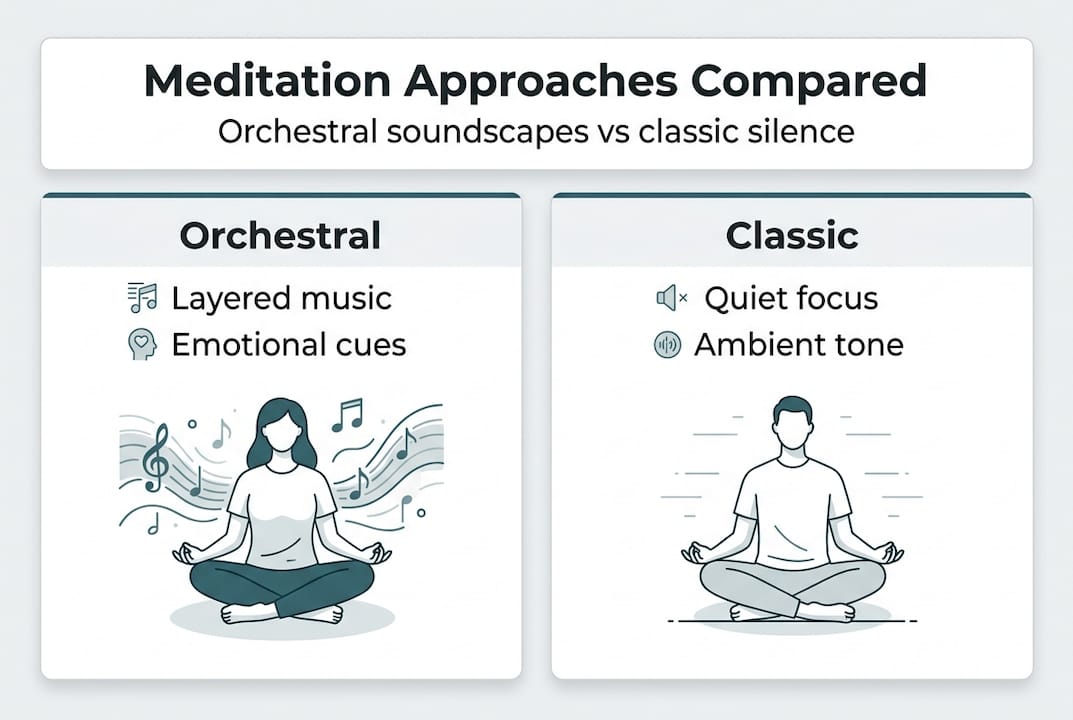
Orchestral soundscapes
Recorded with live musicians, spatial audio technology, and frequency-specific design, orchestral soundscapes do something that a simple nature track or a single singing bowl cannot quite replicate. The layered harmonic content engages multiple areas of the brain simultaneously, and soundscapes and frequency-based music improve immersion and encourage emotional shifts that pure silence rarely achieves with the same reliability. There is also an almost theatrical quality to a sweeping orchestral piece that makes visualisation feel vivid and emotionally resonant rather than flat.
Classic silent or minimal-audio methods
Silent meditation, or sessions using only a single tone or gentle ambient drone, offers its own distinct advantages. It asks more of the practitioner in terms of self-regulation, which can build a specific kind of mental resilience over time. For experienced meditators with an established practice, silence can be profoundly spacious. For someone new to the process, however, silence can quickly become a stage on which the mind performs its full dramatic repertoire. Trying to find peace in meditation from scratch is considerably harder without an anchor.
| Feature | Orchestral soundscapes | Silent or minimal audio |
|---|---|---|
| Ease for beginners | High | Lower |
| Emotional depth | Rich, layered | Spacious, self-generated |
| Attention anchor | Strong (guided by music) | Self-directed |
| Suitable for | All levels, especially beginners | Intermediate to advanced |
| Sensory engagement | Multi-layered | Minimal |
| Visualisation support | Excellent | Requires strong imagination |
When to use each style
- Use orchestral soundscapes when you need a reliable anchor for a restless or busy mind
- Use orchestral soundscapes for emotionally charged sessions where music can safely hold the feeling
- Use silence when you are an experienced practitioner seeking a more self-directed exploration
- Use minimal audio when you want to develop your independent concentration and resilience
- Use either when you are simply following what resonates on a given day, because intuition is a legitimate compass
Exploring the benefits of music in meditation through a scientific lens makes it clear that the choice of sound environment is not trivial. It shapes the entire character of your inner experience.
Our perspective: Why step by step guidance unlocks deeper relaxation
Having explored methods and challenges, it is time for a deeper, hands-on perspective from our own experience.
There is a persistent misconception that guided meditation is somehow the passive or beginner’s version of the real thing. As if you eventually graduate to some purer, silent form and leave the guided sessions behind like stabilisers on a bike. We think that framing misses something important.
The truth, at least from what we have seen and experienced, is that structure actively creates freedom. When your mind has a clear sequence to follow, particularly one supported by the emotional gravity of orchestral layers, it stops clinging to the steering wheel. It lets go. And that letting go is precisely where the deeper relaxation lives.
Orchestral music does something particularly useful here. Each instrument carries its own emotional weight, and together they form a harmonic scaffold that holds your attention without demanding it. You are not white-knuckling your focus. You are floating in it. Compare this to trying to self-navigate silence when your mind keeps interrupting with an agenda, and it becomes obvious why so many people find guided versus self meditation a genuinely different experience rather than just a stylistic preference.
Step-by-step guidance also removes the hidden cognitive load of wondering what to do next. That alone frees up a surprising amount of mental space for actual rest.
Pro Tip: Keep a small journal beside your meditation spot. Two or three sentences after each session, just whatever surfaces naturally, can reveal patterns over time and deepen your self-awareness in ways the session itself sometimes cannot.
Enhance your meditation experience with orchestral soundscapes
If you are ready to take your meditation journey to the next level, here is where to begin.
At Orchestral Meditations, every track is crafted with both intention and extraordinary technical care, recorded at Abbey Road Studios with the National Philharmonic and engineered to work with your nervous system, not just alongside it. Whether you are stepping into guided meditation for the very first time or you are a seasoned practitioner looking to deepen your practice, our library has something designed specifically for where you are right now.
Browse our collection of best meditation music to find the track that resonates with your current needs, or explore the full range of immersive sessions available through orchestral meditation music to find your perfect sonic companion for daily practice. Your mind deserves more than a generic playlist. Give it something genuinely extraordinary.
Frequently asked questions
How long should a step by step guided meditation last?
Most guided meditations run from 10 to 30 minutes, and the best length is simply one you can commit to consistently. Consistency matters more than duration when you are building a meditation habit.
What makes orchestral soundscapes effective for relaxation?
Orchestral soundscapes engage multiple senses simultaneously and encourage deeper emotional shifts than silence typically achieves. Sound-enhanced environments increase the relaxation response in ways that minimal audio often cannot replicate.
Can beginners benefit from guided meditation?
Absolutely, and in many ways beginners benefit the most. Structured guidance helps newcomers build a reliable meditation routine without the frustration of self-direction before the foundations are in place.
What if I get distracted during meditation?
Distraction is completely normal and not a sign of failure. Simply notice where your mind has gone and gently return your attention to the guide or the music. Non-judgemental awareness is itself a core part of effective meditation practice.
Recommended
- Deep Relaxation Guide: Mindful Steps And Orchestral Soundscapes
- Explore Deep Meditative States For Profound Relaxation
- Relax And Unwind With Meditation And Sleep Music
- Relaxing Meditation Music For Better Sleep
- How to Calm Racing Thoughts — The Caia Journal
- 7 astrology meditation methods to enhance spiritual growth | Lunaris