
Most of us have had that moment. You put on a favourite song and something shifts, your shoulders drop, your breathing slows, and the world feels marginally less catastrophic. It’s tempting to conclude that music is simply good for you, full stop. But the reality is considerably more interesting (and more nuanced) than that. Music therapy offers evidence-based support for mental health, yet not all music, in all contexts, produces the same result. What works brilliantly for one person might leave another completely cold. This article explores what the science actually says, which approaches have genuine clinical backing, and how you can use music more purposefully in your own wellbeing practice.
Key Takeaways
| Point | Details |
|---|---|
| Evidence-based benefits | Music therapy can significantly relieve depression, anxiety, and improve quality of life when tailored and professionally guided. |
| Mechanisms involved | Music engages the brain and body through neural, emotional, and physiological pathways that support mental health. |
| Mindfulness and self-care | Even outside clinical settings, mindful music listening can help reduce daily stress and support wellbeing. |
| Limitations to consider | Music is not a universal remedy—personal preference and cultural context are important, and more research is needed. |
| Personalised approach | Blending evidence-based therapy with self-guided listening offers the most benefit for long-term mental health. |
What is music therapy? Clinical foundations and methods
Let’s clear something up straight away: music therapy is not simply putting on a calming playlist and hoping for the best. It is a clinical, evidence-based intervention using music by trained professionals to address specific health goals. Think of it like the difference between jogging around the park and working with a physiotherapist on a structured rehabilitation programme. Both involve movement. Only one is clinically guided.
Professionally trained music therapists work with individuals or groups to design sessions around measurable outcomes, whether that’s reducing anxiety, improving communication, or supporting emotional regulation. The approach is tailored, goal-driven, and regularly reviewed. It is not background music with good intentions.

There are two primary modalities, and understanding the difference matters:
| Modality | What it involves | Best suited for |
|---|---|---|
| Active | Playing instruments, singing, improvising, composing | Autism, self-expression, communication difficulties |
| Receptive | Listening to live or recorded music, guided imagery | Anxiety, depression, dementia, pain management |
As the research confirms, two main modalities exist: active and receptive, each with distinct strengths depending on the population and therapeutic goal. Active engagement tends to suit those who benefit from creative expression and social interaction. Receptive approaches, where the client listens rather than performs, are particularly effective for anxiety and emotional processing.
The conditions music therapy is used for are broader than most people realise:
- Depression and anxiety: Reducing symptoms and improving mood regulation
- Dementia: Supporting memory recall and reducing agitation
- Autism spectrum conditions: Improving social communication and engagement
- Schizophrenia: Enhancing social functioning and reducing negative symptoms
- Post-stroke rehabilitation: Supporting motor and speech recovery
- Parkinson’s disease: Improving gait and motor coordination through rhythmic cues
“Music therapy is not an add-on luxury. For certain populations, it is one of the most accessible and effective tools available.”
The science behind relaxation music reinforces why structure and intention matter so much. Simply listening to something pleasant is not the same as a purposefully designed therapeutic session, though it can still offer real benefits, which we’ll explore shortly. And if you’re curious about how exercise and mental health intersect, music plays a supporting role there too, regulating effort perception and emotional state during physical activity.
How does music act on the brain and body?
Once you understand what music therapy is, the next logical question is: how on earth does sound produce measurable psychological and physiological change? The answer involves several overlapping mechanisms, and honestly, it’s rather remarkable.
Research identifies five key pathways through which music affects us:
- Neural entrainment: The brain synchronises its rhythmic activity to external rhythmic stimuli. A steady beat can literally regulate your arousal state, calming an overactive nervous system or energising a sluggish one.
- Reward and prediction circuits: Music activates dopamine pathways, particularly when it surprises or satisfies our expectations. This is why a well-timed chord resolution can feel almost physically pleasurable.
- Autonomic nervous system modulation: Music influences heart rate, blood pressure, and cortisol levels, the body’s primary stress hormone. Slow, predictable music tends to shift the body towards a parasympathetic (rest and digest) state.
- Neuroplasticity: Repeated musical engagement can reshape neural pathways over time, supporting long-term improvements in mood regulation and cognitive function.
- Immune modulation: Some evidence suggests music can influence immune markers, though this remains an area of active investigation.
The mechanisms of music therapy include neural entrainment, neuroplasticity, reward circuits, autonomic balance, and immune modulation, working together rather than in isolation. That layered quality is precisely why music can feel so potent.
| Mechanism | Effect on the body/mind | Clinical relevance |
|---|---|---|
| Neural entrainment | Regulates arousal and attention | Anxiety, ADHD, sleep disorders |
| Dopamine activation | Mood elevation, motivation | Depression, chronic pain |
| Autonomic modulation | Lowers heart rate and cortisol | Stress, hypertension |
| Neuroplasticity | Strengthens emotional regulation | Long-term mental health support |
Particularly interesting is the link between music, mindfulness, and physiology. Music mindfulness enhances HRV (heart rate variability), reduces stress, and modulates EEG patterns in ways consistent with improved emotional regulation. HRV is essentially a measure of how flexibly your nervous system responds to demands, and higher HRV is associated with better mental health outcomes.
Pro Tip: If you want to use music to shift your nervous system state, pay attention to tempo. Music around 60 beats per minute tends to synchronise with a resting heart rate and encourage calm. Faster tempos can be energising but may increase arousal if you’re already anxious.
Of course, results vary. Individual differences in musical background, cultural associations, and personal preferences mean there is no single track that works universally. Exploring music for mindfulness or meditation music for sleep can help you identify what resonates with your own nervous system.
Key evidence: Who benefits most and in what conditions?
Right, let’s talk numbers. Because this is where things get genuinely exciting, and where the evidence separates music therapy from wishful thinking.
A recent meta-analysis found that music therapy reduces depressive symptoms, improves quality of life, and meaningfully improves sleep. The standardised mean difference (SMD) for depressive symptoms was approximately 0.97, which in clinical terms is a substantial effect. Sleep improvements showed an SMD of around 0.61. These are not trivial numbers.
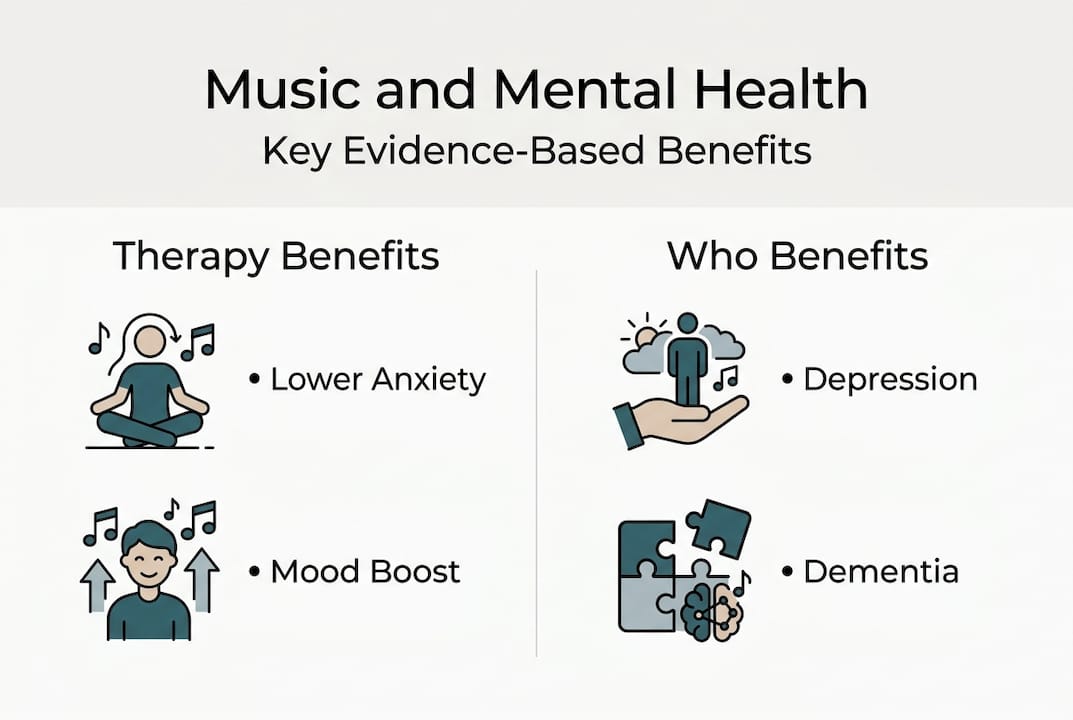
For anxiety specifically, a separate meta-analysis on anxiety outcomes found a medium effect size overall, with receptive and combined approaches outperforming purely active engagement. In plain terms: listening, particularly structured and guided listening, tends to be more effective for anxiety than simply playing an instrument.
Conditions with the strongest evidence base include:
- Dementia: Consistently strong results for reducing agitation, improving mood, and supporting memory recall
- Depression: Significant symptom reduction, particularly when combined with standard care
- Anxiety disorders: Medium effect sizes, especially with receptive approaches
- Schizophrenia: Improvements in social functioning and negative symptoms
- Autism spectrum conditions: Enhanced communication and reduced behavioural difficulties
- Post-stroke and Parkinson’s: Motor and speech improvements through rhythmic auditory stimulation
“An SMD of 0.97 for depression puts music therapy in the same ballpark as some pharmacological interventions, which should give us all pause for thought.”
Even in oncology settings, group music therapy for chemotherapy patients reduces anxiety and improves well-being, demonstrating that the benefits extend well beyond traditional psychiatric contexts.
That said, music therapy works best as an adjunctive treatment, meaning alongside other care, not as a standalone replacement. The evidence is clear that relaxation music for stress can support emotional regulation, but the most significant outcomes occur when music is integrated thoughtfully into a broader therapeutic plan.
Individualisation matters enormously here. A person’s musical history, cultural background, and personal associations with specific genres or instruments will shape how they respond. What sounds soothing to one listener might carry difficult emotional memories for another.
Music for mindfulness and wellness: Beyond formal therapy
Not everyone has access to a certified music therapist, and honestly, that’s fine. Because there’s a meaningful middle ground between clinical music therapy and aimlessly shuffling through a playlist.
Receptive music listening, when done with intention, can meaningfully reduce anxiety and stress. The key word is intention. There’s a difference between having music on in the background while you scroll through your phone and actually sitting with music as a mindfulness practice, attending to its texture, rhythm, and emotional quality.
Music mindfulness is promising for anxiety and stress via autonomic modulation, though the evidence base is less rigorous than for formal music therapy. That’s not a reason to dismiss it. It’s a reason to approach it thoughtfully.
Here are practical ways to integrate music into your wellness routine:
- Dedicated listening sessions: Set aside 15 to 20 minutes to listen without distraction. Treat it like a meditation sitting.
- Body-scan with music: Use slow orchestral or ambient music as a backdrop while systematically relaxing each part of your body.
- Morning intention setting: Choose music that matches the emotional tone you want to cultivate for the day.
- Pre-sleep wind-down: Slow, predictable music in the 45 minutes before bed can support melatonin production and reduce cortisol.
- Movement and breath: Pair music with gentle yoga, stretching, or breathwork for a combined physiological effect.
Pro Tip: When selecting music for mindfulness, avoid tracks with lyrics in a language you understand. Your brain will process the words rather than simply receiving the sound, which can interrupt the meditative state you’re trying to cultivate.
It’s worth being honest about the ‘sound healing’ space, which ranges from genuinely evidence-informed practices to some fairly creative marketing. Binaural beats, Solfeggio frequencies, and theta-wave music all have varying degrees of research support. Some show genuine promise; others need more rigorous study. Our music selection checklist can help you evaluate what’s worth your time, and our relaxation guide offers practical steps for building a meaningful practice.
Limitations, ethical considerations, and future directions
Here’s where we need to be honest, because music therapy, as promising as it is, is not magic. And pretending otherwise does nobody any favours.
The current evidence base has real limitations:
- Small sample sizes: Many studies involve relatively few participants, making it difficult to draw sweeping conclusions.
- Methodological variation: Different studies use different protocols, outcome measures, and definitions of ‘music therapy,’ which makes comparing results tricky.
- Publication bias: Positive results are more likely to be published than null findings, which can inflate apparent effect sizes.
- Short follow-up periods: Many trials don’t track participants long enough to assess whether benefits persist.
- Lack of standardised protocols: Without consistent treatment manuals, it’s hard to know exactly what’s producing the effect.
As the research acknowledges, methodological heterogeneity and small samples limit the strength of conclusions we can draw. That’s not a reason to dismiss music therapy. It’s a reason to interpret the evidence with appropriate care.
“The absence of perfect evidence is not evidence of absence. But it does mean we should be precise about what we claim music can and cannot do.”
Ethical considerations are equally important. Individual tailoring and ethical sensitivity are not optional extras in music therapy. They are central to responsible practice. This includes obtaining informed consent, respecting cultural associations with music, and recognising that certain music may carry traumatic associations for some individuals.
There are also structural barriers to wider access. Workforce shortages and the lack of standardised protocols remain significant obstacles to integrating music therapy into mainstream healthcare. Training more therapists, developing clearer guidelines, and making the case to policymakers are all part of the work ahead.
The future is genuinely promising, though. Digital delivery of music therapy, AI-assisted personalisation, and growing integration with neuroscience are all areas of active development. For those exploring meditation music for relaxation, the intersection of technology and therapeutic music is becoming increasingly sophisticated.
Why a personal and flexible approach to music for mental health matters most
If there’s one thing the science has taught us, it’s that music and mental health is not a one-size-fits-all equation. The research points clearly towards an individualised journey. What profoundly soothes one person might leave another unmoved, or worse, stir up difficult feelings entirely.
I think the most effective approaches blend evidence-based structure with self-guided discovery. You don’t have to choose between formal therapy and personal exploration. The two can coexist beautifully, and often, the combination produces the most lasting results. A music therapist might open a door; your own daily listening practice keeps it open.
What I’d encourage is this: treat music as a regular, intentional part of your mental health toolkit rather than an occasional treat. The neurological benefits of consistent musical engagement compound over time, much like any other wellness practice. It’s not about finding the perfect track. It’s about building a relationship with sound that genuinely serves your nervous system.
Experiment freely. Try orchestral, ambient, binaural, choral. Notice what shifts in your body when you listen. And if you’re dealing with significant mental health symptoms, please combine music with professional care rather than relying on it alone. Music is powerful. It is not, however, a substitute for a qualified clinician. Exploring options like music for unwinding is a wonderful starting point, but think of it as one thread in a richer tapestry.
Discover curated music for your mental wellbeing journey
If this article has sparked your curiosity about using music more intentionally for your wellbeing, you’re in exactly the right place. At Orchestral Meditations, we’ve spent considerable time crafting recordings that align with the principles explored here: purposeful, immersive, and designed to support genuine relaxation and mindfulness.

Our curated meditation music library includes orchestral soundscapes recorded at Abbey Road Studios with the National Philharmonic, alongside binaural and theta-frequency tracks built to support deep meditative states. Whether you’re looking for the best meditation music for a daily practice or want to explore our Solfeggio music collection, we have options tailored to your journey. Consider this your invitation to listen with intention.
Frequently asked questions
What is the difference between music therapy and listening to music on my own?
Music therapy uses structured, goal-driven techniques led by professionals, while casual listening lacks clinical guidance and personalisation. As the evidence confirms, clinical music therapy is an evidence-based intervention distinct from general music enjoyment.
Which mental health conditions benefit most from music therapy?
Strong evidence supports music therapy for dementia, depression, anxiety, schizophrenia, and autism, though results depend on the person and context. Research shows strongest evidence in dementia, with meaningful benefits also documented in depression and schizophrenia.
Is receptive music listening (just listening) effective for stress and anxiety?
Yes, receptive listening can help reduce anxiety and stress, especially when used consistently and purposefully. Studies confirm that receptive listening reduces anxiety and agitation across several clinical populations.
Are there risks or downsides to using music for mental health?
Music is not a one-size-fits-all solution; ethical issues and cultural sensitivity are important, and not everyone will experience the same effects. Research emphasises that individual tailoring is essential and that physiological effects can be limited in certain cases.
How can I choose the right music for my mindfulness or wellness practice?
Focus on tracks that promote calm, comfort, and clarity for you personally, and experiment to find what works best. Evidence shows that music mindfulness enhances HRV and reduces stress, particularly when listening is approached with intention rather than as background noise.
Recommended
- The Power Of Healing Music: Transform Your Well-Being Through Sound
- Why Relaxation Music Matters For Stress Relief: Science
- The Best Music For Mindfulness: Enhance Your Relaxation Experience
- Transform Your Health: Top Benefits Of Music With Healing Frequencies – Orchestral Meditations
- Running to Improve Mental Health – MK Marathon Weekend, Milton Keynes 3-4 May 2026