Most people assume that deep meditation means sitting quietly, breathing slowly, and feeling a bit calmer than usual. Honestly, fair enough. That’s what most guided sessions sell you. But meditation induces changes in deep brain areas tied to memory and emotional regulation, and that’s a whole different conversation from simply chilling out on a cushion. True meditative depth involves measurable shifts in your neural architecture, a dissolving sense of time, and sometimes an almost electric sense of clarity or bliss. This article cuts through the noise to explain exactly what defines a deep meditative state, how science is now measuring it, which techniques reliably produce it, and how immersive sound can act as a powerful catalyst for those shifts.
Key Takeaways
| Point | Details |
|---|---|
| Unique markers of deep states | Profound relaxation, altered consciousness, and neural changes separate deep meditation from ordinary relaxation. |
| Techniques for depth | Focused attention, loving-kindness, and heartfulness progress to advanced absorption with practice. |
| Role of immersive sound | Guided soundscapes and binaural beats can enhance and accelerate access to deep meditative states. |
| Measuring your progress | Subjective reports and scientific tools like EEGs can help track and confirm depth. |
Defining a deep meditative state: sensation, science, and experience
With the basic context set, it’s vital to understand what truly sets deep meditative states apart from a nice, relaxing lie-down with your eyes shut.
Let’s be honest: most of us have experienced a moment during meditation where something shifted. Thoughts slowed to a trickle. The room felt distant. Time became irrelevant. That’s the edge of a deep meditative state, and it feels nothing like ordinary relaxation. Where relaxation softens tension, genuine meditative depth rewires the quality of awareness itself.
Researchers have started mapping these experiences with remarkable precision. Self-reported depth in loving-kindness practices averages 7.43 out of 10, which is striking when you consider how many people assume meditation is simply a relaxation tool. Those high depth ratings correlate with specific neural patterns, not vague feelings of wellbeing.
Science now confirms that deep meditation shows distinct neural signatures that set it apart from relaxation or sleep entirely. We’re talking about changes in EEG power bands, alterations in frontal alpha asymmetry, and fMRI-visible shifts in deep brain structures connected to memory and emotional processing. These are not subtle.
“Deep meditative states are not simply a more relaxed version of waking consciousness. They represent a qualitatively different mode of neural organisation.”
So what does it actually feel like from the inside? Here are the hallmark characteristics most practitioners and researchers agree on:
- Profound physical stillness with little or no impulse to move
- Dramatic slowing or silencing of discursive thought, rather than just a quieter mind
- Distorted or dissolved sense of time, where a 40-minute session feels like 10
- Heightened emotional equanimity, sometimes accompanied by warmth or bliss
- Altered body awareness, often a sense of the body’s boundaries becoming less defined
- Effortless presence, where maintaining attention requires no strain whatsoever
The crucial difference between deep relaxation and genuine meditative absorption lies in that last point. Relaxation is passive. Deep absorption is a specific quality of awareness, alive and receptive, but utterly unhurried. You can explore how meditation frequency and mindfulness interact to support this process, or discover how binaural beats for focus can be used as an entry point. Both are worth understanding before you try to engineer depth on your own.
Key methodologies: techniques that cultivate deep states
Now that the nature of deep states is clear, let’s explore how to reliably access them. And yes, there is a reliable route. Several, actually.
Research identifies focused attention, loving-kindness, Jhanas, and letting go as the main evidence-based techniques for producing deep meditative states. Think of these as a staircase rather than a menu. Each builds on the last.
Here’s a stepwise breakdown of how they typically progress:
- Focused attention (FA): You anchor awareness on a single object, usually the breath. This builds the concentration needed to access deeper states. It’s the foundation. You can’t skip it.
- Loving-kindness (LK): Systematically cultivating warmth and compassion toward yourself and others. This is emotionally activating and, interestingly, produces some of the highest subjective depth ratings in recent studies.
- Heartfulness: A more open, receptive form of awareness that invites whatever arises without grasping or rejecting. Slightly harder to define but immediately recognisable once practised.
- Jhana (progressive absorption): The advanced territory. Jhanas are discrete, highly stable states of meditative absorption with specific characteristics at each level, from physical rapture in the early stages to profound equanimity in the later ones.
- Letting go: Not quite a technique, more a posture of mind. The cognitive mechanisms of meditation research describes this as the deliberate release of striving, which paradoxically unlocks the deepest states.
The counterintuitive bit? Effort works against you once you’re past focused attention. Many practitioners plateau at step one, grinding away at concentration as though depth were a door you could batter open. It isn’t. It’s a door you learn to stop pushing.
Pro Tip: If your practice feels like mental arm-wrestling, you’re almost certainly overefforting. Try softening your intention on the exhale. Let the breath practise itself. This single shift, borrowed from binaural beats best practices, can produce noticeably greater stillness within a few sessions.
Using healing theta meditation during practice can also bridge the gap between effortful concentration and natural absorption, particularly when you’re working through the early stages.

Measuring depth: scientific and subjective benchmarks
Understanding how to cultivate a deep state leads naturally to the question of how its depth is measured and monitored. Turns out, scientists have thought about this rather carefully.
MEDEQ, VAS, EEG, FAA, LZc, WSMI, and fMRI form the core empirical toolkit for assessing meditative depth. Some of these are self-report tools you can use right now; others require a laboratory. Here’s how they break down:
| Measurement tool | Type | What it captures |
|---|---|---|
| MEDEQ (Meditation Depth Questionnaire) | Subjective | Self-rated depth, absorption, and altered awareness |
| VAS (Visual Analogue Scale) | Subjective | Single-item perceived depth rating |
| EEG power bands (alpha, theta) | Objective | Real-time cortical activity changes |
| FAA (Frontal Alpha Asymmetry) | Objective | Approach/avoidance motivation, emotional tone |
| LZc (Lempel-Ziv complexity) | Objective | Neural signal complexity as depth proxy |
| WSMI (Weighted Symbolic MI) | Objective | Cortical integration and information flow |
| fMRI (functional MRI) | Objective | Deep brain structural and functional changes |
For most home practitioners, you won’t be wiring up EEG electrodes before your morning sit (though, honestly, some people are starting to do exactly that with consumer-grade devices). What matters most from this list is the MEDEQ and VAS, because they validate something we often dismiss: your felt sense of depth is scientifically meaningful data.
The neurophenomenology approach confirms that combining first-person reports with third-person neuroscience gives a far richer picture than either approach alone. In plain terms: trust your inner experience, but learn the language to describe it accurately.
Here are a few practical depth markers worth tracking in your own practice:
- Session-to-session depth rating (score yourself 1 to 10 after each sit)
- Time distortion (how far off was your sense of elapsed time?)
- Thought frequency (roughly how many intrusive thoughts arose per minute?)
- Physical stillness (did you have any urge to adjust your posture?)
- Emotional residue (did warmth, calm, or bliss linger after you opened your eyes?)
Tracking these over weeks reveals patterns that no brain scanner could show you. Paired with a scientific approach to meditation music, this kind of self-monitoring becomes a genuinely useful feedback loop.
Beyond relaxation: advanced states, edge cases, and the role of sound
Having understood measurement strategies, it’s crucial to see what sets the most advanced states apart, and how sound modulates these experiences in ways that simple relaxation techniques simply cannot match.
The difference between ordinary relaxation, standard deep meditation, and advanced states like Jhana or Extended Cessation (EC) is not merely one of degree. It’s a difference in kind. Here’s a comparison that might clarify the leap:
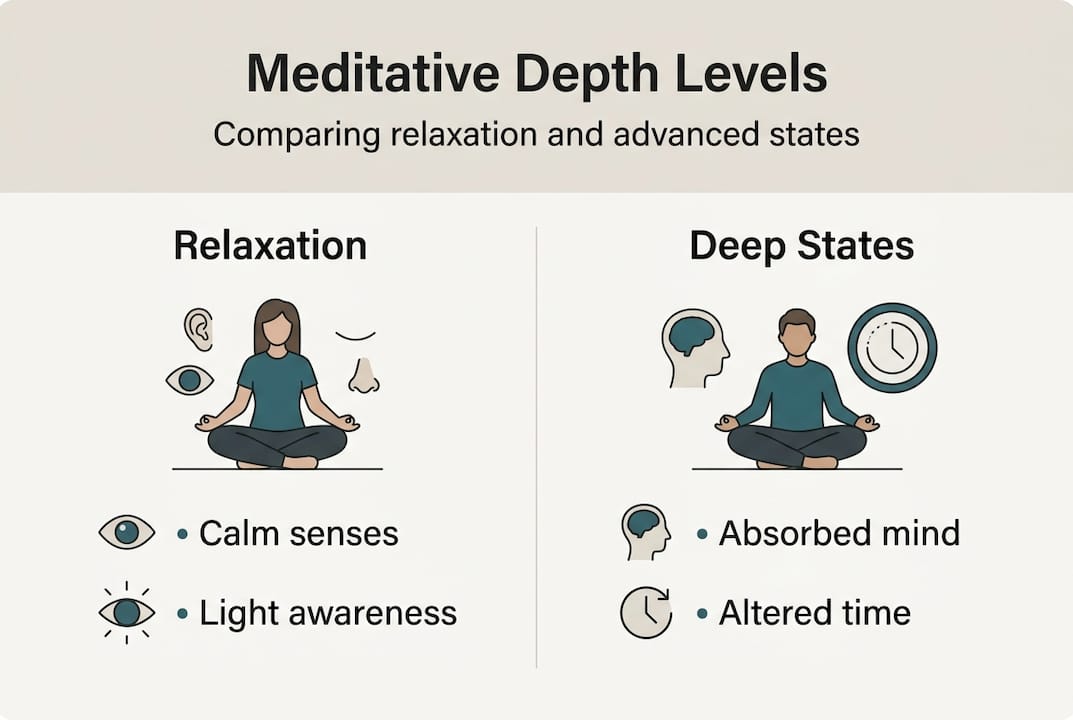
| State | Awareness | Thought activity | Time sense | Neural signature |
|---|---|---|---|---|
| Relaxation | Drowsy, wandering | Frequent | Normal | Minimal change |
| Deep meditation | Stable, receptive | Occasional | Distorted | Theta/alpha shift |
| Jhana | Absorbed, unified | Near absent | Dissolved | High coherence |
| Extended Cessation | Suspended | Absent | Non-existent | Unique complexity |
Jhanas and Extended Cessation involve boundaries of volitional consciousness that are measurably distinct from sleep or anaesthesia, which is remarkable when you consider how still a person in these states appears from the outside. The brain isn’t shutting down. It’s doing something categorically different.
This is where sound becomes genuinely extraordinary. Immersive, guided loving-kindness audio significantly aids entry into advanced meditative states, with enhanced subjective depth that self-directed silent practice often can’t match, especially for those earlier in their journey.
Orchestral soundscapes, binaural beats, and theta-frequency music all serve as scaffolding. They don’t meditate for you. But they create an acoustic environment in which the nervous system finds it considerably easier to release its habitual grip and slip into absorption. Think of it like setting a fire in a well-built hearth versus trying to start one in the open wind.
Pro Tip: Try pairing meditation hertz for deep relaxation tracks with a brief body scan at the start of your session. This grounds attention in the physical before the music carries awareness into the more refined frequencies. If you’re curious about format differences, comparing isochronic tones vs binaural beats can help you choose the right vehicle for your particular practice.
Why most people never truly reach deep meditative absorption
Looking beyond the science and techniques, there’s something most articles on this topic quietly skip over: why so many sincere, consistent practitioners never actually get there.
I’ll be direct. The single biggest obstacle isn’t technique. It isn’t time. It isn’t even the quality of your cushion (though an uncomfortable one is its own special misery). It’s the belief that depth is something you achieve by trying harder. That belief is, to put it gently, completely wrong.
Conventional meditation culture worships discipline and effort, which are useful up to a point, roughly equivalent to learning to drive. But nobody learns to relax their grip on the wheel by gripping harder. Letting go, not efforting, is what neurophenomenology research consistently identifies as the gateway to genuine depth. The meditators who reach advanced states are, almost without exception, the ones who stopped trying to reach them.
This is where a well-crafted soundscape becomes more than a luxury. It creates the conditions for surrender without requiring you to manufacture it by willpower. A session with immersive orchestral music can carry your nervous system across the threshold that years of silent striving sometimes cannot. I’ve watched this happen, and it’s a bit like watching someone finally stop fighting the current and just float. The river does the rest.
If you want a practical starting point, this deep focus meditation guide offers a useful reframe. The real work isn’t concentration. It’s learning to recognise when concentration has done its job, and then gently, joyfully, setting it down.
Enhance your meditation with immersive soundscapes
If you’re ready to translate these insights into deeper practice, carefully crafted musical tools can help bridge the gap between understanding and actual experience.
At Orchestral Meditations, we’ve built our entire library around this exact challenge: creating sound that supports the progression from surface calm to genuine absorption. Our recordings, made at Abbey Road Studios with the National Philharmonic, aren’t decorative background music. They’re engineered with theta frequencies, binaural beats, and 3D surround sound specifically to mirror the neural conditions of deep meditative states. You can explore meditation music across a range of depths and intentions, find personalised meditation music tailored to your practice, or work with our Solfeggio soundscapes for frequency-specific sessions. The science is in the sound.
Frequently asked questions
How long does it take to reach a deep meditative state?
Deep states often require weeks or months of consistent practice, though immersive sound can meaningfully accelerate progress for many practitioners. Individual variation is significant, so patience alongside the right tools matters greatly.
What is the difference between relaxation and a deep meditative state?
Deep meditation shows neural patterns not present in simple relaxation, including distinct EEG and fMRI signatures tied to altered consciousness. Relaxation softens the body; deep states fundamentally shift the quality of awareness.
Can binaural beats really help you reach deep states?
Immersive sound enhances subjective depth particularly when combined with a letting-go approach and regular practice. Binaural beats appear to support this process, though they work best as a catalyst rather than a shortcut.
How do you know if you’ve reached a deep state?
The clearest signs are a dissolved sense of time, profound stillness, reduced body awareness, and sometimes a quality of bliss or warmth. MEDEQ, VAS, EEG, and fMRI can objectively confirm what your inner experience is already telling you.
Recommended
- Deep Relaxation Guide: Mindful Steps And Orchestral Soundscapes
- The Best Meditation Music Only For Deep Relaxation And Mindfulness
- Transformative Deep Theta Meditation Music For Mindfulness And Healing
- Relax And Unwind With Meditation And Sleep Music
- Swimming Mental Focus – Peak Performance Swim Camp