
The best Reiki meditation music is non-lyrical, ambient and orchestral, built from slow, steady layers rather than melodies that demand attention, often with gentle frequency elements such as 432 Hz or Solfeggio tones woven underneath. Start simply: pick one track, play it quietly in the background, and let it sit beneath the session rather than lead it. Think of it as a companion to Reiki, never a replacement for medical care or professional treatment.
TL;DR:
- Use slow, steady, and non-distracting music with a tempo below 70 bpm, avoiding sudden volume changes or dynamic peaks during Reiki sessions.
- Prioritize music with instrumental layers such as strings or pads, and exclude lyrics to prevent activating language centers that disrupt relaxation.
- Choose tracks composed with professional quality, live recordings, or spatial mixing, especially for binaural or surround sound experiences, to maintain depth without distraction.
- Build playlists tailored to session length, using seamless, tonal, and layered tracks for longer sessions, and keep a short reserve track ready for unexpected extensions.
- Adjust music setup carefully by positioning speakers evenly, playing at low volume, and checking with clients about sound sensitivities before starting a session.
What makes music actually work for Reiki sessions
The best Reiki music behaves a bit like a good stage manager: everything runs smoothly and nobody notices it’s there. The moment a listener consciously thinks “ooh, nice key change,” the spell is broken and the nervous system snaps back into alert mode instead of settling into the parasympathetic, rest-and-digest state that Reiki aims for.
A few features separate music that supports that quiet state from music that fights it.
- Tempo stays slow and steady, usually well under 70 beats per minute, with no sudden accelerations.
- Dynamics stay narrow: no crashing crescendos, no jarring silences.
- Instrumentation favours strings, pads and soft woodwind over anything percussive or brassy.
- Lyrics are absent. Words activate the language centres of the brain, which pulls attention away from body sensation.
Frequency layers such as 432 Hz, Solfeggio tones or binaural and theta elements are popular additions, and advocates say they encourage a more receptive mental state. The honest position is that this is contested territory scientifically, so treat frequency claims as a pleasant variable to experiment with, not a guarantee.
Production quality matters more than people expect: a well-mixed binaural or 3D surround track preserves depth without burying a practitioner’s voice, while a cheap looped file often has odd digital artefacts that tug at the ear.
Pro Tip: If a track makes you want to hum along or tap your foot, it is too active for a Reiki session, however pretty it sounds.
Playlists and track recipes for short and full Reiki sessions
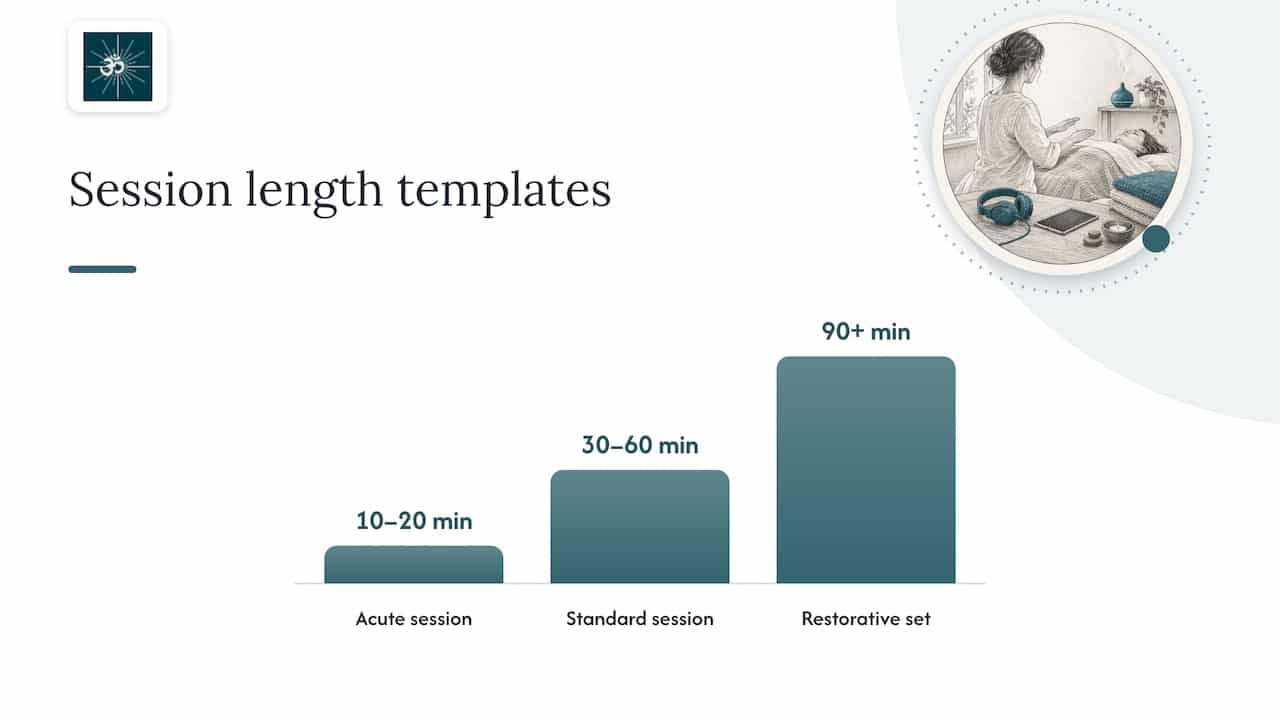
Building a Reiki soundtrack is a bit like packing for a trip: you need different kit for a quick overnight stay than for a fortnight away. Here are three practical templates.
- Acute session (10 to 20 minutes): one continuous ambient orchestral track with minimal structure, low in dynamic range, so there is no obvious “start” or “end” moment to distract the listener.
- Standard session (30 to 60 minutes): three to four tracks in the same key family or tonal palette, sequenced so the first fades in gently, the middle stretch stays sustained and textural, and the final track slowly thins out rather than stopping abruptly.
- Restorative set (90 minutes or a multi-session block): a longer, layered sequence that can include subtle binaural elements, useful for group work or extended personal practice where consistency across sittings matters.
Choose tracks by timbre first, frequency content second. If two pieces use wildly different instrumentation, a listener can feel the seam even with eyes closed.
Headphones suit binaural tracks particularly well, since the stereo separation that creates the binaural effect depends on each ear receiving a distinct signal. Speakers work better for group sessions or when a practitioner needs to speak over the music occasionally.
For listeners who want professionally recorded options rather than generic loops, tracks composed by Robert Emery or Moritz Schneider through Orchestral Meditations offer a tested alternative, built specifically with these dosing and pacing principles in mind.
Pro Tip: Keep a short “reserve” track cued in case a session runs long. Switching apps mid-session breaks the mood faster than silence does.
Setting up the room, timing the music and checking in with consent
Getting the physical setup right matters as much as the track list. Position speakers so sound arrives evenly rather than from one direction, or offer over-ear headphones if the recipient is lying down and comfortable with them.
- Start the music before the session begins, so it is already established by the time hands-on or hands-off work starts.
- Keep volume low enough that a whispered question is still audible. This is the practical test for the “invisible” principle: if you have to raise your voice over the music, it is too loud.
- Plan the fade-out to coincide with the natural end of the session, giving the recipient a gentle re-entry rather than an abrupt stop.
- Ask about sound sensitivities, tinnitus or any history of sound-related trauma triggers before starting, since even gentle music can be uncomfortable for some people.
On timing: a meta-analysis of Reiki therapy found that short acute interventions of 20 minutes or less can produce measurable benefit, while subgroup analysis pointed to stronger improvements in quality of life with courses of eight or more sessions, each around 60 minutes. That suggests both a quick single sitting and a longer repeated course have their place, depending on what the client needs that day.
What the research actually says about music and Reiki
It’s worth being honest about where the evidence is solid and where it’s still thin. Systematic reviews of music therapy have linked passive music listening to improvements in sleep quality, depressive symptoms and anxiety across clinical populations, which gives a reasonable physiological basis for pairing ambient music with Reiki’s relaxation aims.
A systematic review of placebo-controlled Reiki trials found therapeutic effects above placebo for some mental health symptoms including stress, depression and anxiety, though the authors note that higher-quality trials are still needed before firmer conclusions can be drawn.
That caveat matters. Reiki research faces real design challenges: control conditions are hard to standardise, and outcomes like “felt more relaxed” are inherently subjective.
- Expect calmer breathing and reduced mental chatter during a session, not a guaranteed cure for any condition.
- Measure benefit informally: note mood, sleep quality or stress levels before and after a few sessions rather than judging from one sitting.
- Treat Reiki and its music as complementary support alongside, never instead of, medical or psychological treatment.
Why production quality and named composers change the listening experience
Not all ambient tracks are built the same way, and the difference shows up the moment you put on decent headphones. Recordings made at Abbey Road Studios with live musicians from the National Philharmonic carry a warmth and depth that looped synthetic pads simply can’t fake, and when that’s combined with 3D surround mixing and deliberately designed binaural layers, the result sits underneath a Reiki session rather than distracting from it.
- Live orchestral recording avoids the repetitive loop artefacts common in generic meditation playlists.
- 3D surround and binaural mixing preserve spatial depth without masking a practitioner’s spoken cues.
- Frequency content designed with intent, rather than added as an afterthought, tends to sit more comfortably in a long session.
Knowing who composed and produced a track is not a trivial detail. Robert Emery, a British composer and producer with a background conducting and arranging for film and orchestral projects, and Moritz Schneider, who brings a complementary production sensibility to frequency-based soundscapes, each shape how a piece of music breathes, where it swells and where it stays still. That craftsmanship is exactly what separates a track built for meditative states from stock ambient audio repurposed from a sound-effects library.
As with any frequency claim, test individually: what settles one listener might feel oddly clinical to another, so treat a producer’s intent as a starting point rather than a promise.
Where Reiki meditation music actually came from
Reiki itself traces back to early twentieth-century Japan, developed as a technique for stress reduction and relaxation using light touch to support the body’s own life force energy, known as Ki. Music was not originally a fixed part of the practice. Early sessions were often silent, with the practitioner’s hands and presence doing the work.
As Reiki spread westward through the latter half of the twentieth century, practitioners began experimenting with ambient sound to help clients settle more quickly, borrowing from the broader relaxation and new-age music movements that grew alongside yoga and massage therapy in the 1970s and 1980s. Early Reiki soundtracks tended to be simple: synthesiser pads, nature recordings, the odd wind chime.
The frequency-based strand of the tradition, built around Solfeggio tones and 432 Hz tuning, arrived later and drew on older claims about tuning systems and their effects on the body, claims that remain more folklore than settled science. What has genuinely moved forward is production quality. Where a 1980s relaxation cassette might have used a single synthesiser, modern Reiki soundtracks increasingly draw on orchestral recording techniques and spatial mixing that simply weren’t available to earlier composers, which is part of why live-recorded, professionally produced options now sit alongside the older synth-pad tradition rather than replacing it outright.
The different sounds you’ll find under the Reiki music umbrella
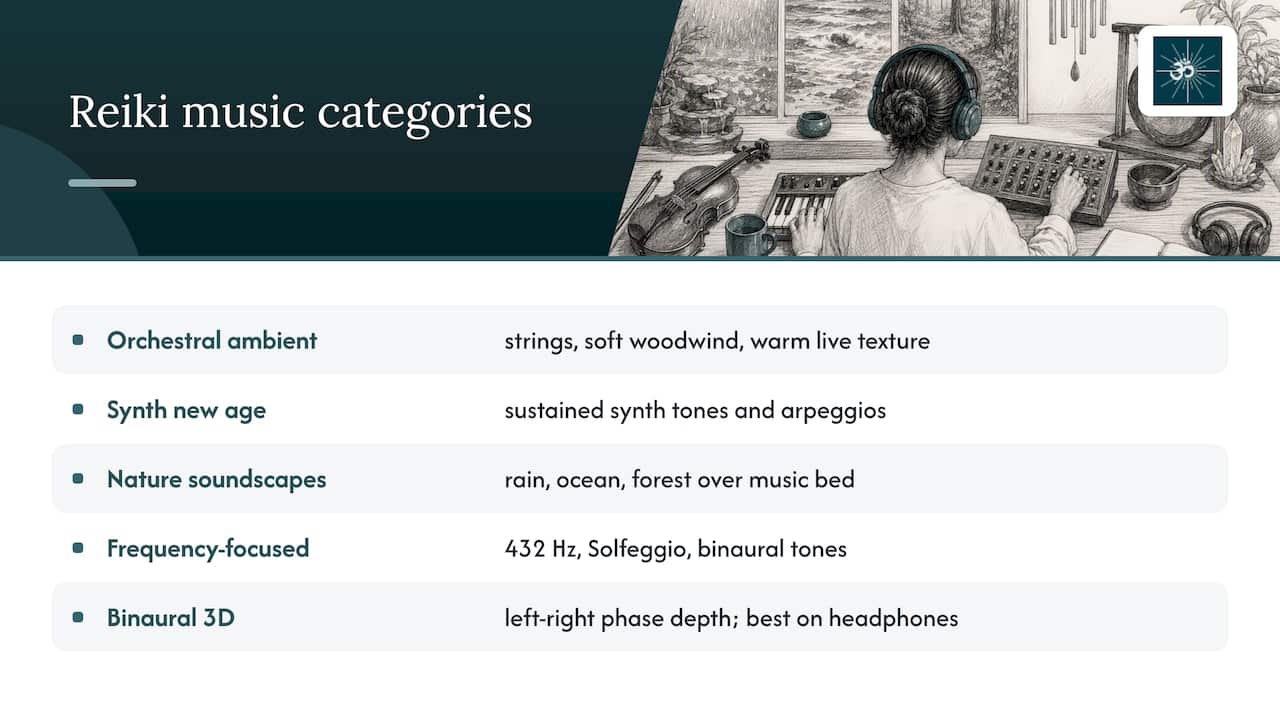
Reiki playlists are not one genre, they are several overlapping traditions, each with a slightly different feel.
Orchestral ambient uses strings, soft woodwind and occasional choir-like pads, often recorded with live musicians, giving a warmer and more textured sound than purely electronic alternatives.
Synth-based new age relies on sustained synthesiser tones and simple arpeggios, a style that has dominated meditation music since the 1980s and remains widely available, though quality varies enormously between producers.
Nature-infused soundscapes blend rainfall, ocean waves or forest ambience with a musical bed underneath, popular with listeners who find pure instrumental music too exposed or quiet.
Frequency-focused tracks foreground 432 Hz tuning, Solfeggio tones or binaural beats as the main selling point, sometimes with minimal musical structure around them.
Binaural and 3D surround productions use specific left-right phase differences, best experienced on headphones, designed to create a subtle sense of movement or depth that flat stereo mixes cannot replicate.
Most practitioners end up mixing styles across a session rather than sticking rigidly to one, pairing an orchestral opening with a frequency-focused middle section, for instance.
Building a Reiki playlist that actually fits you
A playlist built from other people’s favourites rarely fits as well as one built around your own responses, so treat the first few sessions as a testing phase rather than a search for the “correct” answer.
Start by noticing what pulls your attention away. If percussive accents make you tense slightly, remove anything with a drum pulse. If you find strings soothing but synth pads feel cold, lean orchestral.
Group tracks by key or tonal centre rather than by title or artist, since a jarring key change between songs is one of the most common reasons a playlist feels disjointed partway through.
Keep a short note after each session: which track played, how you felt afterwards, whether anything jarred you out of the state. Over four or five sessions, a pattern usually emerges.
Build separate playlists for separate purposes: one short and simple for acute, time-pressured sessions, one longer and more layered for extended personal practice, rather than trying to make a single list do both jobs.
Getting the sound right: equipment that actually matters
You don’t need a recording studio, but a few equipment choices make a genuine difference to how immersive a session feels.
For headphone listening, especially with binaural tracks, closed-back over-ear headphones tend to outperform earbuds, since they block more outside noise and preserve the stereo separation binaural mixing depends on.
For room-based sessions, two speakers positioned to create even coverage across the space beat a single soundbar or a phone speaker, which tend to concentrate sound in one direction and lose the low end entirely.
Bluetooth convenience is fine for most listeners, though a wired connection avoids the occasional dropout or compression artefact that can jolt a deeply relaxed listener.
Volume control matters more than speaker price. A mid-range speaker played at the right low volume will outperform an expensive system turned up too loud, since loudness itself works against the relaxation response you’re trying to encourage.
A personal note on timing and listening with intention
For a brief 20-minute intervention, we reach for a single continuous track with no obvious beginning or end. For a full session, we build a short sequence and let it breathe.
What matters more than any frequency claim is the client in front of you: comfort always outranks a “recommended” track. Try different pieces, jot a line afterwards about what landed, and let that feedback shape the next session.
— ROBERT
Bringing professionally produced Reiki music into your practice
If you’d rather work with recordings built specifically for this purpose than assemble a playlist from scratch, our library gives you a direct route in. We offer single track purchases, a Personal subscription at 21 EUR per month for individual meditation and Reiki use, and a Professional subscription at 150 EUR per month for therapists, yoga teachers and practitioners who need commercial licensing.
Many tracks are recorded with live musicians at renowned studios and composed with frequency layers and spatial mixing built in from the start rather than bolted on afterwards. That matters if you’re choosing between a generic ambient loop and something designed, from the first note, to sit quietly beneath a Reiki session.
Our Royalty Free Meditation Music range covers licensing for practitioners who want to use tracks across client sessions, apps or guided recordings. Start with a free sample, see how a properly produced orchestral track feels under your hands, and take it from there.
This article is general information, not a substitute for advice from a qualified doctor. Consult a qualified healthcare professional about your own circumstances before acting on anything here.
FAQ
What does listening to Reiki music do?
Reiki music aims to quiet mental chatter and support the relaxed, parasympathetic state that Reiki itself tries to encourage. Reviews of passive music listening link it to reduced anxiety and improved mood, which gives a reasonable basis for using it alongside hands-on or hands-off energy work.
What is the best music for meditation?
The best meditation music is slow, non-lyrical and low in dynamic range, typically orchestral or ambient pads rather than anything with a strong beat or vocal line. Many listeners also favour tracks with gentle frequency elements, such as 432 Hz or Solfeggio tones, though individual response varies considerably.
What is Reiki meditation?
Reiki is a Japanese technique for stress reduction and relaxation that uses light touch to support the body’s own energy, often practised alongside a meditative, quiet state. It is widely treated as a complementary therapy, meant to sit alongside rather than replace medical or psychological treatment.
Why did I cry during a Reiki session?
Crying during a Reiki session is a common response when the body shifts into a deeply relaxed state and releases built-up tension. It does not signal that anything has gone wrong, and many practitioners view it as a sign the session reached a genuinely restful state rather than a cause for concern.