
Yes, thoughtfully chosen meditation and therapeutic music can comfort people at the end of life and support the families sitting beside them, and we can tell you exactly how to use it. The World Health Organization points to gentle sound as part of a comforting clinical environment, and peer-reviewed reviews back that up with real data. Your two practical routes are live therapeutic music from a trained musician or hospice music therapist, and carefully curated recordings you can play at the bedside, including the orchestral meditations we produce for exactly this kind of quiet, dignified listening.
TL;DR:
- Live hospice musicians can adjust to breathing and mood during visits lasting five to twenty minutes; recordings suit nights, thin staffing, and infection control limits.
- Keep playback quiet enough for conversation, download tracks before entering care settings, and use a speaker for shared listening or headphones when sound overwhelms.
- Ask relatives for meaningful songs, sample each track first, and stop promptly if the patient turns away, raises a hand, becomes agitated, or grows tearful.
- Small, varied studies report improvements in anxiety, mood, pain, and spiritual health, but music complements medical symptom care and does not replace it.
- Families can download private tracks for €21 monthly; the €150 monthly professional subscription covers licensed use by therapists and care teams.
How music therapy and therapeutic music work at the end of life
Nobody fully understands why a half-remembered tune can do what morphine cannot, but we have some solid clues. Music reaches the brain through pathways that stay active even when speech and memory begin to fade, which is why a familiar song can suddenly bring back a wedding day, a childhood kitchen, or a parent’s voice.
A few mechanisms seem to be doing the heavy lifting:
- Memory and identity: familiar songs trigger autobiographical memories, helping someone feel like themselves again, even briefly.
- Physiological calming: slow tempos and steady rhythms can ease breathing and heart rate, nudging the body toward rest.
- Non-verbal expression: music offers a route to comfort and meaning when words have become difficult or exhausting.
It is worth drawing a clear line between two different things. Clinical music therapy is goal-directed and led by a trained therapist responding to the patient in real time. Therapeutic recordings, the kind families play from a phone or speaker, are simpler but still valuable when chosen with care and attention.
Real-life applications: bedside formats, live sessions and what recorded playlists should sound like
What actually happens at the bedside looks less like a performance and more like a gentle presence. A hospice musician might visit for five to twenty minutes, playing softly and watching how the patient responses. Families often leave a playlist running quietly in the background during visits, or use it to ease the transition into rest.
A workable routine tends to follow this order:
- Start quiet: keep the volume low enough that conversation can still happen over it if needed.
- Choose the format: a small speaker works for shared moments, headphones for a patient who is easily overstimulated.
- Prepare for offline use: download tracks in advance, since hospital and hospice Wi-Fi is not always reliable.
Slow instrumental pieces tend to work well: solo piano, harp, gentle orchestral meditations, and soft blends with ambient nature sounds. Live music has an edge when a musician can respond moment to moment to a patient’s breathing or mood, but recordings are often the more practical choice outside visiting hours, when staffing is thin, or where infection control limits who can come to the bedside.
Pro Tip: Keep one short, calm track cued and ready; in a difficult moment, you will not want to be scrolling through a playlist.
How families and caregivers can assemble and use hospice meditation playlists
Building a playlist does not need to be complicated, and it often means more coming from family than from a professional.
- Gather the meaningful songs first: ask relatives for titles that carry real memories, then sample each one briefly before adding it.
- Add calming instrumentals for the gaps: these smooth the transitions between meaningful songs and quieter rest periods.
- Test and watch: play a short section and observe the reaction before committing to a full track.
A basic MP3 player or a phone with downloaded, labelled folders (try “Morning calm”, “Evening rest”, “Family favourites”) saves fumbling at a moment that calls for steadiness. Pack spare batteries or a charger, since a dead device at the wrong time is its own small heartbreak.
Faith and language matter here too: a hymn in one’s first language can land very differently from an orchestral piece, however well made. Use a soft verbal cue, such as “shall we have a little music now?”, before starting or stopping, and always be ready to turn it off the moment it stops helping.
Pro Tip: Consent still matters here, even when words are hard to find; a hand gently raised or a turned head can be an answer.
When to be cautious: recognising and preventing negative reactions
Music is not universally soothing, and watching for the wrong reaction matters as much as choosing the right track.
- Watch for withdrawal, agitation or tearfulness that does not settle: these can signal the music is adding to distress rather than easing it.
- Common culprits: volume that is too loud, lyrics that land unexpectedly hard, or a song tied to a painful memory.
- Simple fixes: pause, switch to something quieter and more ambient, or shorten the session.
If a patient’s reaction feels complex or does not resolve easily, loop in hospice staff or a clinical music therapist rather than guessing.
Why it matters: evidence summary and practical outcomes
The evidence base here is encouraging without being overblown. A Cochrane review and protocol identifies music therapy as a promising adjunct in end-of-life care, with improvements reported in anxiety, mood and quality of life, though the trials behind this tend to be small and varied in design. A separate review of the empirical data found similar patterns: better pain, anxiety, mood and spiritual well-being scores across several small studies, alongside a consistent call for larger, more rigorous trials.
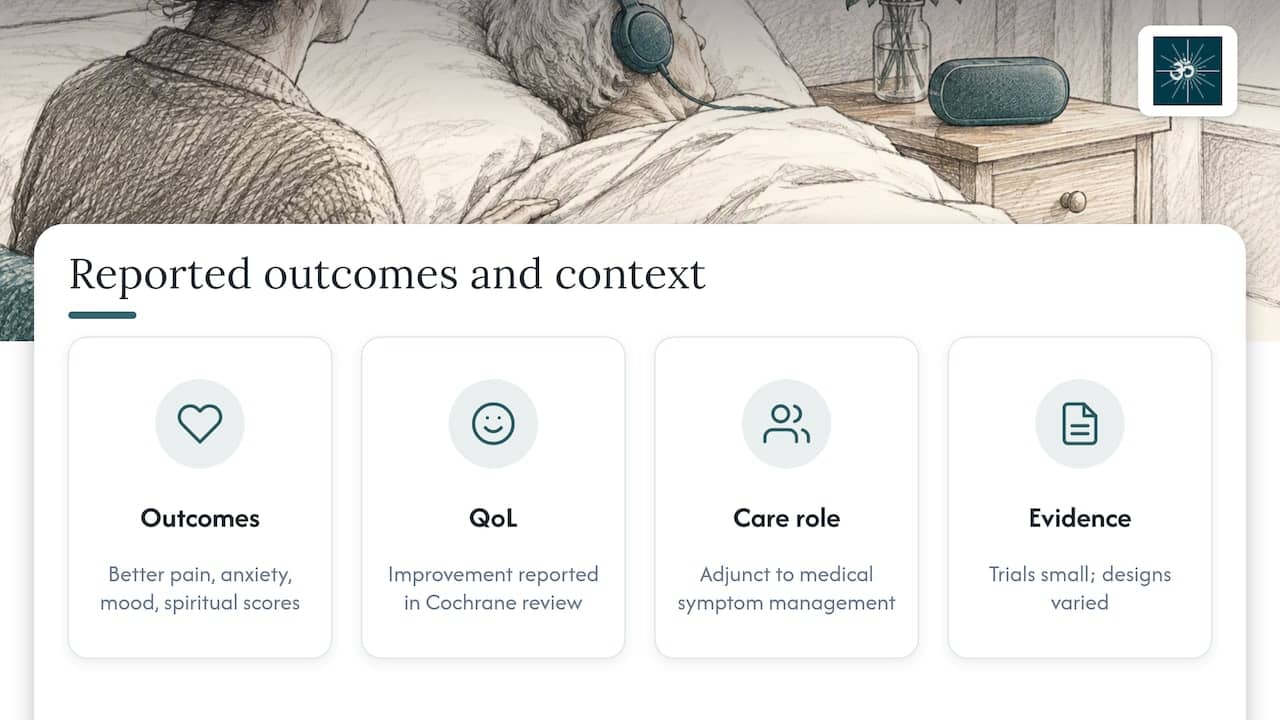
Music interventions show consistent positive signals for reduced anxiety and improved comfort in meta-analyses of terminally ill patients, even as researchers keep pushing for bigger sample sizes. The honest framing is that music supports holistic care; it sits alongside medical symptom management rather than replacing it.
Charity-led work shows the human side of this data. Marie Curie’s end-of-life playlist project gathered songs chosen by people living with terminal illness, and the range was wide, proving comfort through music is deeply personal rather than one-size-fits-all.
Orchestral Meditations: recordings built for moments like this
Our orchestral meditations feature live musicianship combined with binaural and 3D surround techniques designed to create a genuinely immersive listening bed rather than a thin backing track. Our composer and producer, Robert Emery, has extensive experience working across film, television and concert recording, shaping orchestral sound with attention to detail suited for sensitive listening environments.
In practice, this works well:
- Offline downloads: saved in advance, so a patchy connection never interrupts a quiet moment.
- Low-volume orchestral beds: played softly in the background during rest or family visits.
- Licensed tracks for group settings: useful for hospice teams running shared sessions or recorded guided moments.
Compassionate priorities when using music at end of life
If there is one thing we would want you to hold onto, it is this: the patient’s own preferences and dignity come before any idea of a perfect playlist. Simplicity and presence usually matter more than production values. When a situation feels complicated or distressing, a hospice music therapist or staff member is worth bringing in; you do not have to work this out alone.
— ROBERT
Finding the right music without the guesswork
We built our personal and professional subscriptions so families and care teams never have to settle for generic streaming playlists when something more considered is available. The personal subscription gives individuals downloadable orchestral tracks for private hospice playlists, while the professional subscription adds clear licensing for therapists and care settings running group sessions.

- Personal subscription: €21 per month, downloadable tracks for private use.
- Professional subscription: €150 per month, licensed for therapists and care teams.
- Royalty-free tracks: single purchases for apps, guided sessions or group use, priced on request.
| Option | Best for | Price |
|---|---|---|
| Personal subscription | Family playlists at home | €21 per month |
| Professional subscription | Hospice teams, therapists | €150 per month |
| Royalty-free tracks | Apps, group sessions | On request |
For families building a wider care plan, a palliative care checklist can help you think through the practical side alongside the music.
FAQ
Can music really comfort someone who is unconscious or unresponsive?
Many hospice practitioners report that patients respond to music even when they cannot speak or open their eyes, often through slowed breathing or a visibly relaxed body. The evidence base is still developing, but systematic reviews support gentle auditory stimulation as part of comforting end-of-life care.
Is live music better than recorded playlists for hospice patients?
Live music allows a musician to respond in real time to a patient’s breathing, mood or small gestures, which recordings cannot do. Recordings are often more practical outside visiting hours or where staffing is limited, and both approaches appear widely in hospice practice.
How loud should hospice meditation music be?
Volume should stay low enough to allow conversation over it and never startle a resting patient. Starting quiet and adjusting based on the patient’s visible comfort is the safest approach.
What should I do if my loved one gets upset during a song?
Pause the music immediately and switch to something quieter or stop altogether if distress continues. If the reaction feels unusual or does not settle, hospice staff or a music therapist can help work out what happened.
Where can I find high-quality meditation recordings for hospice use?
Our royalty-free meditation music offers orchestral tracks recorded at Abbey Road Studios, suitable for personal playlists or licensed group use in care settings.