
The short answer: let your EMDR therapist decide what kind of stimulation drives the reprocessing, and bring your own choice of calm, slow, instrumental music for the parts of the work where you need to feel safe: preparation, resourcing and grounding. Music is a helper in this therapy, not a replacement for it, and the best pieces are the ones that steady you without pulling your attention away from what you are doing.
I am a pianist and conductor by trade, not a clinician, so I will lean on the people who are. Below is what the German and international literature says about music in EMDR, what to listen for when you pick a piece, and how to use it without nasty surprises.
TL;DR
- In EMDR, the type of stimulation (eye movements, taps or headphone sounds) is agreed with your therapist in the preparation phase, along with a stop signal. Music choices belong in that same conversation.
- For resourcing, safe-place work and grounding, slow, steady, mostly instrumental music with low tones is a sensible starting point.
- Open headphones and a volume control you can reach yourself keep you in charge and let you hear your therapist.
- Bilateral audio and calming music are different tools. Calming orchestral pieces suit the quiet phases of the work and the time between sessions.
- Trauma work should be led by a trained EMDR therapist. Music is there to support that work.
What music actually does in an EMDR session
EMDR (Eye Movement Desensitisation and Reprocessing) is a trauma therapy in which you revisit a difficult memory in small, controlled doses while your attention is alternately stimulated left and right. The stimulation can be guided eye movements, alternating touch on the hands or sounds in the headphones.
According to a German article in the Psychotherapeutenjournal by Schubbe, the form of stimulation is agreed in the preparation phase, and during processing, recordings with bilateral stimulating sound can be used. That is the first thing to know: music enters EMDR through a door your therapist holds open, not one you kick in on the day.
Music therapists have written about it in more colourful terms. In EMDR Therapy Quarterly, Sophie Leader describes music as a calming co-facilitator: a steady beat and a recurring form can help a client who struggles to connect with a difficult emotion, almost like someone holding your hand and saying “I get it”. I love that image, because it matches what every musician knows: a good, simple piece of music keeps time for you when you cannot.
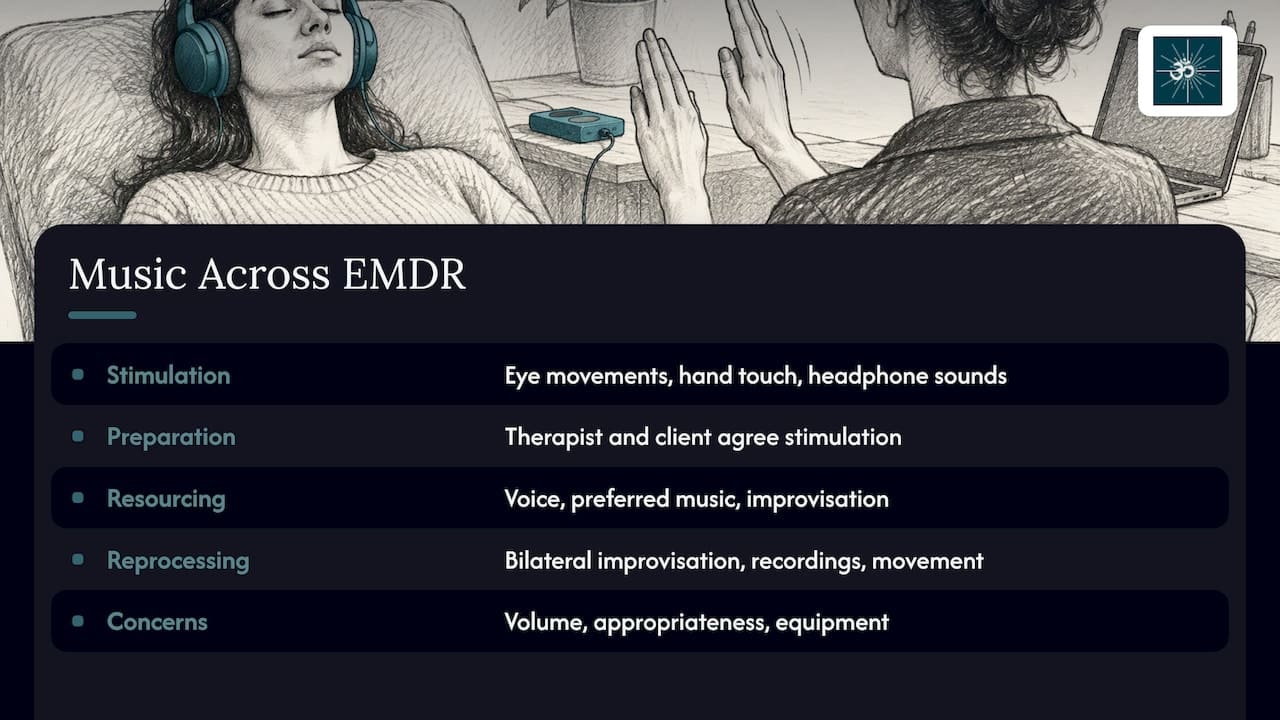
A phenomenological study of six EMDR-trained music therapists by Kavaliova (2024) found music used in every phase: for resourcing (voice, music the client prefers, improvisation), for reprocessing (improvisation with bilateral stimulation, pre-recorded music, movement to music) and with effects such as a sense of safety, more efficient reprocessing and deeper experiencing. Volume, appropriateness and equipment came up as central concerns. Hold on to that last point, we will come back to it.
Bilateral audio versus calming music: two different jobs
This is where most searches go sideways. Plenty of videos and playlists promise “EMDR music”, and they are not all doing the same thing.
Bilateral audio stimulation is a sound that alternates between your left and right ear. The German medical encyclopaedia eMedpedia explains that bilateral alternating stimulation is usually done with horizontal eye movements, with tactile stimulation (alternating touch on the backs of the hands) and acoustic stimulation through headphones as alternatives. It also notes that the dose is adjusted to the task: low (slow, few repetitions) for pure resource techniques, and high (fast, many repetitions) for the standard processing technique.
Calming music has no such function. It does not drive reprocessing. What it does is help your nervous system settle, give you a reliable sound to return to, and make the safe place in your mind feel a little more real.
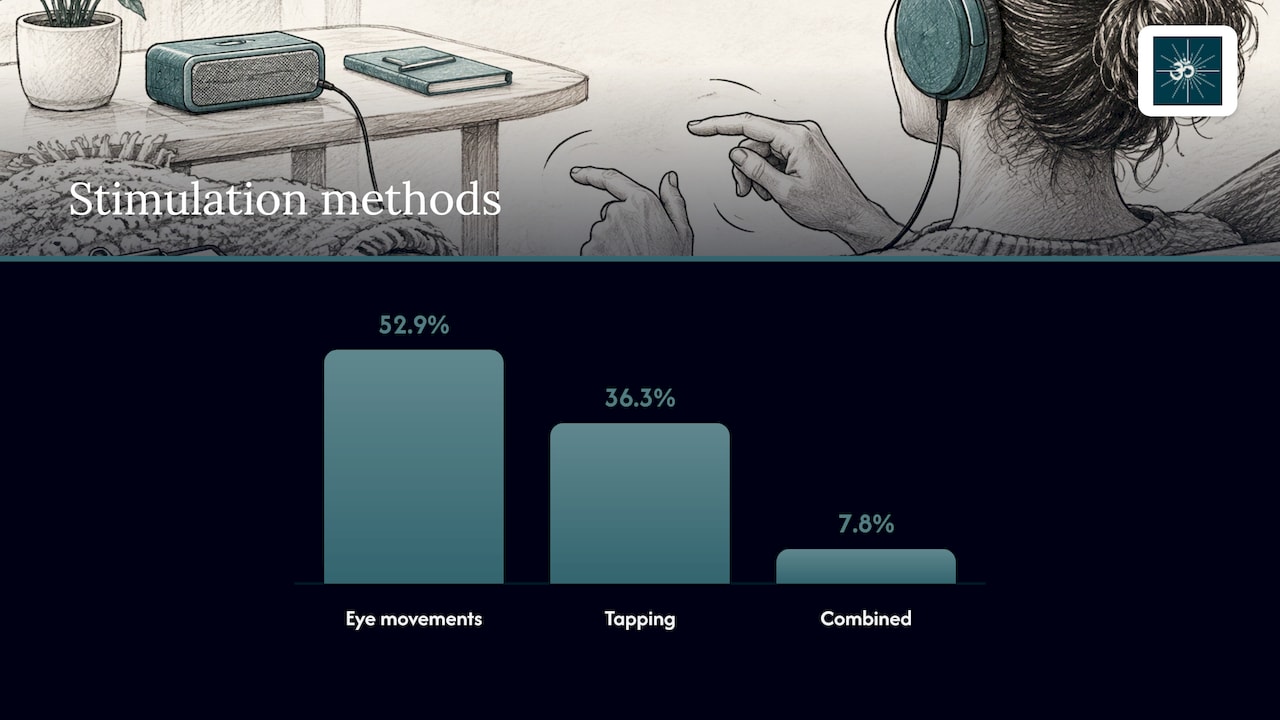
Researchers are candid that eye movements remain the best-studied form. Hase (Frontiers in Psychology, 2021) points out that the evidence base for EMDR rests mainly on eye-movement studies, and that what matters most is that the therapist can watch your process and adjust the dose, speed and rhythm. In German practice, too, eye movements are the most common choice: a 2021 study by Mischler and colleagues of 102 video-conference sessions run by 23 therapists found stimulation by eye movements in 52.9% of sessions, by tapping in 36.3% and by a combination in 7.8%.
What does that mean for you? Do not decide on your own to swap your therapist’s chosen stimulation for a playlist. Ask what they use, and ask where music could fit around it.
Matching music to the phases of EMDR
EMDR runs through eight phases. You do not need all of them memorised, but four moments are where music is most often discussed.
Preparation and stabilisation
In the early phases your therapist builds your resources: a safe place, a calm place, a helpful figure. The British Association for Counselling and Psychotherapy (BACP) describes how, in phase 2, a safe place is supported with slow bilateral eye movements or taps. Slow is the operative word. Hase notes that for installing resources the bilateral stimulation is generally slow, and cites research suggesting that slow stimulation produces a different pattern of brain activation that may ease access to positive memories.
This is the phase where your own music taste matters most. Kavaliova’s therapists describe client-preferred music as a resourcing tool. A piece that already makes you feel held is a good candidate, and it is worth telling your therapist which one it is.
Reprocessing
This is the demanding stretch. Hase describes fast stimulation in series of 20 to 30 seconds during reprocessing, and the BACP explains that in phase 4 the stimulation can also be sounds played alternately in each ear until distress on the SUD scale (the 0 to 10 rating of how disturbing the memory feels) reaches 0.
This is mostly a therapist-led, technical job. If your therapist suggests bilateral audio or a recording, follow their lead on the sound, speed and volume. Choosing your own atmospheric piece at this stage is something to agree first, since it can compete with the stimulation instead of supporting it.
Closure and grounding
Phase 7 is about making sure you leave the session steady. According to the BACP, grounding is secured before you walk out. A slow, warm piece with no sudden dynamic changes is a natural fit here: the aim is to bring your breathing down and your attention back into the room. Some people also pair this with sensory grounding, and a guide to grounding techniques for anxiety gives simple ideas you can combine with a calm piece of music.
Between sessions
EMDR does not stop when the hour does. Memories can feel stirred up for a few days, and a reliable listening ritual (the same piece, the same chair, the same time of evening) gives your nervous system something predictable. Writing a few lines about what came up is also a good habit, and a tool like putting feelings into words can give that exercise a structure.
What to look for in a piece of music
There is one study I find genuinely useful here, because it is specific. Grifoni and colleagues (2023) ran an Italian feasibility study called EMDR+, combining bilateral ear stimulation and eye movements with music personalised to each patient. For the reward songs they selected pieces with a slow, stable rhythm, many low tones, mostly a major key and mostly instrumental performance. All 12 patients with trauma completed the treatment without side effects, in an average of 8.5 sessions rather than the usual 12. It was a small study, and it is a pointer rather than a promise, but the music profile is a good checklist.
Translated into plain listening criteria:
- Slow, even pulse. Something around the pace of a relaxed resting heart is easier to settle into than anything driving or syncopated.
- Low register. Cellos, basses, low strings and soft low brass feel grounding. Piercing high notes tend to feel alert.
- Mostly instrumental. Lyrics pull you into language and story, which is the opposite of what you want when you are working with a memory.
- Gentle dynamics. No sudden swells, crashes or silences that make you jump. A piece that goes from a whisper to a thunderclap is a bad companion.
- Warm, major-leaning harmony. Not saccharine, just open and unthreatening.
- No history. Avoid anything tied to a person, a place or a period connected to your difficult memory. A piece you heard at the worst time of your life will bring that time with it, however pretty it is.
That last one is the point I would underline in red. I have watched people cry at a piano chord because of where they first heard it. Music is the most efficient memory-retrieval machine we have, which is wonderful for therapy and a nuisance when you pick the wrong piece.
One more piece of vocabulary. Binaural beats (a slightly different tone in each ear, which the brain blends into a perceived third tone) are not the same as bilateral stimulation, and neither is the same as an orchestral track. If a track claims to “do EMDR” for you, check with your therapist before you trust it.
Headphones, volume and your stop signal
The practical details are where a good session is made or lost.
In the EMDR+ study, open headphones allowed patients to hear the therapist’s voice and ambient sounds, and a separate volume control gave them control over the music. The authors see that patient control as a safety feature. Kavaliova’s therapists name volume and equipment as central too.
So, in practice:
- Open or semi-open headphones keep you connected to the room and to your therapist’s voice.
- Start quiet. You can always turn it up. It is much harder to un-hear something that startled you.
- Keep the volume control within your reach, so you never need to ask for permission to turn it down.
- Agree your stop signal. Schubbe describes this as part of the preparation phase, and it applies to music as much as to anything else. A raised hand is enough.
- Test the piece before the session, at the same volume, so the first time you hear it is not the first time you are working with a hard memory.
A note on safety that is not up for negotiation: EMDR should be learned and delivered by trained professionals. The German Federal Joint Committee (G-BA) assessment stresses that therapists should have attended sufficient training seminars with authorised EMDR trainers and that patients with dissociative disorders should only be treated by experienced EMDR therapists. If you live with dissociation, or you feel overwhelmed during a session, the person to talk to is your EMDR therapist, and in an emergency your local emergency services.
If you are a therapist or practitioner
Kavaliova argues that EMDR-trained music therapists bring extra tools (instruments, voice, live versus recorded music), more flexibility and knowledge of the neuroscience of music, and calls for music-specific training even for those who are not music therapists. If you work with clients, a short, well-chosen set of calm pieces in your room is worth more than a vast library. Ask each client which pieces feel safe, note them down alongside their safe place, and keep them consistent.
If you use recorded music in paid sessions, in group work or in content you publish, you also need the right licence for it. Streaming a personal playlist in a professional setting is a licensing question, not just a taste question.
Where our music fits
Orchestral Meditations is a royalty-free library of orchestral meditation music recorded with live musicians, including sessions at Abbey Road Studios with the National Philharmonic. The catalogue includes 3D surround sound, binaural, theta and Solfeggio-frequency tracks, with personal and professional licences for use in meditation, therapy, yoga, apps and guided audio.
For your own calm listening, the personal subscription is €21 per month. If you work with clients, the professional subscription is €150 per month and covers professional use. You can also browse individual tracks, such as Bes – Sleep Meditation for the evenings after a heavy session. Our article on science-backed sound and music explains how we think about sound design.

If you would like to see the whole range, the royalty-free meditation music page is the place to start.
Our perspective
I have spent a good part of my life in rooms where sixty or so musicians try to breathe at the same moment. It is oddly similar to what happens in a good therapy room: everything depends on a steady pulse and a sense that someone is keeping time for you.
That is why I am wary of anything that promises to “do the therapy” through a playlist. EMDR belongs to trained therapists, and what we offer sits beside it: calm, live-played orchestral music for the moments when you are resourcing, winding down or grounding yourself.
We record with live players because a room full of people breathing together sounds different from a sample library. Our recordings were made at Abbey Road Studios with the National Philharmonic, and the music is composed and produced by a small team, among them Moritz Schneider, with whom I have worked on projects for years, including an album for the Swiss singer SEVEN. I conducted and produced much of this, so I may be biased, but I have also spent two decades learning what a cello does to a room.
My advice is simple. Choose slow, low, instrumental pieces. Keep the volume in your own hands. Tell your therapist what you picked. And choose something you would happily hear on an ordinary Tuesday, because the best grounding music is the music you trust.
ROBERT
The people behind the music
Robert Emery, who composes, produces and conducts for Orchestral Meditations, is an English pianist, conductor and orchestrator. According to his Wikipedia entry, he became known performing with artists including Russell Watson, Meat Loaf and Stewart Copeland, was named music director of the National Philharmonic Orchestra of Great Britain in 2023, and recorded the meditation music at Abbey Road with over 128 musicians and singers. The same entry says that, together with composer Moritz Schneider, he composed, produced and conducted the 2017 album 4Colors for the Swiss singer SEVEN.
Why does that matter for your listening? A conductor knows how to shape dynamics so that a phrase swells and falls without startling anyone, which is exactly the property you want in calming music.
FAQ
Can I use any relaxing music in an EMDR session?
Not automatically. Your therapist agrees the form of stimulation with you in the preparation phase, so music should be part of that conversation. Slow, steady, mostly instrumental pieces with low tones are a good starting point for resourcing and grounding, as the EMDR+ study’s selection criteria suggest.
Is bilateral music the same as EMDR?
No. Bilateral audio is one possible form of stimulation within EMDR, usually through headphones, and it is dosed by the therapist. EMDR itself is a structured therapy with eight phases, and recordings alone are not a substitute for it.
What volume and headphones should I use?
Open headphones that let you hear your therapist and the room, and a volume control you can reach yourself, are the setup described in the EMDR+ study. Start quiet and agree a stop signal beforehand.
Can I listen to calm music between sessions?
Yes, many people find a regular listening ritual helpful for settling afterwards. Pick a piece with no link to the memory you are working on, and tell your therapist if anything stirs up strong feelings.
Do I need a licence to play music in my practice?
If you use recorded music professionally, in sessions, classes or published content, you need a licence that covers professional use. Our professional subscription is €150 per month and is designed for exactly that kind of use.
Sources
- Schubbe, EMDR, Brainspotting und Somatic Experiencing, Psychotherapeutenjournal 2/2014
- Leader, EMDR+Music Integrated Model, EMDR Therapy Quarterly
- Kavaliova, Exploration of Music-Based Experiences in the EMDR Therapy Process
- eMedpedia, EMDR, Traumatherapie
- Hase, The Structure of EMDR Therapy, Frontiers in Psychology
- Mischler et al., Therapists’ Experiences With the Effectiveness and Feasibility of Online EMDR
- BACP, How does EMDR really work?
- Grifoni et al., Auditory Personalization of EMDR Treatment
- G-BA, EMDR als Methode der Psychotherapie
- Robert Emery (pianist), Wikipedia
- Grounding techniques to calm anxiety
- Expressing emotions aloud