
Binaural beats do produce a genuine, measurable effect on brain activity, and for most people the realistic payoff sits in three areas: relaxation, sleep support and short bursts of focus. The catch is that the science is promising rather than settled. Studies show inconsistent results between individuals, so the honest answer is “probably helpful for many, guaranteed for none.” Treat it as a supportive tool alongside good sleep habits or breathing practice, not a substitute for medical care, and read on for the how and the how-much.
TL;DR:
- Binaural beats are most consistently effective for promoting relaxation and sleep, with positive results reported in sleep onset improvements and anxiety reduction.
- The brain perceives a phantom beat created by slight differences in tone between ears, requiring stereo headphones to maintain the illusion and targeting specific frequency ranges for mental states.
- Effects vary widely among individuals, with small sample sizes, inconsistent protocols, and short exposure windows limiting definitive scientific conclusions.
- Proper equipment, matching frequencies to goals, and integrating breathwork can enhance the comfort and potential benefits of binaural beat sessions.
- High-quality, professionally produced tracks with warm carrier tones and clear mixing provide a more pleasant experience, increasing the likelihood of sustained use and potential gains.
How binaural beats create the sensation of a “beat” in your head
Here’s the bit that trips most people up: there’s no actual third sound being played. Binaural beats are an auditory illusion. Your left ear hears one pure tone, your right ear hears a slightly different one, and your brain, doing its best impression of a slightly confused sound engineer, perceives a phantom pulsing “beat” that doesn’t exist in the audio file at all. That perceived beat equals the mathematical difference between the two tones, and it typically falls somewhere in the 1 to 30 Hz range.
Say that again in plain numbers: play a 200 Hz tone in your left ear and a 210 Hz tone in your right ear, and your brain conjures up a beat within the alpha range, associated with calm, relaxed alertness. Change the right ear’s tone to 204 Hz instead, and you create a beat deep in delta territory, the domain of slow-wave sleep.
This is why stereo headphones are non-negotiable. Play binaural beats through a phone speaker or a car stereo and both tones blend in open air before they reach your ears, and the illusion collapses. You need genuine separation, one tone per ear, which is precisely why every credible track is built for headphone listening. The underlying “carrier tone” (the base pitch each ear actually hears) also matters more than most listeners realise, something worth returning to later.
Frequency bands aren’t arbitrary either. Researchers and clinicians associate each range with a different mental state:
- Delta (0.5–4 Hz): deep, dreamless sleep
- Theta (4–8 Hz): meditative states, light sleep, some REM-related activity
- Alpha (8–13 Hz): calm relaxation, the “resting but awake” zone
- Beta (13–30 Hz): alert concentration, active problem-solving
- Gamma (30–50 Hz): high-level attention and information processing
Producers pick a target band, then reverse-engineer the two carrier tones to land the beat frequency exactly within the target frequency range. Simple maths, but it’s the entire mechanism behind why a “focus” track sounds different from a “sleep” track, beyond just the music layered on top.
What benefits do people actually report from binaural beats?
Ask ten people what binaural beats did for them and you’ll get ten slightly different answers, which is exactly what you’d expect from a tool whose evidence base is described as mixed rather than conclusive. Still, patterns emerge, and some are backed by more than anecdote.
Relaxation and anxiety reduction — supported by mixed but genuinely encouraging clinical evidence. Some trials report measurable drops in pre-operative anxiety and general stress scores among listeners exposed to alpha or theta-range beats, though systematic review evidence notes that other trials found no meaningful mood shift compared with a rhythmic control sound. Practical application: a short alpha session before a stressful meeting, or theta before winding down for the evening.
Sleep support — preliminary but promising. Several studies link delta and theta exposure to improved subjective sleep quality, particularly for people struggling with sleep onset rather than sleep maintenance. In practice, this tends to mean a 20 to 30 minute delta or theta track played as part of a wind-down routine rather than left running all night.
Focus and attention — genuinely mixed, but interesting where it appears. Beta and low-gamma tracks are the ones most often used for short, task-specific concentration boosts (writing, studying, repetitive admin) rather than long deep-work sessions. Anecdotal reports of moderate productivity lifts are common; robust cognitive-performance data is thinner on the ground.
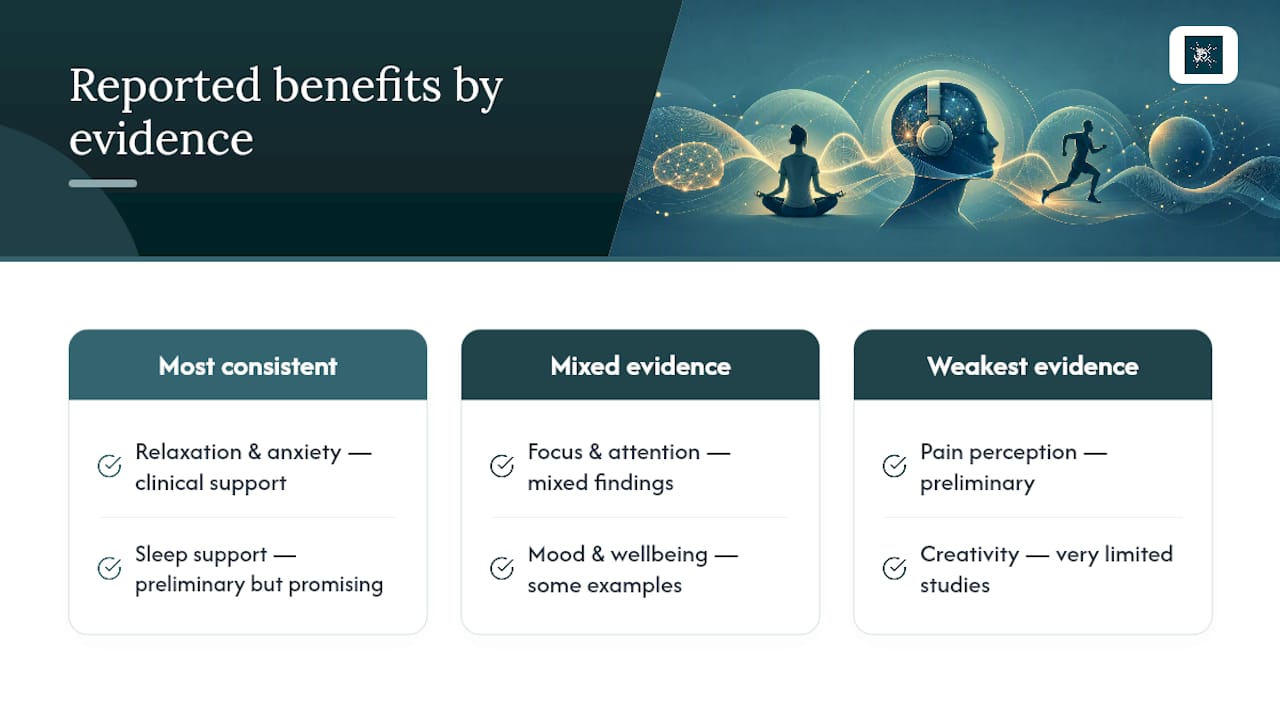
Mood and general wellbeing — supported by some clinical examples but inconsistent overall. Clinical findings describe short-term memory and mood benefits in specific contexts, but sample sizes are often small and protocols vary so much between studies that comparing them directly is difficult.
Pain perception and creativity — the thinnest evidence category here, largely preliminary, with a handful of small studies suggesting a possible effect on perceived pain intensity and divergent thinking tasks. Worth experimenting with, not worth relying on.
One consistent thread across the research on auditory beat stimulation is that anxiety and sleep are the two domains where positive findings appear most often, even as cognitive and mood effects stay inconsistent from study to study.
The pattern that emerges is fairly intuitive: the calmer, slower states (relaxation, sleep) show the most consistent positive signal, while the more demanding cognitive claims (focus, creativity) lean more on user reports than hard data.
What does the actual research say about binaural beats?
Strip away the marketing copy on most wellness apps and the underlying science looks like this: measurable, but not magic.
EEG studies confirm that binaural beats can genuinely entrain brain activity, meaning your cortical oscillations shift towards the target frequency. Research tracing the auditory pathway from brainstem to cortex has found real connectivity changes when binaural beats are played. But here’s the twist that rarely makes it into blog posts selling “instant relaxation”: monaural beats (a different, non-illusory stimulus) sometimes produce stronger entrainment than binaural ones, and mood modulation doesn’t reliably follow the EEG changes. Your brain waves can shift while you feel exactly the same.
That gap between what shows up on an EEG readout and what a person actually reports feeling is the single most important nuance in this entire topic. Entrainment is real and observable. Whether it translates into “I feel calmer” or “I focused better” is far less predictable, and depends heavily on the individual.
“Individual response depends on task parameters and personal differences,” according to commentary on variability in binaural beat responsiveness, which is really just a formal way of saying: what works brilliantly for your colleague might do nothing for you, and the only way to find out is to try it yourself and pay attention.
The methodological limitations behind the “mixed results” verdict are worth naming plainly, because they explain why no one can hand you a guarantee:
- Small sample sizes. Many trials run with a few dozen participants, not the hundreds needed for confident generalisation.
- Heterogeneous protocols. One study’s “theta session” might be shorter; another’s might be much longer. Comparing them is a bit like comparing two recipes that both claim to be “soup.”
- Short exposure windows. A lot of research measures effects after a single session, not after weeks of regular use.
- Weak controls. Not every trial compares binaural beats against a proper rhythmic or monaural control, which makes it hard to know whether the beat itself is doing the work or simply the act of sitting still with headphones on.
The practical conclusion, and the one worth holding onto: binaural beats are a reasonable, low-risk adjunct for relaxation and sleep support, sitting alongside things like breathing exercises or a wind-down routine. They are not, and should not be marketed as, a replacement for therapy, medication, or clinical treatment for anxiety, insomnia, or mood disorders. Where symptoms are serious or persistent, a clinician stays the primary port of call.
Are binaural beats safe? Side effects to know about
For most healthy adults, binaural beats are low-risk. That doesn’t mean risk-free, so it’s worth knowing what “feeling weird” actually means before you dismiss it or panic about it.
Mild, fairly common reactions include:
- Light dizziness or a slightly “swimmy” feeling, especially during the first few sessions
- Mild headache, often from listening at too high a volume or for too long in one sitting
- A general sense of disorientation or feeling “off,” which usually passes within minutes of finishing
Rarer but genuinely important: anyone with a history of seizures or epilepsy should be cautious, since rhythmic auditory (and especially combined audiovisual) stimulation has been linked to seizure risk in susceptible individuals. If that applies to you, speak to a doctor before experimenting.
A few sensible ground rules apply regardless of your history. Never listen while driving or operating machinery, since some tracks are designed to lower alertness. Keep volume moderate rather than loud, since louder isn’t more effective and can contribute to the headachy, overstimulated feeling some listeners report. And if a session leaves you distressed, unusually anxious, or just off, stop and don’t force it.
Anyone managing a severe mental health condition, or pregnant and wondering whether relaxation audio fits into their routine, should raise it with their clinician first rather than guessing.
Pro Tip: Start with a shorter session than you think you need, around ten minutes, before committing to a full 30 minute track. It’s much easier to spot how your body reacts to five minutes of theta than to sit through half an hour wondering if that odd, floaty feeling is normal.
How do you actually use binaural beats properly?
Getting this right isn’t complicated, but skipping the basics is exactly why some people try binaural beats once, feel nothing, and write the whole thing off.
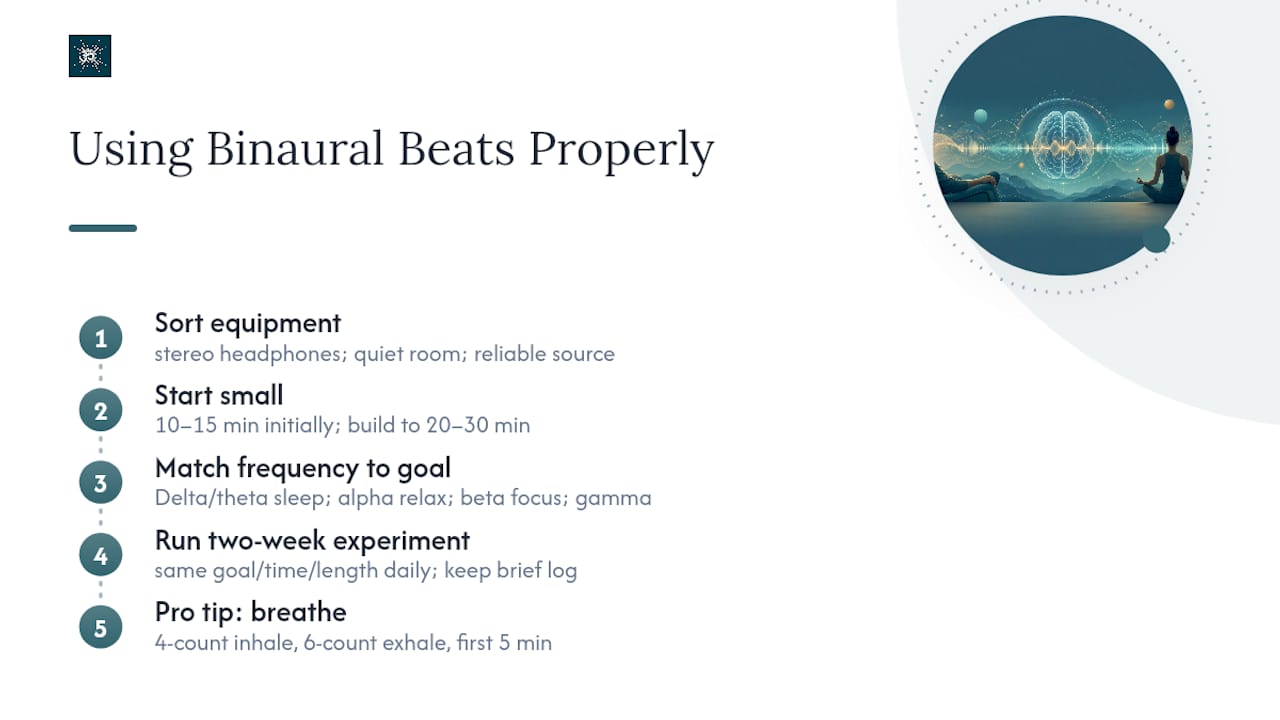
1. Sort your equipment first. You need proper stereo headphones (over-ear or in-ear, doesn’t matter which, as long as each ear gets its own isolated channel), a quiet room, and a reliable audio source. Skip the tinny laptop speakers entirely.
2. Start small. Ten to fifteen minutes for your first few sessions. Once you know how your body responds, build up towards 20 to 30 minutes for relaxation or focus work. Sleep-support sessions can run a little longer, but there’s no need to leave a track playing all night unless that genuinely feels comfortable for you.
3. Match the frequency to the goal. Delta or theta for winding down and sleep, alpha for general relaxation, beta for short concentration pushes, gamma if you’re curious about the high-attention end (though the evidence there is thinnest). Pay attention to carrier frequency too: very high carrier tones can sound harsh or tinny through cheaper headphones, while low, warm carriers tend to feel more comfortable over a longer session, which is part of why production quality genuinely shapes the experience.
4. Run a proper two-week experiment. Pick one goal, say, falling asleep faster. Use the same session length and roughly the same time each day. Keep a short log: energy, mood, how quickly you dropped off, anything odd you noticed. Two weeks gives you enough data points to spot a real pattern rather than one good (or bad) night skewing your impression.
Pro Tip: Pair your session with slow, deliberate breathing for the first five minutes, in for four counts, out for six. It won’t change what the beat frequency is doing neurologically, but it gives your body a second, very reliable relaxation cue while the audio does its work, and a bit of breathwork alongside sound therapy is a combination a lot of practitioners swear by.
Why production quality changes how binaural beats actually feel
This is the part that gets skipped in almost every “binaural beats explained” article, and it’s the part that matters most once you’ve decided the science is worth trying: not all binaural tracks are made equal, and the difference isn’t cosmetic.
Carrier tone choice affects how comfortable a session feels. A poorly chosen high carrier frequency can sound thin or almost irritating through mediocre headphones, undermining the very relaxation the track is supposed to deliver. Mixing quality matters just as much. Careful binaural or 3D mixing reduces intra-aural interference, the subtle clashing that can happen when two close frequencies aren’t balanced properly, which helps your brain “lock on” to the intended beat rather than fighting through a muddy signal.
This is where composition and production genuinely earn their place in the conversation, not as a sales pitch, but as a real variable. Orchestral Meditations works with composer and producer, Robert Emery, known for large-scale orchestral projects and his work as a conductor and broadcaster on classical music programming, and producer Moritz Schneider, whose background in sound engineering informs the layering of orchestral texture around binaural frequencies rather than leaving listeners with a bare, clinical tone. The idea is straightforward: a low, warm carrier tone wrapped in a properly recorded orchestral arrangement is a more pleasant, easier listen than a raw sine-wave beat, even though the underlying frequency mechanics are identical.
If you’re choosing a track for yourself, a few practical markers help separate a well-produced binaural recording from a rushed one:
- Low, comfortable carrier tones rather than piercing high frequencies
- Clean mixing with no harsh panning artefacts between the left and right channels
- Ambient or orchestral layers that feel calming rather than distracting
None of this changes the clinical evidence one way or another. Good production doesn’t manufacture a benefit that isn’t there scientifically, but it removes the friction, the harsh tones, the fatigue, the mild irritation, that can stop someone sticking with a practice long enough to find out whether it helps them at all.
What I’d actually tell a friend trying this for the first time
Here’s my honest take: set your expectations low and specific, not high and vague. Don’t expect a single session to transform your sleep or dissolve your anxiety. Expect, maybe, to feel slightly calmer after twenty minutes, or to fall asleep five minutes faster over a week of trying. Small, incremental, and genuinely subjective, because what settles your nervous system might do nothing for the next person.
If a session leaves you feeling nothing at all, don’t assume it’s broken or that you’re “doing it wrong.” Try a different frequency band, check your headphones are giving each ear a properly separated channel, and consider pairing the audio with something structured like slow breathing rather than expecting the sound alone to carry all the work.
Keep a simple log. And if sleep problems or anxiety symptoms are persistent rather than occasional, treat binaural beats as a companion to proper support, not a substitute for it.
— ROBERT
Where to find professionally produced binaural tracks
If you’ve read this far and decided the science is worth your own experiment, the next question is simply where to find tracks worth your time. A cheap, thin sine-wave beat and a properly composed orchestral binaural recording will get you the same underlying frequency mechanics, but they will not feel the same after twenty minutes with headphones on.
There are professional libraries of royalty-free meditation music built around binaural and 3D soundscapes, theta frequencies, and orchestral compositions recorded with live musicians, available as single-track downloads or through subscriptions, with personal and professional licensing for wellness practitioners, therapists, yoga instructors and content creators. If you’re the kind of listener who noticed the difference between a harsh sine tone and a warm, layered soundtrack in the section above, this is built for exactly that preference: proper orchestral texture wrapped around the same frequency science, rather than a bare beep in your ear. Browse the meditation music shop to sample a track before committing to a subscription, and start your own two-week experiment with something designed to make the to be twenty minutes actually pleasant.
Key studies worth reading if you want the full picture
For readers who want to check the evidence themselves rather than take any article’s word for it, these are the sources worth going to directly:
- The systematic review of binaural beat stimulation for the clearest overview of how entrainment has been measured and where the evidence gets shaky.
- The 2022 review of auditory beat stimulation applications for a broader look at anxiety, sleep and cognitive findings across multiple trials.
- The EEG connectivity study on binaural beats for the technical detail on how entrainment shows up on brain scans, and why monaural controls complicate the picture.
- Clinical findings on binaural beat applications for concrete examples of studies measuring anxiety and sleep outcomes in real settings.
FAQ
Do binaural beats really work?
Evidence shows binaural beats can measurably shift brain activity, and several studies report benefits for anxiety and sleep quality, though results are inconsistent between individuals and studies. The honest answer is that they work for many people to some degree, not for everyone, and not as a guaranteed effect.
Is it okay to listen to binaural beats every day?
Yes, daily listening is generally considered safe for most healthy adults at moderate volume and sensible session lengths. There’s no strong evidence that daily use causes harm, though it’s worth varying frequency bands and paying attention to how you feel rather than running the same track on autopilot.
Why do I feel weird after listening to binaural beats?
Mild dizziness, light-headedness or a floaty, disoriented feeling are fairly common, particularly during early sessions, and usually pass quickly once the audio stops. If the sensation is strong, distressing, or you have a history of seizures, stop listening and speak to a doctor before trying again.
How long should you listen to binaural beats?
Start with around ten to fifteen minutes for your first few sessions, building up to twenty or thirty minutes once you know how you respond. Sleep-support sessions can run a little longer, but there’s no need to play a track all night unless that genuinely feels comfortable.