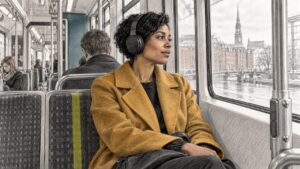
ASMR and meditation music both help you unwind, but they work in different ways. ASMR relies on close, tactile sounds such as whispering, tapping or brushing to produce a tingling sensation. Meditation music offers a slow, spacious backdrop that gives your attention somewhere calm to rest. If you want a quick, pleasant sensory shift and you are one of the people who get tingles, ASMR is a fine choice. If you want to settle your mind, sit with your breath or drift off, music built for meditation is usually the better fit. And yes, you can use both.
TL;DR
- ASMR is a sensory response (scalp and neck tingles) set off by triggers like whispering or brushing sounds. Meditation music is a calming sound environment for attention, breathing and sleep.
- Research treats ASMR and mindfulness meditation as different phenomena that can share relaxation effects. Neither should be sold as a proven treatment for mental-health conditions.
- Only some people feel ASMR at all, so personal preference decides more than any ranking does.
- A study found a 6 Hz binaural beat combined with ASMR-style natural sounds could produce sleep-related brain signals, so mixing the two is not silly.
- Keep the volume sensible: the WHO-ITU standard allows adults 80 dB for up to 40 hours a week.
What each one actually is
Let me confess something first. The first time someone told me to watch a person whisper at a microphone for forty minutes to calm down, I assumed it was a prank. I spend my working life with live orchestras, where the loudest thing in the room is a bass drum, so a person gently crinkling paper felt like a different planet. Then I tried it, and my scalp did something odd and rather lovely. Fair enough, ASMR. I was converted to curiosity, if not to a lifestyle.
So, definitions without the fluff.
ASMR (autonomous sensory meridian response) is a perceptual phenomenon. A 2018 paper in the journal Mindfulness describes specific audiovisual triggers, often whispering, close personal attention or brushing sounds, producing tingling on the scalp, neck and sometimes the body, usually with calm and positive feelings. A 2022 Dutch study adds tapping, scratching and slow hand movements to the list of triggers.
Meditation music is a different animal. It is not trying to trigger a physical reflex. It is trying to give your mind a stable, unhurried sound world while you do something else: follow your breath, scan your body, visualise, or fall asleep. Tempo is slow, harmony is gentle, and nothing jumps out at you. Some of it uses binaural beats, theta-range tones or Solfeggio-tuned pitches, which we will come to.
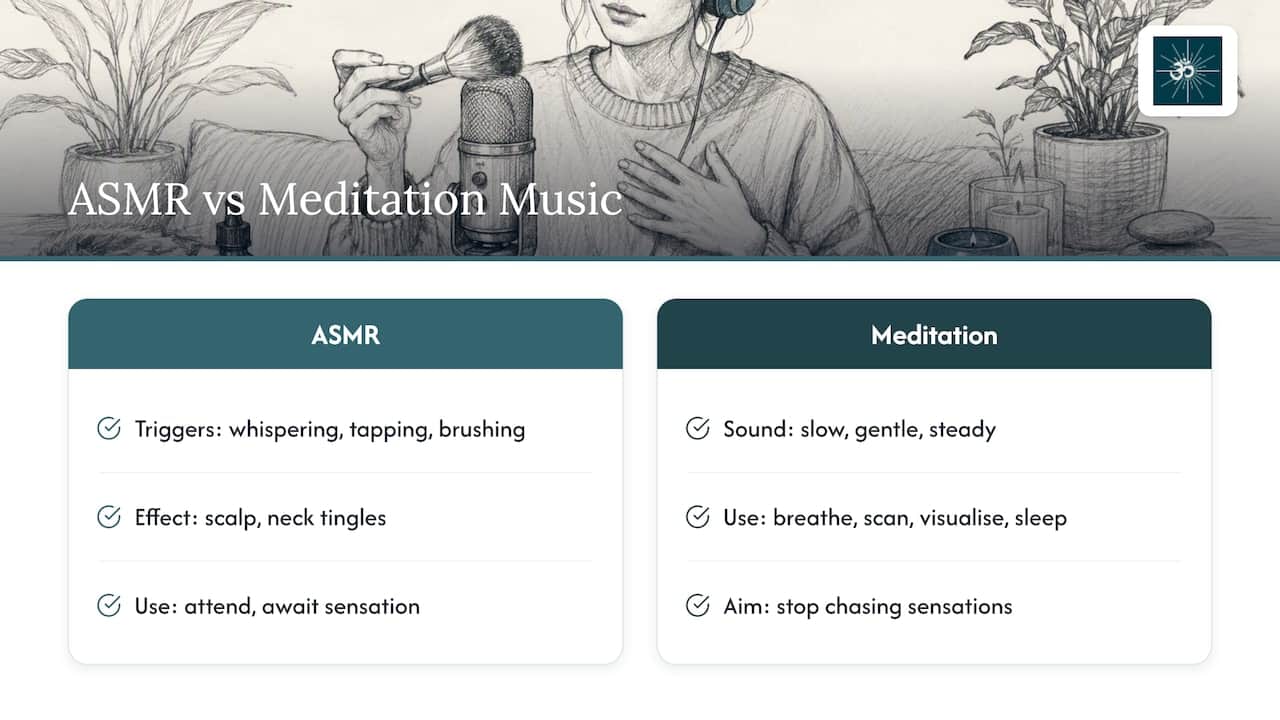
The simplest way to feel the difference: ASMR asks you to pay attention to a sound and wait for a sensation. Meditation music asks you to stop chasing sensations altogether.
ASMR vs meditation music at a glance
| ASMR | Meditation music | |
|---|---|---|
| What it is | A tingling response to specific triggers | A calm sound backdrop for attention, breath or sleep |
| Typical sounds | Whispers, tapping, brushing, crinkling, close-up voice | Slow orchestral, ambient or instrumental textures, sometimes with binaural beats |
| Who it works for | Only people who experience the response | Almost anyone, though taste matters |
| Attention | Focused on the trigger | Soft, wandering or anchored to the breath |
| Usual format | Video or close-mic recording, often with a person on screen | Audio you can run for a sit, a yoga class or a night’s sleep |
| Good for | A quick sensory wind-down, tingles, comfort | Meditation, mindfulness practice, sleep routines, background for therapy and teaching |
| Main catch | Not everyone gets tingles; may be more activating than you expect | Preference-dependent; poor-quality loops can irritate |
Is ASMR considered meditation?
Short answer: not really, though the two overlap. The 2022 Dutch study mentioned above notes that ASMR and mindfulness can both lead to relaxation, but research has found them to be different phenomena. Meditation, in the mindfulness sense, is a trained way of relating to your experience. ASMR is something that happens to you when the right trigger lands.
There is a fair counterpoint from the German-speaking world. A scholarly article titled “ASMR als Meditation” (2017) argues that ASMR videos can be comparable to meditation because of their calming effect, and examines ASMR as a media-mediated meditative practice. So if you find that watching someone fold towels slows you down, you are in respectable company.
The two even help each other. A peer-reviewed German study found that a body-scan mindfulness exercise beforehand enhanced how strongly people perceived ASMR tingles. Mindfulness can influence ASMR without making the two identical. My own translation: a calmer, more attentive listener tends to feel more.
What the research says about stress, mood and the body
Here is where I try to keep my enthusiasm on a leash, a skill my orchestra players say I have never fully mastered.
ASMR
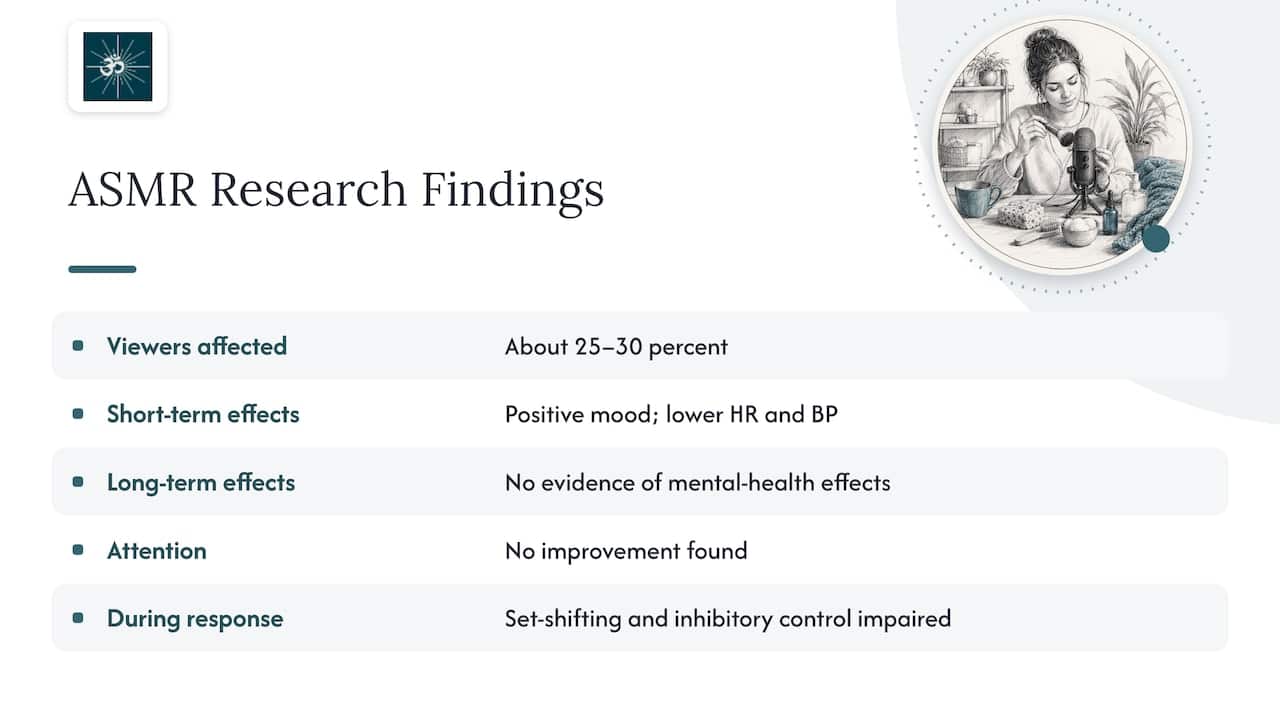
Ruhr University Bochum’s 2023 report on its systematic review says that about 25 to 30 percent of viewers experience ASMR, and that studies found short-term positive mood effects plus changes such as slower heartbeat and lower blood pressure. The same report is careful: researchers had not found a study showing long-term mental-health effects caused by ASMR, so it should not be presented as a proven treatment.
In a study of 38 young adults, ASMR viewing lowered heart rate. Depressive feelings fell in people who experienced tingles, and EEG readings changed too. The same paper, however, reports that ASMR did not improve attention, and that ASMR-triggering audio has been reported to impair set-shifting and inhibitory control while the response is happening. In plain terms: lovely for unwinding, not obviously a focus tool.
A 2022 South Korean comparison found that ASMR and binaural beats are both reported to be effective for stress reduction, but ASMR uniquely increases beta and high-beta activity linked to cortical arousal. That is a neat reminder that “relaxing” and “switching your brain off” are not the same thing. ASMR can feel soothing while your brain is, in measurable ways, rather busy.
Music
A 2021 Japanese fMRI study found that both ASMR sounds and classical music produced a pleasant, relaxed state in healthy adults, with ASMR activating more brain areas, notably the medial prefrontal cortex. So on the narrow question of “does it relax you?”, the answer is a draw, and the route differs.
A German study of musical and language-based approaches found that music, language-based methods and their combination all reduced perceived stress, while music produced a greater increase in activation, especially when activation was the chosen aim. Music is flexible: it can calm or lift, depending on what you choose and why.
For sleep, a 2024 systematic review and meta-analysis found that music listening interventions give a potential, moderate improvement in subjective sleep quality for adults with mental health problems. “Potential” and “moderate” are the honest words there, and I like them.
The honest caveat
A 2025 scoping review of sound interventions notes that music and nature sounds generally reduce stress markers such as cortisol and heart rate variability, but that they can occasionally induce stress depending on personal preference and context. The authors argue for personalised sound choices. Anyone who has been trapped in a lift with a pan-flute cover of a pop hit knows this in their bones.
That preference point is worth sitting with. Research on pink noise and sleep points the same way: the same sound that helps one sleeper can disturb another, depending on loudness and personal response.
Which one for which job?
This is the part you came for. Think about the job, not the label.
For falling asleep
Both can work, and many people use one or the other every night. Music has the stronger evidence base for sleep quality in the research above. ASMR suits people who enjoy it and find it comforting. One word of caution from the German health insurer BARMER: it quotes psychologist Claus-Christian Carbon warning that persistent sleep disorders should not be self-treated with unqualified ASMR videos. If you have been sleeping badly for weeks, see your GP (Hausarzt) rather than stacking up more playlists.
For meditation and mindfulness
Meditation music wins. You want something that holds still beneath you. Whispering voices and sharp tapping invite you to track details, which is the opposite of letting go. Slow orchestral textures, long strings, soft brass swells and a gentle pulse leave you plenty of room. Our own piece on science-backed sound and music for mindfulness goes deeper into how to set that up.
For focus and work
Neither is a guaranteed winner, and ASMR in particular did not improve attention in the study above. If you want to concentrate, instrumental music without lyrics or sudden surprises is the safer bet. Test it for a week and be honest about whether you got more done or just felt cosier.
For a stressful moment
If you are an ASMR responder, a few minutes of your favourite trigger can take the edge off. If you are not, you will probably find it strange or even irritating, which is normal. Slow music with a steady rhythm is the more universal first aid.
For teachers, therapists and creators
Here ASMR is awkward. A whispering video is a personality, a voice, a persona. Meditation music is infrastructure: it sits under your guidance, your class or your app without competing for attention. It also comes with licensing questions, which I will address below.
Why do some people love ASMR (and others shrug)?
The “why Gen Z loves it” angle gets a lot of airtime, but the numbers say something simpler: only roughly a quarter to a third of viewers report the response, as the Bochum report notes. If it does nothing for you, you are not broken. Equally, ADHD readers sometimes tell us they like ASMR because a single predictable sensory stream is easier to follow than a busy room. That is anecdote, not evidence, and I would not put it on a poster. If attention or sleep problems affect your daily life, a psychologist or doctor is the right person to talk to, not a playlist.
Can you use ASMR and meditation music together?
Yes, and researchers have tried it. A 2019 South Korean study proposed combining a 6 Hz binaural beat with ASMR-triggering natural sounds and found that the combined stimulus could induce sleep-related brain signals while keeping users psychologically comfortable. It is a small, early piece of work rather than a prescription, but it tells us the two are not rivals.
A practical way to blend them:
- Start with two to three minutes of body-scan breathing, no sound or very quiet music. Remember the German study: mindfulness first can sharpen the ASMR effect.
- Put slow meditation music at low volume as your bed of sound.
- Add one soft ASMR-style element if you like it: gentle rain, soft brushing, a quiet voice. Keep it well below the music’s level.
- Let a timer end the session so you are not woken by a loud ad or autoplay.
If the combination makes you tense, drop the ASMR layer. You are not failing a test.
Protect your ears
Calming sound at damaging volume defeats the purpose. The WHO-ITU safe listening standard sets the adult listening allowance at 80 dB for up to 40 hours per week. The WHO also advises well-fitted, noise-cancelling headphones to reduce the need to raise volume in noisy settings, and frequent breaks from loud sounds. ASMR and sleep sessions are often listened to on headphones for long stretches, so keep the level low and comfortable, and take the headphones out if you doze off.
What makes meditation music good (and not just slow)?
Speaking as someone who has conducted a great many orchestras, I can tell you that slow is easy and good is hard. A few things separate music that supports meditation from music that merely sounds sleepy:
- Real instruments. Live strings and woodwinds have tiny variations in bow pressure, breath and room sound. Your body notices, even when your mind does not.
- Space in the arrangement. Long notes, patient harmonic movement, no sudden dynamic jolts.
- A deliberate role for frequencies. Binaural beats, theta-range design or Solfeggio tuning, used with care, are tools for some listeners. They are not magic, and the research on them remains modest and mixed.
- Recording quality. Spatial, 3D-style sound can make the music feel like a place you step into, not a speaker playing at you.
- No lyrics, no hooks. Nothing to sing along to at 2 a.m.
The sound-bowl world offers a useful parallel. A 2025 systematic review found that most studies reported reductions in anxiety and depressive symptoms and increases in heart-rate variability after Tibetan singing bowl interventions in adults. That does not make every bowl a cure, but it shows that slow, resonant, non-verbal sound is a serious area of study rather than a wellness fad.
Our perspective: why we record it live
We make orchestral meditation music, so you should know where we stand. We think ASMR is a charming, genuinely useful tool for the people who respond to it, and we have no interest in telling anyone to stop watching someone gently tap a wooden spoon.
But we believe meditation needs something broader and quieter than a trigger. That is why our library is recorded with live musicians, including sessions at Abbey Road Studios with the National Philharmonic. Robert Emery, who is Music Director of the National Philharmonic Orchestra of Great Britain, has conducted orchestras such as the London Philharmonic and Royal Philharmonic. His view, which he repeats to anyone who will stand still: acoustic instruments played by humans resonate with your body in a way digital instruments simply do not.
Moritz Schneider, the composer and producer on the other side of the mixing desk, has written for feature films, albums and musicals for over 20 years. A few years ago he found a deep passion for meditation music, what he calls music for inner films. He has said that the power of frequencies created by recording a live instrument, played by a talented heartbeat, cannot be beaten. They have worked together for thirteen years and, helpfully for the music, remain best friends.
We add the scientific side on purpose: binaural beats, theta-focused pieces, Solfeggio-based tracks and 3D surround sound. But we are careful about promises. Sound can support a practice, a mood and a sleep routine. It does not replace medical care.
— ROBERT
Choosing and licensing meditation music
If you are a listener, the plan is simple. Try a few styles, note how you feel in the following hour (not just during), and keep what helps. If you want a steady supply of orchestral meditations for personal use, our personal subscription is €21 per month.
If you teach yoga, run therapy sessions, build a meditation app or create guided audio, you need the right licence rather than a random streaming playlist. Our professional subscription is €150 per month, and our royalty-free meditation music page explains the library for professional use. Check the licence terms on each page for exactly what is covered before you publish anything.
A one-week experiment
Instead of deciding in the abstract, run a small test. It costs nothing but a few evenings.
- Nights 1 to 2: ASMR of your choice, 15 to 20 minutes, low volume.
- Nights 3 to 4: Slow orchestral meditation music only, the same duration.
- Nights 5 to 6: Meditation music with a very quiet ASMR layer, or a body scan first and then either one.
- Night 7: Whichever felt best.
After each session, jot down two things: how quickly you felt settled, and how you felt the next morning. Tiny notes, big clarity. If nothing helps and your sleep or anxiety is a persistent problem, take it to a doctor or psychotherapist.
FAQ
Is ASMR considered meditation?
Not in the strict sense. Research treats ASMR and mindfulness meditation as different phenomena that can both lead to relaxation. Some scholars, particularly in German media studies, describe ASMR videos as a meditative practice because of their calming effect, so the line is blurry in everyday use.
Is ASMR good or bad for the brain?
The evidence so far points to short-term mood and body benefits, such as a slower heartbeat, for people who feel the response. One study found it did not improve attention, and Ruhr University Bochum notes that no study has yet shown long-term mental-health effects. It looks harmless for most people, but it is not a proven treatment.
Is meditation music better than ASMR for sleep?
Music currently has the clearer research backing, with a 2024 meta-analysis showing a moderate potential improvement in subjective sleep quality for adults with mental health problems. ASMR can help individuals who enjoy it. Choose whichever you actually find calming, and see a doctor if sleep problems persist.
Why do some people feel nothing from ASMR?
Only about a quarter to a third of viewers experience the response, according to the Bochum review. It is a trait, not a skill, so lack of tingles says nothing about your ability to relax. Meditation music does not depend on that trait.
Sources
- Mindfulness and autonomous sensory meridian response (ASMR)
- The effects of autonomous sensory meridian response (ASMR) on mood, attention, heart rate, skin conductance and EEG
- ASMR als Meditation
- Body scan meditation enhances the autonomous sensory meridian response
- Ruhr University Bochum: What’s the story behind ASMR clips?
- Comparison of autonomous sensory meridian response and binaural beats
- Induction of Relaxation by Autonomous Sensory Meridian Response
- The Aim Justifies the Means: musical and language-based interventions
- Music listening interventions and sleep: systematic review and meta-analysis
- Effects of Sound Interventions on the Mental Stress
- Pink noise for sleep
- BARMER: ASMR-Videos: Massage für das Gehirn?
- Binaural beat combined with ASMR-triggering sounds
- WHO-ITU: Safe listening devices and systems
- WHO: Deafness and hearing loss, safe listening
- Effects of Tibetan Singing Bowl Intervention