There is no single best Solfeggio frequency for focus, and anyone who names one with a straight face is selling you something. If you want a sensible place to start, try 528 Hz as a calm-down before a work block, and treat 741 Hz and 852 Hz as the traditional “clarity” tones worth a curious experiment. Then do the one thing that actually tells you the answer: compare a work session with the track against a work session in silence.
That is the short version. The longer version is more interesting, partly because the science is thinner than the YouTube thumbnails suggest, and partly because what you listen to matters at least as much as the number in its title.
TL;DR
- No Solfeggio tone has been shown to be universally best for concentration. Research on music and binaural beats for cognition is mixed.
- 528 Hz has a small, preliminary study pointing to relaxation, not sharper attention. 741 Hz and 852 Hz are the traditional “focus” tones, but that is spiritual language, not clinical fact.
- The recording matters as much as the label: a steady, unobtrusive track beats a clever frequency that keeps grabbing your attention.
- Test one track against silence for a week, keep the volume low, and stop if anything rings, hurts or muffles.
What “Solfeggio for focus” actually means
The commonly listed Solfeggio set runs 174, 285, 396, 417, 528, 639, 741, 852 and 963 Hz. Popular guides pair each tone with a theme, such as release, change, harmony or intuition, and one study-music guide even attaches concentration to 174 Hz while describing 528 Hz as transformative. Another says 741 Hz is for problem-solving. Notice the problem already: different sources hand out the “focus” badge to different numbers.
That is because these are belief-based associations, not clinical indications. The historical story of an ancient Solfeggio scale is also disputed among musicologists, so the numbers are best treated as a modern meditation tradition rather than a lost technology. I say that as someone whose working life is spent making this kind of music, and I think it makes the practice more honest, not less.
When people search for a Solfeggio frequency for focus, they usually mean one of three things:
- A tone to listen to for a few minutes before working, to settle the mind.
- A track to play quietly in the background during study or desk work.
- A meditation that trains attention itself, with the music as a steady anchor.
The best choice differs for each, so it helps to know which one you are after before you press play.
What the research says (and does not)
Let us start with the sobering part. A systematic review of music, noise and binaural-beat studies on arousal, cognition and attention covered 31 studies, and the findings for music and binaural beats were mixed or too limited for firm conclusions. The review’s broader message is that sound can help or hinder thinking depending on its acoustic properties, the task, your personal preference and how alert you already are.
There is also a deeper caution about the popular “brainwave” explanation. A 2022 paper reviewing rhythms in cognition concluded that the evidence does not unequivocally support the assumed role of brain rhythms in some of the processes people lean on to justify entrainment claims. In plain English: “this frequency syncs your brain into focus” is a tidy story, and tidy stories deserve suspicion.
What about Solfeggio tones specifically? A 2026 exploratory study in the Journal of Scientific Exploration exposed 18 participants to six pure Solfeggio tones, five minutes each at 75 to 79 dB, and measured skin conductivity, a marker of autonomic arousal. It found significant increases for 741 Hz and 852 Hz. Some participants afterwards reported annoyance, tiredness or feeling less calm.
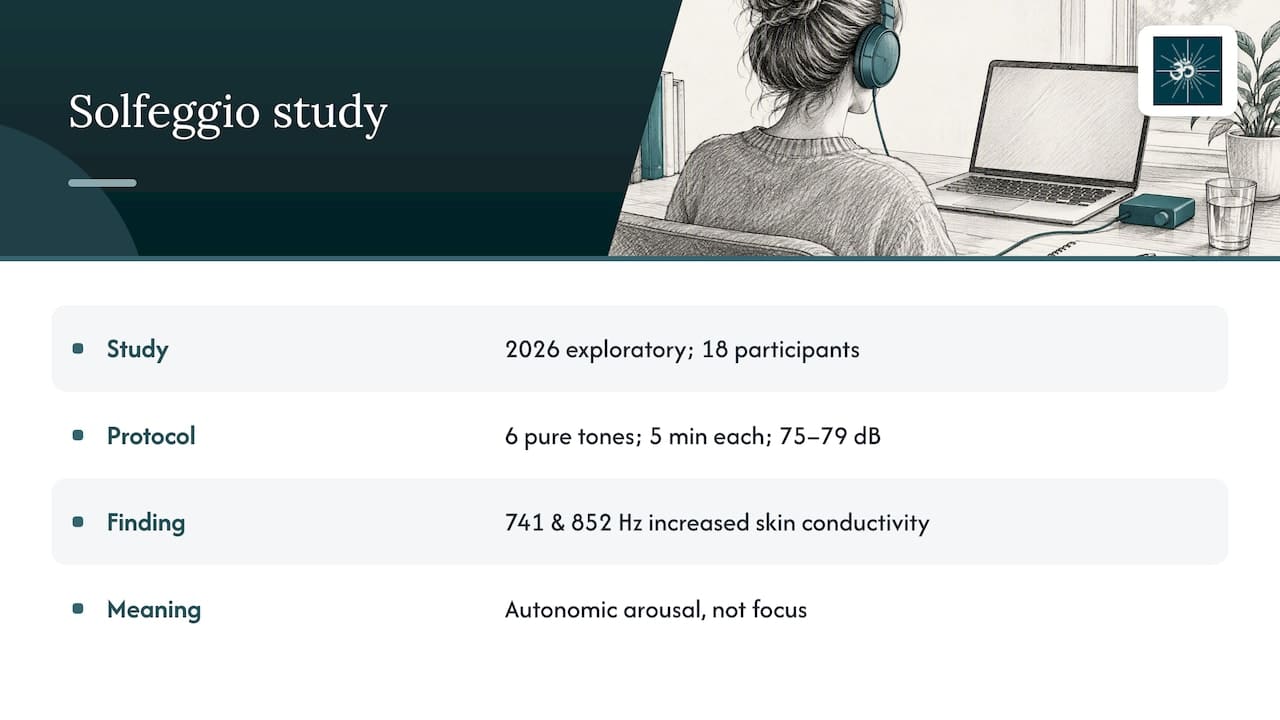
Read that carefully. Higher arousal is not the same as better concentration, and a pure, unchanging sine tone is not what most of us would call pleasant company for a two-hour work block. It does tell us something useful, though: the “focus” tones are not automatically soothing, and your own response should overrule the label.
528 Hz, 741 Hz and 852 Hz compared
These are the three tones that come up most when people look for focus music. Here is how they stack up honestly.
| Frequency | Traditional association | What the evidence supports | Best use |
|---|---|---|---|
| 528 Hz | Harmony, transformation, “love tone” | One small 2018 study suggests lower cortisol and tension after listening; nothing on attention | A short settling meditation before work |
| 741 Hz | Self-expression, problem-solving, “clearing” | Higher skin conductivity in one small study; no proof of sharper cognition | A curious experiment for creative or analytical tasks, at low volume |
| 852 Hz | Intuition, connection | Same arousal finding as 741 Hz; no proof of improved focus | Reflective, open-ended thinking rather than detail work |
528 Hz: the most defensible starting point
The often-quoted human data for 528 Hz is modest. A 2018 study of nine healthy adults (one man, eight women, aged 26 to 37) compared 528 Hz with 440 Hz and reported lower cortisol and less tension and anxiety after 528 Hz. Exposure was brief, around five minutes.
Nine people. Five minutes. That is a signal worth following up, not a verdict. It points towards relaxation, and while a calmer nervous system can make concentration easier, “less stress” and “better attention” are different outcomes. Nobody should merge the two in a sales page, and we try not to.
741 Hz: the “detox” claim does not survive contact with biology
You will see 741 Hz advertised as a cleanser of cells, toxins and mental fog. Even a site devoted to Solfeggio frequencies separates the traditional idea of “clearing” as a metaphor from any demonstrated physical detoxification. As a symbolic invitation to clear your head, fine. As a medical claim, no.
852 Hz: intuition, not arithmetic
852 Hz is usually described in terms of intuition and returning to inner awareness. If you are reconciling a spreadsheet, that is probably not the brief. If you are journaling, planning, or sitting in a reflective meditation before a creative session, it may suit you better than a bright, busy tone.
And what about the other six?
The remaining tones (174, 285, 396, 417, 639 and 963 Hz) are mostly attached to emotional or spiritual themes. Some guides do assign concentration to 174 Hz, but that has the same status as the rest: tradition, not trial. If a lower, softer tone feels grounding to you, there is no reason not to use it. Just do not expect the number to do the work.
Solfeggio versus chakra frequencies
This question comes up a lot, and the confusion is understandable because both systems pair numbers with inner states. Solfeggio tones are a set of nine frequencies, usually discussed in terms of emotional and spiritual themes. Chakra frequencies come from a different tradition, where seven energy centres are matched with notes or tones, often linked to the Sanskrit seed syllables used in chanting.
The two systems overlap in marketing more than in origin, and sometimes in the numbers too, which is why a track labelled with one can be sold under the other’s banner. Neither has a body of controlled evidence showing it improves attention. If you already practise within a chakra tradition, there is no harm in choosing music that fits it. If you are choosing for focus, pick the sound you find steadiest and test it.
Why the recording matters more than the number
Here is the thing I wish more people said out loud. A pure sine wave at 528 Hz and a beautifully recorded orchestral piece that happens to sit around the same tonal centre are not the same experience, even if they share a label. One is a test tone. The other is a room full of people breathing in time.
The systematic review’s practical message is that music can help or hurt depending on acoustic properties, the task, your preference and your arousal level. A steady, unobtrusive track may help some people. Unwanted or attention-grabbing audio can impair performance. So the best Solfeggio track for focus is the one that disappears into the background while supporting whatever ritual you have chosen.
Practically, that means looking for:
- Slow, predictable movement. Sudden dynamic swells, a sharp percussion hit or a lyric will pull your attention away from the page.
- Warm, natural timbre. Strings and woodwinds played by real musicians tend to sit more gently than a harsh synthesised tone.
- Long, unbroken duration. A track that ends after four minutes is a tiny interruption, and tiny interruptions add up.
- No lyrics for reading or writing tasks. Language competes with language.
A simple way to test it yourself
You do not need a laboratory. You need one track, a notebook and a week. The routine below follows the practical protocol that the research points towards.
- Choose one professionally produced track. Do not hop between ten tabs of “focus frequencies”. Pick one and give it a fair trial.
- Sit quietly for a short pre-work meditation. Five to ten minutes is plenty. Breathe, let the track play, and notice when your attention wanders. If you want a gentle structure for this, our step-by-step guided meditation techniques walk through it.
- Do a focused work block. Twenty-five to forty-five minutes on a single task, with the track either off or playing very softly.
- Repeat on alternate days with silence or neutral sound. This is your baseline, and it is the step almost everyone skips.
- Score each session. A quick note: how easily did you start, how often did you drift, how tired did you feel afterwards?
If the track becomes the foreground, turn it off. If you feel more irritable or tired afterwards, that is useful data too, and it echoes what some participants in the 2026 tone study reported. Comparing against a baseline is the same logic that careful people apply to any wellness gadget, and this piece on judging a sleep device against a trial period shows the same habit applied to a different kind of tool.
Keep the volume sensible
This is the part that is not optional. The World Health Organization’s hearing guidance explains that the damage from loud sound depends on volume, duration of exposure and distance from the source. Its recommendations include keeping listening below 85 dB, using a comfortable volume, taking breaks, and keeping personal-device volume to no more than 60% of maximum.
Focus music should be quiet enough that you could hold a conversation over it. If a noisy open-plan office tempts you to turn it up, consider noise-cancelling headphones instead of more volume. Ringing in the ears, pain or muffled hearing are stop signals: take the headphones off, and if the symptoms persist, see a doctor, ideally an ear, nose and throat specialist (HNO-Arzt in Germany).
Our perspective: how we think about frequencies
We make meditation music for a living, so you might expect us to tell you that a particular number will transform your productivity. We will not. What we have learned in the studio is more humbling, and more useful.
The library at Orchestral Meditations is built from live orchestral recordings, some made at Abbey Road Studios with the National Philharmonic, alongside binaural, theta and Solfeggio-based tracks. The reason we record live musicians is simple: we believe that acoustic instruments played by people resonate with the body in a way digital ones do not. That is a conviction from years of making music, not a clinical claim, and we are happy to label it as such.
When we work with frequencies, we treat them as a compositional and meditative framework, not a promise. A tone can set a mood, give the ear an anchor and invite a certain kind of stillness. What it cannot do is override your preferences, your tiredness or the fact that your phone is buzzing. This is why we would rather help you find the track that suits your practice than convince you a number is magic.
The two of us, Robert Emery and Moritz Schneider, have written and produced together for more than a decade. Moritz has spent over twenty years composing for film, albums and musicals, and I trained at the Royal College of Music and spend a lot of time conducting. Neither of us got into this because we wanted to sell sine waves. We wanted to make music that people feel in the chest as well as hear in the ears, and if it also helps you settle into a good morning’s work, wonderful.
So our advice is the same as the one we give ourselves: be curious, test it against silence, keep the volume low, and trust your own ears over any list of numbers.
— ROBERT
Who this is for, and who might skip the frequency angle
A few different readers land on this topic, and the right takeaway differs slightly.
Students and desk workers. Stick with the low-volume, background-listening approach, keep it lyric-free, and compare with silence. If you find you work better in quiet, that is a perfectly good result.
Meditators. Frequency-based tracks can be a lovely anchor for a sitting practice. Use 528 Hz or any tone you find calming for the sit itself, and then let the work block run in near silence if you prefer.
Yoga teachers, therapists and content creators. Your question is often different: you need music you can legally play for clients or put into your own audio. That is a licensing question as much as a sound one, and it is worth checking before you build a class or an app around a track.
People who get tired or irritable from pure tones. You are not broken. The 2026 study noted some participants felt exactly that. Move to fuller, more musical textures, or to nothing at all.
Finding focus-friendly meditation music from us
If you want to try a professionally recorded piece rather than a bare tone, our personal subscription costs €21 per month and gives you access to our meditation music library, which includes orchestral, theta and Solfeggio-based recordings. It is a practical way to run the one-track-at-a-time test above without committing to a single purchase.
If you teach, treat clients or build apps and audio, the professional subscription costs €150 per month and is aimed at professional use. You can also read about our royalty-free meditation music for classes, therapy sessions and wellness content. Prefer to look around first? Our home page is the place to start.
A realistic expectation to carry away
If you remember one thing, make it this: the research does not crown a best Solfeggio frequency for focus, but it does give you a reasonable method. Music is a variable, not a guarantee. It can calm the mind enough to make starting easier, and it can just as easily become a distraction.
So choose a steady, well-recorded track. Begin with 528 Hz if you want a calm opening, try 741 Hz or 852 Hz if you are curious about their traditional “clarity” reputation, and keep the volume where a conversation could still happen. Score your sessions against silence. After a week you will know more than any list can tell you.
FAQ
What hertz is good for focus?
There is no proven number. Research on music and binaural beats for cognition is mixed, so the answer depends on you and the task. Traditionally 741 Hz and 852 Hz are linked to clarity and 528 Hz to calm, but those are associations rather than clinical findings. Test one track against silence and keep whichever helps.
Does 528 Hz help you concentrate?
Not demonstrably. A small 2018 study of nine adults reported lower cortisol and less tension after 528 Hz, which suggests relaxation, but it did not measure attention, memory or productivity. Feeling calmer may make it easier to settle into work, though that is an indirect benefit at best.
Is 741 Hz or 852 Hz better for studying?
Neither has been shown to be better. A 2026 study found both raised skin conductivity, a sign of arousal, and some listeners later felt annoyed or tired. If you try them, keep the volume low, limit sessions, and stop if you feel less calm rather than more focused.
Is it safe to listen to focus frequencies through headphones all day?
It can be, if you keep the level low. WHO guidance advises staying below 85 dB, taking breaks and keeping personal devices to no more than 60% of maximum volume. Stop and see a doctor if you notice ringing, pain or muffled hearing.
Sources
- The effects of music and auditory stimulation on autonomic arousal, cognition and attention: a systematic review
- Rhythms in cognition: the evidence revisited
- Evaluating the effects of pure tone Solfeggio frequencies on skin conductivity
- Study of sound frequencies, brain activity and microbial metabolism (MedCrave)
- 741 Hz frequency: what it is associated with
- The best study music: can Solfeggios or binaural beats help you make the grade?
- WHO hearing loss guidance