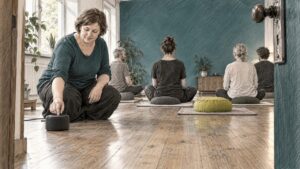
The best meditation retreat music is the music you hardly notice: slow, acoustic, free of sudden changes, played at a modest volume, and used only at the moments when it helps people let go. It is not a continuous soundtrack. Silence does most of the work at a good retreat, and music is the tool you reach for at thresholds: arriving, settling, moving, closing.
I’ll be honest. When I first put together music for a group sitting, I made the classic mistake. I pressed play on a two-hour “healing” playlist, sat back feeling rather pleased with myself, and watched half the room fidget until a harp glissando landed like a cartoon SPLAT in the middle of someone’s first real stillness. Lesson learned. This guide is what I wish I had been handed beforehand.
TL;DR
- Use music at transitions (arrival, opening, movement, closing), not wall to wall. Leave long stretches of real silence.
- Choose slow, acoustic, predictable pieces without sudden dynamics or lyrics. Live-recorded orchestral strings and soft winds are a strong fit.
- Keep the volume low and give ears breaks: WHO guidance ties safe listening to volume and duration.
- Warn people before sound begins or changes. Trauma-sensitive participants react badly to surprises.
- If you teach or run retreats professionally, check the licence before you play or stream any track to paying guests.
Why music at a retreat at all?
A retreat already does a great deal. A meta-analysis of traditional meditation retreats pooled 21 studies with 2,912 participants and looked at psychological outcomes and mindfulness levels, finding benefits in healthy populations. Separately, a systematic review and two meta-analyses on music interventions found that listening to music affects both physiological arousal (heart rate, blood pressure, hormones) and psychological stress responses. A later review of music therapy for stress points the same way, with a caveat worth underlining: music therapy means personally tailored work led by a trained therapist, which is not the same thing as pressing play on a playlist.
So the two ingredients are individually well studied. Combining them is where craft comes in. Music can ease the jolt from a motorway drive to a quiet hall, give restless minds something soft to hold onto, and mark the start and end of a session so the group knows where it is. It can also get in the way, which is the part most playlists ignore.
If you want a wider primer on how sound supports a practice at home, our article on science-backed sound and music for mindfulness goes into more depth. Stress is a broad subject, and if your guests are busy professionals, this overview of types of stress management for executives puts music alongside other approaches.
The golden rule: music is not always on
In well-run silent retreats, music tends to be rare and deliberate. Teachers describe using it as a short offering within a silent programme, or as a bridge between intense silence and grounding activity, rather than constant background sound. One example is the idea of a music “darshan” in a silent retreat, where the point is letting go and being in the here and now. Constant audio input, by contrast, can distract from the inner work participants came to do.
A useful question before every track: what is this piece for? If the answer is “to fill the quiet because quiet feels awkward”, skip it. Silence is not a gap in your programme. It is the programme.
Where music earns its place: a retreat day, moment by moment
Here is a pattern that works for a typical weekend or week-long retreat. Adjust it to your tradition and your group.
| Moment | What music can do | What to choose |
|---|---|---|
| Arrival and check-in | Softens the shift from travel to stillness | Gentle, open, unhurried instrumental pieces at very low volume |
| Opening circle | Signals that the retreat has begun | A short piece (3 to 8 minutes) with a clear, calm ending |
| Morning movement or yoga | Supports pacing and breath | Steady tempo, warm strings or piano, no abrupt peaks |
| Sitting practice | Usually silence; occasionally a quiet bed of sound for beginners | Sustained, slow-moving harmonies; no melody that demands attention |
| Body scan or guided relaxation | Gives the voice a soft floor to rest on | Spacious, low-register textures that stay out of the voice’s way |
| Evening wind-down | Helps the day settle | Longer, very slow pieces; theta-oriented or binaural tracks only with headphones and consent |
| Closing circle | Marks the return to ordinary life | A warmer, more resolved piece, then a few quiet minutes |
Notice how little of the day is music. That is by design.
What makes music suitable for meditation
You can do better than “it sounds relaxing”. Here are the qualities that matter, and the reasons.
Slow, predictable movement
Sudden entries, key changes, crescendos and percussion hits grab attention. In meditation, attention is precisely what you are trying to gentle down. Look for pieces where the next bar is roughly what you expected.
Acoustic, live-played sound
This is partly taste and partly belief, and I will own that. Many composers who work in this field argue that real instruments played by real people carry tiny variations in timing, bow pressure and breath that a sampled loop does not. You do not have to take that on faith: play a sampled pad and a live string section back to back for the same group and ask which they would prefer to sit with for ten minutes. Our composers’ answer is no secret, and I come back to it below.
No lyrics, or very few
Words recruit the language part of the mind. For most sitting practice, instrumental is simpler. Chant and mantra are a different matter and belong to your tradition.
A sensible length
A 3-minute piece is a bell. A 60-minute piece is an environment. Know which one you are after, and make sure your sound system will not stumble in the middle of a long track.
Honest use of binaural beats and theta tracks
Binaural beats are an auditory illusion: two slightly different tones, one in each ear, produce a perceived beat. They are popular in meditation music, so it is fair to ask what the evidence says. A 2017 EEG study on a 6-Hz binaural beat looked at theta rhythm and frontal midline theta activity, the kind of activity associated with meditative states. Results across the literature are mixed, and effects may fade within minutes through habituation, so treat these tracks as one option rather than a guarantee. A more recent EEG-based study of binaural beat meditation (a preprint, not yet peer reviewed) examines user experience, which is a reminder that how people feel about the sound matters as much as the waveform.
Practical rule: binaural tracks need stereo headphones, so they suit individual evening sessions, not a speaker-led group hall. Always tell participants beforehand and let anyone opt out.
Trauma-informed music: the part nobody mentions
There is a myth that anything relaxing is healing. It is not. For someone with a history of trauma, a sudden sound, a darkened room, a closed-eye instruction or even a soft, unfamiliar drone can trigger exactly what the retreat was meant to ease. Researchers in music therapy and mindfulness stress that integrating the two should be trauma-informed: create safety first, then choose music to support the process rather than overwhelm it.
What that means for you as a host or teacher, in plain terms:
- Announce before you play. Say what is about to happen, roughly how long it will last, and that anyone can open their eyes, move, or leave.
- Avoid abrupt transitions. Fade in and out; never cut from silence to full sound.
- Bracket silence. Guidance for trauma-sensitive mindfulness teaching describes framing silent periods with a clear opening and closing, and using music as a grounding resource.
- Offer choices. Eyes open or closed, headphones or room speakers, music or quiet corner.
- Know your limits. If a participant has a clinical trauma history, the right person to guide their work is a qualified therapist, not a retreat playlist. In Germany that may mean a trained music therapist (Musiktherapeut) or a psychotherapist working with their GP.
Germany, incidentally, takes music therapy seriously on the clinical side: a 2021 review of AWMF guidelines found 29 medical guidelines in the AWMF register that include music therapy. That is a good reminder of the line between a wellness retreat and treatment. Retreat music supports calm. It does not replace care.
Protect ears: volume and duration
We tend to think of hearing damage as a nightclub problem. Meditation music is quiet, so surely it is fine? Mostly yes, but retreats can mean many hours of listening over several days, sometimes on headphones, so it is worth a minute of arithmetic.
The WHO and ITU safe listening standard is built around the idea of a weekly “sound dose”: for adults, roughly 80 dB is considered safe for up to 40 hours a week, but the allowance falls steeply as volume rises, to about 12.5 hours a week at 90 dB. In practice:
- Set headphone volume at a moderate level. A common rule of thumb is around 60% of maximum, though devices vary, so judge by comfort: you should be able to hear your own breath and a neighbour whispering.
- Build in silent breaks. Ears recover in quiet, and so do minds.
- Be especially careful with immersive 3D and binaural tracks, which feel closer and can tempt people to turn them up.
- Never let anyone fall asleep with headphones on at loud volume.
Free music, streaming playlists, and what to watch for
Search results for this topic are crowded with streaming playlists of rain, flutes and “528 Hz” compilations. Some are lovely. For a private evening at home, nothing wrong with them. But if you are running a retreat, there are three things to check:
- Licence. Playing a streaming-service track to paying guests in a venue is commercial use. Standard consumer accounts do not normally cover it, and in Germany public performance may also involve collecting society fees. Check terms before the event, not after.
- Consistency. Loose compilations often mix gentle pieces with sudden ones. One surprise bell in a sixty-minute playlist is enough to ruin a body scan.
- Provenance. If you rely on health claims (“heals anxiety”, “cures insomnia”), you are on shaky ground. Music can support relaxation, and that is a claim you can stand behind.
This is where royalty-free, professionally licensed music is a practical answer. You get a defined licence, a consistent sonic world, and tracks you can edit into your own guided audio.
Our perspective: why we record live, and why we record for the body
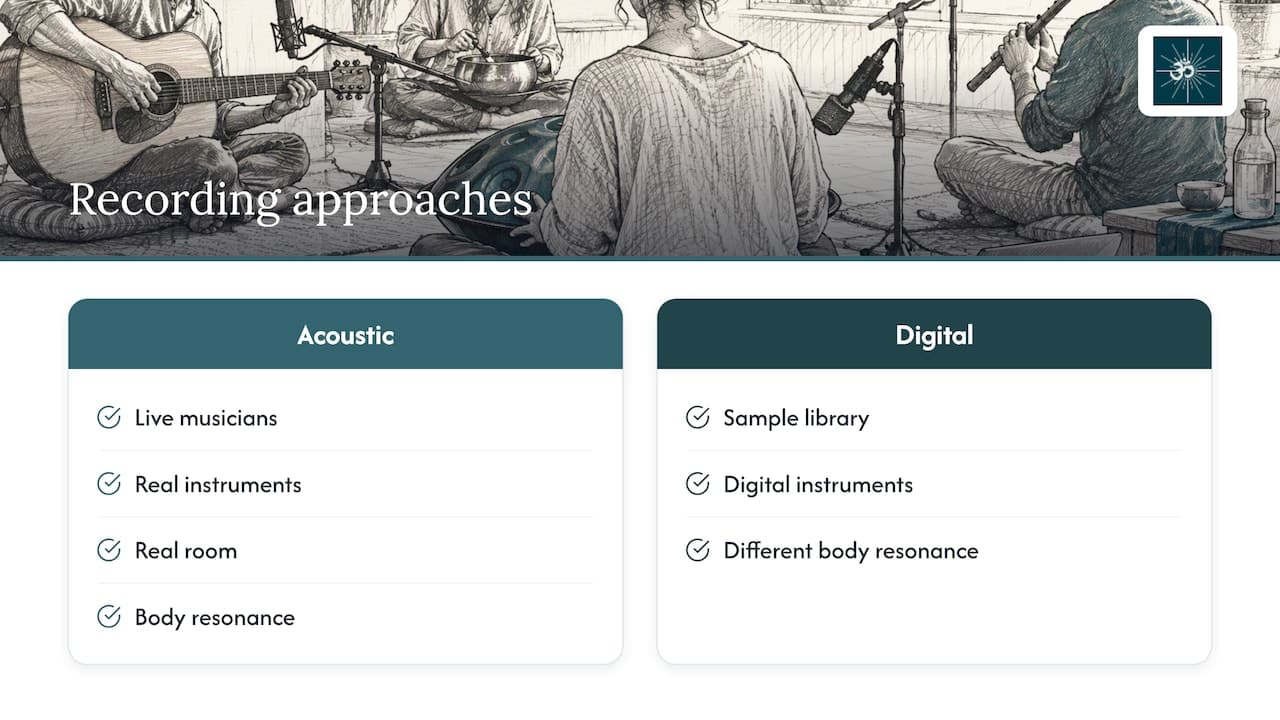
We make meditation music for people who are going to sit with it, sleep with it, teach with it. That shapes everything. Our tracks are recorded with live musicians, including sessions at Abbey Road Studios with the National Philharmonic, because we believe what the body receives from a real instrument in a real room differs from what it gets from a sample library.
The two people behind it are Robert Emery and Moritz Schneider, composers and producers who have worked together for thirteen years and, usefully for music that has to feel honest, are also close friends. Robert is a composer and conductor who began on piano at seven and studied at the Royal College of Music. He puts it simply: he believes in humans creating music with acoustic instruments, because digital instruments do not resonate with the body in the same way. Moritz has written for feature films, album productions and musicals for over 20 years. Together they composed the musical The Witch, which premiered in Switzerland in 2017. That mix of film, stage and studio discipline is why our pieces breathe, build slowly and resolve gently, the things a retreat needs.
We also layer in the science-led tools you may have heard about: binaural beats, theta-oriented tracks and Solfeggio-frequency pieces, mixed in 3D surround for headphones. My advice, as above: use them intentionally, tell your guests, and never oversell. A beautifully played cello line with no special frequency at all will do more for most people than a clever trick.
For retreat leaders, our rule is the one this article opened with. Less music, chosen better, introduced kindly.
— ROBERT
Choosing music for your own retreat or practice
Whether you are hosting twelve people in a Black Forest guesthouse or sitting alone on a Sunday, here is a short decision path.
- Define the job. Arrival, movement, guided session, sleep, closing? One track rarely does all five.
- Choose the format. Speakers for a room, headphones for binaural or 3D work.
- Audition in context. Play it in the actual space at the actual volume, with someone standing at the back.
- Check for surprises. Listen to the entire track once, start to end, before anyone else does.
- Sort the licence. Personal listening and professional use are different things.
- Brief your guests. Two sentences before the music starts will spare someone a very bad five minutes.
Where our music fits
If you are listening for yourself, our personal subscription costs €21 per month and gives you access to the library of orchestral meditation music. If you teach, run retreats, make apps or produce guided audio, the professional subscription at €150 per month is built for commercial use, and our royalty-free meditation music page explains the licensing for yoga, therapy, massage and wellness content. You can also start from our home page and browse single meditations.
FAQ
What is music for meditation called?
There is no single name. People say meditation music, ambient music, relaxation music or sound healing music, depending on the style. What they share is slow tempo, sustained harmony and little rhythmic drive. Some tracks add binaural beats, theta-range tones or Solfeggio frequencies.
How do I meditate using music?
Start with a short piece, around five to ten minutes, at low volume. Sit comfortably, let the sound be one thing among others you notice, and return to your breath when your mind wanders. As you grow used to it, try silence for part of the session, since the aim is a still mind rather than a perfect soundtrack.
Should music play all day at a meditation retreat?
Generally no. Experienced teachers use music at transitions and leave long stretches of silence, because constant sound can distract from the inner work. Plan short, deliberate musical moments, and announce them so nobody is startled.
Can I play any streaming playlist at my retreat?
Not safely. Consumer streaming accounts are typically for private listening, and paid events count as commercial use. Use music with a clear professional or royalty-free licence, and check the terms before your guests arrive.
Sources
- Effectiveness of traditional meditation retreats: a systematic review and meta-analysis
- Effects of music interventions on stress-related outcomes: a systematic review and two meta-analyses
- Music therapy for stress reduction: a systematic review and meta-analysis
- Brain responses to a 6-Hz binaural beat
- Diving into binaural beat meditation: an EEG-based evaluation of user experience
- Silent retreat with music darshan, OM Stiftung
- Music therapy and mindfulness, trauma-informed integration
- Teaching individuals with traumatic stress
- WHO and ITU safe listening devices and systems standard
- Music therapy in AWMF guidelines, 2021 review