
If you play music in a meditation class, yoga studio or massage practice in Germany, the short answer is this: “royalty-free” and “GEMA-free” are not the same thing, and the difference can cost you real money. Music is only truly GEMA-free when none of the composers or rights holders behind it are represented by GEMA, and you can prove it on paper. This guide explains what that means, what to ask a provider before you buy, and how we at Orchestral Meditations think about it.
TL;DR
- In Germany, public music use (a studio, a class, a spa) generally needs a GEMA licence unless you can show the music is outside GEMA’s repertoire.
- “Royalty-free” describes the licence between you and the seller. “GEMA-free” describes who administers the composers’ rights. Never assume one means the other.
- Get the status in writing: composer names, a statement on GEMA membership, and the licence scope for your exact use.
- Binaural and theta music is worth using for its calming effect, but the research is cautious, so treat it as support, not treatment.
- Our catalogue is royalty-free, with personal and professional licences. Ask us about the licensing details for your use before you play it publicly.
Why meditation teachers in Germany end up reading about GEMA
I’ll confess something. Years ago, as a working musician, I thought collecting societies were somebody else’s problem. Something for radio stations and nightclubs, surely. Then I watched a friend who ran a small yoga studio receive a letter that began politely and ended with a number. She had been playing a lovely ambient playlist for months. Nobody had told her it mattered.
It does matter, and Germany is stricter than many readers expect. GEMA’s own guidance for music users says that whenever you want to use music in public, whether live, as background music, as recordings or online, you should contact GEMA. A meditation room with paying students counts as public use in most practical cases. A private evening with headphones on does not.
The search results for this topic are full of CDs and playlists labelled “GEMA-frei”. Some are excellent. Others are a label slapped on a download with nothing behind it. So let’s go through what the label should mean.
What GEMA actually does (and why it applies to your class)
GEMA is the German society that administers the performance and reproduction rights of composers, lyricists and publishers. When you play a track in a public setting, someone has to pay the people who wrote it. GEMA collects that money through tariffs, which depend on how you use the music: background music in a physical room, streaming, on-demand content and so on.
Two details are worth knowing.
First, copyright in a composition lasts a long time. GEMA states that protection runs for 70 years after the death of the last surviving author or composer. That is why “it’s old, so it must be free” is a risky assumption for anything but the very oldest classical works. And even then, a modern recording of an old work has its own rights attached.
Second, the burden of proof. In German practice there is the so-called GEMA-Vermutung: it is presumed that music played in public belongs to GEMA’s repertoire, and the person using it has to show otherwise. In plain words, if someone asks, “I think it’s free” will not do. You need documents.
Royalty-free is not the same as GEMA-free
This is the knot most articles never untie, so let’s untie it slowly.
Royalty-free means you pay once (or subscribe) and then use the track under the licence terms without paying per play or per use to the licensor. It is a statement about your contract with the seller.
GEMA-free means the composers of the music are not represented by GEMA, so there is nothing for GEMA to collect. It is a statement about the composers’ membership and rights administration.
A track can be royalty-free and still have a composer registered with a collecting society. A track can be GEMA-free yet licensed so narrowly that you cannot use it in a paid class. The two ideas overlap, but they are different questions, and a careful buyer asks both.
| Question | Royalty-free | GEMA-free |
|---|---|---|
| What does it describe? | Your licence with the seller | Who administers the composers’ rights |
| Who gives you the answer? | The seller’s licence terms | The composer or rights holder, ideally in writing |
| Does it protect you in a GEMA check? | Not by itself | Yes, if documented |
| Typical risk if misunderstood | Using a track beyond the licence scope | Paying GEMA fees you thought you had avoided |
What to ask before you buy “GEMA-free” meditation music
Whether you buy from us or anyone else, here is the checklist I would hand a friend opening a studio in Leipzig or Cologne.
- Who composed the music? Real names, not just a brand. If you cannot find out who wrote it, you cannot prove anything about it.
- Is every composer and rights holder outside GEMA? One co-writer who is a member can change the picture for a whole track.
- Can you get a written statement? Many German providers supply a declaration signed by the composer. Keep it, along with your invoice and track list.
- Does the licence cover your use? A personal licence for your own evening practice is not a licence to play the track to ten paying students. Professional use needs a professional licence.
- Does it cover recording and publishing? If you put a guided session on YouTube, an app or a course platform, you need synchronisation and distribution rights, not just playback rights.
- Is the whole playlist covered? One stray track from a commercial artist, played between sessions, undoes your careful work.
On that last point: GEMA notes that private uploads to YouTube are covered by YouTube’s own agreements with GEMA. Commercial content is another story, so a teacher selling online courses should not lean on that rule.
The honest comparison: three ways to get music into your studio
There are really only three routes, and each has a place.
| Route | Best for | Watch out for |
|---|---|---|
| GEMA licence for commercial music | Studios that want a specific, famous track | Ongoing tariffs, reporting, and the cost grows with use |
| Verified GEMA-free music | Studios and teachers who want fixed, predictable costs | Needs paperwork; one non-free track breaks the chain |
| Royalty-free music under a professional licence | Teachers, therapists, app and course creators | Confirm GEMA status and scope in writing for your use |
None of these is morally superior. The cheapest option on paper is not always the cheapest once you add the admin. If you play music for two hours a week in a spare room, the sums are different from a studio running thirty classes. For anything more than a hobby, a short call to GEMA or an adviser who knows your tariff is cheap insurance.
Meditation music that deserves its place in the room
Now the fun part. Once the legal skeleton is in place, what should the music actually do?
We have spent a lot of time on this question, and the answer is less mystical than you might think. Good meditation music gets out of the way of the practice while still being worth hearing. Think of a good waiter: present when needed, invisible otherwise. Bad meditation music is the waiter who sits at your table and tells you about his week.
A few things separate the two.
- Live players. A real string section breathes. The bow changes, the room moves, and the subtle irregularities keep the ear from tuning out. Programmed strings can sound pleasant for about four minutes.
- Slow harmonic movement. Chords that change gently let the nervous system settle. Sudden key changes are a cartoon-like SPLAT for a drifting mind.
- Room and space. Reverb from a great room tells the body it is safe. This is why we care so much about where we record.
- No hooks. A tune you can hum is lovely in the car and distracting on the mat.
Binaural beats, theta and Solfeggio: what the research does and does not say
Our catalogue includes binaural beats, theta-range music and Solfeggio-frequency tracks. Let me be careful here, because this is where wellness marketing tends to run away with itself.
Binaural beats are produced when each ear receives a slightly different tone through headphones, and the brain perceives a third, pulsing tone. A 2024 systematic review of binaural beats for anxiety and depression looked at how they are used, including the practical point that the beats are often masked with nature sounds or music rather than played as bare tones, because that tends to be more pleasant to listen to. A separate 2024 systematic review and meta-analysis on binaural beats in people with anxiety examined the same question for anxiety specifically.
What I take from this, as a musician and not a clinician: there is encouraging evidence that binaural beats can help with anxiety and stress, results vary between studies, and a musical setting makes the whole thing easier to live with. That last part is our home turf. A binaural layer sitting inside an orchestral texture is far more bearable for twenty minutes than a flat electronic pulse.
I would not promise you healing from any of it. Solfeggio frequencies in particular are popular in the wellness world, but I will not claim a number on a track is a medical intervention. If you or your students live with persistent anxiety, depression or sleep problems, the right first step is a conversation with a GP (Hausärztin or Hausarzt) or a psychotherapist. Music is a lovely companion to that care, not a replacement for it.
If you enjoy reading about the wider world of sound-based approaches, this overview of vibroacoustic therapy and its clinical research is a useful side trip, though it covers a different technique from headphone-based music.
Where we record, and who is behind the music
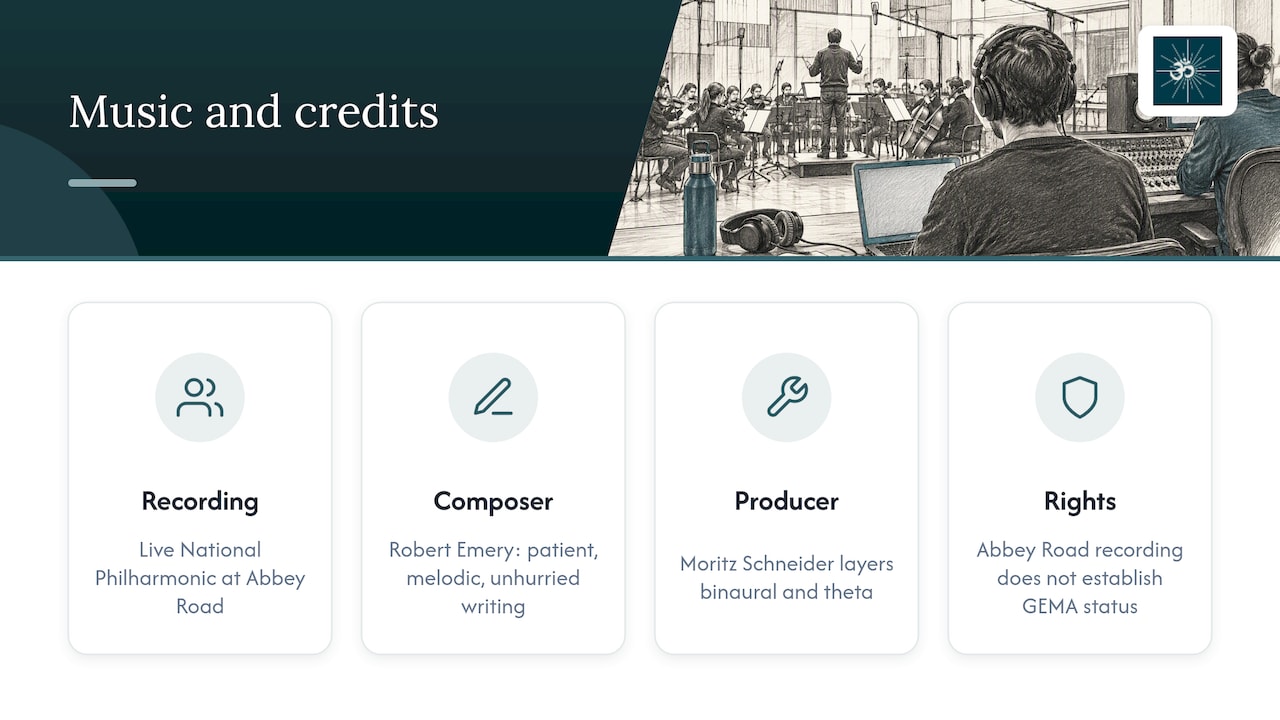
We record our orchestral meditations with live musicians, including sessions with the National Philharmonic at Abbey Road Studios. The 2023 announcement of our Abbey Road recordings tells the story of how that came about. We add 3D surround sound on top, because a meditation should feel like sitting inside the music, not watching it through a window.
Two names matter most to us. Robert Emery is the composer whose writing gives the library its character: patient, melodic, and unhurried. Moritz Schneider is the producer who shapes how it sounds and how the binaural and theta layers are woven into the orchestra, so that the science serves the music and not the other way around. If you want to know who is behind a track before you play it to your students, that is exactly the kind of transparency you should expect from any provider.
I should be clear about what this article does not claim. We are not telling you that any track is exempt from GEMA by virtue of being recorded at Abbey Road. Studio pedigree tells you about sound quality, not about rights administration. For the legal status of a given track and your intended use, ask us directly and get the answer in writing.
Perspective: why we think about licensing differently
We came to this from the music side, not the legal side. Our first concern was always whether a piece of music actually helps someone let go. But the longer we have worked with teachers, therapists and app builders, the clearer it has become that a beautiful track you are afraid to play is not much use.
So we think about it this way. Practitioners need three things: music that works, a licence that matches what they actually do, and clear information about who made it. That is why we separate personal and professional use, why we publish composer information, and why we would rather you ask a slightly awkward licensing question today than receive a letter next year.
We also believe meditation music should not be mass-produced. A track recorded by live players in a great room, with a composer who understands pacing, will carry a student further than a thousand algorithmic loops. The slow, human unevenness is the point.
And if you teach in Germany, we would gently suggest that you treat your music like your insurance: boring to sort out, wonderful when you need it.
— ROBERT
A practical setup for a German studio or teacher
Here is how I would arrange things if I were starting a small studio tomorrow.
- Decide what you use music for. Background in class? Guided recordings you sell? An app? Each use has different rights.
- List your tracks. A simple spreadsheet: title, composer, source, licence, date bought, and where the written confirmation lives.
- Get written confirmation on GEMA status. From the composer or provider, for each track or the whole library.
- Keep it for years. Copyright claims can look back a long way, so archive invoices and statements somewhere safe.
- Keep the unlicensed stuff out. No personal playlist on the studio speaker, no “just this once” from a streaming account. Personal streaming subscriptions are meant for personal listening.
- Review once a year. Studios change, and so do the ways you use music.
It reads like homework because it is homework. It also takes an afternoon, once.
Choosing between a personal and a professional licence
Here is where our own offer comes in, and I will be plain about it.
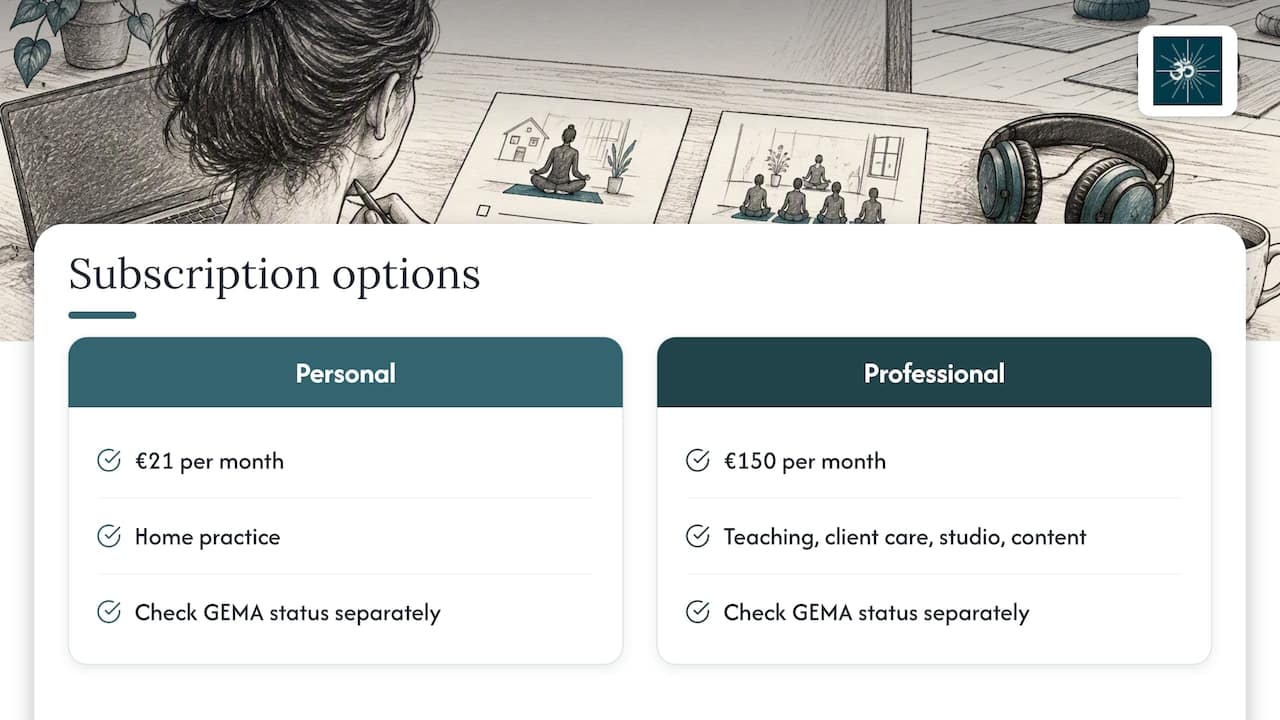
If you meditate at home, a personal subscription is €21 per month and gives you access to the orchestral library for your own practice. If you teach, treat clients, run a studio or build content, the professional subscription is €150 per month and is built for that kind of use. Our royalty-free meditation music page explains the professional licensing options for yoga, therapy, massage, apps and guided audio. It has no published price, so you can enquire about what fits your project.
Before you play any track in a paid class in Germany, check the GEMA status for your use with us and keep our answer on file. You can explore the full library on the Orchestral Meditations homepage.
What about YouTube, Spotify and other platforms?
A common shortcut: put on a free meditation video and press play in class. For a private evening, that is fine. In a commercial class, the situation is different, since platform licences are designed for private listening, not for a room full of paying clients. GEMA explains that YouTube’s agreements cover private uploads, not commercial productions, which need their own rights clearance.
The same logic applies to a music therapist who wants to create client audio: personal-use rules will not stretch to a professional setting. When in doubt, ask.
There is also a research angle worth a nod. A systematic review of music therapy in critical care found music to be a simple complementary therapy, which is a good reminder that this field takes music seriously. Therapists using recorded music with clients deserve tracks they can use with a clear conscience, legally and artistically.
FAQ
Is royalty-free meditation music automatically GEMA-free?
No. Royalty-free describes your licence with the seller, while GEMA-free means the composers are not represented by GEMA. Ask the provider for a written statement about the composers’ GEMA status, not just the licence terms.
Do I need a GEMA licence for a yoga or meditation class in Germany?
Generally yes, if you play music publicly and cannot show it is outside GEMA’s repertoire. GEMA advises contacting them whenever music is used in public. For your own tariff, check with GEMA or a licensing adviser.
Can I use a personal subscription for my classes?
No. A personal subscription is for your own listening. Classes, therapy sessions and client work call for a professional licence, so use the professional subscription or ask us about the royalty-free professional options.
Does binaural meditation music cure anxiety?
No, and nobody honest will promise that. Reviews suggest binaural beats may help reduce anxiety and stress, but results vary. If anxiety is affecting your daily life, please see your GP or a psychotherapist, and use music as a support alongside that.
Can I upload a guided meditation with your music to YouTube or an app?
That is a commercial or publishing use, which needs the right professional licence and clearance. Contact us with your project details before you publish, and keep the written confirmation.
Sources
- GEMA: Use music and register it at GEMA
- GEMA: How to use music on YouTube, Twitch and Co
- The Efficiency of Binaural Beats on Anxiety and Depression: A Systematic Review
- Effect of Music Therapy in Relieving the Symptom Experiences and Improving Outcomes of Critical Care Patients: A Systematic Review
- Revolutionary New Meditation Music: Recorded at Abbey Road Studios