Yes, orchestral and classical music can deepen a yoga practice, but only when tempo, dynamics, and arrangement are chosen to follow the breath rather than dictate it. Orchestral Meditations records precisely this kind of material at Abbey Road Studios with the National Philharmonic, working with composer and producer Robert Emery, and the results sit well against the curated classical tracks below. Skip ahead for specific pieces, then a sequencing map for building your own class playlist.
TL;DR:
- Music should follow the breath during yoga, avoiding rapid tempo changes, abrupt dynamics, or percussive instrumentation that could disrupt flow.
- Recommended tracks include restrained compositions by Pärt and Satie for grounding, and gradual buildup with piano and strings for active phases; long textures suit resting and meditation.
- Transitioning between phases requires smooth crossfades and matching keys, with near silence or minimal textures reserved for savasana to prevent disturbance.
- High-quality recordings using real orchestras at studios like Abbey Road ensure consistent sound depth and better support the calming environment.
- Licensing licensed, professionally recorded orchestral tracks is essential to avoid copyright issues and maintain audio quality across different playback systems.
What makes orchestral music work for yoga?
Music helps a yoga class in the same way a good teaching cue does: it gives the room a shared sense of pace without anyone having to think about it. The trouble is that most orchestral music was never written with a downward dog in mind. Beethoven builds to something. Yoga asks you to arrive, not build to a climax and crash back down.
That’s the core tension. Classic FM’s curated list of meditation pieces leans hard on composers who write with restraint, Arvo Pärt and Erik Satie chief among them, precisely because their music holds a mood instead of chasing one. Pärt’s Spiegel im Spiegel barely moves. Satie’s Gymnopédies drift rather than march. Both qualities matter more in a yoga room than melodic beauty alone.
Yoga International’s teacher-sourced guidance makes the same point from the instructor’s side: music should support breath, never set its pace. That single rule does more to filter a decent yoga playlist from a poor one than any genre label.
Recommended orchestral and classical tracks for every phase
Here is a working shortlist, organised by where each piece earns its place in a class rather than by composer or era.
Warm-up and grounding (slow, spacious, minimal melody):
- Arvo Pärt, Spiegel im Spiegel — sparse piano and violin, no percussive pulse, lasting several minutes. Ideal for settling a room before the first sun salutation.
- Max Richter, On the Nature of Daylight — sustained strings with long decay, lasting several minutes, works well for seated breathing before movement begins.
- Orchestral Meditations, orchestral theta-frequency openers — recorded with live strings at Abbey Road and layered with theta frequencies for a grounding effect that recorded-only synth tracks rarely achieve.
Flow and vinyasa (steady mid-tempo, gentle forward motion):
- Ludovico Einaudi, Nuvole Bianche — a rolling piano line with light string support, lasting several minutes, suits sun salutation sequences without rushing them.
- Erik Satie, Gymnopédie No. 1 — unhurried waltz feel, lasting a few minutes, good for linking postures without a driving beat.
- Ólafur Arnalds, Near Light — strings with soft electronic texture, useful mid-flow when energy needs to lift slightly without turning percussive.
Restorative and Yin holds (static textures, long tones):
- Henryk Górecki, Symphony No. 3 (excerpt) — sustained choral and string writing, best used in short excerpts of several minutes for longer holds.
- Orchestral Meditations, binaural strings compositions — 3D surround recordings designed for extended stillness, with no sudden instrument entrances to interrupt a held pose.
Savasana and closing (near-silence, minimal new material):
- Max Richter, Sleep (selected movements) — designed for long, undisturbed listening, no dynamic surprises.
- Orchestral Meditations, National Philharmonic ambient recordings — produced by Robert Emery specifically for extended relaxation states, with the kind of harmonic decay that closing meditation needs.
Stream these to sample them, but licensed downloads matter once you’re teaching regularly. Playing unlicensed streaming audio in a paid class can breach copyright terms most streaming services set for commercial use; a royalty-free licence resolves that cleanly, and that’s covered further down.
How do I choose the right orchestral track for my class?
Three checks separate music that supports a class from music that fights it.
Tempo feel. You don’t need a metronome, but you do need to ask whether a track builds urgency. A piece that accelerates or adds layers every sixteen bars will pull students out of their breath rhythm and into the music’s rhythm instead, which is the opposite of what you want.
Dynamics. Avoid tracks with abrupt crescendi, sudden brass entries, or anything that feels like a film score hitting its emotional peak. Studio curation practice tailors playlists by class type precisely because energising and calming music demand opposite dynamic profiles.
Instrumentation. Strings and soft piano rarely force a pace. Heavy percussion almost always does. Vocal tracks, even wordless ones, tend to pull attention toward lyrics or melody rather than breath, so instrumental pieces work better for most classes.
- Check whether the track’s loudest moment sits mid-piece or at the very end.
- Listen once with your eyes closed and notice if you feel rushed.
- Favour pieces with a consistent instrumental palette throughout.
Pro Tip: If a piece is nearly right but runs two minutes too long, fade it out rather than cutting it abruptly. A hard cut mid-phrase is jarring in a way a student will notice even in savasana; a slow fade over 15 to 20 seconds feels intentional.
How should tempo change across a 60-minute class?
A useful way to plan a class playlist is to think in five tempo phases rather than picking songs at random.
- Warm-up (0 to 10 minutes): near-static textures, minimal movement in the music itself, roughly the pace of slow breathing.
- Build (10 to 25 minutes): gentle forward motion, still no percussive drive, allowing sun salutations to develop naturally.
- Peak (25 to 40 minutes): the most textured section of the class, where richer orchestration is acceptable, but avoid dramatic crescendi even here.
- Cool-down (40 to 50 minutes): strip back instrumentation, favour strings and piano over fuller arrangements.
- Savasana (50 to 60 minutes): near-silence or a single sustained texture with no new instrument entrances.
Transitions matter as much as the tracks themselves. Crossfade over 5 to 10 seconds rather than cutting hard, and where possible match the key of consecutive tracks so the shift feels seamless rather than noticeable. For savasana specifically, insiders in sound-for-relaxation work recommend audio with no new instrument entrances and long harmonic decay, because anticipation of change disturbs the very state you’re trying to protect.
Three ready-made orchestral playlists for different classes
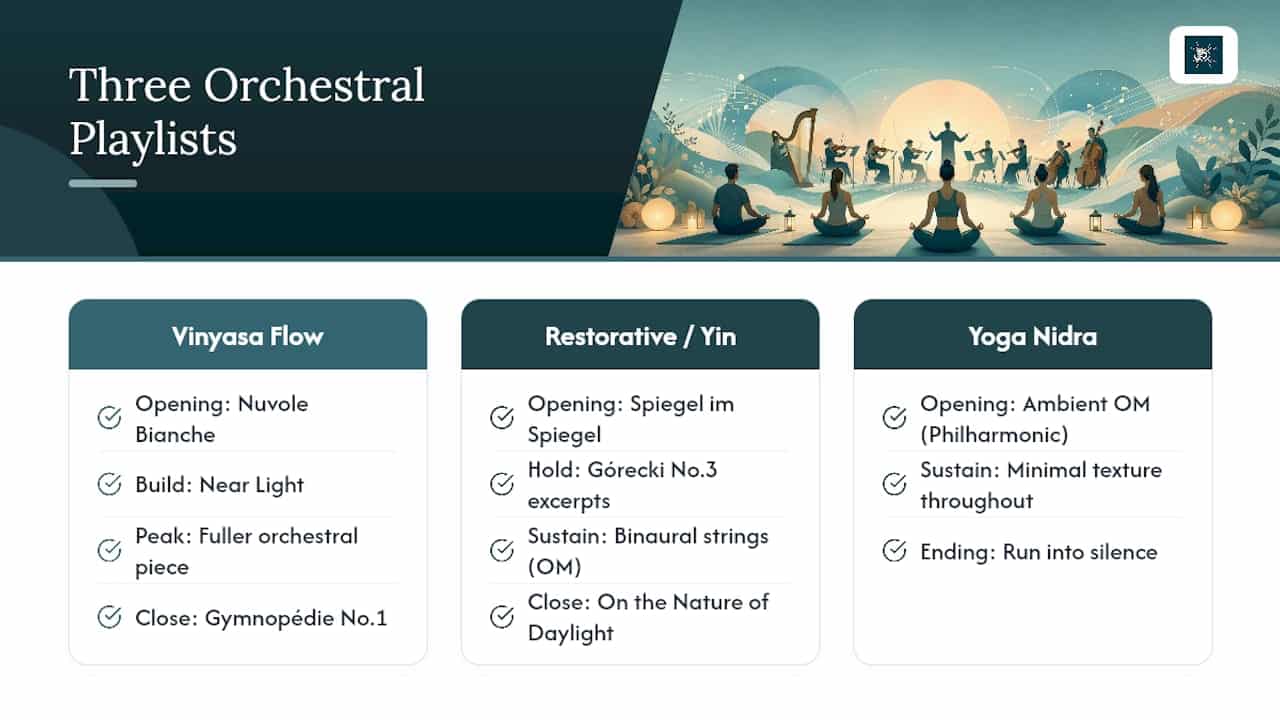
Vinyasa flow (energising, about an hour): Open with Nuvole Bianche, build through Near Light, peak with a fuller orchestral piece, then close on Gymnopédie No. 1 as the pace eases.
Restorative or Yin (about an hour): Start with Spiegel im Spiegel, hold through excerpts of Górecki’s Symphony No. 3 or an Orchestral Meditations binaural strings piece for the long poses, and finish on On the Nature of Daylight.
Yoga nidra or closing meditation (about half an hour to three quarters of an hour): Begin with an Orchestral Meditations ambient National Philharmonic recording, sustain minimal texture throughout, and let it run into silence rather than a defined ending.
For a typical class of moderate length, drop one track from the peak section of each list. For a longer class, extend the restorative or flow section with a second mid-tempo piece rather than adding intensity at the peak.
Why recording quality and composer credit actually matter
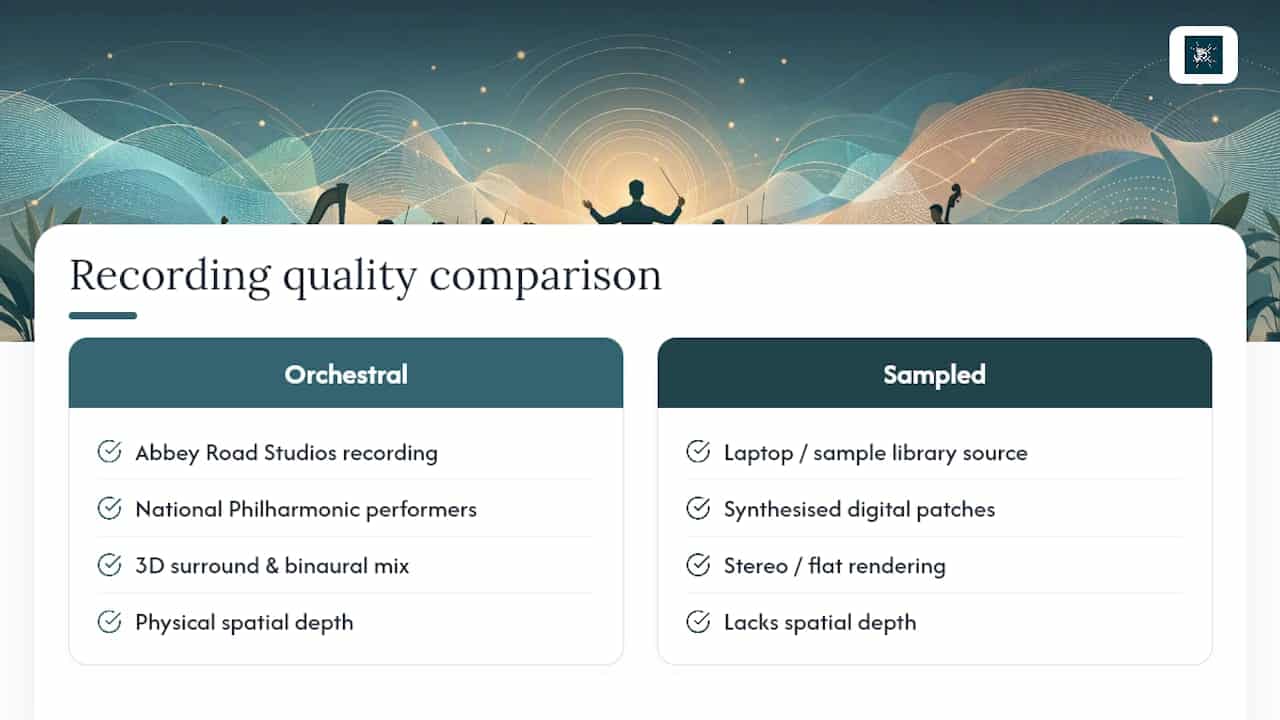
A meditation track recorded on a laptop with a sample library sounds different from one played by a full orchestra in a room built for sound, and yoga students notice the difference even when they can’t name it.
This library is recorded at Abbey Road Studios with the National Philharmonic, using 3D surround and binaural techniques that give a track physical depth rather than flat stereo width. Having credited composers and producers matters here for a practical reason: a track built by a known composer, recorded with a real orchestra, and mixed for genuine spatial depth reproduces consistently across headphones, studio speakers, and app playback. A poorly rendered digital patch does not.
The gap between a synthesised meditation loop and a live orchestral recording isn’t aesthetic snobbery. It’s the difference between a texture that holds still under scrutiny and one that starts to grate the third time a student hears it in the same term.
A teacher’s real decisions during class
Last term I ran a Tuesday evening flow where the room was tense from the day, so I opened with Spiegel im Spiegel instead of my usual mid-tempo piece, giving everyone longer to settle. Mid-flow, when energy lifted naturally around sun salutation B, I let a fuller orchestral track carry that lift rather than switching songs. By savasana, I cut the volume to near-ambient rather than silence entirely, because a full stop can jolt a relaxed room as much as a loud note can.
The rule I keep coming back to: when in doubt, turn it down before you turn it off.
— ROBERT
Where to browse and licence orchestral meditation tracks
There are tracks recorded specifically for meditative use, cleared for professional licensing, so you’re never one copyright notice away from losing your class music. The library includes royalty-free orchestral recordings, 3D and binaural pieces, and theta and Solfeggio frequency tracks, available as single-track downloads or through a subscription, with separate licences for personal listening and professional use in classes, apps, or therapy settings.
If you’re building a savasana or restorative sequence, the ambient National Philharmonic recordings and binaural strings pieces mentioned above are strong starting points, and pairing them with guided cues is straightforward if you’re combining voice with music, as covered in this guide to guided meditation techniques. Browse the full catalogue and licensing options on the Orchestral Meditations shop to find tracks ready for your next class.
Sources
- The best classical meditation music for mindfulness and yoga
- 12 songs to flow to when you’re on your mat at home
- The Best Yoga Music Playlists for Flow and Relaxation — Yoga Tribe Brooklyn
FAQ
Can I do yoga and meditation together with music playing?
Yes. Orchestral music works well across both, provided it stays quiet enough during seated meditation phases that it never competes with breath awareness.
What music is best for yoga?
Strings and soft piano pieces with minimal percussion tend to work best, since they support breath rather than setting a beat, as noted in Yoga International’s guidance.
What is a good closing meditation track for a yoga class?
A sustained, low-dynamic piece with no new instrument entrances works best; Orchestral Meditations’ ambient National Philharmonic recordings are built specifically for this closing phase.
Is it okay to listen to music while doing yoga?
Yes, and most teachers use it deliberately, though some Hatha or Yin classes prefer near-silence during the longest holds so the music never becomes a distraction from stillness.