Long, royalty-free tracks with a steady tempo, minimal melody and a neutral emotional tone work best for hypnotherapy. Look for pieces with a clear pro-therapy licence, running 30 to 60 minutes, ideally with a dedicated ramp-out ending. Orchestral Meditations, produced with composer and producer credits from figures like Robert Emery, is a solid example of the professional standard practitioners should be aiming for.
TL;DR:
- Professional-grade music recorded by live orchestral musicians offers better natural dynamics and smoother transitions than synthetic loops, supporting deeper trance states.
- Licensing must explicitly cover therapeutic use, including session recording and public sharing, with practitioners keeping all documentation to avoid legal issues.
- Tracks should have a stable tempo, minimal melody, and a neutral emotional tone, lasting 30 to 60 minutes to match typical hypnotherapy durations without looping.
- Use carefully structured fade-ins and fade-outs, with music set several decibels below the voice, to ensure smooth transitions and avoid disrupting the induction or emergence.
- Binaural and theta-frequency tracks only work over headphones with proper playback setup, and genre choices such as ambient, orchestral, or nature sounds are best for neutrality and client relaxation.
What to look for in music for hypnotherapy sessions: a quick checklist
Not every calming track earns a place in a session. The wrong choice pulls attention towards itself right when you need the client’s focus turned inward, which defeats the entire point of playing anything at all.
The strongest hypnotherapy background music shares a handful of traits, and once you know them, spotting the right track takes seconds rather than an afternoon of trial listening.
- Stable tempo and volume: no sudden swells, no dramatic key changes that yank attention back to the room.
- Minimal or absent melody: a memorable tune competes with your voice; composers who write specifically for hypnosis avoid strong melodic hooks and sudden dynamic shifts for exactly this reason, as TunePocket’s composer guidance explains.
- Neutral emotional colour: music that leans too happy or too sombre nudges the client’s state in a direction you haven’t chosen.
- Long-form duration: 30 and 60 minute versions cover most induction-to-emergence arcs without needing to loop a track awkwardly.
- Binaural or theta variants where appropriate: useful for headphone-based sessions, less useful over speakers.
- File quality: WAV for editing flexibility, high-bitrate MP3 fine for straightforward playback.
- Clear licence terms: pro-therapy or digital-media licensing that explicitly covers session and recorded use.
Pro Tip: Test a track with your eyes closed and a stopwatch running. If you can’t tell what minute you’re in without checking, the music is doing its job.
Licensing and commercial use: what practitioners must check
This is the section most hypnotherapists skip, and the one that causes the most grief later. A track sounding perfect in your headphones means nothing if the licence doesn’t cover how you actually use it.
Three licence tiers turn up repeatedly across specialist libraries. A personal licence typically covers your own private listening only, nothing client-facing. A pro-therapy licence extends that to live sessions with clients and, often, recordings you make for them individually. A digital-media or Pro-Therapy+Digital-Media licence goes further still, covering monetised content such as YouTube guided meditations, apps, or courses sold to the public, and many suppliers bundle unlimited duplication rights into this tier, as Silencio Music’s licensing pages set out.
Watch for the small print that trips practitioners up:
- Time-limited licences that expire after a set period.
- Territory restrictions that exclude certain countries.
- Platform exclusions (fine for a private clinic, not cleared for public streaming).
- Blanket bans on monetised content even under a “commercial” label.
Keep every receipt and the full licence text on file. If a professional body or your insurer ever asks how your session audio is sourced, you want that answer ready in seconds, not buried in an inbox from three years ago.
How to use music in a session: timing, mixing and the ramp-out technique
Music placement matters as much as music choice. A gorgeous track played at the wrong volume, or cut off abruptly, can undo minutes of careful induction work.
Structure the audio around three blocks: a settling phase during induction, a longer stretch of steady, unchanging texture through the deep work, and a gentle rise back towards alertness at emergence. Set the music several decibels below your spoken voice throughout. As one specialist hypnosis-music supplier notes, tracks paced around 60 beats per minute with deliberately unstructured measures are built precisely so they never compete with narration.
Fades matter more than most practitioners assume. A hard cut jolts a relaxed nervous system; a slow fade lets the transition pass almost unnoticed.
For the emergence itself, try this sequence:
- In the final minute of deep work, let the music’s energy lift slightly rather than cutting straight to a new track.
- Introduce your re-orientation script over that rising section, not before it starts.
- If using a dedicated ramp-out track, cross-fade into it over 5 to 10 seconds rather than switching instantly.
- Bring volume up gradually as you count the client back to full alertness.
- Let the music fade to silence only once the client has opened their eyes.
Pro Tip: Rehearse your ramp-out timing without a client present at least once. The gap between “sounds right in theory” and “actually reorients someone from trance” is bigger than most new practitioners expect.
Production features that matter: binaural, 3D, frequencies and file formats
Not all technical features on a product page are equally useful, and some only work under specific listening conditions.
Binaural beats and theta-range entrainment rely on delivering slightly different frequencies to each ear, which only works over headphones. Play a binaural track through room speakers and the effect simply vanishes, so match the format to how your client will actually listen.
3D or ambisonic mixes suit fully immersive, headphone-based guided sessions where the client is doing nothing but listening. For sessions where your spoken voice needs to sit clearly on top of the music, a simple stereo mix is the safer, more controllable choice.
Steady low pulses without sharp transients help entrainment along; a single loud drum hit can undo several minutes of settling. Solfeggio-tagged and theta-frequency packs are common in royalty-free hypnosis bundles, often alongside ambient pads designed to run for hours without repeating obviously.
On format: WAV remains the practitioner’s preferred choice for editing and layering under narration, since lossless files hold up better through multiple edits than compressed MP3s do.
Why Orchestral Meditations meets the standard practitioners need
Most royalty-free libraries are built by one person with a synthesiser and a subscription to a stock-sound bank. That’s not a criticism, it’s just a different level of production, and it shows up in the listening.
Orchestral Meditations records with live musicians associated with the National Philharmonic, at Abbey Road Studios, using techniques including 3D surround and binaural mixing. That pedigree matters practically, not just as a marketing line:
- Live musicians produce more natural dynamic control than layered loops, which makes mixing under spoken voice noticeably easier.
- Studio-grade recording reduces the harsh transients and digital artefacts that pull attention in cheaper libraries.
- Long-form, professionally mastered tracks suit the 30 to 60 minute session arcs practitioners actually need.
- Pro licensing options cover in-session and recorded, commercial use rather than personal listening alone.
The catalogue’s composer and producer credits include Robert Emery, a conductor and producer known for large-scale live orchestral broadcasts and recordings, whose work brings a level of compositional craft that matters more in therapeutic audio than most buyers realise. A meandering, undirected ambient loop and a piece composed with genuine structural intent underneath its calm surface feel different to a nervous system, even when a client can’t articulate why.
Music written by someone who understands orchestral pacing and dynamics produces exactly the kind of predictable, non-intrusive texture that supports trance rather than interrupting it.
Where to sample and buy hypnotherapy tracks
Before committing, audition properly. Listen for three things specifically: does the tempo stay put, is there a melody line that keeps pulling your attention, and does the track offer a usable ending rather than an abrupt stop.
A few source types are worth knowing:
- Specialist hypnosis libraries offer purpose-built tracks with ramp-outs and licence tiers already sorted for therapeutic use, as seen on Silencio Music’s product pages.
- Streaming compilations, such as large hypnotic playlists on Spotify, are useful for auditioning mood but rarely carry licences suitable for commercial or recorded client use.
If you need something more specific than the catalogue offers, request a WAV master or a custom edit from the composer directly. Many suppliers, Orchestral Meditations included, will accommodate bespoke length or fade requests for practitioners with recurring needs.
Different genres and styles that support relaxation and focus
Ambient and orchestral drone-based pieces dominate hypnotherapy playlists for good reason, but they’re not the only option worth knowing about.
Slow, sustained orchestral pads (strings and soft brass held over long chords) create warmth without introducing a hummable tune, which is precisely why Abbey Road style recordings translate so well into this space. Solfeggio-frequency compositions layer specific tonal frequencies under an ambient bed and appeal to clients who respond to that framing, even if the therapeutic mechanism itself remains debated.
Nature-infused soundscapes (rain, gentle water, distant wind) work well for clients who find pure tone difficult to settle into, giving the ear something organic to rest on without any risk of melody intruding. Binaural-only compositions, built around theta-range pulses rather than musical content, suit headphone-based sessions where entrainment is the primary goal rather than aesthetic pleasure.

Avoid genres with a clear cultural or genre identity: lo-fi hip hop, acoustic guitar, anything with a recognisable groove. These carry associations and rhythmic pulls that work against the neutrality hypnotherapy music needs. The safest rule of thumb: if you’d recognise the track playing in a café, it’s probably too characterful for a session.
How different instruments and sounds affect the trance state
Instrument choice shapes a session more than most practitioners give it credit for, largely because certain timbres carry emotional or cultural weight that the client absorbs unconsciously.

Sustained strings (cellos, violas held in low registers) tend to read as warm and grounding, making them a strong choice for inductions where you want the client to feel held rather than stimulated. Soft piano, used sparingly, can work well but risks introducing melodic phrases if the composer isn’t disciplined about restraint.
Percussion is the instrument category to treat with most caution. Even a soft mallet strike creates a transient, an audible spike, and spikes are exactly what steady entrainment tries to avoid. If a track includes any percussion, check whether it’s a soft, continuous pulse (fine) or discrete hits (risky).
Synthesised pads and drones, when done well, offer the smoothest possible bed because there’s no attack transient to manage at all, which is part of why binaural and theta-frequency tracks are usually built from synthetic tone rather than recorded instruments. Bells and singing bowls appear often in meditation music but carry a strong, immediately recognisable timbre; some clients find that grounding, others find it snaps them straight back into “meditation app” associations rather than trance.
Matching music to each client’s preferences and goals
A track that works beautifully for one client can actively work against another, which is why a single default playlist across your whole practice is rarely the smartest approach.
Start with the therapeutic goal itself. Anxiety-focused sessions often benefit from warmer, string-led textures that feel emotionally held rather than clinically neutral. Sessions targeting focus, performance, or habit change sometimes work better with more neutral, texture-only beds that stay entirely out of the emotional foreground.
Client history matters too. Someone with a strong personal association to a genre, classical, ambient, even certain nature sounds, may respond very differently to it than a client with no prior exposure. Ask directly during intake whether specific sounds relax or unsettle them; a five-minute conversation here saves an awkward mid-session surprise.
Headphone availability changes what’s viable. Binaural and 3D-mixed tracks only deliver their intended effect through headphones, so a client-side speaker setup limits you to conventional stereo options regardless of preference.
Building a small rotation, three or four tracks matched to different goals, works better in practice than hunting for one universal piece. It also protects against the subtle habituation effect where a client who has heard the same track dozens of times starts associating it with routine rather than depth.
Common mistakes practitioners make with hypnotherapy music
The most frequent error is choosing music that’s simply too interesting. A track that would make a wonderful commute soundtrack is usually the wrong choice for a session, because interesting is the opposite of what you need once the induction begins.
Skipping the licence check ranks close behind. Practitioners routinely assume a “royalty-free” label covers commercial and recorded use automatically, then discover months later, often when trying to sell recorded sessions or post them online, that their licence never covered that use at all.
Playing music at the wrong volume relative to voice causes more disrupted sessions than almost any other factor. Too loud and it competes with narration; too quiet and any ambient room noise leaks through the gap.
Forgetting the ending is a subtler mistake but a real one. A track that simply stops, or loops jarringly, on emergence undoes the careful pacing built through the rest of the session. Building a short rise into the final minute, or switching to a dedicated ramp-out track, solves this cleanly.
Finally, some practitioners over-rely on binaural or theta-branded tracks purely on reputation, without checking whether their playback setup (speakers rather than headphones) can even deliver the intended effect. Marketing language doesn’t override physics.
The editorial take: why professional production matters more than the industry admits
Most guidance on hypnotherapy music focuses entirely on technical rules, tempo, melody, licensing, and treats production quality as an afterthought. That’s backwards. A track built from thin synthesiser patches can technically tick every checklist box while still sounding faintly artificial in a way clients register without naming it.
The gap between “meets the specification” and “actually supports trance” often comes down to who composed and recorded the piece. Work from a producer with genuine orchestral pedigree, someone like Robert Emery or Moritz Schneider, tends to carry a structural intent underneath its calm surface that thinner ambient loops lack, and that intent shows up as smoother dynamics under a therapist’s voice.
Practitioners should prioritise production pedigree first, then filter by licence, then by genre preference. Get the first two wrong and no amount of client-matching fixes a track that sounds thin or behaves unpredictably mid-session.
— ROBERT
Get properly licensed, studio-recorded music for your practice
Orchestral Meditations gives hypnotherapists a way to skip the trial-and-error of stock libraries entirely. Every track is recorded with live musicians at Abbey Road Studios, using 3D surround and binaural techniques, and delivered with licensing built for professional and commercial use, not just personal listening.
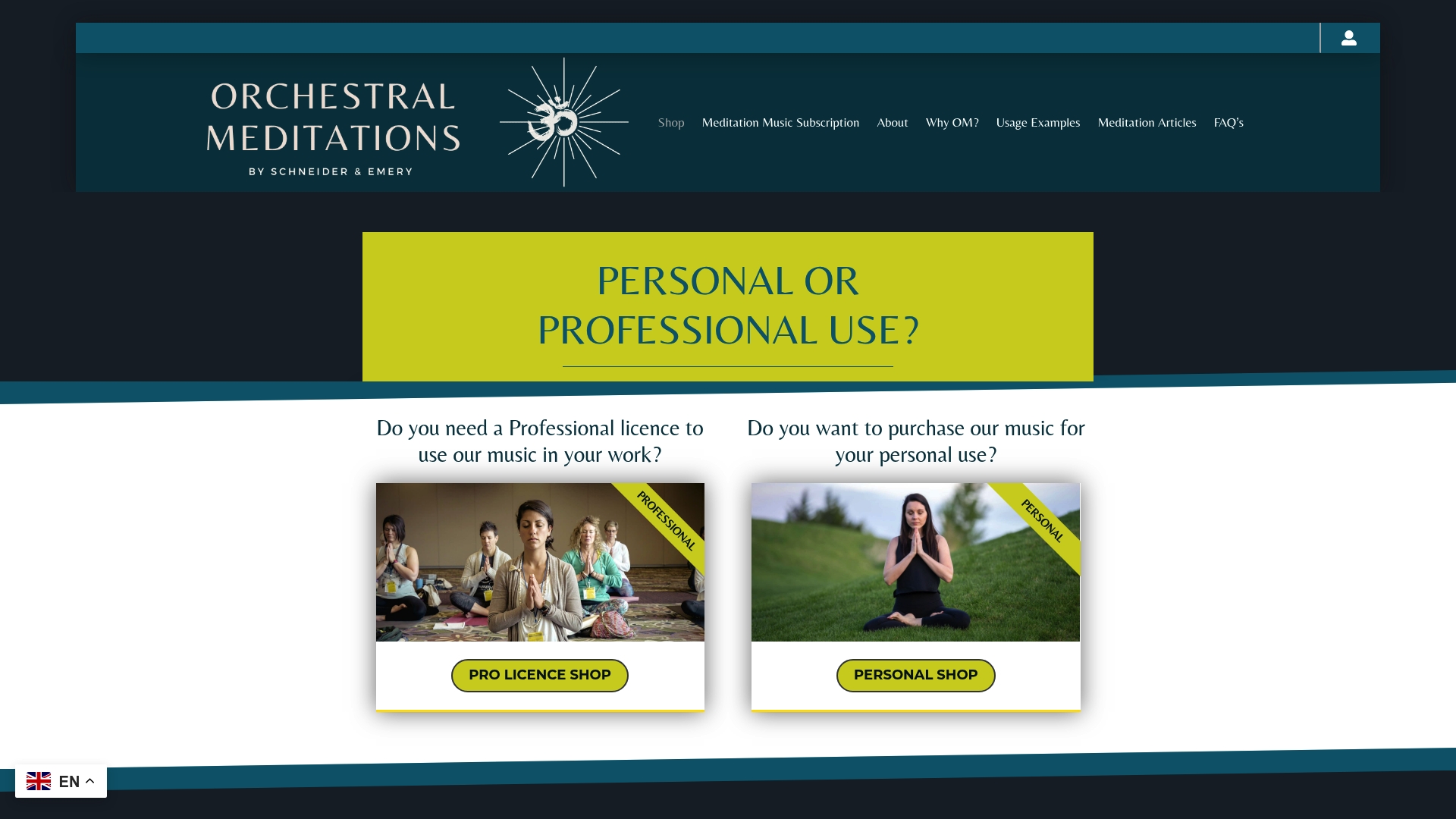
That combination, orchestral pedigree plus pro-therapy licensing, is genuinely uncommon at this price point. Many practitioners cobble together a synth-based loop from a generic stock site and hope the licence quietly covers recorded sessions later. Orchestral Meditations removes that guesswork by stating the terms upfront and pairing them with tracks composed for genuine emotional neutrality rather than background filler.
For sessions where multisensory support matters, pairing music with something like an inhalable relaxation diffuser alongside your audio can round out the client’s environment further. And if you’re building recorded guided sessions rather than live ones, the guided meditation techniques guide walks through combining voice and music for that specific format.
Browse the full Orchestral Meditations catalogue and sample tracks by duration and licence type before you buy, so the first track you commit to is genuinely the right one for your next client.
Sources
- Paz • Silencio Music — hypnosonic background music for hypnosis and meditation
- Music for hypnosis — TunePocket
- Royalty-free background music — Hypnosense
FAQ
What are some good sounds for hypnosis?
Steady ambient pads, sustained low strings, and gentle nature textures like distant water work well because they carry no melody and no sudden dynamic shifts to distract from the induction.
What makes a song suitable for hypnosis?
A track earns the label by staying tempo-stable, melody-light, and emotionally neutral throughout, with a long enough runtime, typically 30 to 60 minutes, to cover a full session without looping awkwardly.
Does listening to hypnotherapy actually work?
Music itself doesn’t create the trance state, but the right background track removes distractions and supports the pacing a hypnotherapist builds through voice and suggestion, which composer guidance consistently points to as the reason minimal-melody tracks perform better in practice.
How should I prepare for a hypnosis session involving music?
Test your chosen track beforehand for volume balance against your speaking voice, confirm your licence covers the session type, and if using binaural or theta variants, make sure the client will be listening on headphones rather than speakers.