If you need meditation music that behaves the same way every single time you press play, choose studio-recorded, professionally mastered tracks over anything captured in a bedroom or lifted from a stock library. That distinction sounds fussy until you are three minutes into a paid course recording and a phone buzzes on the desk of the person who recorded it at home.
Two things separate studio work from everything else: consistent levels across an entire album (no jarring volume jumps between tracks) and access to high-resolution files or stems that professionals can actually edit. Orchestral Meditations, recorded with composers including Robert Emery and Moritz Schneider, is one example readers can check against this standard directly, right down to the credits.
- Consistent mastering across a full session or album
- High-resolution files and stems available on request
- Verifiable composer and recording credits, not anonymous stock audio
Key Takeaways
Studio-recorded meditation music, backed by verifiable composer credits and lossless stems, is the only reliable choice for clinical, commercial, or monetised audio work.
| Point | Details |
|---|---|
| Verify the specs | Confirm sample rate, bit depth, and stereo/binaural/ambisonic format before buying. |
| Insist on stems | Separated layers let you balance a voiceover properly without fighting one flattened file. |
| Match licence to use | Personal, clinical, and commercial licences differ; check territory and exclusivity terms in writing. |
| Mix with headroom | Keep 6 to 8dB of headroom on the music bed and duck it under narration with a sidechain. |
| Choose verifiable pedigree | Orchestral Meditations records at Abbey Road Studios with experienced composers and producers, on both personal and commercial licences. |
What does “studio recorded meditation music” actually mean?
“Studio recorded” means the music was captured in an acoustically controlled room, using calibrated microphones, with musicians who can perform the same phrase twice without drift in tuning or timing. That is a meaningfully different product from a lo-fi ambient loop built on a laptop with a single synth patch, and the difference is audible even to listeners who could not name a single piece of studio equipment.
Composers working in this space often strip away the things that usually define music: fixed tempo, melodic resolution, a sense of “arrival.” That is deliberate. Removing those cognitive hooks is a recognised technique in music therapy, and it is why well-produced meditation pieces feel like a texture to sink into rather than a song to follow.
When you are auditioning a track, listen and look for:
- Sample rates of 48kHz or higher, with 24-bit depth as the professional baseline
- Genuine stereo width, or dedicated binaural and ambisonic mixes rather than a stereo file relabelled “3D”
- Slow harmonic movement built around specific frequency targets, such as theta-range pulses or Solfeggio tuning
Statistic to remember: poor audio quality breaks immersion faster than almost any other production fault, according to UCLA Mindful, which is exactly why frequency consistency across a whole session matters more than a flashy intro.
What file formats and deliverables should you check before buying?
Ask for the technical specification sheet before you hand over payment, not after. This is the part most buyers skip, and it is the part that determines whether the track will actually work in your setting.
- Request lossless masters. WAV or FLAC files preserve the full dynamic range needed for further mixing; MP3 is fine as a final listening copy, but it is a lossy dead end for editing.
- Ask whether stems are included. Stems, meaning the orchestral layers split apart (strings, pads, low drones, percussion), let you rebalance the mix around a voiceover instead of fighting a single flattened file.
- Confirm the spatial format. Stereo suits general listening and apps; binaural mixes need headphones to register the intended effect and work best for solo, focused sessions; ambisonic or 3D surround suits spa spaces and installations with multi-speaker setups.
- Check loudness targets. Streaming platforms and meditation apps typically expect masters around minus 16 to minus 14 LUFS integrated, quieter than a pop single, because sustained calm needs headroom rather than compression.
- Get the paperwork. A proper delivery includes metadata, a cue sheet if the track will be broadcast or used in a paid app, and licence terms stated in plain English, not buried in a PDF nobody reads.
Pro Tip: If a vendor cannot tell you the sample rate and bit depth of their master file without checking, that is a fair signal the “studio recorded” claim is marketing rather than fact.
Red flags worth walking away from: no stems offered at any price, licence terms that mention “personal use only” with no professional tier, or a seller who cannot name the studio, musicians, or composer behind the recording.
Who actually needs studio-recorded tracks?
Not every use case justifies the investment, and pretending otherwise wastes your money. Studio quality earns its cost when the recording is doing serious work.
- Clinics and therapy practices, where consistent, clinically appropriate audio supports repeat sessions with vulnerable clients
- Meditation and wellness apps, where thousands of plays magnify any flaw in the original file
- Paid courses and hypnotherapy programmes, where a client has paid for the experience and expects it to sound finished
- Spas and studios using multi-speaker or 3D sound systems, where a flat stereo file simply falls apart
Where studio tracks are genuine overkill: a quick Instagram reel, a private playlist for your own commute, or a one-off class you are trying out before committing to a paid licence. Save the investment for the work that will be repeated, sold, or scrutinised.
How do you choose and licence the right track?
Work through this before you pay, not after a client complains that the “meditation music” in their app sounds thin on a phone speaker.
- Confirm the technical specification in writing: sample rate, bit depth, and whether stems are available.
- Ask directly whether the licence covers commercial use, and for which territories.
- Check for exclusivity: is this track sold to unlimited buyers, or can you secure sole use for your brand?
- Clarify duration limits. Some licences cap total video minutes or subscriber counts per year.
- Get the licence terms in an email or PDF, not a verbal assurance on a sales call.
Questions worth sending to any vendor before you buy:
- “Can you supply the WAV or FLAC master, and are stems included in this price?”
- “Does this licence cover use inside a paid app or clinic setting, or personal use only?”
- “Is this track sold exclusively, or available to other buyers under the same licence?”
Independent producers on platforms such as Bandcamp show how varied royalty-free pricing and delivery can be, from single-track downloads to bundled packs, which is useful context when you are judging whether a quote feels fair. The common thread across every reliable seller: clear specs, clear rights, no ambiguity.
How do you mix studio music with a voiceover properly?
Getting the balance right between narration and an orchestral bed is mostly about restraint, not clever plugins.
- Set your levels first. Bring the voice in around minus 6dB to minus 3dB peak, and let the music sit roughly 8 to 12dB below the voice during spoken sections.
- Leave headroom. Keep 6 to 8 dB of headroom on the music bed before mastering, so nothing clips when the two elements combine.
- Shape the frequencies. High-pass the voice around 80 to 100Hz to remove rumble, then apply a gentle dip in the 1 to 3kHz range on the music, exactly where spoken word sits, so the voice cuts through without fighting the strings.
- Use ducking, not hard cuts. A sidechain compressor triggered by the voice track lowers the music automatically and releases smoothly, which sounds far more natural than manually drawing volume dips.
- Master to the right loudness. Export around minus 16 LUFS for podcast-style platforms, or minus 14 LUFS for most streaming and app environments, and always check on a phone speaker before calling it finished.
Pro Tip: Multiband compression, applied gently to just the music stem, keeps the orchestral texture full without ever competing with the frequencies where the human voice naturally sits.
Where does Orchestral Meditations get its studio credentials?
Recording location matters because it is the one claim a buyer can actually verify. Orchestral Meditations records with live orchestral musicians at Abbey Road Studios, a venue whose recording history is a matter of public record rather than marketing copy, and works with the National Philharmonic on its orchestral sessions.
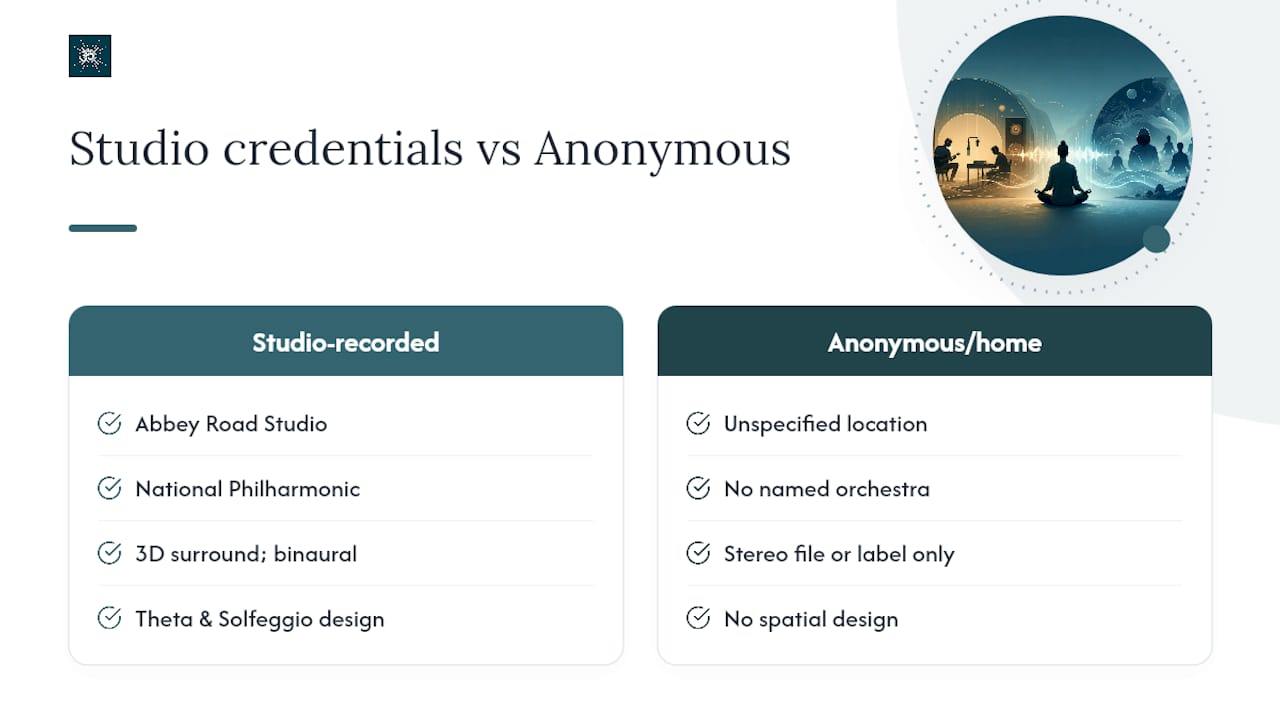
The production side leans on genuine spatial techniques rather than a stereo file with a label slapped on it: 3D surround mixing, binaural encoding, and deliberate application of theta-range and Solfeggio frequency design across the catalogue.
Composer and producer credits sit at the centre of that claim. Robert Emery is a British composer and conductor known for large-scale orchestral and film work, and Moritz Schneider brings production and mastering experience to the same catalogue, the kind of named, checkable credit that a home-recorded file simply cannot offer.
A track recorded with a named composer, a named studio, and a named orchestra gives a buyer something to verify. Anonymous production gives them nothing to check at all.
Delivery on the platform includes both personal and professional or commercial licences, letting a therapist or app developer buy the same recording a casual listener does, at the tier their use actually requires.
Why studio pedigree still matters more than production polish alone
Every guide to meditation music will tell you to check the sample rate. Fewer will tell you that the composer’s name on the file is doing more work than any spec sheet. When a client asks where a recording came from, “professionally produced” is not an answer. “Recorded at Abbey Road Studios with Robert Emery” is.
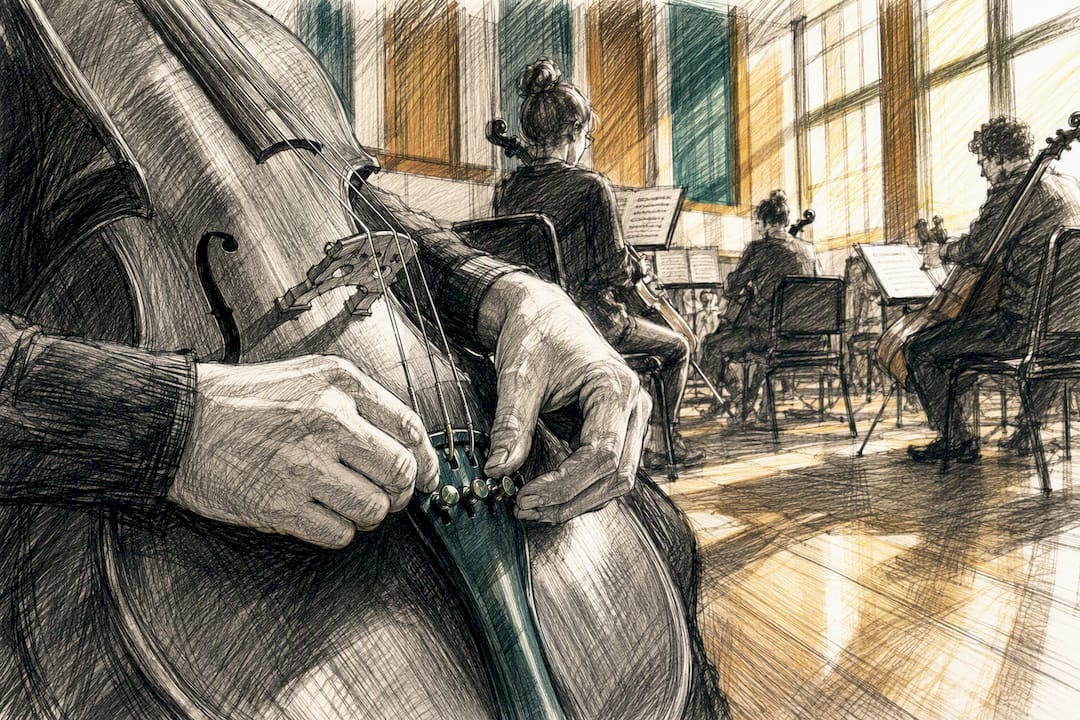
I have sat in on enough guided sessions to notice the moment a cheap ambient loop breaks concentration, usually right when a loop point clicks or a synth pad phases oddly. Swap that for a properly recorded orchestral bed and the room genuinely settles differently. Moritz Schneider’s mastering work on similarly credited catalogues shows the same pattern: the polish is invisible until it is missing.
Where to buy or licence studio-quality meditation tracks
Orchestral Meditations sells exactly the catalogue this article has been describing: Abbey Road recordings, composer credits you can check, and both personal and commercial licences on the same track, rather than forcing professionals into a bespoke commissioning process.
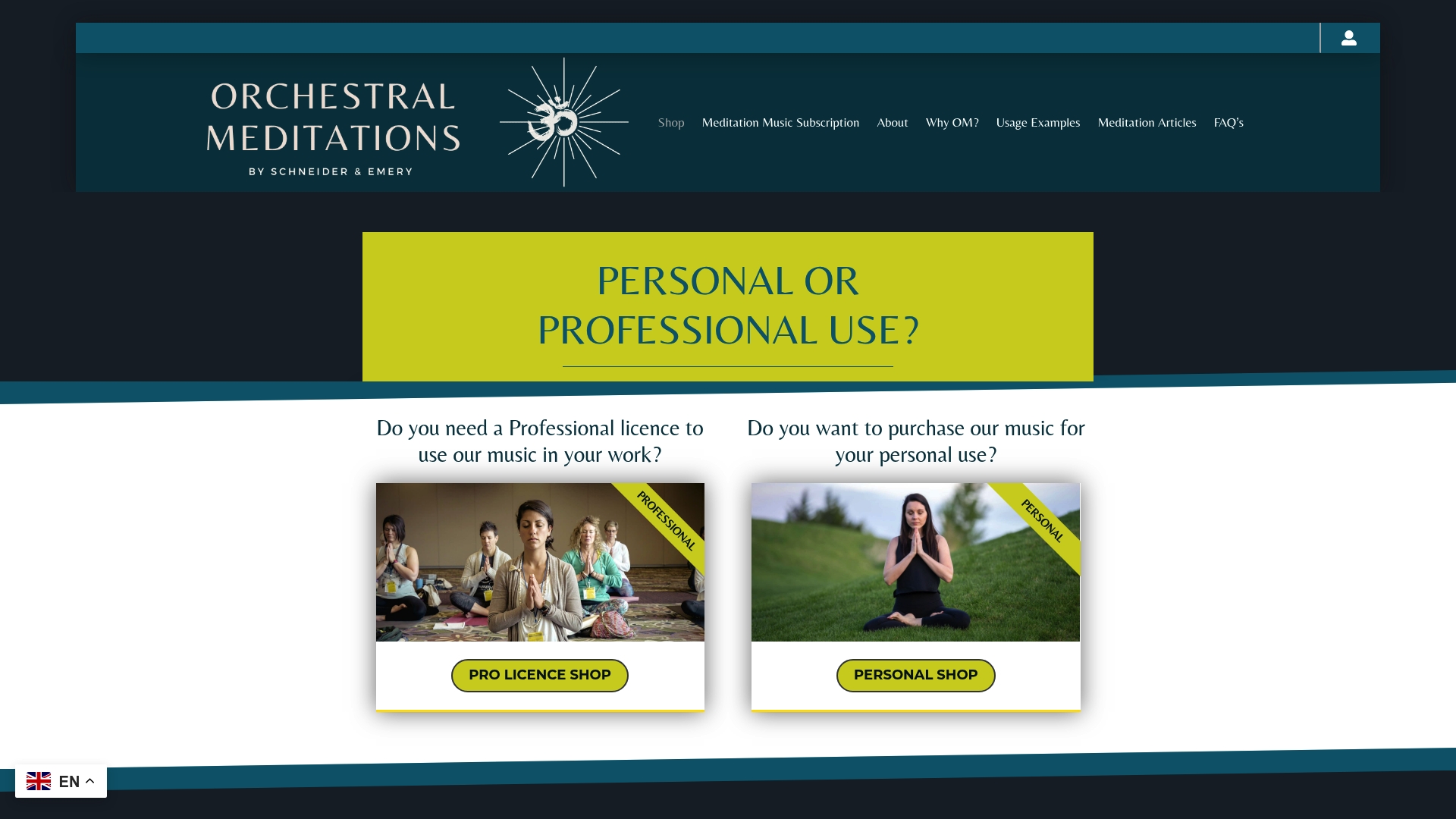
If you are scoring a guided course, building an app, or soundtracking a therapy room, start with the English-language meditation music catalogue, where individual tracks and subscriptions sit side by side with licence terms stated upfront. Listeners after a smaller, curated starting point can browse the best meditation music for personal use, while anyone drawn to the orchestral and Solfeggio design choices covered above can read more in the definitive guide to orchestral meditation music. Pick a track, check the licence tier against your use case, and download.
Sources
- UCLA Mindful
FAQ
What does “studio recorded” mean for meditation music?
It means the track was captured in an acoustically treated room with professional microphones and, often, live musicians, giving consistent levels and tone rather than the variability typical of home recordings.
Is WAV or MP3 better for meditation music production?
WAV or FLAC is essential for mixing and editing because it preserves the full dynamic range, while MP3 is only suitable as a final, compressed listening copy.
Do I need stems for a guided meditation project?
Yes, if you are adding a voiceover, stems let you rebalance the orchestral layers around the narration instead of fighting one fixed mix.
Where can I find studio-quality, royalty-free meditation music with a commercial licence?
Orchestral Meditations offers Abbey Road recordings with composer credits including experienced composers and producers, available under both personal and commercial licence tiers.
What LUFS target should I use for a guided meditation app?
Aim for roughly minus 16 to minus 14 LUFS integrated, which keeps the recording calm and consistent without excessive compression flattening the dynamics.