Here’s the single sentence you actually came for: a Hertz frequency chart is a table of exact vibration rates, measured in cycles per second, that tells you precisely what pitch a musical note, a “healing” tone, or a brainwave band corresponds to. This page gives you every version of that chart in one place.
You’ll find a machine-readable note table running from C0 to C8, an alternate column for the 432 Hz camp, the full Solfeggio list, the Schumann resonance, and the five brainwave bands, all with practical notes on how to actually use them rather than just admire them.
A few numbers to anchor everything that follows:
- Standard concert pitch is A4, typically set at 440 Hz.
- Human hearing runs roughly from 20 Hz to 20,000 Hz, though most musical content you’ll ever mix or meditate to sits between about 80 Hz and 4,000 Hz.
- The most talked-about “wellness” frequency, 528 Hz, sits comfortably inside that range and is often marketed as the miracle or love tone.
Key Takeaways
Accurate frequency reference charts, paired with professionally recorded music rather than raw tones, give listeners both the precision and the depth needed for meaningful meditation and production work.
| Point | Details |
|---|---|
| Standard tuning anchor | A4 sits at 440 Hz; every other note is calculated from that reference using equal temperament. |
| Calculation formula | Use f = reference × 2^(n/12) to find any note’s frequency from a known anchor pitch. |
| Healing frequencies are traditional, not proven | Solfeggio tones and 528 Hz carry anecdotal associations; only small pilot data exists for 432 Hz. |
| Brainwave bands guide meditation design | Delta through gamma map roughly to sleep, relaxation, and alertness states, with mixed entrainment evidence. |
| Production quality changes perception | Orchestralmeditations records live orchestral pieces at Abbey Road Studios with 3D surround and binaural techniques for a richer listening experience than a plain generated tone. |
Hertz frequency chart for musical notes, from C0 to C8
Right, let’s get the actual chart on the table, because that’s why you’re here.
Standard Western tuning uses a system called equal temperament, where every octave doubles in frequency and each of the twelve semitones within it sits at a fixed ratio apart. With the reference point set at A4 = 440 Hz, every other note on the piano falls into place mathematically. Middle C (C4) comes out at roughly 261.63 Hz, and the C an octave above it (C5) lands at 523.25 Hz, exactly double.
Here’s the reference table, with a second column for readers who prefer the 432 Hz tuning standard (more on why that number keeps coming up in a moment):
Notice what happens between the two columns: every single value shifts by the same ratio (432 divided by 440, or roughly 0.9818). That’s the part people get wrong constantly. Dropping to 432 Hz doesn’t retune one note. It nudges the entire keyboard down by a fixed percentage, so the relationships between notes, the actual intervals that make a chord sound like a chord, stay identical. Only the anchor point moves.
A few notes on how musicians and producers actually use this table day to day:
- Tuning: guitarists and orchestral players use A4 as their reference pitch when tuning against a piano, tuner app, or fellow musician.
- EQ notching: if you need to cut a resonant frequency in a mix (say a boxy 250 Hz buildup), this chart tells you which note that roughly corresponds to, which helps you decide whether you’re fighting a fundamental or a harmonic.
- Sub-bass and 808 work: C1 and C2, sitting around 32 to 65 Hz, are the territory most trap and hip-hop producers tune their kick and 808 patterns to for maximum low-end punch.
If you want the full note-to-frequency chart with every semitone rather than just the C notes, most interactive versions online let you export as CSV or copy individual rows straight into a spreadsheet. In a DAW, you can usually paste a frequency value directly into an oscillator’s pitch field if it accepts Hertz input rather than note names, which saves a lot of squinting at a piano roll.
How do you calculate a note’s frequency from a reference pitch?
The formula behind every cell in that table above is:
f = reference × 2^(n/12)
Where “reference” is your anchor pitch (440 Hz for standard tuning), and “n” is the number of semitones your target note sits away from that reference, positive if higher, negative if lower.
Worked example: to find C4 starting from A4 = 440 Hz, count the semitones down from A4 to C4, which is 9. So the equation becomes 440 × 2^(-9/12), which comes out to roughly 261.63 Hz, matching the table exactly. Go up an octave to C5, and n becomes +3 semitones from the A above (or you simply double 261.63 Hz), landing at 523.25 Hz.
A few practical points worth keeping in your back pocket:
- In MIDI terms, each semitone step corresponds to one MIDI note number, so producers often calculate frequency straight from MIDI note number using a near-identical version of this formula.
- To work out cents deviation (how far a note is out of tune, in hundredths of a semitone), use 1200 × log2(f1/f2). Anything under about 10 cents is inaudible to most listeners.
- Retuning to 432, 442, or 444 Hz shifts every note by the same percentage. It is a global reference shift, never a single-note fix, and it won’t correct an out-of-tune instrument on its own.
What are Solfeggio frequencies, the Schumann resonance and 432 Hz?
This is the list most people searching for a “healing frequency chart” actually want, so here it is, annotated honestly rather than mystically.
The Solfeggio set traces to a modern reinterpretation of an old numerological system rather than any peer-reviewed acoustic research, and 528 Hz gets the biggest marketing push of the six, usually branded as the frequency of “DNA repair” or unconditional love. There isn’t controlled clinical evidence behind that specific claim, so treat it as a tradition worth exploring for its own sake, not a medical intervention.
The Schumann resonance) is a different beast entirely. It’s an electromagnetic pulse generated by lightning activity in the cavity between the Earth’s surface and the ionosphere, peaking near 7.83 Hz. It’s not a sound wave, and at that frequency it sits well below the bottom of human hearing anyway. Wellness content that plays “Schumann resonance tones” is really just playing a low sine tone inspired by that number, not the resonance itself.
432 Hz has the most interesting paper trail of the bunch. A pilot study comparing listeners exposed to music at 432 Hz versus 440 Hz found a modest reduction in heart rate and respiratory rate with the lower tuning, but the study’s own authors flagged the sample size as too small to draw firm conclusions and called for larger controlled trials. That’s the honest state of the evidence: a coherent early signal, not proof.
Pro Tip: When auditioning any of these tones for the first time, keep the volume low and the session short, then open a spectrum analyser to check what harmonics and overtones are actually present. A “pure” 528 Hz tone from a cheap generator often carries unwanted harmonic noise that changes how it actually sounds. You can compare traditional associations against the current evidence in more depth in Orchestralmeditations’ 432 Hz versus 440 Hz breakdown, or see how 432 Hz stacks up against 528 Hz for relaxation.
What are the brainwave frequency bands and what do they do?
Brainwave bands describe the electrical oscillation patterns your brain produces, measured in Hertz via EEG, and they’re the basis for most “binaural beats for focus” or “theta meditation” content you’ll find.
| Band | Approximate range | Common association |
|---|---|---|
| Delta | 0.5 to 4 | Deep, dreamless sleep |
| Theta | 4 to 8 Hz | Light meditation, drowsiness |
| Alpha | 8 to 12 Hz | Relaxed wakefulness, calm focus |
| Beta | 12 to 30 | Active thinking, alertness |
| Gamma | 30 and above | High-level cognitive processing |
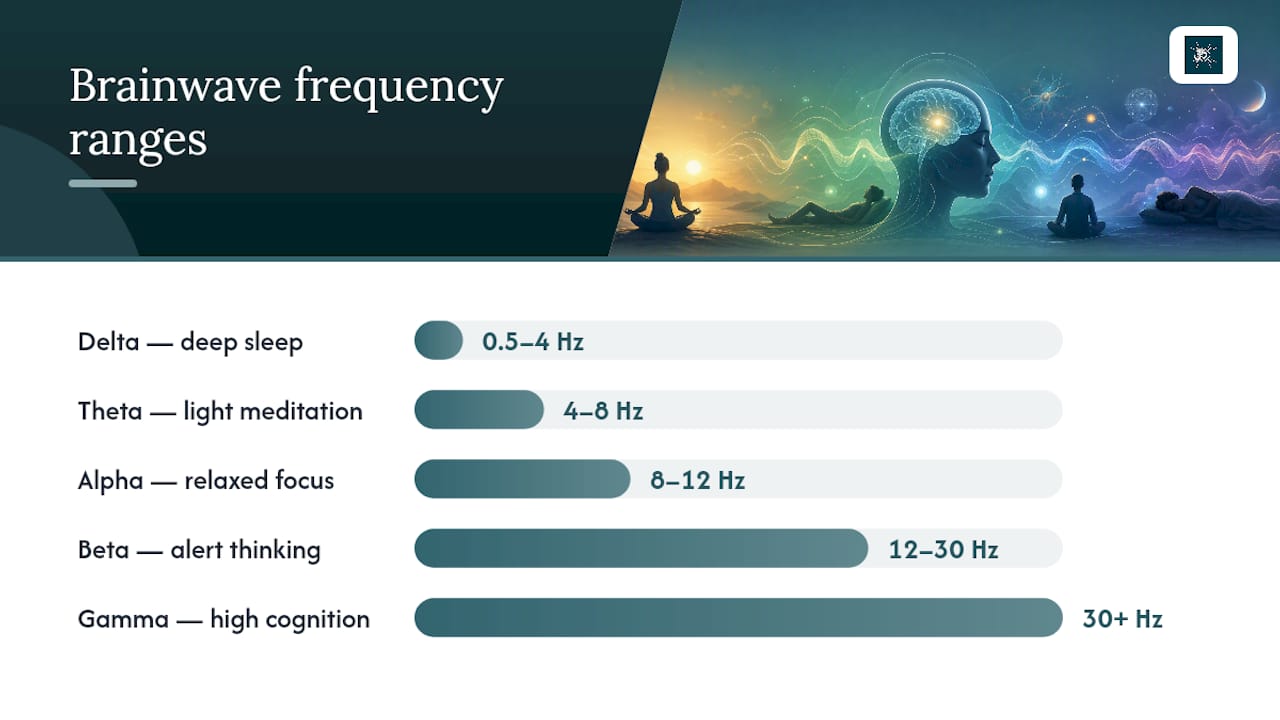
For sound design purposes, meditation producers typically build a piece around the alpha or theta range when the goal is winding down, and use binaural beats, two slightly different tones played one to each ear, to try nudging the brain toward that target frequency through a phenomenon called entrainment.
A couple of things worth knowing before you commit an evening to theta tracks: individual response to entrainment varies a lot from person to person, and the research on how reliably it actually shifts brain state is genuinely mixed rather than settled science. It’s a reasonable relaxation aid, not a guaranteed neurological switch.
What tools can you use to generate and check Hz accurately?
You don’t need a physics lab. A handful of tools cover almost every use case:
- Online tone generators for quick single-frequency playback checks, no install required.
- DAW-native tone plugins or oscillators for producers building tracks directly in Ableton, Logic, or similar software.
- Spectrum analysers (FFT-based) to visually confirm what frequency is actually coming out of your speakers, not just what the label says.
- Pitch detection apps for tuning instruments against a target Hz value on the fly.
- Mobile apps on iOS and Android for casual checks, though most lack the precision to confirm a strict tuning standard.
Free options handle verification fine; paid plugins earn their keep when you’re producing content for sale, where accuracy actually matters to your listener.
Pro Tip: Before trusting any binaural beat track, check whether it’s genuinely playing two separate close-frequency tones (one per ear channel) rather than a single mono tone with a “binaural” label slapped on it. Wearing proper headphones is not optional here, since the whole effect depends on each ear receiving a distinct signal. Calibrate your playback level first, then confirm output with a spectrum analyser before you export or publish anything.
Is it safe to listen to healing frequencies, and what does the evidence actually say?
Here’s the balanced version, because most pages on this topic pick a side and stop asking questions.
- Most Solfeggio and “healing frequency” claims remain anecdotal and traditional rather than clinically proven; a small pilot on 432 Hz found modest physiological differences but explicitly called for larger trials before anyone treats it as established fact.
- Keep casual listening sessions at a comfortable, conversational volume, and avoid extended exposure above roughly 85 decibels, the level where hearing damage risk starts climbing with duration.
- If you use a device with medical implications, such as a pacemaker, or you’re pregnant, be cautious with very low-frequency, high-intensity playback through subwoofers or bone-conduction devices, and check with a clinician first.
- A cheap decibel meter app plus a spectrum analyser is enough to confirm a track is playing what it claims, and at a volume that won’t cause harm.
For a fuller look at what the evidence base can and can’t support, Orchestralmeditations’ guide to sound frequencies and relaxation and sound therapy for mental health both walk through the research without overselling it. It’s also worth remembering that audio Hertz and the electromagnetic Hertz used to describe radio and infrared bands are entirely different physical phenomena sharing only a unit name, and the same caution applies to red-light or near-infrared wellness claims that get lumped in with sound frequency marketing.
Why does the recording behind a frequency matter as much as the number?
An exact Hz value on a chart is only half the story. How that tone is recorded changes how a listener actually experiences it, which is where Orchestralmeditations’ production approach comes in.
The label’s meditation library is recorded with live orchestral musicians, some sessions captured at Abbey Road Studios, using 3D surround techniques and binaural layering rather than a bare synthesised sine wave. Composer and producer Robert Emery, known for large-scale orchestral projects and his work bringing full ensembles into immersive recording formats, has spoken about how mic placement, room acoustics, and stereo imaging shape the emotional weight of a piece long before mastering even begins. Producer Moritz Schneider brings a similarly technical eye to retuning and calibrating orchestral samples, where precise frequency calculation matters as much as the performance itself.
A few production choices that shift how a given frequency lands on the ear:
- Close-miked strings emphasise warmth and harmonic richness around the fundamental note.
- Reverb and room ambience add perceived depth without altering the actual measured Hz value.
- Careful mastering controls how present the low-end (sub 100 Hz) content feels without muddying the mix.
Pro Tip: Audition frequency-based meditation tracks on headphones first to catch binaural detail, then switch to speakers for a second pass, since the two formats can feel noticeably different at the same volume.
An editorial view on treating frequency charts as tools, not talismans
The chart is the easy part; restraint is the hard part. Exact Hz values are genuinely useful for tuning, mixing, and choosing a meditation track that matches your intention, but no single number rewires your body on its own.
Use the numbers with curiosity rather than blind faith, and pair them with music actually built to hold your attention, which is exactly where a well-produced piece from Orchestralmeditations earns its place over a bare test tone.
Hear these frequencies done properly, not just generated
A raw 528 Hz sine wave from a free tone generator does the job for testing your ears, but it won’t hold your attention for a twenty-minute meditation session, and that’s the gap Orchestralmeditations exists to close. Every track in the library is built around live orchestral performance, recorded with the same 3D surround and binaural techniques discussed above, so the frequency work sits inside an actual piece of music rather than a clinical beep.
Whether you’re a therapist looking for a professional-licence track to play in sessions, a yoga instructor who needs something calmer than a stock playlist, or simply someone who wants 432 Hz done with real strings instead of a plugin, the English meditation music collection is the natural next step from here. Browse the full curated library, pick a track that matches the frequency range you’ve just read about, and download it for personal or professional use today.
Sources
- Equal temperament and note frequencies (HyperPhysics)
- Pilot study comparing 432 Hz and 440 Hz (PubMed entry)
- Electromagnetic spectrum chart (NASA/GSFC)
- What is Hz in music — frequencies explained (ScienceInsights)
FAQ
What are the 9 sacred frequencies?
Definitions vary across sources, but the most common version combines the six Solfeggio tones (396, 417, 528, 639, 741, 852 Hz); there is no single agreed canonical list.
What does 528 Hz do to your body?
Marketing claims describe 528 Hz as a “DNA repair” or love frequency, but this rests on traditional and anecdotal belief rather than controlled clinical evidence.
What is the healthiest Hz to listen to?
There is no single “healthiest” frequency; a small pilot study found modest heart rate and respiratory reductions with 432 Hz music compared with 440 Hz, but the safest approach is comfortable volume and moderate listening duration regardless of tuning.
Can you provide a chart of Hertz frequencies for healing?
Yes, the healing frequencies table above lists the six Solfeggio tones, the Schumann resonance near 7.83 Hz, and 432 Hz with their traditional associations and evidence level, and Orchestralmeditations’ healing frequency guide expands on each one with curated tracks.
How do I calculate a note’s frequency myself?
Use the formula f = reference × 2^(n/12), where “reference” is your anchor pitch such as 440 Hz and “n” is the number of semitones between your target note and that reference.