
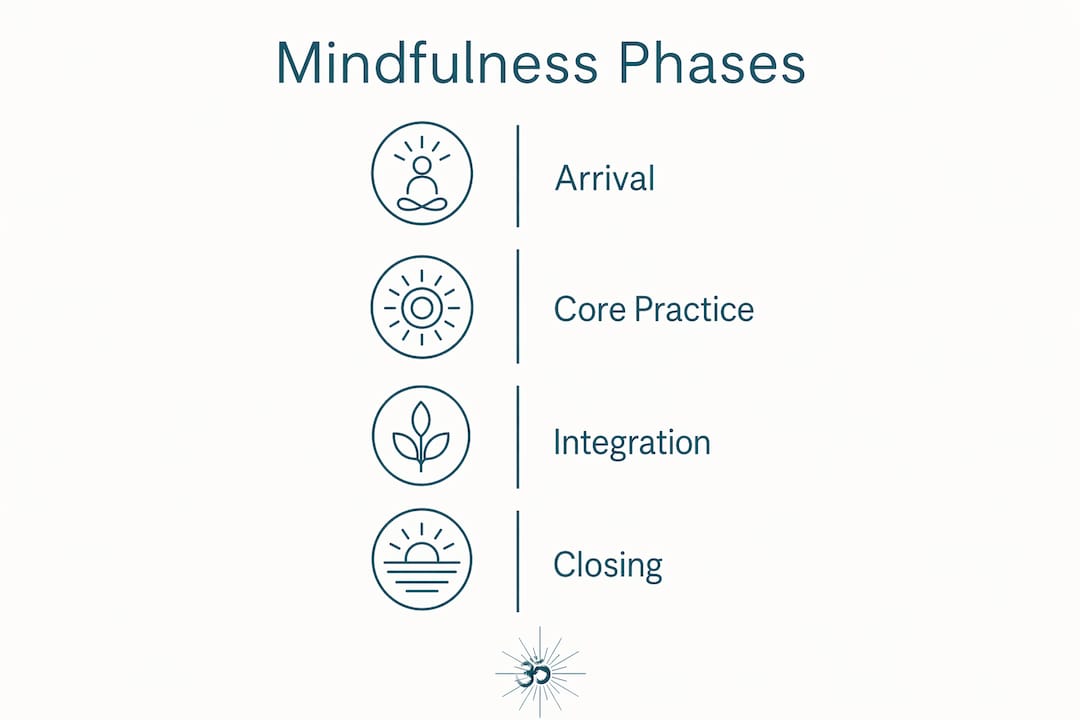
A well-structured mindfulness session follows three core phases: arrival and settling, core practice, and integration and closing. Skip any one of these, and you risk leaving participants feeling unmoored, like a song that ends mid-chorus. Knowing how to structure mindfulness sessions is the single most practical skill you can develop as a practitioner or facilitator. The good news is that the framework is simple, adaptable, and backed by solid clinical evidence. Composers like Robert Emery and producers like Moritz Schneider have built entire musical catalogues around this very arc, which tells you something about how universal the structure really is.
How to structure mindfulness sessions: the three-phase framework
The most effective mindfulness session framework divides time into three distinct acts: opening, core practice, and closing. Most meditation sessions use this three-act structure, with an opening of 2–3 minutes, a core practice of 5–15 minutes, and a closing of 1–2 minutes. That structure holds whether your session runs 10 minutes or a full hour.

For a 60-minute session, the breakdown becomes more detailed. Structured group therapy sessions typically allocate 10 minutes to arrival and check-in, 5 minutes to an opening practice, 15 minutes to didactic content, 15 minutes to an experiential exercise, 10 minutes to group processing, and 5 minutes to closing. Each phase has a distinct psychological purpose, and rushing any one of them collapses the whole arc.
Shorter sessions simply compress the same logic. A 20-minute personal session might spend 3 minutes settling, 14 minutes on breath or body awareness, and 3 minutes on quiet reflection. The proportions shift, but the sequence never does. Think of it like a good three-course meal: you would not skip straight from the bread basket to dessert.
| Phase | 10-min session | 25-min session | 60-min session |
|---|---|---|---|
| Arrival and settling | 1 min | 3 min | 10 min |
| Core practice | 7 min | 18 min | 35 min |
| Integration and closing | 2 min | 4 min | 15 min |
Pro Tip: Adjust the length of the settling phase based on participant stress levels that day. A group arriving from a busy commute needs a longer arrival phase than one already seated in a quiet room.
How to adapt session structure for beginners versus experienced practitioners
Guidance density is the variable that separates a beginner session from an advanced one. Beginners need verbal cues every 30–60 seconds, while experienced practitioners benefit from longer silences and invitational prompts that encourage self-directed exploration. Getting this wrong in either direction is costly: over-guide an experienced meditator and they feel patronised; under-guide a beginner and they spend the whole session wondering if they are doing it wrong.
For beginners, the structure of mindfulness practices should lean heavily on concrete anchors. Good starting exercises include:
- Breath focus: counting exhalations from 1 to 10, then restarting
- Body scan: moving attention slowly from the top of the head to the soles of the feet
- Mindful single-tasking: applying awareness to daily activities such as eating, walking, or listening
- Grounding exercises: noticing five things you can see, four you can touch, three you can hear
Each of these gives the mind something tangible to return to when it wanders. And it will wander. That is not failure; that is the practice.
Experienced practitioners, by contrast, respond well to open-ended invitations. Phrases like “you might notice…” or “if it feels right, allow your attention to…” create space without instruction. Invitational language reduces frustration and encourages genuine openness to the present moment, rather than a performance of relaxation.
Pro Tip: Model vulnerability as a facilitator. Openly acknowledge when your own mind wanders during a demonstration. This normalises distraction and builds trust faster than any scripted reassurance.
What practical steps help in planning effective mindfulness activities?
Planning mindfulness activities well before the session begins is what separates a smooth, grounding experience from one that feels improvised and slightly chaotic. A quiet, uncluttered space is the non-negotiable starting point. Beyond that, the planning process follows a clear sequence.
- Define your session goal. Is this about stress reduction, emotional regulation, or building a daily habit? The goal shapes every subsequent decision.
- Choose a theme. Themes like “returning to the breath,” “self-compassion,” or “body awareness” give the session coherence and help participants connect individual exercises to a larger purpose.
- Select your core practice. Match the exercise to the theme and to participant experience. A body scan suits a stress-reduction goal; loving-kindness meditation suits a self-compassion theme.
- Choose your music. Music by Robert Emery, whose orchestral compositions are designed to support meditative states, works particularly well during the settling and integration phases. Moritz Schneider’s production work, which incorporates binaural beats and theta frequencies, suits the core practice phase where deeper focus is the aim.
- Plan your verbal cues. Write out key prompts in advance, noting where you will pause and for how long. This prevents the common pitfall of filling silence with unnecessary words.
- Prepare a check-in and a closing reflection. A brief opening check-in (one word or one sentence from each participant) sets the tone. A closing reflection anchors the experience before people re-enter their day.
Common pitfalls are worth naming directly. Ending a session abruptly is one of the most frequent mistakes. Abrupt endings undermine emotional safety and can leave participants feeling unsettled rather than restored. Build in a genuine transition: lower the music gradually, invite slow movement, and allow a moment of quiet before speaking.
Another pitfall is cramming too much content into a short session. In short sessions, extending silent windows is more effective than introducing new concepts. Silence is not dead air; it is where the practice actually happens.
How does session structure enhance emotional safety and engagement?
Consistent session structure creates predictability, and predictability reduces anxiety. When participants know what to expect, they can relax into the experience rather than bracing for the unknown. This is especially true in group settings, where social anxiety can otherwise compete with the practice itself.
The concept of the emotional arc is central here. Viewing a session as an emotional arc means pacing the experience so that participants move gently from ordinary waking awareness into a deeper state, and then back out again with care. This arc mirrors the structure of a well-composed piece of music, which is no coincidence. The parallel between musical composition and session design is one that Robert Emery and Moritz Schneider have explored directly in their work at Orchestralmeditations.
A non-judgemental atmosphere is the other pillar of emotional safety. Facilitators who model vulnerability by acknowledging their own distractions openly create an environment where participants feel safe to do the same. Mindfulness should never be used as a performance metric or a disciplinary tool.
“Invite awareness to the breath rather than ordering relaxation. The difference in participant response is immediate and significant.”
The benefits of a well-structured session for mental well-being are concrete and worth stating plainly:
- Reduced anxiety through predictable rhythm and clear transitions
- Improved emotional regulation from consistent practice of awareness techniques
- Greater engagement because participants trust the process and the facilitator
- Stronger habit formation when sessions follow a reliable mindfulness session framework
- Deeper relaxation achieved through proper pacing of the emotional arc
How can music by Robert Emery and Moritz Schneider deepen your sessions?
Music is not decoration in a mindfulness session. Used well, it is a structural tool that supports each phase of the practice. Matching musical pacing to session phases supports participant immersion and emotional regulation in ways that silence alone cannot always achieve.
Robert Emery is a composer whose orchestral work is specifically designed to facilitate meditative states. His compositions, recorded with the National Philharmonic at Abbey Road Studios, carry a warmth and spatial depth that suits the settling phase particularly well. The live orchestral sound creates a sense of presence without demanding attention, which is exactly what you want when participants are still arriving mentally.
Moritz Schneider’s production work adds a scientific dimension. His use of binaural beats and theta frequencies is designed to guide the brain towards states associated with deep relaxation and focused awareness. Theta frequencies (typically 4–8 Hz) are associated with the hypnagogic state between waking and sleep, which is precisely the territory a well-structured core practice aims to reach. Pairing Schneider’s production with Emery’s compositions creates a layered sonic environment that supports both the emotional and neurological aspects of mindfulness.
| Session phase | Music-enhanced session | Silent session |
|---|---|---|
| Arrival and settling | Gentle orchestral music eases transition from daily activity | Silence can feel abrupt or uncomfortable for newcomers |
| Core practice | Binaural or theta-frequency tracks support sustained focus | Silence suits experienced practitioners who self-regulate well |
| Integration and closing | Fading music signals the end of deep practice naturally | Facilitator must manage the transition entirely through voice |
Pro Tip: Select a music track whose length matches your intended core practice duration. This removes the need to watch a clock and keeps your attention where it belongs: on the participants.
For those wanting to use music in mindfulness, the key is intentionality. Choose tracks in advance, test the volume, and know your fade points. Music that surprises the facilitator will certainly surprise the participants.
Key takeaways
A structured mindfulness session built on arrival, core practice, and integration phases produces measurably better engagement, emotional safety, and habit formation than an unstructured approach.
| Point | Details |
|---|---|
| Three-phase structure is non-negotiable | Every session needs arrival, core practice, and closing phases, regardless of length. |
| Guidance density must match experience | Beginners need cues every 30–60 seconds; experienced practitioners need longer silence and invitational language. |
| Emotional arc prevents abrupt endings | Pacing the session as an arc preserves emotional safety and sustains participant trust. |
| Music supports every phase | Orchestral and frequency-based tracks by Robert Emery and Moritz Schneider enhance focus, transitions, and relaxation. |
| Planning prevents pitfalls | Preparing cues, themes, and music in advance stops the most common facilitation mistakes before they happen. |
What I have learned from years inside the structure
There is a temptation, especially when you first start facilitating, to treat the session structure as a loose suggestion rather than a genuine framework. I understand the impulse. Structure can feel constraining when you are trying to create something that feels organic and alive. But here is what I have found: the structure is not the cage. It is the trellis. The practice grows through it.
The emotional arc is the piece most facilitators undervalue. They spend time on the core practice and rush the closing. That is like a composer writing a magnificent second movement and then ending the symphony with a single, flat note. The closing phase is where the experience becomes memory. It is where participants carry the session out into their day.
I would also say this plainly: if you are not using music, you are leaving something significant on the table. The work of Robert Emery and Moritz Schneider at Orchestralmeditations is not background noise. It is architecture. Their recordings, made at Abbey Road Studios with live orchestral musicians, carry a physical and emotional weight that synthesised tracks simply cannot replicate. I have watched participants settle three times faster with the right music than without it.
The mistake I see most often is facilitators treating silence as the default and music as the add-on. Flip that thinking. Design your session with the music as a structural element, and let silence appear where it genuinely serves the practice.
— ROBERT
Orchestralmeditations: music built for every phase of your practice
Orchestralmeditations produces meditation music recorded at Abbey Road Studios with the National Philharmonic, featuring compositions by Robert Emery and production by Moritz Schneider. The library includes orchestral soundscapes, binaural beat tracks, theta frequency recordings, and Solfeggio-based compositions, each suited to a specific phase of a mindfulness session.
Whether you are building a personal daily practice or leading group sessions, the full meditation music library at Orchestralmeditations offers tracks matched to every stage of the session arc. From gentle settling pieces to deep-focus core practice recordings, the catalogue is designed with session structure in mind. You can also explore curated personal selections to find the right sound for your specific practice goals.
FAQ
What are the three phases of a mindfulness session?
A mindfulness session is structured around arrival and settling, core practice, and integration and closing. This three-phase framework applies to sessions of any length, from 10 minutes to over an hour.
How long should each phase of a 60-minute session be?
A 60-minute session typically allocates 10 minutes to arrival and check-in, 5 minutes to an opening practice, 30 minutes to core experiential content, and 15 minutes to processing and closing. Timings adjust based on group experience and session goals.
How do I adapt guidelines for mindfulness sessions to beginners?
Beginners need frequent verbal cues every 30–60 seconds and benefit from concrete anchors like breath counting or body scans. Keep silent periods short initially and increase them gradually as confidence builds.
Does music improve a mindfulness session?
Music matched to session phases supports emotional regulation, eases transitions, and helps participants reach deeper states of focus. Orchestral recordings with binaural or theta frequencies, such as those produced by Moritz Schneider, are particularly effective during core practice.
How do I avoid abrupt endings in a mindfulness session?
Fade music gradually, invite slow physical movement, and allow a moment of quiet reflection before speaking. Abrupt endings undermine the emotional safety built during the session and reduce the lasting benefit of the practice.