852 Hz is defined as the sixth and highest tone of the original six Solfeggio frequencies, traditionally associated with awakening intuition and accessing deeper inner insight. If you have ever sat down to meditate and found your mind running at full sprint, replaying yesterday’s argument or tomorrow’s to-do list, you already know the problem. A consistent auditory anchor can help quiet that noise. Composers Robert Emery and Moritz Schneider, whose work for Orchestralmeditations has been recorded at Abbey Road Studios with the National Philharmonic, have integrated this frequency into atmospheric meditation music precisely because it gives the restless mind something steady to hold onto. This article explains what 852 Hz actually is, what science says about it, and how to use it practically.
What is 852 Hz and where does it come from?
852 Hz is the sixth Solfeggio tone, sitting at the top of the original six-frequency set that also includes tones such as 396 Hz, 417 Hz, 528 Hz, 639 Hz, and 741 Hz. Each tone in this system carries a traditional theme, and 852 Hz is linked to the Ajna chakra, commonly called the third eye, and to the awakening of intuition and inner sight.
A fair warning before we go further: the idea that these frequencies come from ancient sacred texts is a popular claim, but it does not hold up to historical scrutiny. The Solfeggio system as it is used today is largely a New Age and modern interpretation, not a direct inheritance from medieval monks. That does not make the frequencies useless. It simply means you should approach the tradition with open eyes rather than unquestioning reverence.
The six original tones and their traditional associations are:
- 396 Hz — releasing guilt and fear
- 417 Hz — facilitating change and undoing situations
- 528 Hz — transformation and DNA repair (a claim that remains scientifically contested)
- 639 Hz — connecting and relationships
- 741 Hz — expression and problem-solving
- 852 Hz — awakening intuition and returning to spiritual order
Robert Emery and Moritz Schneider draw on these traditional associations when composing their meditation music, weaving the frequencies into orchestral textures that feel grounded rather than gimmicky. Their approach treats the tradition as a creative and meditative framework, not a medical prescription.
How does 852 Hz actually work in the brain?
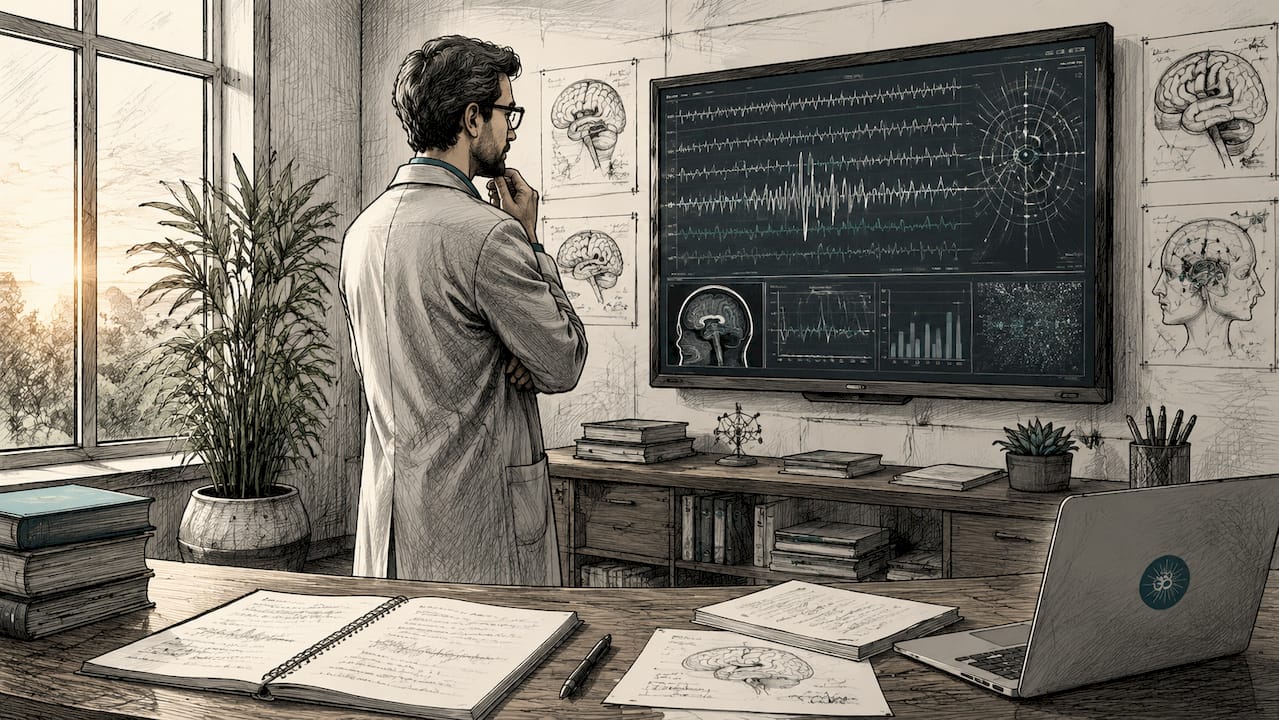
Here is where things get genuinely interesting, and where a lot of popular content gets things badly wrong. 852 Hz sound waves do not possess the physical energy to penetrate the skull and directly stimulate brain regions like the pineal gland. The skull is not a speaker cabinet. Sound at this frequency simply does not work that way.
What actually happens is more subtle and, honestly, more fascinating. Steady 852 Hz tones reduce the auditory cortex’s threat-detection activity. When the brain’s threat-monitoring system quietens down, the default mode network, which is the part responsible for mind-wandering and rumination, also becomes less active. The result is a genuine shift toward relaxation, not because of mystical frequency properties, but because of consistent, non-threatening auditory input.
Think of it like this: a crackling fire does not have magical properties, but sitting beside one for twenty minutes tends to calm most people down. The steady, predictable sound does the work. 852 Hz operates on a similar principle, just at a specific pitch.
From a musical standpoint, 852 Hz sits approximately 44 cents sharper than the standard equal-tempered G#5/Ab5 pitch. That sharpness gives it a slightly unusual, non-standard quality that composers like Robert Emery exploit deliberately. The frequency sits just outside the familiar grid of Western tuning, which may be part of why it feels distinctive and attention-catching to listeners.
The key effects of 852 Hz on the listening brain include:
- Reduced threat-detection activity in the auditory cortex
- Lower cognitive load, making it easier to sustain attention
- A quieter default mode network, reducing mental chatter
- A consistent auditory anchor for meditation, helping beginners enter deeper states
Pro Tip: Treat 852 Hz as a meditative tool rather than a mystical cure. Set an intention before you press play, focus on your breath, and let the tone do the quiet work of reducing mental noise in the background.
What are the real benefits of 852 Hz frequency?
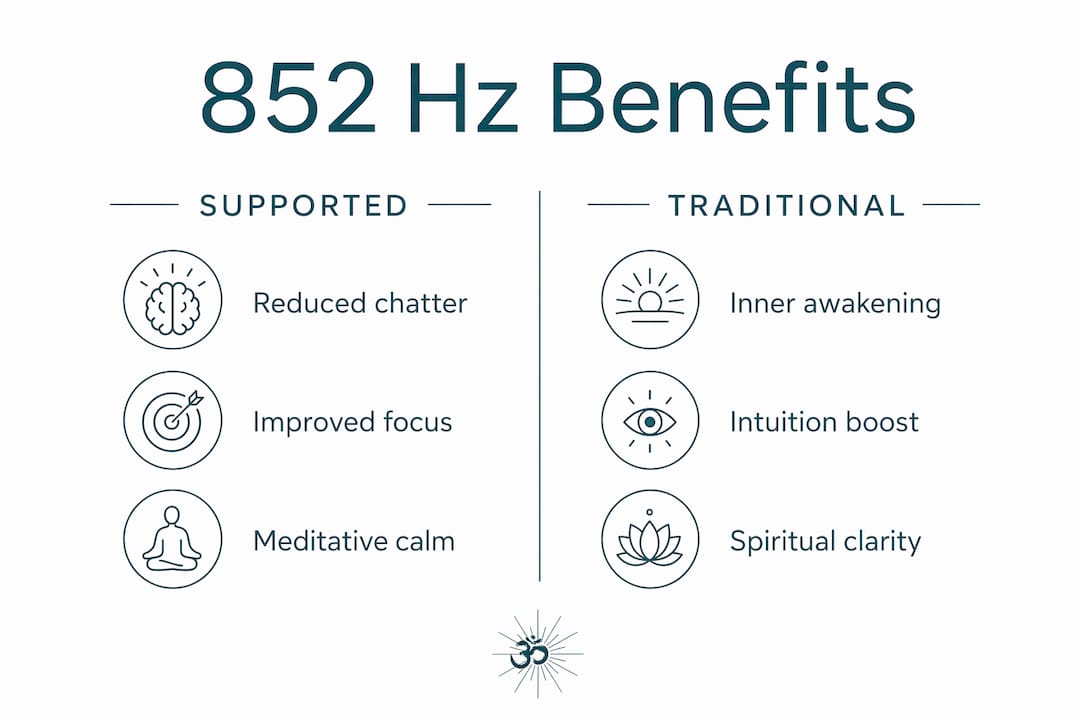
People who use 852 Hz music regularly report a consistent cluster of experiences: reduced overthinking, a sense of improved mental clarity, and what many describe as enhanced intuitive awareness. Those reports are worth taking seriously, even if the explanation is not quite what the marketing copy suggests.
The honest answer is that these benefits reflect general meditation and relaxation effects rather than properties unique to 852 Hz. A review of healing sound frequencies found limited direct empirical evidence specifically supporting 852 Hz healing claims in clinical settings. That is not a reason to dismiss the frequency. It is a reason to set realistic expectations.
The table below separates what the evidence supports from what remains in the realm of tradition and personal experience.
| Claim | Evidence level | What it means in practice |
|---|---|---|
| Reduced mental chatter during meditation | Supported by neuroscience of auditory anchoring | Consistent tone reduces cognitive load and threat-detection |
| Improved mental clarity after sessions | Reported by users; consistent with general meditation research | Likely reflects relaxation response, not frequency-specific healing |
| Awakening intuition or psychic ability | No clinical evidence | A metaphor for noticing inner clarity obscured by mental noise |
| Direct pineal gland stimulation | No physical basis | Sound at this frequency cannot penetrate brain tissue |
| General relaxation and stress reduction | Supported by sound therapy research | Consistent with benefits of other soothing soundscapes |
The awakening that practitioners associate with 852 Hz is gradual. It is about noticing inner clarity that was always there, obscured by mental noise, rather than a sudden psychic event. That framing is actually more useful than the dramatic version, because it sets you up for the patient, consistent practice that produces real results.
Moritz Schneider’s compositions for Orchestralmeditations are built around this understanding. The music is designed to support sustained listening sessions where the benefits accumulate over time, not to deliver a quick hit of spiritual excitement.
How does 852 Hz compare with neighbouring Solfeggio frequencies?
Choosing a frequency for meditation is a bit like choosing a tea. They all have their place, and the right one depends on what you actually need that evening. The table below gives a practical overview of 852 Hz alongside its closest Solfeggio neighbours.
| Frequency | Traditional theme | Sound character | Best used for |
|---|---|---|---|
| 639 Hz | Connection and relationships | Warm, mid-range tone | Emotional processing, social anxiety |
| 741 Hz | Expression and problem-solving | Slightly sharp, clarifying | Creative work, mental focus |
| 852 Hz | Intuition and inner insight | High, distinctive, non-standard pitch | Deep meditation, mental clarity, reflection |
The differences in sound character are real and noticeable. 741 Hz has a clarifying quality that many find useful during creative or analytical work. 852 Hz sits higher and feels more inward-looking, which is why it tends to suit quiet evening sessions or pre-sleep reflection better than daytime focus work.
Robert Emery’s orchestral compositions often layer multiple frequencies across a single piece, using the Solfeggio frequency benefits of each tone to create a richer meditative texture. That layering approach reflects a sophisticated understanding of how frequencies interact rather than treating each tone as a standalone remedy.
For listeners comparing 852 Hz with lower frequencies like the 396 Hz frequency, the experiential difference is significant. The 396 Hz frequency is traditionally associated with releasing fear and guilt, and its lower pitch tends to feel grounding and earthy. 852 Hz, by contrast, feels more expansive and mentally oriented. Neither is better. They serve different moments in a meditation practice.
Pro Tip: If you are new to Solfeggio frequencies, start with a single frequency for two weeks before adding another. Mixing frequencies mindfully, rather than stacking them all at once, gives you a clearer sense of what each one actually does for you.
How to use 852 Hz music in your meditation practice
The most common mistake people make with 852 Hz sound therapy is treating it like a vending machine. You put in twenty minutes and expect enlightenment to drop out. It does not work that way, and expecting it to will leave you frustrated and dismissive of something that could genuinely help.
A practical approach looks like this:
- Start with ten minutes. Do not begin with hour-long sessions. Ten minutes of focused listening is more valuable than an hour of distracted background noise.
- Choose music over pure tones if you are a beginner. Pure sine wave tones at 852 Hz can feel stark and clinical. Orchestral compositions by Robert Emery and Moritz Schneider wrap the frequency in musical texture that is far easier to sustain attention with.
- Set your volume carefully. The tone should be audible but not loud. If you are straining to hear it or wincing at the volume, neither extreme is serving you.
- Pair it with breathwork. Slow, deliberate breathing alongside 852 Hz listening amplifies the relaxation response. Four counts in, hold for four, out for six works well.
- Choose your environment deliberately. Quiet evenings, the period before sleep, or moments of personal reflection are ideal. Ambient noise from traffic or conversation will mask the frequency and undermine the auditory anchor effect.
- Avoid checking your phone. This sounds obvious. It is not. The threat-detection reduction that 852 Hz promotes is undone almost instantly by a notification.
- Build gradually. After two weeks at ten minutes, extend to twenty. After a month, you will have a clearer sense of what the practice is actually doing for you.
The meditation frequency guide from Orchestralmeditations offers additional practical detail on structuring listening sessions across different frequency types, which is worth reading alongside this.
Key takeaways
852 Hz is a high-range Solfeggio tone that reduces cognitive load and mental chatter through auditory anchoring, making it a practical and evidence-consistent tool for meditation and mental clarity.
| Point | Details |
|---|---|
| Origin and tradition | 852 Hz is the sixth Solfeggio tone, linked to intuition and the Ajna chakra in modern New Age tradition. |
| How it works | Steady tones reduce auditory threat-detection and quiet the default mode network, producing genuine relaxation. |
| Scientific evidence | No clinical evidence supports unique healing or pineal gland effects; benefits align with general sound therapy research. |
| Practical use | Start with ten minutes, use orchestral music over pure tones, and pair with breathwork for best results. |
| Composer quality | Robert Emery and Moritz Schneider integrate 852 Hz into layered orchestral compositions designed for sustained meditation. |
Why I think most people are using 852 Hz the wrong way
I have spent a long time around meditation music, and the pattern I see most often is people approaching 852 Hz like a shortcut. They read that it awakens intuition, they press play, and then they wait for something dramatic to happen. When nothing dramatic happens, they conclude the whole thing is nonsense.
That is a shame, because the frequency genuinely does something useful. It just does not do it the way the more excitable corners of the internet suggest. The awakening associated with 852 Hz is quiet and cumulative. It is the experience of sitting down after three weeks of consistent practice and realising that your mind is a bit less chaotic than it used to be. That is not a dramatic headline. It is, however, a real change.
What I find compelling about the work of Robert Emery and Moritz Schneider is that their compositions reflect this understanding. The music does not try to force a state. It creates conditions. There is a meaningful difference between those two things, and it shows up in how the music is structured: long, unhurried phrases, orchestral depth that rewards sustained attention, and frequency integration that feels like part of the music rather than a technical overlay.
My honest advice is to approach 852 Hz with the same patience you would bring to learning a new skill. The sound healing principles behind it are sound. The results are real. They just arrive on their own schedule, not yours.
— ROBERT
Orchestralmeditations: 852 Hz music worth actually listening to
If you have read this far and you are ready to move from theory to practice, the quality of the music you choose matters more than most guides admit.
Orchestralmeditations offers a curated collection of meditation music composed by Robert Emery and Moritz Schneider, recorded at Abbey Road Studios with the National Philharmonic. The 852 Hz frequency tracks are woven into full orchestral arrangements with 3D surround sound, making them significantly more immersive than a bare sine wave on a free streaming platform. If you want to give 852 Hz a genuine trial rather than a cursory one, this is where to start. Browse the full library and find the track that suits your practice.
FAQ
What is 852 Hz used for in meditation?
852 Hz is used as an auditory anchor in meditation, reducing mental chatter and cognitive load through steady, consistent sound. It is traditionally associated with awakening intuition and inner clarity.
Is there scientific evidence for 852 Hz healing?
Clinical evidence is limited; no peer-reviewed studies confirm unique healing effects specific to 852 Hz. The relaxation benefits it produces are consistent with general sound therapy and meditation research.
How is 852 Hz different from 396 Hz frequency?
The 396 Hz frequency is traditionally associated with releasing fear and guilt, with a lower, grounding pitch. 852 Hz sits much higher, feels more mentally expansive, and is associated with intuition and inner insight rather than emotional release.
Can 852 Hz stimulate the pineal gland?
No. Sound waves at 852 Hz lack the physical energy to penetrate brain tissue and directly stimulate the pineal gland. Relaxation effects arise from neural down-regulation, not direct biochemical stimulation.
How long should I listen to 852 Hz per session?
Start with ten minutes of focused listening and build gradually over several weeks. Consistent shorter sessions produce more reliable results than occasional long ones.