A binaural beat for meditation is an auditory illusion created when two slightly different frequencies are played separately into each ear, producing a perceived third tone that guides the brain into calmer, more focused states. The brain does not hear this third tone through the ears at all. It manufactures it entirely. That is the remarkable part. Producers like Robert Emery and Moritz Schneider, who craft the orchestral meditation soundscapes at Orchestralmeditations, have built entire catalogues around this principle, combining it with live orchestral recordings to create something genuinely transportive. If you have ever wondered why certain meditation music feels like it physically slows your thoughts down, binaural beats are almost certainly the reason.
How does a binaural beat for meditation actually work?
The mechanism behind binaural beats rests on a concept called the frequency following response (FFR). When your left ear receives a tone at, say, 200 Hz and your right ear receives one at 206 Hz, your brain perceives a rhythmic pulse at 6 Hz. That is the binaural beat. Your brain then tends to synchronise its own electrical activity to match that perceived rhythm. This synchronisation is the FFR in action.
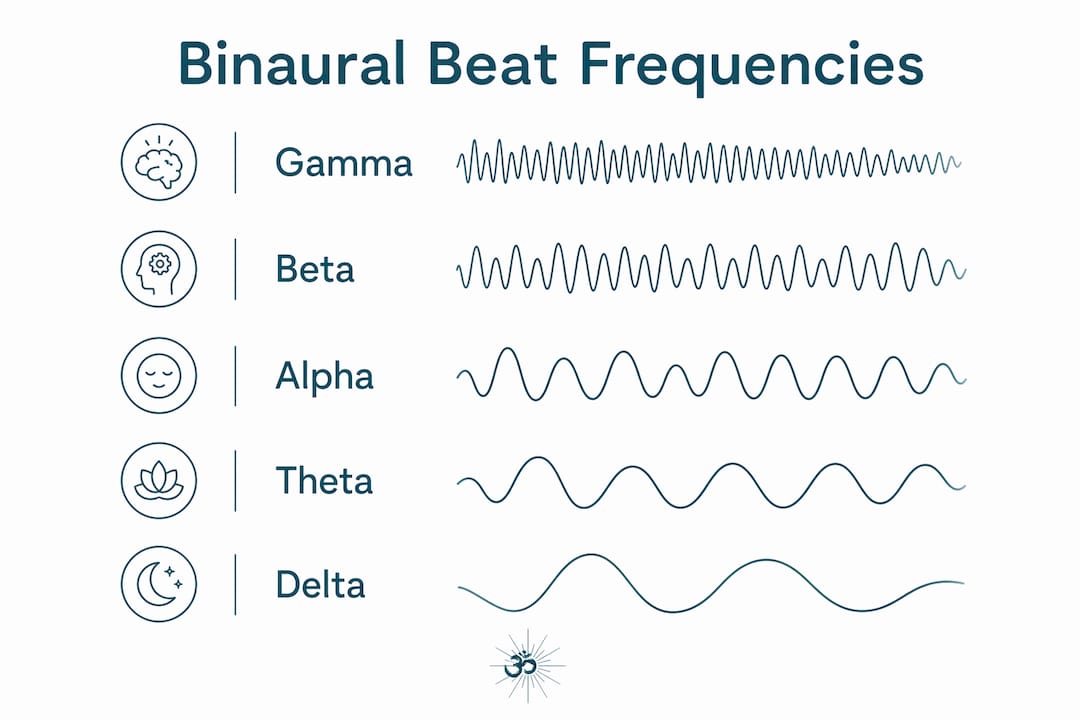
The result is that you can, in theory, nudge your brain towards specific states by choosing specific frequency differences. Theta frequencies (4–8 Hz) are associated with deep meditation and creative insight. Alpha frequencies (8–13 Hz) correspond to relaxed alertness. Gamma frequencies (30–50 Hz) are linked to heightened awareness and compassion practices. Each serves a different purpose depending on where you are in your meditation journey.

There is one non-negotiable piece of equipment here. Binaural beats require headphones to work at all. Playing them through speakers allows the two frequencies to mix in the air before they reach your ears, cancelling the effect entirely. Earbuds work in a pinch, but over-ear headphones deliver the cleanest separation between channels and the most reliable entrainment.
The science, to be honest, is not entirely settled. A 2023 systematic review found that out of 14 studies examined, only 5 showed positive results, 8 returned negative findings, and 1 was mixed. That is worth knowing. It does not mean binaural beats are useless. It means they are not a magic switch, and individual responses vary considerably. Think of them as a helpful nudge rather than a guaranteed destination.
- Theta (4–8 Hz): Deep meditation, reduced anxiety, creative states
- Alpha (8–13 Hz): Relaxed focus, stress reduction, light meditation
- Gamma (30–50 Hz): Advanced practice, heightened awareness, compassion-focused meditation
- Delta (0.5–4 Hz): Deep sleep induction, not typically used for active meditation
Pro Tip: If you find pure binaural tones feel clinical or distracting, that is entirely normal. Embedding them within pink noise or gentle ambient soundscapes, as Robert Emery does in his orchestral compositions, makes the experience far more pleasant without reducing the entrainment effect.
What are the best binaural beat frequencies for meditation?
Choosing the right frequency is less complicated than it sounds. Think of it like choosing the right gear on a bicycle. You would not start a hill in top gear, and you would not cruise a flat road in first. The frequency you choose should match your current state and your intended destination.
Here is a practical framework for selecting your frequency:
-
Start with Alpha (8–13 Hz) if you are new to meditation or feeling particularly wired after a busy day. Alpha states are gentle and accessible. They reduce the gap between your current mental noise and the calm you are aiming for.
-
Move to Theta (4–8 Hz) once you have a few weeks of regular practice behind you. Research shows that 6 Hz theta beats significantly enhance calmness and focus, with effect sizes above 0.84 in studies involving over 100 participants. That is a meaningful result by any psychological standard.
-
Explore Gamma (40 Hz) only after you have established a consistent practice. Gamma binaural beats complement the brain activity associated with compassion and loving-kindness practices, making them a natural fit for more advanced meditators.
Session length matters just as much as frequency. Recommended session durations for meditation sit between 15 and 30 minutes. Starting at 15 minutes and increasing gradually is the sensible approach, particularly if you are new to the practice. Sessions beyond 30–45 minutes tend to show diminishing returns, and taking breaks every hour or two prevents the kind of auditory fatigue that leaves you feeling more frazzled than when you started.
| Frequency Band | Range | Best For | Suggested Session Length |
|---|---|---|---|
| Alpha | 8–13 Hz | Relaxation, stress relief, beginners | 15–20 minutes |
| Theta | 4–8 Hz | Deep meditation, creativity, anxiety reduction | 20–30 minutes |
| Gamma | 30–50 Hz | Advanced practice, compassion meditation | 15–25 minutes |
| Delta | 0.5–4 Hz | Sleep induction | 30–60 minutes |
One detail that often gets overlooked is volume. High volume causes ear fatigue and actually masks the subtle rhythmic pulse your brain needs to entrain. Keep the volume low to moderate. You should be able to hear the beat clearly without straining, and without it dominating your awareness like a jackhammer.
Moritz Schneider, whose work spans both classical composition and sound design, approaches this balance with particular care. His tracks layer binaural frequencies beneath orchestral textures so that the beat is present but never intrusive. It is the sonic equivalent of good lighting in a room. You notice the atmosphere, not the bulbs.
Pro Tip: Pure binaural tones embedded in pink noise are consistently preferred by users over isolated tones. Pink noise masks the monotony of raw beats and prevents the brain from slipping into a cognitive task mode, which is the opposite of what you want during meditation.
Binaural beats vs. isochronic tones vs. monaural beats: which should you use?
This is the question that trips up a lot of people who are genuinely trying to do their research. The three main auditory entrainment methods each work differently, and the differences matter.
Binaural beats are created inside the brain when two separate frequencies are delivered to each ear. They require headphones and produce a subtle, internal rhythmic effect. The entrainment is gentle and well-suited to sustained meditation sessions.
Isochronic tones are single tones that switch on and off at a set rhythm. The brain perceives the rhythm directly, without any internal processing. They do not require headphones, which makes them more flexible. Many people find them more immediately noticeable than binaural beats, though some find the pulsing quality more distracting during meditation.
Monaural beats sit somewhere in between. Two frequencies are mixed before reaching the ears, creating an audible beat that both ears hear simultaneously. Like isochronic tones, they do not require headphones. They tend to feel slightly warmer and less mechanical than isochronic tones.
Here is a direct comparison to make the choice clearer:
| Method | Headphones Required | Perceived By | Best Use Case |
|---|---|---|---|
| Binaural Beats | Yes (over-ear) | Brain internally | Sustained meditation, sleep, deep focus |
| Isochronic Tones | No | Both ears directly | Flexible listening, background use |
| Monaural Beats | No | Both ears directly | Ambient meditation, relaxation |
For a deeper look at how these methods compare in practice, the isochronic tones vs binaural beats guide from Orchestralmeditations covers the nuances well.
Robert Emery’s compositions at Orchestralmeditations often blend binaural beats with broader orchestral soundscapes, effectively combining the internal entrainment of binaural processing with the emotional resonance of live instrumentation. It is a rather clever approach. You get the neurological nudge of the binaural beat alongside the aesthetic richness of a full orchestra recorded at Abbey Road Studios. The two work together rather than competing.
- Binaural beats suit meditators who already own good headphones and want the deepest entrainment effect.
- Isochronic tones suit people who meditate in varied environments or share a space with others.
- Monaural beats suit those who find the pulsing quality of isochronic tones too pronounced.
How to get the most from binaural beat meditation music
Getting the setup right is genuinely half the battle. You can have the finest binaural beat meditation music in the world, but if you are listening through laptop speakers in a noisy kitchen, you will get precisely nothing from it. Here is what actually makes a difference.
Environment and posture matter more than most guides admit. A quiet room, a comfortable seated or lying position, and a few minutes of deliberate breathing before you press play will do more for your session than any frequency optimisation. Think of the binaural beat as the engine. Your environment and posture are the road.
- Use quality over-ear headphones. Earbuds work but deliver less channel separation.
- Set volume to low to moderate. The beat should be audible, not dominant.
- Choose a track embedded in ambient sounds rather than a raw tone. Masking raw tones with soundscapes prevents the monotony that triggers cognitive task mode.
- Start with 15-minute sessions and add five minutes each week as your practice deepens.
- Sit or lie in a position you can hold comfortably for the full session without fidgeting.
One thing worth saying plainly: binaural beats are auditory scaffolding, not a substitute for meditation technique. They are particularly useful in the first few minutes of a session, when beta brainwave activity tends to dominate and the mind resists settling. Once you are in a meditative state, the beats support you. But they cannot do the work of attention and intention for you.
Experts at Verywell Mind describe binaural beats as a low-risk add-on rather than a primary treatment. Core practices like mindfulness and breathwork remain the foundation. Binaural beats are the excellent supporting cast, not the lead.
Pro Tip: Tracks by Robert Emery and Moritz Schneider, available through Orchestralmeditations, are recorded using 3D surround sound techniques that deepen the spatial quality of the listening experience. If you have not tried immersive soundscape meditation, it is worth exploring. The spatial dimension adds a layer of immersion that flat stereo recordings simply cannot replicate.
Key takeaways
Binaural beats work best as a consistent, well-set-up complement to established meditation practice, not as a standalone shortcut.
| Point | Details |
|---|---|
| Headphones are non-negotiable | Over-ear headphones deliver the channel separation binaural beats require to work at all. |
| Match frequency to your goal | Use Alpha for relaxation, Theta for deep meditation, and Gamma for advanced compassion practice. |
| Keep sessions to 15–30 minutes | Start short and increase gradually; sessions beyond 45 minutes show diminishing returns. |
| Embed beats in ambient sound | Pink noise or orchestral soundscapes prevent monotony and improve the overall meditation experience. |
| Beats support, not replace, technique | Binaural beats reduce the effort needed to enter meditation but cannot substitute for mindfulness practice. |
Why i think binaural beats are misunderstood (and underused)
Most people I speak to about binaural beats fall into one of two camps. Either they expect them to be a sort of neurological override switch that will instantly transport them to a state of blissful enlightenment, or they have read one sceptical article and written the whole thing off entirely. Both positions miss the point rather spectacularly.
My honest view, having spent years working with meditation music and sound design, is that binaural beats are one of the most genuinely useful tools available to meditators who struggle with the early minutes of a session. That restless, chattering phase when you sit down and your brain immediately produces a to-do list the length of a Dickens novel. Theta beats at 6 Hz do not silence that chatter by force. They create conditions where it becomes easier for you to let it pass. That is a meaningful distinction.
What I find particularly compelling about the work of Robert Emery and Moritz Schneider is that they approach binaural beats as composers first and technologists second. The frequencies are embedded within genuinely beautiful orchestral music, recorded with the National Philharmonic at Abbey Road Studios. That matters because the emotional and aesthetic quality of the music you meditate to is not a trivial detail. It shapes the entire character of the experience. A raw 6 Hz tone played on its own is about as inviting as a dial-up modem. The same frequency woven into a full orchestral texture is something else entirely.
The caution I would offer is this: do not let the technology become a crutch. If you find yourself unable to meditate without your binaural beat tracks, that is worth noticing. The goal is to use them as training wheels, not permanent infrastructure. Explore the binaural healing beats available through Orchestralmeditations with that spirit of curiosity and experimentation, and you will find them genuinely rewarding.
— ROBERT
Discover Orchestralmeditations’ binaural beat meditation music
If you are ready to put all of this into practice, Orchestralmeditations offers a curated library of professionally produced binaural beat meditation music that takes the guesswork out of getting started.

Composed and produced by Robert Emery and Moritz Schneider, the tracks are recorded at Abbey Road Studios with the National Philharmonic, embedding theta, alpha, and gamma frequencies within rich orchestral soundscapes. The result is meditation music that sounds extraordinary through headphones and actually does what it promises. Whether you are a complete beginner working with 15-minute alpha sessions or an experienced practitioner exploring gamma frequencies, the library has something genuinely suited to where you are right now. Browse the full collection and find your frequency.
FAQ
What is a binaural beat for meditation?
A binaural beat for meditation is an auditory illusion produced when two slightly different frequencies are delivered separately to each ear, creating a perceived rhythmic pulse that encourages the brain to synchronise with calmer brainwave states.
Do binaural beats actually work for meditation?
Research results are mixed. A 2023 systematic review found 5 out of 14 studies showed positive effects, while 8 returned negative findings. Theta beats at 6 Hz have shown significant improvements in calmness and focus in controlled studies, suggesting real but variable benefits.
What frequency is best for deep meditation?
Theta frequencies in the 4–8 Hz range are most commonly associated with deep meditation, reduced anxiety, and creative insight. A 6 Hz theta beat embedded in pink noise has shown the strongest evidence for enhancing meditative states.
Do you need headphones for binaural beats?
Yes. Binaural beats require over-ear headphones to function correctly. Playing them through speakers allows the two frequencies to mix in the air before reaching your ears, which cancels the binaural effect entirely.
How long should a binaural beat meditation session last?
Recommended session lengths sit between 15 and 30 minutes for meditation. Beginners should start at 15 minutes and increase gradually. Sessions beyond 45 minutes show diminishing returns and can cause auditory fatigue.