
If you play music during paid Reiki sessions, classes or livestreams, you need the right to play it in that setting. A personal streaming account is not that right, and “royalty-free” does not automatically mean “free to use however I like”. In Germany, public playback usually also involves GEMA, even when the music is gentle, the room is small and nobody is dancing.
I know. You came into Reiki to move energy, not to read licence terms. But ten minutes now spares you an awkward letter later, so let’s get through it together, with a cup of tea and as little jargon as I can manage.
TL;DR
- A personal streaming subscription is meant for personal, non-commercial listening, so it is not a licence to play music to paying clients.
- In Germany, music that people outside your private circle can hear is “public”, and GEMA licensing generally applies whether or not you earn money from it.
- “GEMA-free” music still has to be registered with GEMA, and you need to be able to show that it really is GEMA-free.
- Online classes, livestreams, downloads and apps are licensed separately from the music playing in your treatment room.
- Before you buy any royalty-free track, read what the licence says about client sessions, recordings, apps, resale and the number of seats or users.
Why Reiki music licensing trips so many practitioners up
Most of us start the same way. You find a lovely track on a streaming service, you press play, you place your hands, and the session goes beautifully. Nobody thinks, “I have just become a music user in the legal sense.” Yet that is exactly what happens the moment a client is in the room.
There are three separate questions hiding in one innocent playlist:
- Do I have the right to play this track to other people at all?
- Do I owe a collecting society (in Germany, GEMA) anything for the playback?
- If I record or stream the session, do I have the right to put the music into that recording?
The answers differ for a one-to-one session in your practice, a weekly group class, a recorded guided meditation you sell, and an app you build. Let’s take them one at a time.
Can you play your own streaming playlist to clients?
The short version: no, that is not what a personal subscription is for.
Take Spotify as a typical example. Its German terms of use grant you a limited right to use the service and its content for personal, non-commercial purposes. A paid Reiki session, a class with a booking fee or a studio background playlist is not personal use. The same logic applies to most consumer music services, so read the terms of whichever one you use.
It is a bit like buying a tin of paint for your living room and then using it to decorate a hotel. The paint is fine. The permission is what is missing.
This catches out generous people in particular. “I am only charging for my time, not for the music” sounds reasonable, but the question the terms ask is whether the use is personal and non-commercial, not whether you invoice for the music line by line.
What “public” means in Germany, and why GEMA enters the picture
GEMA is the German society that collects and distributes fees for the public use of music. According to its own guidance, a GEMA licence is needed for all public uses of copyrighted music, whether or not the use is commercial or earns money.
So what counts as public? Under § 15(3) of the German Copyright Act (UrhG), music is public when it is accessible to several people who are not connected to each other, or to the organiser, by personal relationships.
Apply that to your week:
| Situation | Likely “public”? | What it means in practice |
|---|---|---|
| Reiki for yourself at home | No | Personal listening, covered by ordinary personal terms |
| One-to-one session with a client in your practice | Treat as public | Clients are not part of your private circle; check licensing before you play anything |
| Group class or circle of paying participants | Yes | Participants are not connected to each other personally |
| Waiting room or reception music | Yes | Anyone passing through can hear it |
| Workshop or retreat with strangers | Yes | Same reasoning as a class |
The table is a guide to the principle, not legal advice. If your set-up is unusual (a members-only circle of long-standing friends, say), ask GEMA directly or a lawyer who works with copyright, because the definition turns on personal relationships and not on how it feels.
Royalty-free, GEMA-free and licence-free are three different things
This is where I see the most confusion, and where I will happily admit I was confused myself for years.
Royalty-free usually means you pay once (or subscribe) for a licence and then owe no further per-play royalties to the producer or composer. It says nothing about whether the licence covers your use. It also says nothing about collecting societies.
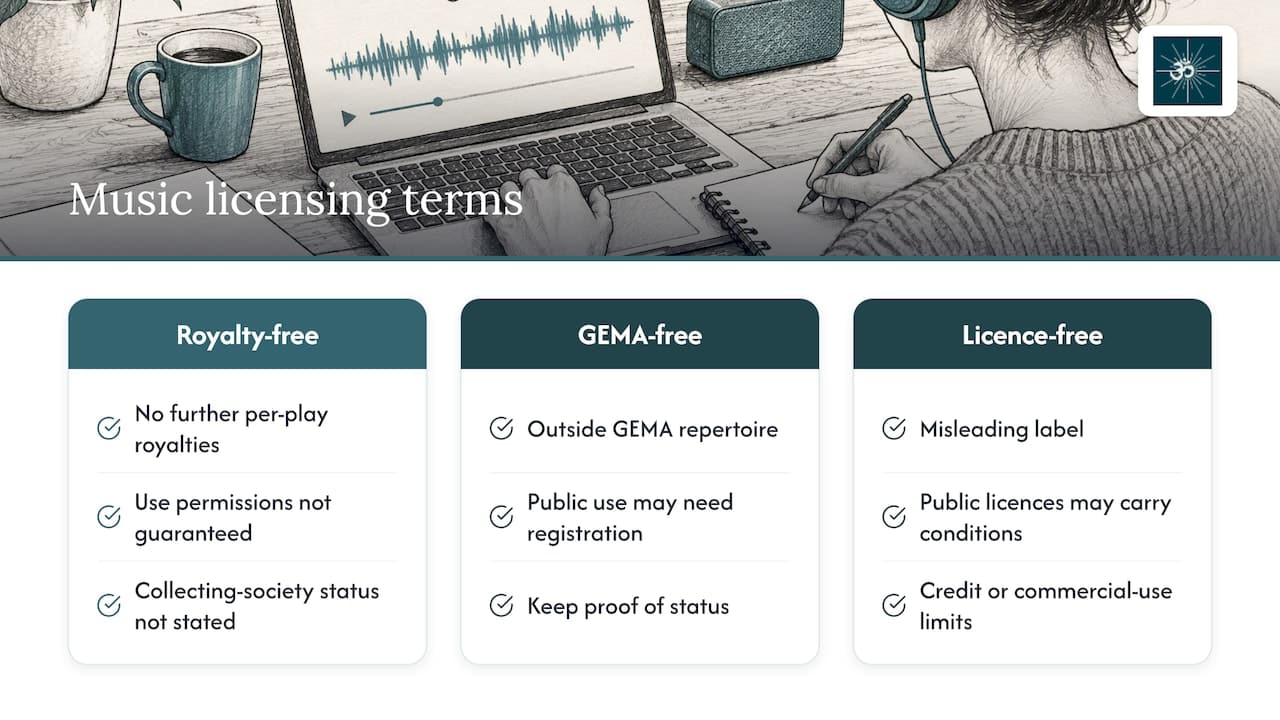
GEMA-free means the composers are not represented by GEMA for that music, so GEMA’s repertoire does not apply to it. It does not mean you can ignore GEMA. GEMA says GEMA-free music used publicly in a fitness studio must be registered with it, and that you need proof that the music is GEMA-free. Its guidance for medical practices says much the same: even GEMA-free music has to be registered so that the titles can be checked. A Reiki or wellness practice is not a gym or a doctor’s surgery, but the principle is the same one, and it is wise to treat it as relevant to you.
One more reason to be careful: for public performances of dance and entertainment music, GEMA presumes that works are in its repertoire unless you prove otherwise with detailed programme or track lists. So keep records. A tidy list of what you play, with the licence for each track, is boring and extremely useful.
Licence-free is not really a thing. Even music anyone may use under a public licence usually comes with conditions, such as credit or a ban on commercial use.
What a royalty-free licence for Reiki music should actually cover
When a practitioner asks me whether a track is “safe to use”, I translate it into a checklist. Read the licence text and look for each of these:
- Who the licence is for. Personal and professional licences are different products. A personal licence is for your own listening. Treatment rooms, classes and client-facing content need a professional or commercial licence.
- Where you may play it. Live sessions in a practice, group classes, retreats, spa or massage rooms. Does the text name the settings you work in?
- Recording and publishing. Guided meditations on your own site, a course platform, YouTube or a podcast all put the music into a recording. Check that recorded and online use are mentioned.
- Apps and products. If you build the music into an app, a game or a sold audio product, you need explicit permission for that. Background use in a room is a different matter from embedding in a product.
- Resale of the music itself. Most licences let you use the music inside your own work but not sell or redistribute the tracks as such.
- Duration and ending. What happens to content you made if you stop paying? Does a subscription licence cover content published while you were subscribed? Does it cover your whole team or just you?
- Credit. Some licences ask you to name the composer or label.
- Territory. For a practice in Germany, check that nothing limits use to another country.
If a licence is vague on any of these, ask the provider in writing and keep the answer. A one-line email reply is worth more than your memory of a website page.
Playing Reiki music in the treatment room
For live, in-person sessions, you have two broad routes in Germany.
Route one: music from GEMA’s repertoire. You play commercially released music and take out the appropriate GEMA licence. GEMA offers tariff packages for certain sectors. For fitness studios, for example, its packages cover background music in areas such as wellness and reception, and the fee depends in part on the covered area and the playback media. Reiki practices are not on that list by name, so ask GEMA which tariff fits a practice or studio like yours.
Route two: music licensed directly from a producer who controls the rights. You get a professional licence for specific tracks and play them in your sessions. Where you do this with music that is not in GEMA’s repertoire, GEMA’s registration and proof requirements are the thing to confirm before you rely on it.
In both routes, your own playback matters. GEMA’s reproduction tariff for recorded media (VR-Ö) is a separate subject, but its rule is worth knowing: if you use only original music works or files and make no copies, no VR-Ö licence fee is due. Burning a handful of CDs for different treatment rooms is a copy, so think before you duplicate.

Online classes, livestreams and recorded Reiki content
The moment your session leaves the room, the picture changes. A Zoom class with music, a recorded distance-healing meditation, a membership site and an app all involve music being transmitted or reproduced, and each has its own licensing logic.
For online use across Germany, GEMA directs you to its online portal: its guidance covers livestreams, on-demand streaming, downloads and apps, and you register for the licence that fits. That is the route for music in GEMA’s repertoire.
For music licensed from a producer, the question is simpler to state and slightly fussier to check: does the licence explicitly allow synchronisation of the music with your voice or video, distribution in online classes and publication on the platforms you use? Platforms also run their own automatic music detection. Having the licence document to hand makes any dispute much shorter.
Why we make the case for live-recorded music
We are going to step out of the legal weeds for a moment, because the licence is only half the story. The other half is what your client hears.
At Orchestral Meditations we record meditation music with live musicians, including sessions with the National Philharmonic at Abbey Road Studios. We do this because we believe acoustic instruments played by people resonate with the body in a way digital imitations do not. That is our conviction as musicians, and it shapes how we work: 3D surround sound, binaural beats, theta frequencies and Solfeggio-frequency tracks, all designed to support deep relaxation.
For a Reiki practitioner that matters twice. First, you want music that holds a room without drawing attention to itself. Second, you want a licence that was written with practitioners in mind, so the answer to “may I play this to my clients?” is in the paperwork and not in your imagination.
That is why our library comes with personal and professional licensing options, covering meditation, therapy, yoga, apps, guided audio, massage and wellness content. Our professional subscription exists for people who use music in their work, and our personal subscription is for people who simply want to listen.
Founders Robert Emery and Moritz Schneider have worked together for thirteen years. Robert studied at the Royal College of Music, conducts, and is Music Director of the National Philharmonic Orchestra of Great Britain. Moritz has written for feature films, albums and musicals for over twenty years, with award-winning work. Between them there is a lot of orchestra experience, and one firm belief: if you are going to ask people to relax to music, play them the real thing.
ROBERT
The people behind the music
You will be playing this music in the most receptive moments of your clients’ day, so it is fair to ask who made it. Orchestral Meditations was founded by composer and conductor Robert Emery and composer and producer Moritz Schneider.
Robert began piano at seven, studied at the Royal College of Music and has conducted orchestras around the world. He is Music Director of the National Philharmonic Orchestra of Great Britain, the orchestra heard on our Abbey Road recordings. During the pandemic he set up a registered charity to help struggling musicians.
Moritz, who grew up in the Swiss musical theatre scene, has composed for film, albums and stage for over two decades. His musicals, written with Robert, have premiered in Switzerland and Austria. His own words on the matter are charmingly practical: the power of frequencies created by a live instrument played by a talented heartbeat cannot be beaten.
To be clear, that is a composer’s conviction and not a clinical finding. But it explains why the tracks are made the way they are, and why we treat the studio as seriously as a concert hall.
Choosing music for Reiki: what tends to work in a session
Licensing aside, here is what I would put in front of a friend who practises Reiki.
- Keep the music from competing with your hands. Slow, spacious pieces with no sudden dynamic changes leave the client’s attention free. A swelling cymbal during a hand position is the musical equivalent of a cartoon-like SPLAT.
- Match the track length to your session. A track that ends at minute 22 of a 60-minute treatment forces a silent gap or a fiddly playlist. Longer pieces, or a library with many options, make planning easier.
- Think about stereo and headphones. If you offer sessions with headphones or want a wide, enveloping sound in the room, immersive 3D recordings can feel quite different from standard stereo.
- Be gentle with binaural and theta content. Tracks built on binaural beats are generally intended for headphone listening. Tell clients what they are hearing before you begin.
- Respect the client’s preferences. Some clients love orchestral warmth, others want only bowls or silence. Ask before the first session.
The wider scientific picture on music and relaxation is broad, and I do not want to oversell it. Treat music as a supportive part of the setting you create, not as a treatment in itself.
A worked example: Anna’s Reiki practice in Hamburg
Let us make this concrete with an invented practitioner, so nobody’s real invoice is harmed. Anna runs a small Reiki practice in Hamburg. She offers one-to-one sessions, a monthly group evening and a recorded guided relaxation for her newsletter subscribers.
She has been playing a streaming playlist on a speaker. Here is how she tidies it up:
- Stops using her personal account for the treatment room, because the terms cover personal, non-commercial use.
- Contacts GEMA to ask which licence fits a small practice with a monthly group, and notes what she plays.
- Picks a library with a professional licence that names client sessions, classes and recorded content, and saves the licence text in a folder.
- Keeps a simple track list of what plays in her room, since GEMA’s guidance leans on track lists as proof.
- Checks the licence for her newsletter recording, because that puts the music into a published file.
None of this takes a weekend. It takes an afternoon, and afterwards she can think about breathwork and not paperwork.
Where our subscriptions fit
If you want one library, one licence and no hunting around for each track’s permissions, that is what we built the subscriptions for.
The personal subscription costs €21 per month and is for your own listening and practice. If you use music in client sessions, classes or content, the professional subscription costs €150 per month and is made for professional use. For the catalogue of tracks and the licence types, see our page on royalty-free meditation music.
Whichever licence you pick, read its terms for your own use case, and keep them on file. That is good practice with any provider.
Questions to settle before you hit play
Here is a one-page version you can paste into your notes app.
- Is the playback public under § 15(3) UrhG, meaning will people outside my personal circle hear it?
- Do my streaming terms allow it, or are they personal only?
- If the music is not in GEMA’s repertoire, is it registered with GEMA and can I show that?
- Does my licence name the setting: client sessions, classes, retreats, online, recordings, apps?
- Do I make copies of the music, and what does that trigger?
- Do I keep a track list and a copy of each licence?
If you can answer all six, you are ahead of most of the industry.
FAQ
Do I need a licence to play music in a one-to-one Reiki session?
It depends on whether the playback counts as public, which in Germany turns on whether the listeners are connected to you by personal relationships. Clients paying for a treatment generally are not, so treat the session as public use. Ask GEMA which licence applies to your practice, or use music licensed professionally for client sessions.
Is royalty-free music automatically fine for Reiki classes?
No. Royalty-free describes how you pay, not where you may use the music. Check that the licence is professional or commercial, that it names classes or client sessions, and what it says about recordings and online use.
Does “GEMA-free” mean I can ignore GEMA?
Not quite. GEMA’s guidance says GEMA-free music used publicly must be registered, and that you need to prove it is GEMA-free. Keep the producer’s confirmation and a track list on file.
Can I use the same music in my online Reiki class and my treatment room?
Only if each licence covers both. In-room playback and online streaming, downloads or apps are licensed separately, and GEMA has a dedicated online registration for the latter. With a producer’s licence, look for explicit mention of online and recorded use.
Can I use my personal subscription for client sessions?
No, personal subscriptions are meant for personal listening. If you work with clients, choose a professional licence so your use is covered.