
There’s a particular kind of frustration that comes from scrolling through a generic “relaxation” playlist at 11 pm, hoping it’ll finally switch your brain off, only to find that track three is inexplicably a dramatic film score and track seven sounds like a cat walking across a synthesiser. We’ve all been there. The truth is, most pre-made playlists are assembled with roughly the same care as a supermarket meal deal. They’re convenient, occasionally fine, and almost never exactly what you need. A personalised playlist, built around your own physiology, intention, and listening environment, is an entirely different beast. This guide walks you through the science, the preparation, and the step-by-step process of creating a relaxation playlist that actually works for you.
Key Takeaways
| Point | Details |
|---|---|
| Use slower tempos | Tracks between 60 and 80 BPM best support deep relaxation and mindfulness. |
| Start with intention | Choosing tracks is more effective when you clarify your goal, such as sleep, meditation, or stress relief. |
| Refine and personalise | Test your playlist against your physical responses and update regularly for sustained benefit. |
| Monitor for habituation | Refresh your playlist every few weeks to prevent your brain adapting and losing relaxation gains. |
Understanding the science behind relaxation music
Before you start dragging tracks into a folder and calling it a playlist, it’s worth understanding why certain music relaxes you and why other music, despite being labelled “calm,” leaves you feeling weirdly tense. The answer lies partly in tempo, partly in brainwave activity, and partly in something researchers call emotional valence.
Let’s start with tempo, because it’s the most immediately actionable factor. Optimal tempo for relaxation sits between 60 and 80 beats per minute (BPM), a range that activates the parasympathetic nervous system and encourages alpha brainwaves. Alpha brainwaves are the signature of a relaxed but alert mind, the kind of state you drift into during a long warm bath or a slow walk in the park. Go much faster than 80 BPM and you start nudging the nervous system towards alertness. Go slower than 60 BPM and you risk tipping into something so lethargic it’s almost uncomfortable.
Slow tempo music below 70 BPM has measurable physiological effects: it reduces anxiety markers, lowers blood pressure, slows heart rate, and boosts heart rate variability, which is a strong indicator of nervous system resilience. That last one matters because higher heart rate variability is associated with better emotional regulation and stress recovery. It’s genuinely impressive what a well-chosen piece of music can do to your body without you even trying.
Brainwave entrainment adds another layer. Music doesn’t just reflect your mood; it actively steers your brain towards certain states. Theta frequencies (4 to 8 Hz) are associated with deep relaxation and light sleep, alpha waves (8 to 13 Hz) with calm wakefulness. Understanding music’s effect on mental health helps you see why the right track can feel almost medicinal.
Here’s where it gets interesting, though. Tempo alone isn’t sufficient for relaxation; the emotional tone of a piece, its valence, must also align with your intended effect. A slow, menacing orchestral piece at 65 BPM will not relax you, regardless of its tempo. Your nervous system reads emotional content, not just rhythm. This is why why slow music relieves stress is a more nuanced question than it first appears.
| Musical element | Relaxation effect | Recommended range |
|---|---|---|
| Tempo | Slows heart rate, activates parasympathetic system | 60 to 80 BPM |
| Emotional valence | Determines nervous system response | Positive or neutral |
| Frequency (binaural) | Entrains brainwaves to alpha or theta states | 4 to 13 Hz |
| Dynamics | Reduces startle response, maintains calm | Low to moderate |
To summarise the key physiological responses you’re aiming to trigger:
- Slower heart rate and reduced blood pressure
- Activation of alpha and theta brainwaves
- Decreased cortisol and anxiety markers
- Improved heart rate variability
“Music is not background noise for the nervous system. It’s a direct input, and the nervous system responds accordingly, whether you’re paying attention or not.”
This is why a thoughtfully constructed playlist hits differently to a shuffled one. You’re engineering a physiological response, not just filling silence.
What you need before building your relaxation playlist
Now that you understand the science, it’s essential to prepare properly before you start assembling your playlist. Skipping this stage is a bit like deciding to cook a complicated dish without checking whether you have any of the ingredients. You’ll technically end up with something, but it won’t be what you wanted.
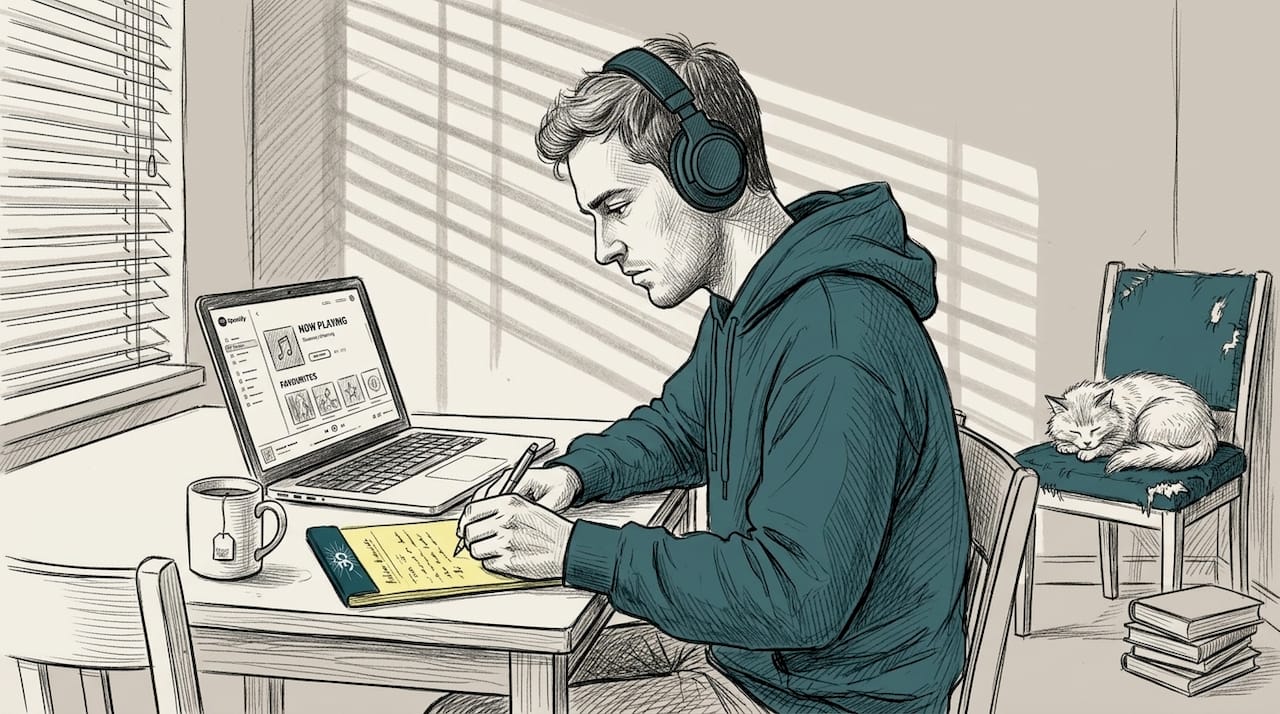
The single most important step is setting your intention before selecting a single track. Are you building this playlist for sleep? For a focused mindfulness session? For stress relief after work? These are meaningfully different states, requiring different tempos, different emotional tones, and different session lengths. A sleep playlist wants to gently drag you into unconsciousness. A mindfulness playlist wants to keep you present and alert but calm. Conflating the two is why so many generic playlists feel oddly unsatisfying.
Once your intention is clear, consider your tools. Here’s a quick comparison of the most common platforms:
| Platform | Crossfade support | Offline playback | BPM tagging | Ad-free option |
|---|---|---|---|---|
| Spotify | Yes | Premium only | Via third-party | Premium |
| Apple Music | Yes | Yes (subscription) | Limited | Yes |
| YouTube Music | Limited | Premium only | No | Premium |
| Downloaded audio | N/A | Always | Manual | N/A |
Crossfade is worth highlighting because seamless transitions between tracks are genuinely important for relaxation playlists. A jarring gap or a sudden cut between pieces yanks you back to ordinary consciousness faster than a cold shower. Any platform that supports smooth crossfading earns its place here.
Before you begin, run through this checklist:
- Listening equipment: Quality headphones or speakers matter more than people admit. Earbuds are fine; over-ear headphones are better for immersive sessions.
- Environment: Choose somewhere quiet. Background noise competes with the music’s physiological effect.
- BPM awareness: Know the tempo range you’re targeting before you search for tracks.
- Session length: Decide in advance whether you need 20 minutes or 90 minutes. This shapes how many tracks you’ll need.
- Format: Will you stream or download? Buffering during a deep relaxation session is the sonic equivalent of stepping on a Lego.
Pro Tip: Use a hybrid approach by downloading your core playlist tracks and streaming supplementary ones. This protects your session against Wi-Fi unreliability without requiring you to download an entire library. You can also review a playlist customisation checklist to make sure nothing gets overlooked before you start.
If you’re unsure which types of sound work best for your sessions, exploring the range of soundscape options for relaxation will give you a much clearer sense of what’s available beyond standard music tracks.
Step-by-step guide to creating your relaxation playlist
With your tools and purpose ready, let’s walk through exactly how to assemble a relaxation playlist tailored to you. There’s a specific logic to this process, and following it produces noticeably better results than just picking tracks you vaguely enjoy.
Step 1: Anchor your intention and apply the iso-principle
The iso-principle, borrowed from music therapy, suggests you start where your listener is emotionally and musically, then gradually guide them to where you want them to be. In practice, this means your first track shouldn’t be the most serene piece in your collection. If you’ve just come from a hectic afternoon, a sudden shift to profound stillness can actually feel jarring rather than restful. Begin with something that meets your current energy level, then descend gradually.
Step 2: Select 5 to 10 tracks based on physical response, not just preference
This is the part most people get wrong. We pick music we like rather than music that works. A recommended step-by-step approach involves selecting tracks based on the physical responses they generate, paying attention to breathing rate, shoulder tension, and jaw tightness rather than whether you find the melody pleasant. For longer sessions, a single long-form orchestral or ambient piece can replace several shorter tracks.
Step 3: Sequence by decreasing tempo
Arrange your tracks so the BPM decreases across the playlist. Start in the 70 to 80 BPM zone, move through the mid-60s, and end somewhere in the 55 to 65 BPM range for your deepest relaxation tracks. This mirrors the natural slowing of the body as it moves from alert to restful. For music for mindfulness tips that go beyond basic sequencing, there’s a lot to explore.
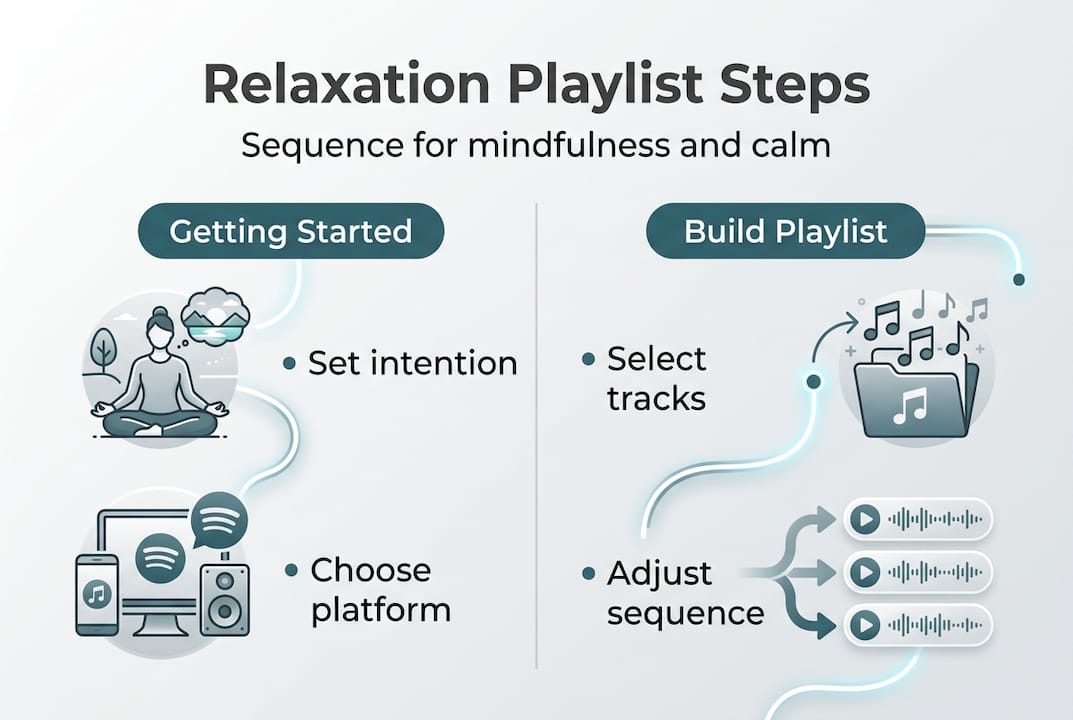
Step 4: Enable crossfade and set transition times
Set your platform’s crossfade to somewhere between three and eight seconds. Too short and transitions feel abrupt; too long and tracks start bleeding into each other in a way that can feel muddy rather than seamless.
Step 5: Test with full physical attention
Listen to the playlist from start to finish in the environment you intend to use it. Note where your attention wanders, where your breathing shifts, and where tension returns. These are your data points.
Step 6: Refine and repeat
Swap out any track that disrupted your state, adjust the sequencing if the descent felt too sudden, and re-test. The orchestral music for meditation genre is particularly well-suited to this kind of sequenced descent because orchestral dynamics offer a natural arc.
Pro Tip: If you’re interested in going deeper technically, the scientific approach to meditation music covers how binaural beats and frequency-based compositions can be layered into a standard playlist for enhanced effect.
Stat to note: Listeners who select music based on physical response rather than preference report measurably better relaxation outcomes across both sleep and mindfulness contexts.
Testing, refining and personalising your playlist
Creating the playlist is only half the journey; personalising and refining it guarantees long-term effectiveness. This is the stage most guides skip, which is a shame because it’s where the real results live.
Start with a simple before-and-after comparison. Before you press play, take a quick scan of your body: note your breathing rate, any tightness in your shoulders or chest, and your general anxiety level on a rough scale of one to ten. After the playlist ends, do the same check. If the numbers and sensations have shifted noticeably, your playlist is working. If they haven’t moved much, something needs adjusting.
Common issues and their likely causes:
- Attention keeps wandering: Tracks may be too structurally complex or too familiar. Try simpler, less melodically distinct pieces.
- Tension returns mid-playlist: There’s likely a tempo or valence spike somewhere in the sequence. Identify the culprit track.
- Playlist feels too short: You’re probably underestimating your session length. Add two or three longer tracks at the quieter end.
- Relaxation has plateaued: Classic habituation effect, which happens when you’ve used the same playlist so often your brain stops responding to it as a relaxation cue. Time to refresh.
Here’s a comparison of signs your playlist is working versus signs it needs attention:
| Positive signs | Warning signs |
|---|---|
| Breathing slows noticeably | Breathing stays shallow or irregular |
| Shoulders drop and relax | Persistent tension in neck or jaw |
| Mind settles within 5 to 10 minutes | Thoughts race or attention drifts constantly |
| You lose track of time pleasantly | You check the time repeatedly |
| Post-session anxiety score drops | Anxiety score unchanged or worse |
Pro Tip: Set a calendar reminder to review your playlist every three to four weeks. Personalisation and regular updating are the two most reliable predictors of sustained playlist effectiveness, and a fresh batch of tracks every month keeps your nervous system responding rather than habituating.
Browsing curated meditation playlist tips regularly is a good habit; you’ll pick up new track ideas and structural approaches you might not have considered.
Why most relaxation playlists fail and what actually works
Here’s the uncomfortable truth that most relaxation guides dance around: a generic playlist doesn’t fail because the music is bad. It fails because it encourages passive listening. You press play, zone out, and expect the music to do all the work while your nervous system sits there wondering what’s happening. Without active engagement, even technically perfect music becomes wallpaper.
The biggest overlooked success factor in effective relaxation playlists is active physical feedback. Not journalling about your feelings. Not rating tracks. Simply paying attention to what your body does while the music plays, and adjusting accordingly. This is what separates people who find genuine relief through music from those who conclude that “relaxation music doesn’t work for me.”
Generic playlists also suffer from predictability. I’ve watched people use the same twenty-track playlist every night for six months and wonder why it’s stopped working. Testing your physical responses and updating your selection regularly isn’t optional; it’s the mechanism by which the whole thing keeps functioning.
Playlists must evolve, full stop. Predictable repetition creates diminishing returns at a neurological level. Think of it like a perfume you wear every day: eventually, you stop smelling it entirely. Your nervous system is doing the same thing with a static playlist.
The solution isn’t complicated. Review your personalising playlist checklists with fresh eyes every few weeks, swap out two or three tracks, adjust the sequence, and actually notice what your body does. That’s it. It’s less about finding the perfect playlist and more about committing to the process of refinement.
Take your relaxation playlists further with expert-curated music
Building a genuinely effective relaxation playlist takes intention, good source material, and tracks that are actually designed with the nervous system in mind. That last part is harder than it sounds when you’re sifting through streaming libraries.
Orchestral Meditations offers a library of professionally recorded tracks built specifically for relaxation and mindfulness, recorded at Abbey Road Studios with the National Philharmonic. These aren’t background tracks assembled for mood. They’re scientifically crafted soundscapes using binaural beats, theta frequencies, and orchestral arrangements designed to guide your nervous system into genuine rest. Whether you’re building a sleep playlist, a mindfulness session, or something for active stress relief, the meditation music collection gives you playlist-ready material that does exactly what it promises. Browse the best meditation tracks and find the pieces that resonate with your practice, ad-free and with no synthesiser-walking-cat moments in sight.
Frequently asked questions
What is the ideal number of tracks for a relaxation playlist?
Aim for 5 to 10 tracks or a single long-form audio session; this range gives you enough variety to test what works without overwhelming your initial curation process.
How often should I update my relaxation playlist?
Every three to four weeks is a sensible rhythm; frequent updates reduce habituation and keep your nervous system responding to the music as an active relaxation cue rather than background noise.
Which music tempo is best for relaxation and mindfulness?
Music between 60 and 80 BPM best induces relaxation and synchronises naturally with calm breathing and a slowing heart rate.
What if my playlist is not helping me relax?
Test changes to tempo, track valence, and your listening environment; personalising based on physical responses rather than musical preference is the most reliable way to improve efficacy.
Recommended
- The Best Relaxation Music For Stress Relief And Peaceful Moments
- The Best Relaxation Music For Stress Relief And Peaceful Moments
- Relaxation Music Checklist: Essential Criteria For Wellness
- Curated Meditation Playlists For Deep Relaxation: 2026
- 7 Botanical Blends for Wellness Naturally Explained – Gutted.