Most of us treat music during yoga the same way we treat hold music on a phone call: background filler, there to stop the silence from feeling awkward. But what if I told you that the right soundscape during your practice is actively rewiring your nervous system, dropping your stress hormones, and nudging your brain into states that most people only reach after years of dedicated meditation? Ambient and orchestral music in yoga enhances relaxation by activating the parasympathetic nervous system, reducing cortisol, and promoting alpha and theta brainwaves. That is not background noise. That is a therapeutic tool hiding in plain sight.
Key Takeaways
| Point | Details |
|---|---|
| Music activates relaxation | Scientifically-crafted music triggers the parasympathetic nervous system for deeper calm during yoga. |
| Therapeutic benefits proven | Music and mantras in yoga can reduce pain and anxiety by over 90% in clinical contexts. |
| The right soundtrack matters | Selecting music aligned to practice goals enhances effectiveness and avoids unnecessary distraction. |
| Silence enhances self-inquiry | Periods of silence in yoga expose inner states and support profound personal growth. |
| Integrate soundscapes wisely | Using volume, sequencing, and non-verbal soundtracks improves mood, focus, and wellbeing in practice. |
How music influences mind and body in yoga
Here is something that might genuinely surprise you. Your nervous system does not wait for you to consciously decide how you feel about a piece of music before it reacts. The moment a carefully crafted orchestral passage reaches your ears, your body is already responding. Breathing slows. Heart rate dips. The parasympathetic nervous system, your body’s “rest and digest” mode, starts quietly taking the wheel.
This is not poetry. It is measurable physiology. Music in yoga enhances relaxation by activating the parasympathetic nervous system, reducing cortisol, and promoting alpha and theta brainwave states. Alpha waves are associated with calm alertness, that lovely “in the zone” feeling. Theta waves go deeper, linked to the hypnagogic states just between waking and sleep, where profound insights and imagery arise. Most of us spend our yoga sessions somewhere between mildly stressed and pleasantly distracted. Theta is a different country entirely.
So what actually creates these effects? A few key mechanisms are worth understanding:
- Frequency matching: The brain has a tendency to synchronise its own electrical rhythms to external rhythmic inputs, a process called entrainment. Slow, steady orchestral passages with deliberate tempos encourage your brainwaves to follow suit.
- Cortisol suppression: Stress hormones respond to perceived threat. Music that the limbic system interprets as safe, spacious, and non-threatening actively signals that no threat is present, which reduces cortisol output.
- Vagal tone improvement: The vagus nerve, the long wandering nerve connecting brain to gut, responds to slow, predictable sound patterns. Increased vagal tone means better emotional regulation and faster recovery from stress.
- Respiratory synchronisation: Without even trying, we unconsciously match our breathing to musical tempo and phrase length. Slower phrases encourage slower, deeper breaths, which then feed back into greater parasympathetic activation.
Understanding these mechanisms changes how you listen. You are no longer picking a playlist because it “feels nice.” You are making a deliberate, informed choice about your physiological state during practice.
| Brainwave state | Frequency range | Associated experience | Music style that encourages it |
|---|---|---|---|
| Beta | 13 to 30 Hz | Alert, thinking, anxious | Upbeat, rhythmic |
| Alpha | 8 to 12 Hz | Calm, relaxed, focused | Ambient orchestral, slow strings |
| Theta | 4 to 7 Hz | Deep meditation, imagery | Binaural, mantra, drone |
| Delta | 0.5 to 3 Hz | Deep sleep, profound rest | Very slow, minimal sound |
For practitioners curious to go deeper into the science of choosing the right sound environment, our orchestral soundscapes guide covers this territory comprehensively. And if you want to match your soundscape to specific practice goals, the soundscapes for relaxation article breaks down the options beautifully.
Therapeutic impacts: Evidence from sound resonance and Nada Yoga
Right. Now we get to the genuinely remarkable stuff. Because what we are talking about is not just “nice music makes yoga feel better.” The clinical evidence goes considerably further than that, into territory that honestly raised my eyebrows the first time I encountered it.
Nada Yoga is the ancient Indian tradition of using sound as a vehicle for spiritual and physical healing. It is not just chanting for the sake of chanting. Modern researchers have taken these principles into clinical settings and found results that would make a conventional pharmacologist do a double take. A 12-week Nada Yoga music therapy programme reduced anxiety (P=0.026) and significantly improved quality of life metrics including fatigue, nausea, and dyspnea in ovarian cancer patients. Read that again. These are not yoga enthusiasts seeking a mood lift. These are patients facing serious illness, and the music intervention moved the needle on measurable clinical outcomes.
Equally striking is the research on yogic sound resonance techniques. The Mind Sound Resonance Technique (MSRT), which incorporates mantras such as AUM and Om alongside yoga practice, produced results that were, frankly, astonishing. In patients with neck pain, MSRT significantly reduced pain by 95.5%, tenderness by 92.82%, disability by 91.32%, and state anxiety, while also improving spinal flexibility (P<0.01). Those are not modest improvements. Those are the kind of numbers that would get a pharmaceutical drug enormous attention.
Here is a quick comparison of what different sound-based yoga approaches tend to achieve, based on the current body of evidence:
| Approach | Primary benefit | Evidence strength | Best suited for |
|---|---|---|---|
| Ambient orchestral music | Cortisol reduction, brainwave entrainment | Moderate to strong | General practice, relaxation |
| Nada Yoga | Anxiety and quality of life improvement | Clinical trial level | Stress, chronic illness support |
| Mantra and MSRT | Pain, disability, and anxiety reduction | Strong clinical evidence | Physical pain, neck and spine issues |
| Binaural beats | Theta entrainment, deep meditation support | Growing evidence base | Deep meditation, sleep transition |
To summarise what the evidence is actually pointing us toward, here are the four core therapeutic outcomes consistently supported by research:
- Pain reduction: Particularly with mantra-based techniques, pain scores drop dramatically in clinical populations.
- Anxiety relief: Both Nada Yoga and ambient music demonstrate significant reductions in state and trait anxiety.
- Fatigue and quality of life: Twelve-week programmes show meaningful improvements in exhaustion and daily functioning.
- Spinal and physical flexibility: Sound resonance combined with yoga postures improves measurable physical outcomes.
“The mind tuned to sound becomes the mind freed from suffering.” This ancient Nada Yoga principle is, it turns out, increasingly supported by peer-reviewed science.
Pro Tip: If you practise yoga for pain management or stress recovery, consider adding a mantra-based or Nada Yoga soundtrack to your sessions at least three times per week for a minimum of eight weeks before evaluating results. The clinical evidence suggests that consistent, cumulative exposure is where the real benefits emerge.
Our guide to symphonic stillness explores how orchestral music specifically can serve these therapeutic functions, and the scientific approach to meditation music article goes into the compositional and technical decisions behind truly effective soundscapes.
Choosing your yoga soundtrack: Benefits, drawbacks, and styles
Now here is where I want to be genuinely honest with you, because the internet is full of articles that will cheerfully tell you to just slap on a Spotify playlist and call it yogic bliss. The reality is a little more nuanced. Music during yoga is genuinely powerful, but it is also not universally appropriate for every practitioner or every session.
Let us start with the good news, because there is plenty of it. The benefits of incorporating well-chosen music into your yoga practice are real and meaningful:
- Emotional regulation: Music scaffolds your emotional state, giving your nervous system something coherent to follow when your mind is scattered.
- Motivation and flow: The right tempo and energy can help you move through sequences with greater ease and less internal resistance.
- Deepened relaxation: Particularly in Savasana and restorative practices, ambient orchestral music can guide you into states of rest that might otherwise take considerably more effort.
- Reduced perception of effort: Research across exercise science consistently shows that music reduces perceived exertion, which means you can practise longer and with more comfort.
- Therapeutic support: As we have already seen, specific sound techniques actively improve pain, anxiety, and physical outcomes.
But here is the honest other side of that coin. Music can distract from pratyahara, the yogic principle of sense withdrawal, trigger unexpected memories, or divide your attention from breath awareness. Pratyahara is the fifth limb of Patanjali’s eight-limbed path, and it is essentially the skill of drawing your attention inward, away from external stimulation. Music, by its very nature, is external stimulation. Used carelessly, it can become another thing your mind is chasing rather than a vehicle for stillness.
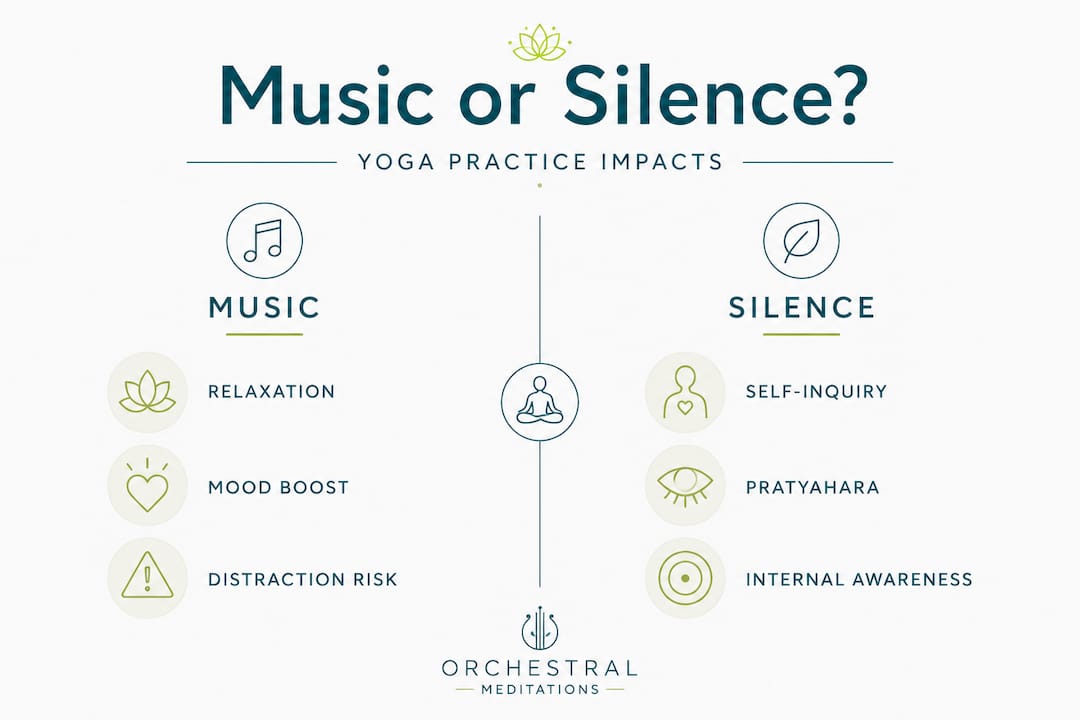
Silence, on the other hand, has its own set of gifts. It exposes whatever is actually happening internally: the restless thoughts, the uncomfortable feelings, the habitual mental chatter. That can be profoundly useful for self-inquiry. It can also, if you are being honest, feel absolutely terrifying at first. Many practitioners use music as a kind of emotional buffer against the discomfort of silence. There is nothing inherently wrong with that, as long as you are aware that is what you are doing.
Pro Tip: Try alternating between music-supported and silent sessions over a month. Notice what changes in each. The contrast itself becomes a form of practice, revealing your relationship to sound, silence, and the need for external scaffolding.
How to choose the right soundtrack:
- For restorative or Yin yoga: Slow, spacious ambient orchestral music or drone-based sounds. Think long string passages, low sustained notes, and wide dynamic range.
- For Vinyasa or flow: Moderate tempo, rhythmically coherent music without jarring dynamics. Orchestral pieces with a clear forward motion work beautifully.
- For meditation or Yoga Nidra: Theta-frequency binaural beats, mantra recordings, or deeply ambient soundscapes with minimal melodic movement.
- For pranayama: Consider silence or very minimal, barely-audible ambient texture. The breath needs to be the foreground.
Our article on orchestral sound in meditation explores why live orchestral recordings carry a particular quality that synthesised music simply cannot replicate, and if you are curious about the wider therapeutic context, music supports mental health in measurable, evidence-based ways worth reading about.
Application: Integrating scientifically-crafted soundscapes into your yoga practice
Theory is lovely. But you came here for something practical, something you can actually use on your mat tomorrow morning. So let us get into it.
The most common mistake I see practitioners make is treating music selection as an afterthought, a last-minute decision made while rolling out the mat. The soundtrack you choose is as much a part of your session design as the sequence of postures. Treat it that way.
Here is a step-by-step approach to building your music-integrated yoga practice:
-
Define your session intention first. Before you choose any music, ask yourself: what is this session for? Recovery? Energy? Deep meditation? Emotional processing? The answer determines everything that follows.
-
Match tempo to movement pace. As a general rule, aim for music with a tempo (beats per minute) that loosely mirrors your intended movement speed. Restorative sessions suit 40 to 60 BPM. Moderate flow works well around 70 to 90 BPM. Keep this in the background of your awareness rather than letting it become a rigid formula.
-
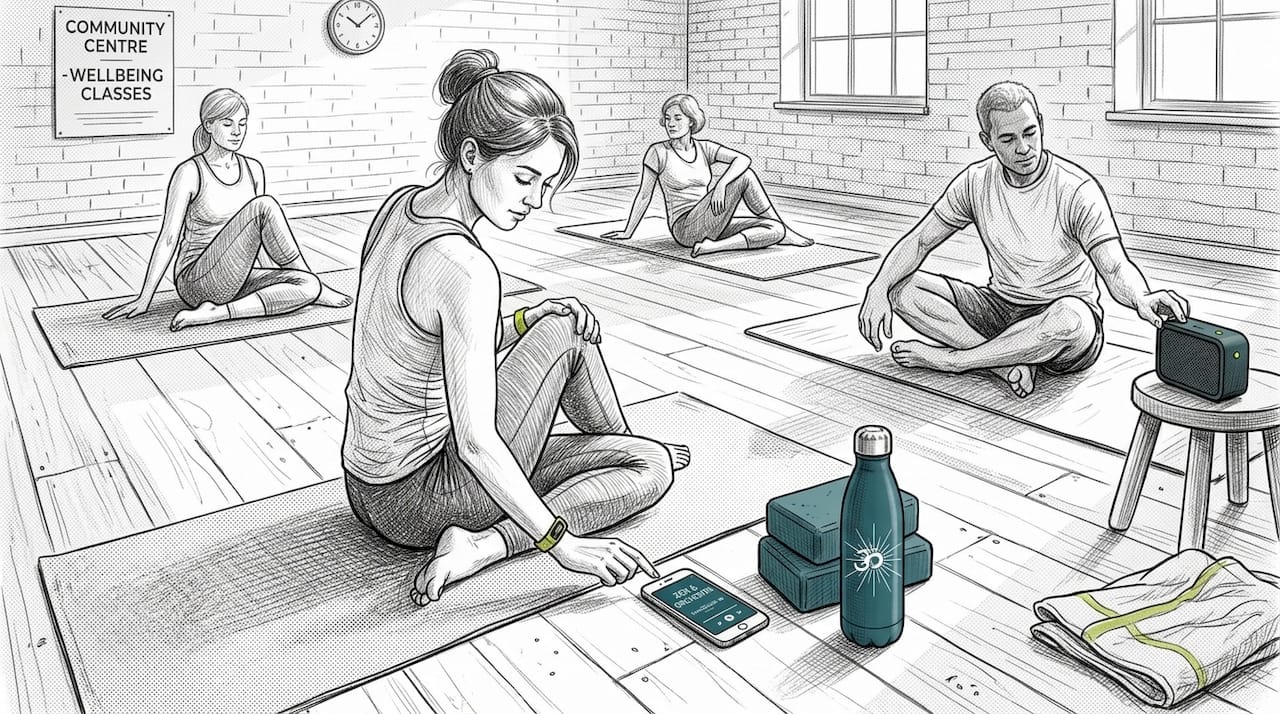
Set the volume intentionally. Music during yoga should be audible but not dominant. A useful test: if you can easily hear yourself breathing, the volume is probably right. If the music is louder than your breath, turn it down. The breath is always the primary teacher.
-
Use sequenced soundscapes rather than shuffled playlists. A shuffled playlist creates unpredictable sonic jumps that pull the nervous system out of its rhythm. A sequenced soundscape, particularly one designed specifically for meditation or yoga, builds a coherent emotional arc. This matters more than most people realise.
-
Consider unguided music for experienced practitioners. The Nada Yoga research actually found that music therapy was more effective without verbal instructions in some populations. Pure music, without a voice talking over it, may allow deeper immersion, particularly for those who have been practising long enough to guide themselves.
-
Allow a transition period after the session. When your practice ends, do not immediately switch to a podcast or conversation. Sit in the residual soundscape for a minute or two. Let the nervous system consolidate whatever state it has reached. This is when some of the deepest integration happens.
-
Experiment with theta-frequency and binaural recordings for Savasana. These are specifically designed to encourage the brainwave states associated with deepest rest and subconscious processing. Even five minutes in theta territory at the end of a practice can have a disproportionate effect on how you feel for the rest of the day.
A few additional considerations worth noting:
- Headphones vs. speakers: Binaural beats require headphones to work as designed (since they rely on different frequencies reaching each ear separately). Orchestral ambient music works beautifully through speakers, which also allows it to fill the physical space of your practice area in a more immersive way.
- Live recordings matter: There is a measurable difference in the complexity and warmth of live orchestral recordings compared to synthesised or sampled equivalents. The acoustic nuances in a live recording, the tiny variations in timing, the natural reverb of a great studio, contribute to the nervous system’s sense of safety and depth.
- Consistency builds depth: The more you practise with the same soundscapes, the deeper the associative conditioning becomes. Your body begins to recognise those sounds as the signal that it is time to shift states, which accelerates the transition into deeper practice.
For a deeper look at what practitioners actually use therapeutic music for, the music uses in wellness article is genuinely illuminating, and the healing with meditation music resource covers the science and practice in admirable detail.
The uncomfortable truth: When music hinders self-discovery in yoga
I want to share something with you that took me longer than I would like to admit to fully appreciate. Music, particularly beautifully crafted, therapeutically designed music, can become a very sophisticated avoidance mechanism.
Here is what I mean. We reach for a soundscape because it helps. And it genuinely does. But sometimes, what we are really reaching for is insulation from the deeper, quieter, more confronting experience that awaits us in genuine stillness. The moment the music fills the room, the uncomfortable internal landscape becomes a little less vivid. The looping thought we have been avoiding becomes a little easier to ignore. The grief or irritability or boredom that would otherwise demand our attention gets softened into something more manageable.
That is, in some sessions, exactly what you need. But in other sessions, it is a missed appointment with yourself. Silence exposes internal states for deeper self-inquiry in a way that even the most carefully crafted soundscape cannot fully replicate. Pratyahara, real sense withdrawal, requires the senses to have nothing particularly compelling to latch onto. Music, by design, is compelling.
I am not arguing against music in yoga. Far from it. The evidence for its therapeutic value is overwhelming, and I genuinely believe that orchestral soundscapes, crafted with real intention and scientific rigour, can facilitate states of healing and insight that are extraordinary. But I think the most honest and ultimately most useful relationship with yoga music involves knowing when to switch it off. The sessions that initially feel bare and strange in silence often turn out to be the most revealing. The discomfort is not a sign that something is wrong. It is frequently a sign that something is actually, finally, right.
Our thoughts on orchestral sound transforms meditation explore this balance with care, acknowledging both the power and the limits of any external tool.
Explore orchestral soundscapes to elevate your yoga experience
If reading this has made you curious about what a genuinely well-crafted, scientifically-informed orchestral soundscape actually sounds like during practice, that curiosity is worth following. Orchestral Meditations offers a curated library of meditation and yoga music recorded at Abbey Road Studios with the National Philharmonic, incorporating binaural beats, theta frequencies, and 3D surround sound in compositions designed specifically for deep meditative and yogic states.
Whether you are seeking something to carry you through a restorative evening practice or a theta-rich soundscape for your morning meditation, you can explore the full library of orchestral meditation music and find what resonates. If you want a curated starting point, the best meditation music selection offers a thoughtfully assembled range that suits a variety of practice styles and intentions. Your mat deserves a soundtrack that takes your practice as seriously as you do.
Frequently asked questions
What types of music are best for yoga relaxation?
Ambient, orchestral, and Nada Yoga soundscapes are consistently shown to activate the parasympathetic nervous system and promote relaxation. Theta-frequency binaural recordings are particularly effective for deep meditative states.
Does music in yoga improve pain and anxiety outcomes?
Yes, substantially. MSRT with mantras like AUM and Om can reduce pain by over 95% and state anxiety significantly, with clinical trials showing results that outperform standard interventions for neck pain and related conditions.
Are there times when silence is better than music during yoga?
Absolutely. Silence encourages deeper self-inquiry and supports the practice of pratyahara, sense withdrawal, which music by its nature can work against. Alternating between both approaches tends to yield the greatest long-term growth.
How should I choose music for my yoga session?
Match your selection to your session goal. Slow, ambient orchestral music supports restoration and relaxation; orchestral and mantra soundscapes support emotional depth and meditation; and binaural or theta recordings are best suited to Yoga Nidra or deep Savasana practice.