Good yoga class music transitions are mostly about planning. Decide where the energy of the class rises and falls, choose music whose tempo and density follow that curve, and let each track change land on a natural pause in your teaching. Use short crossfades, keep the volume low enough for your voice to stay clear, and leave room for silence. Do that, and students will never notice the music changing, which is exactly the point.
This guide walks through the whole thing: a phase-by-phase map, tempo ranges, the technical bits (crossfade, gapless playback, remotes), how long your playlist should really be, and what to check about licensing if you teach in Germany.
TL;DR
- Map your music to the shape of the class (arrival, warm-up, build, peak, cool-down, Savasana) and change tracks where your own instructions pause, not mid-pose.
- Match tempo to intent: roughly 50–75 BPM for restorative or yin, and faster, more rhythmic music only for dynamic flow, tapering down before final relaxation.
- Use short crossfades of a few seconds, keep instrumental music for instruction-heavy sections, and control volume with a remote rather than walking to the speaker.
- Plan less music than class time, keep a spare track ready, and treat silence as part of the playlist.
- If you play music in a studio or online, check licensing first. Royalty-free tracks with a professional licence remove most of the guesswork.
Why transitions matter more than the tracks themselves
I have a confession. Early in my career as a conductor, I believed the music was the whole show. Then I watched a yoga teacher friend lose an entire room in four seconds: a gorgeous, hushed track ended, and the next one started with a drum loop at full volume. Twenty people in Child’s Pose jerked up like startled meerkats. Lovely playlist. Terrible handover.
That is the thing about transitions. A student on the mat is doing something your average concert-goer never does: they are turning attention inward, with breath and body as the main event. Music is a guest at that party. When the guest changes its outfit loudly, everyone looks up.
A transition can go wrong in a few predictable ways:
- A tempo jump. Moving from a 60 BPM drift to a 110 BPM pulse with no bridge.
- A volume jump. Tracks mastered at different loudness levels, so the new one is suddenly twice as present.
- A timing clash. The track change lands in the middle of a cue, so your voice and the new intro fight.
- A mood clash. A bright, major-key melody arriving straight after a dark, introspective piece.
Every section below is a way of avoiding one of those four.
Map the class before you pick a single track
The most useful habit is to plan music by class sequence rather than by favourite songs. The German yoga magazine YogaWorld suggests building a playlist phase by phase, using its 60-minute example as inspiration rather than a rule, because musical taste and perception differ so much between people. I like that humility. Nobody gets to declare the one correct song for downward dog.
Another German source, the yoga blog Fuck Lucky Go Happy, adds a smart first step: define your class theme and your peak pose first, then pick a musical high point to accompany a sustained pose where students can actually listen, rather than a technically demanding movement where they are concentrating on not falling over.
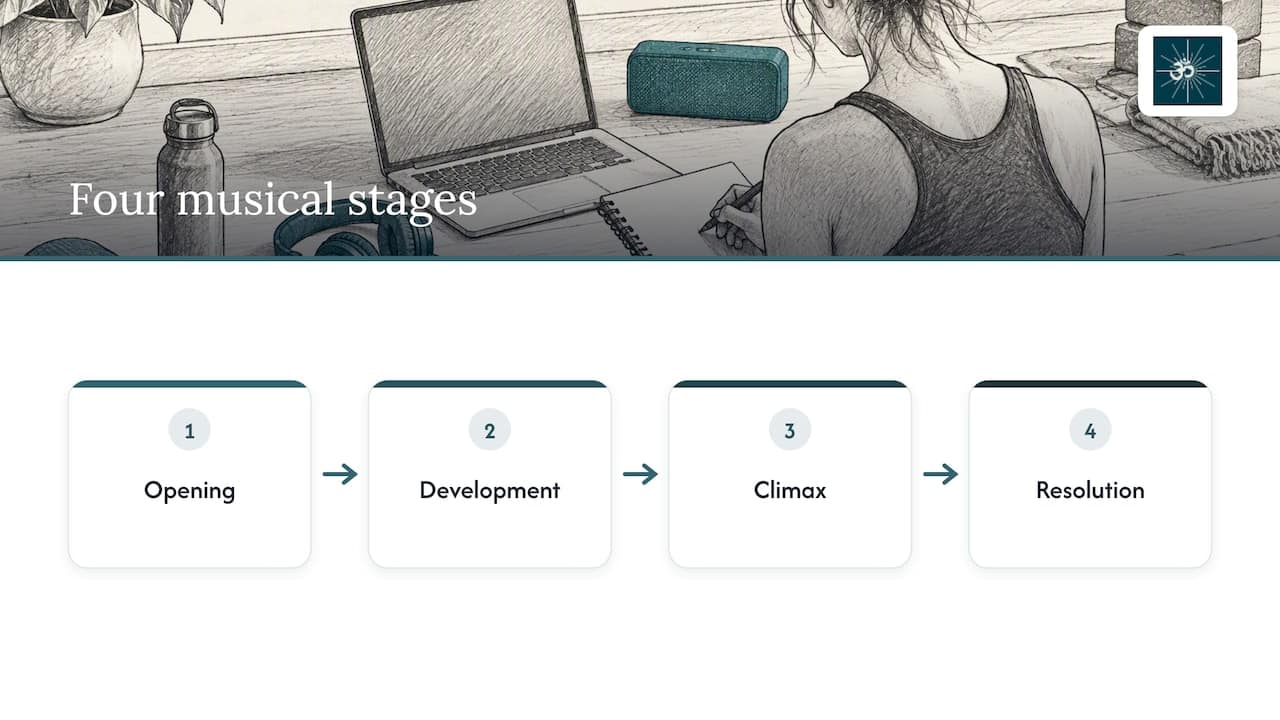
If you like a more cinematic frame, you can think of the class as a film score, with an opening, a development, a climax and a resolution, and map your movement phases to those musical ideas, an approach described by a yoga-teacher resource. It is a handy mental model, and as someone who has spent decades with orchestras, I can tell you it matches how a symphony breathes.
A sample 60-minute map
Treat this as a template to bend, not a commandment.
| Phase | Minutes | Music intent | Typical tempo | Transition cue |
|---|---|---|---|---|
| Arrival and centring | 0–5 | Soft, spacious, little rhythm | Slow, pulse barely felt | Fade in under your welcome |
| Warm-up | 5–15 | Gentle pulse, warm tone | Gradually rising | Change at the end of a round |
| Build | 15–30 | More rhythm and layers | Highest of the class | Change when you move to a new sequence |
| Peak | 30–40 | Emotional high point, ideally a sustained pose | Steady, not frantic | Let the track finish naturally |
| Cool-down | 40–50 | Thinning texture, lower register | Dropping | Overlap into the slower track |
| Savasana | 50–60 | Very quiet, or silence | Slow or none | Long, soft fade |
Notice the last column. A transition is not a property of the music alone. It is a handshake between the music and your teaching, so every row has a cue that belongs to you.
Choose tempo and mood for each phase
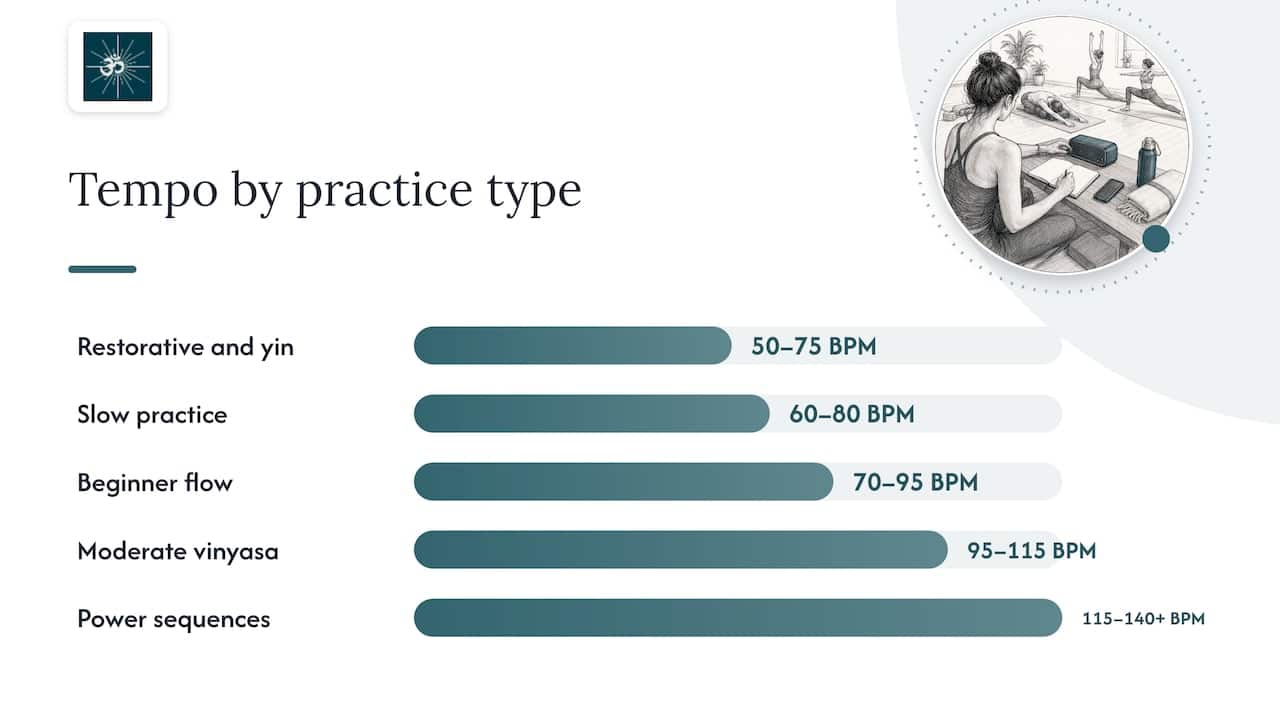
Tempo is the quickest lever you have. One international yoga resource suggests calm music of around 60–80 BPM with minimal lyrics for slow practice and meditation, with dynamic flow allowed to be faster and more rhythmic before tapering down for final relaxation. The same page offers rough guidelines: 50–75 BPM for restorative and yin, 70–95 for beginner flow, 95–115 for moderate vinyasa, and 115–140 and above for power sequences. These are rules of thumb, not laws of physics, but they give you a sane starting grid.
Here is how I would use it in practice:
- Pick the tempo of your peak first. A moderate vinyasa peak might sit near 100 BPM.
- Work backwards. Your warm-up should sit a notch or two below it, and your arrival track well below that.
- Work forwards. Cool-down and Savasana should step down in a series of small drops, not one cliff.
Small steps are the trick. If two adjacent tracks are within 10–15 BPM of each other, a short crossfade is usually all you need. If they are further apart, put a bridge track between them: something in the middle in tempo, mood and key.
Instrumentation changes how a track feels
Tempo is only half of it. A 70 BPM track with a bright synth lead feels busier than a 70 BPM track played by strings and a low piano. For the quiet phases, favour:
- sustained strings, soft winds and warm low registers;
- few or no lyrics (words pull the thinking mind toward language, which is precisely what you are asking students to rest from);
- slow harmonic change, so nothing surprising happens every four bars.
There is also some supporting science for low sounds and breathing. A 2024 exploratory mixed-methods study on music-guided resonance breathing found that participants considered low instrumental or vocal sounds potentially supportive of abdominal breathing, and they preferred breathing cues they could recognise while keeping freedom in their own rhythm. That study was not about yoga classes, so take it as a hint rather than a prescription. Still, it fits what most teachers feel: low and slow tends to invite a longer exhale.
The mechanics of a smooth handover
Now for the part with the knobs.
Crossfades and phrase changes
A yoga-teacher guide recommends crossfades of roughly 2–6 seconds, marking phrase changes (often every 8 or 16 bars) and lining movement blocks up with them. The same source suggests lowering the music during heavy instruction, and using a low-volume ambient layer to smooth an intense climax. I would add one caution from my own experience: a crossfade works best when both tracks share a key or are in closely related keys. Two ambient pieces in clashing keys, overlapped for five seconds, produce a little wobble of dissonance that sounds like a cat walking across a piano.
Breath is a handy ruler. One teaching resource suggests thinking in 8-count breath cycles and aligning transitions with phrase boundaries, which reduces friction and makes sequences feel intuitive. In plain terms: if you are cueing a flow in rounds of eight breaths, try to have the music turn a corner when a round ends.
Set up your player properly
Most streaming apps can do the heavy lifting. Spotify’s German support page explains that crossfade fades one song out while the next fades in, that Automix creates beat-synchronised transitions for selected playlists, and that gapless playback removes the pauses between songs. It also notes that Spotify Connect does not allow these settings. That last detail catches people out: if you cast to a studio speaker through Connect, your carefully set crossfade may quietly vanish.
A few practical rules:
- Test the actual setup. Run the playlist through the studio’s real speaker system, not your headphones.
- Check the gaps. Some albums, especially live recordings, rely on gapless playback to sound right.
- Normalise loudness. If one track is louder than its neighbours, fix it before class, not during.
- Use a remote. YogaWorld recommends a player with a remote for the sound system, so you can adjust volume without disrupting your teaching. A phone on a lanyard works too.
Rehearse the transitions
This is the step almost everyone skips. One resource advises you to test transition points in rehearsal with students or colleagues. Run through your class alone once with a stopwatch, saying your cues out loud. You will find the awkward bit within five minutes, usually where a track ends 40 seconds before you have finished your instruction.
Voice, volume and the case for silence
Your voice is the most important instrument in the room. Ulrike Sinn of Fuck Lucky Go Happy argues that music should work as a teaching tool: present enough to shape the energy, quiet enough that your instructions stay understandable. YogaWorld likewise suggests instrumental music for sections with a lot of instruction.
The golden rule of volume is that students should hear music when you stop talking, and barely notice it when you speak. If you keep nudging the volume up and down, your transitions will start to sound like a nervous radio presenter.
Let silence do some of the work
Silence is not a gap in the playlist. It is a track. Yoga teacher Sage Rountree notes that music can regulate the nervous system, but that too much stimulation from lyrics or strong beats can pull students out of a calm, parasympathetic state. She treats silence as a deliberate tool, one that supports pratyahara, the withdrawal of the senses. The same logic appears in broader writing on rest and relaxation: if you are curious about why low-distraction sound and quiet help the body settle, this piece on meditation and beauty rest covers the calming side of it.
Where does silence fit best?
- Before Savasana, as a short pause that signals the shift.
- After a demanding sequence, when students are catching their breath and do not need a melody.
- During longer holds, if you are guiding closely with your voice.
A gentle drop to silence, followed by a soft new track fading in, is one of the most elegant transitions there is, and it costs nothing.
How much music to plan
Here is a counterintuitive tip: do not fill the whole class. Fuck Lucky Go Happy reports that for a 90-minute class it uses roughly 75–80 minutes of playlist music, and for a 60-minute class about 55 minutes, which leaves room for meditation, chanting, explanations, demonstrations and pauses without music.
The same article recommends keeping a buffer before your planned Savasana track, so the class does not reach final relaxation too early, and having a skip-ready extra track in case timing shifts. I would go further and build a flexible middle section:
- Put two or three interchangeable tracks of similar tempo in your build phase.
- Mark one “short version” track and one “long version” track for Savasana.
- Keep a simple fallback: if you are running late, skip one middle track rather than cutting the final one short.
That way a chatty student or an extra demonstration will not wreck the carefully planned ending.
Adapting the playlist to different classes
There is no single best song for yoga, and anyone who tells you otherwise is selling something. The right choice depends on your class type and your people. Here is how the approach flexes:
| Class type | Music approach | Transition style |
|---|---|---|
| Restorative or yin | Slow, sustained, few layers | Long overlaps, lots of silence |
| Beginner flow | Gentle pulse, clear and unfussy | Change between sequences, with a clear cue |
| Vinyasa | Rising and falling rhythm | Phrase-aligned changes at round ends |
| Power | Strong rhythm, but still reduced under heavy instruction | Crisp changes, with a calm bridge before cool-down |
| Meditation or breathwork | Minimal or no beat, evolving textures | Very slow fades |
Also consider the room. A small studio with hard floors and a loud heating system needs a different level than a quiet living room. And ask your students. A short survey (“Do you prefer music, or more quiet?”) will teach you more than another hour of playlist-hunting.
Check your licensing before you hit play
If you teach in Germany, music in a class is not just an artistic question. Playing copyrighted recordings in front of paying students is a public use, and studios often need the proper permissions. GEMA, the German collecting society, publishes tariffs for different uses. For example, its tariff VR-Ö covers reproduction, such as creating custom playlists or digital copies of copyrighted works for public performance. Which tariffs apply to you depends on your setup (studio, online classes, retreats, recordings), so ask GEMA or your studio’s operator directly rather than guessing. If you stream class recordings online or sell them, check the platform’s rules as well.
The simplest way to sidestep the complexity is to use music designed for professional use. Royalty-free tracks with a clear licence mean you know where you stand when you teach, record or build a class app.
Perspective: why live-recorded music makes transitions easier
We make meditation music for a living, so we are biased, but we have a reason for it. Orchestral Meditations is built around live musicians: our recordings were made at Abbey Road Studios with the National Philharmonic, and we use 3D surround sound and frequency-based design such as binaural, theta and Solfeggio tracks. People often ask whether that matters for a yoga class.
In one respect, yes: transitions. Acoustic instruments have natural attacks and decays. A long string note blooms and fades the way a breath does, so when one piece melts into the next, there is less of that hard digital edge that startles a student mid-exhale. The composers behind our library think about this all the time. Moritz Schneider, who has been writing music for film, albums and musicals for over 20 years, discovered his passion for meditation music as “music for inner films”, and he describes the way the music comes to him as similar to working with channelling mediums. Robert Emery trained at the Royal College of Music, is Music Director of the National Philharmonic Orchestra of Great Britain, and has conducted orchestras around the world. He holds that acoustic instruments resonate with the body in a way digital ones simply do not.
Their partnership has lasted thirteen years, and you can hear what two friends who have toured together bring to slow, patient music: a shared sense of when a phrase has finished saying what it needs to say. That is exactly the instinct a yoga teacher needs when choosing a moment to change tracks.
My advice, as a conductor? Stop thinking of your playlist as a list. Think of it as a score. Every piece needs a beginning, an ending, and a sensible way of getting from one to the next.
— ROBERT
Bring it together: a simple workflow
If you want a repeatable process, try this:
- Define the class theme and peak pose. Everything is built around this moment.
- Draw the energy curve. Mark where the class rises, plateaus and falls.
- Assign tempo ranges to each phase. Keep neighbouring tracks within a modest tempo gap.
- Choose instrumental music for the instruction-heavy sections. Save richer or lyrical tracks for sustained holds.
- Set crossfades and check gapless playback on the real sound system.
- Plan about 55 minutes of music for a 60-minute class, with a spare track on standby.
- Rehearse once. Adjust where the cues and the music clash.
- Check your licensing, especially if you teach commercially or record classes.
After a few classes you will not need the checklist. You will start hearing the shape of the class before you have chosen a single track, which is a rather lovely moment.
Music made for teaching
If you are building classes with a professional offering in mind, our royalty-free meditation music library is made for teachers, therapists and content creators who want live-recorded orchestral tracks with professional licensing. If you are a practitioner who wants a steady supply of calm, personal-use music for your own practice, the personal subscription costs €21 per month. Teachers who need music for classes, apps or guided audio can look at the professional subscription at €150 per month. Not sure how to structure the quieter end of the class? Our guide to step-by-step guided meditation is a good companion for the final relaxation.
FAQ
How long should a crossfade be in a yoga class?
A short crossfade of about 2–6 seconds suits most transitions between tracks of similar tempo and mood. Slow, ambient pieces can take a longer overlap, while a track change in a dynamic flow may need a tighter one. Test with your actual speakers, since the same fade can sound different in a large room.
Which song is best for yoga?
There is no single best song, because taste and perception differ between people. Choose by phase: calm, low-lyric music for centring and Savasana, a steadier pulse for flow, and a memorable high point for a sustained peak pose. Then listen to your students’ feedback and adjust.
Should I play music throughout the whole class?
Not necessarily. Many teachers plan less music than the class length, for example about 55 minutes for a 60-minute class, and leave space for silence, explanation and demonstration. Quiet moments, especially before Savasana, help students turn their attention inward.
Do I need a licence to play music in my yoga studio in Germany?
Often, yes, because playing recordings to paying students is a public use. GEMA publishes tariffs for different uses, and which one applies depends on how you use the music, so ask GEMA or your studio operator before you build your playlists. Royalty-free music with a professional licence can simplify matters.
Sources
- Quick Tips: Wie erstelle ich eine Yoga-Playlist (YogaWorld)
- Sound on! So baust du deine perfekte Yoga-Playlist (Fuck Lucky Go Happy)
- Film-Score Flow: Sequencing & Licensing for Yoga
- Soundtrack Yoga: Grammy Week Playlist Guide
- Yoga Music: Build the Right Soundscape for Practice
- Music-guided resonance breathing: an exploratory study (ScienceDirect)
- Übergänge zwischen Songs (Spotify Support)
- Should You Use Music in Your Yoga Classes? (Sage Rountree)
- Tarif VR-Ö für die Vervielfältigung (GEMA)