Singing bowls give you live sound and physical vibration, while meditation music gives you a steady, immersive backdrop you can use anywhere, at any volume, for as long as you like. Neither is “better” in general. The bowl is a short, tactile, attention-grabbing event. Music is a long, supportive environment. Most people who stick with meditation for years end up using both, and this guide shows you when to reach for which.
TL;DR
- A singing bowl works through a struck note, its overtones and a vibration you can feel in the body. Recorded music works through melody, harmony and a sustained atmosphere.
- Research on singing bowls is promising but still limited. Small studies show lower heart rate, less tension and more relaxation, and reviewers want larger trials.
- One 2026 study found a one-minute bowl sound reduced subjective arousal more than binaural beats, pink noise or silence. That is a short, specific result, not a verdict on music in general.
- Use a bowl to open and close a session or to anchor wandering attention. Use music for longer sits, sleep, yoga and guided work.
- You do not have to choose. A bowl strike followed by quiet orchestral music is a very practical combination.
What actually separates a bowl from a track
I’ll start with a confession. The first time I owned a singing bowl, I hit it so enthusiastically that my cat left the room and did not come back for an hour. Lesson learned: a bowl is an instrument, and instruments have manners.
Here is the real difference, stripped of mystique.
A singing bowl produces a small number of very pure, long-ringing notes, with overtones that shift as the sound decays. You strike it or circle the rim with a mallet, and then you wait. The sound is sparse. There is a lot of space around it, and that space is much of the point.
Meditation music is composed. It has harmony, movement, and (when it is done well) an emotional shape that can carry you from restless to settled over ten, twenty or sixty minutes. You press play and it does the pacing for you.
In practice, that means:
- A bowl asks you to listen closely to one thing. Music invites you to listen broadly, or even to stop listening and drift.
- A bowl needs a person to play it, or at least a person to strike it. Music needs a speaker or headphones.
- A bowl is mostly about the moment of the note. Music is mostly about the stretch of time between notes.
Neither description is a ranking. They are two tools for two slightly different jobs.
The case for singing bowls
The vibration is physical
This is the strongest argument for a bowl, and it is one the clinicians make as well. Cleveland Clinic’s guidance on sound baths says recordings can be used, but that an in-person session is best because your whole body can feel the instrument’s vibration. A speaker gives you sound pressure. A bowl in the same room, or placed near you, gives you sound you can sense in your chest and hands.
Sound-bath practitioners quoted by Fast Company describe the same thing from the inside: in a live session sound waves are continuously created in the room, and they argue recorded sound cannot recreate that. That article is a first-person experience piece rather than a controlled comparison, so treat it as a description of what it feels like, not as proof.
It gives your attention a job
Beginners often tell me they “cannot meditate” because their mind will not be quiet. A struck bowl is a lovely cheat. The instruction becomes very simple: listen until the sound has completely gone. That is already a meditation, and it has a built-in finish line.
What the research shows so far
The evidence is encouraging and, to be fair to the sceptics, still thin.
- A systematic review of 19 clinical studies reports potential benefits for anxiety, depression and tension, and also says larger randomised trials are needed before firm recommendations can be made.
- A 2022 study from University Hospital Regensburg in Germany looked at a 20-minute professional singing bowl massage in 34 people. Mean heart rate fell from 75.5 to 71.5 beats per minute, EEG activity changed, and 97.1% of participants said they felt more balanced. There was no comparison group, so we cannot say how much was the bowls and how much was lying down for 20 minutes.
- A 2023 randomised controlled trial in anxious adults found that a single Tibetan singing bowl session produced a stronger relaxation response than progressive muscle relaxation or a control condition.
- A 2016 observational study found that people new to singing bowl meditation had a bigger drop in tension than those with previous experience. Novelty may matter.
- A 2020 Austrian crossover study of 48 participants found that people felt less sleepy after 20 minutes above a struck bowl than above a silent one (median score 3 versus 4), though the pupil-based objective measure did not differ significantly.
Notice that last one. Bowls may not simply sedate you. In that study they left people feeling subjectively less sleepy. That is a good reminder that “relaxing” and “sleep-inducing” are not the same thing.
If you want the wider physiological picture of sound and vibration, this overview of vibroacoustic therapy benefits summarises clinical research on how the body responds.
The downsides, honestly
- Skill and care. Playing a bowl well takes practice. Crystal bowls in particular need careful handling.
- Space and noise. A bowl carries. If you live in a flat with thin walls (hello, most of Germany’s cities), your neighbours may have opinions at 6 a.m.
- Limited length. A single note fades in under a minute or so. For a 30-minute sit you need to keep striking, which can pull you out of the very state you are building.
- Evidence limits. Cleveland Clinic states that evidence for health effects is limited and that sound baths should complement medical treatment, not replace it.
The case for meditation music
It is a sustained environment
Music is better than a bowl at one thing in particular: staying with you. A well-composed piece can hold a room for 20 or 40 minutes without you doing anything. That matters for sleep, for body scans, for yoga and for guided meditation, where your hands and mind are otherwise occupied.
It has solid evidence behind it as a relaxation tool
Germany’s federal health portal says relaxation methods can help you manage stress, prevent illness and support treatment of physical and psychological conditions. It also notes that the effect depends on your personal circumstances and preferences, and on whether you can fit the practice into daily life. That last bit is why music wins for so many people: it is easy to repeat.
Music and vibration are closer than you’d think
A German study published in PLOS ONE compared a body monochord (a large string instrument you lie on or beside) with relaxation music. It found that both vibration and music improved mood and lowered skin conductance, a marker of arousal. So it is not a case of live sound working and recordings being useless. Both relax, in slightly different ways.
The honest weaknesses
- Not all “meditation music” is made equal. A lot of it is a synthesised pad on a loop, which is fine as wallpaper but does not give you much to rest on.
- Speakers and headphones cannot fully reproduce a live instrument in a room. That is a limit of the medium, and it is why recording quality, instrument choice and spatial sound matter so much.
- Music can carry associations. A tune you love can pull you into thought rather than out of it.
What a 2026 study says about bowls versus other sounds
One recent study deserves its own spot because it is the closest thing to a direct head-to-head. A 2026 online experiment found that a one-minute singing bowl intervention reduced subjective arousal, and did so more effectively than binaural beats, pink noise or silence.
Should you throw out your playlists? No. Here is how I read it:
- It tested one minute of sound. That tells us a bowl is a fast way to take the edge off. It does not tell us what happens across a 30-minute practice.
- It measured subjective arousal, meaning how activated people said they felt.
- It compared a bowl with simple sounds (pink noise, binaural tones), not with composed orchestral music played by live musicians.
The practical takeaway: a bowl is an excellent opener when you need to shift gears quickly. After that, what carries you through the rest of the session is a separate question.
Side by side
| Question | Singing bowl | Meditation music |
|---|---|---|
| How you experience it | Single notes, overtones, physical vibration | Continuous melody and harmony, atmosphere |
| Best length | One to ten minutes of focused listening | Ten minutes to an hour or more |
| Effort required | Playing it, waiting for the sound to fade | Pressing play |
| Best for | Starting or ending a session, anchoring attention | Sleep, yoga, body scans, guided meditation, background practice |
| Portability | Needs carrying, careful handling | Phone and headphones |
| Neighbour risk | Real | Controllable with volume |
| Evidence | Small studies, promising, more trials needed | Relaxation effects supported; depends on the person |
| Cost to start | Instrument plus mallet, plus some practice | Free tracks to subscription |
When to choose which
Choose a singing bowl if
- You like ritual and a clear start and finish to your practice.
- You find silence stressful and need one point to focus on.
- You are meditating for five to ten minutes and want something tactile.
- You are guiding someone else and want a gentle signal for “begin” and “end”.
Choose music if
- You are meditating for more than 15 minutes.
- You want to fall asleep, or you are doing yoga, stretching or massage.
- You share walls with other people.
- You want a practice you can do on a train, in a waiting room or in bed.
- You are a teacher or practitioner who needs reliable audio for clients.
Choose both if
- You want a bowl strike to mark the beginning, followed by 20 minutes of quiet music.
- You want to calm down fast and then stay calm.
The German health portal’s point about personal circumstances and preferences is the right rule of thumb here. Try each for two weeks and notice what you actually keep doing. The best method is the one you use.
How to combine them: a simple 15-minute practice
This is the routine I’d give a beginner. If you want a more structured approach to the guided side, our step-by-step guided meditation guide goes deeper.
- Settle (1 minute). Sit or lie down comfortably. Start your music at a low volume, quiet enough that you could hear someone speaking softly.
- Strike (1 minute). Strike the bowl once, gently. Listen until the sound has fully disappeared. Do not rush to the next step.
- Breathe (3 minutes). Let your breathing slow naturally. Let the music be there without chasing it.
- Rest (8 minutes). Stay with whatever is most present: music, breath or the memory of the bowl.
- Close (2 minutes). As the music ends, strike the bowl once more, and again listen to the end of the note before you open your eyes.
If your mind wanders, that is not failure. Noticing that it wandered is the practice.
Who we are, and why this matters to us
Orchestral Meditations was founded by composer and conductor Robert Emery and composer and producer Moritz Schneider. Their about page says they have worked together for thirteen years and have toured the world as friends and collaborators. Both come to meditation music from a heavily professional music background. Robert started piano at seven, studied at the Royal College of Music and conducts. Moritz has written music for feature films, albums and musicals for over 20 years.
That background shapes how we think about this question. Robert puts it simply on our about page: he believes in the power of people making music on acoustic instruments, because digital instruments do not resonate with your body in the same way. Moritz says something similar about frequencies produced by a live instrument and played by a human heartbeat.
It is worth being clear about what that does and does not claim. It is a composer’s conviction, not a clinical finding. But it explains why our tracks are recorded with live musicians, including sessions with the National Philharmonic at Abbey Road Studios, and why we care about spatial sound.
Perspective: where we land on bowls versus music
We like singing bowls. We do not think of them as a rival. A bowl is one live, resonant instrument. An orchestra is many of them playing together, with composed harmony and a pace designed to bring you down gently.
Here is what we have learned from making this music:
- Live sound feels different. The reason people love a bowl in the room is the same reason we record string players, not samples. A human playing a real instrument produces tiny irregularities in timing and tone that your ear reads as alive.
- Recording quality is not a detail. A recording cannot be the room. What it can do is capture as much of a performance as possible. That is why we use 3D surround recording and why we put effort into how tracks are produced and mixed. We are honest that it remains a recording.
- Frequencies are a tool, not a magic trick. We use theta-range and Solfeggio-tuned approaches in some tracks, and binaural beats in others. We encourage listeners to treat them as ways to support a quiet state, not as guaranteed outcomes. The research on bowls and music shows relaxation benefits, but it does not yet show that any particular frequency is special.
- Use what you will actually use. If a bowl gets you to your cushion every morning, wonderful. If an orchestral track gets you through a restless night, equally wonderful.
Our own approach is to treat the bowl as the punctuation and the music as the sentence.
— ROBERT
When music or bowls are not the right choice
Both bowls and music are gentle, but gentle does not mean risk-free for everyone.
- Emotional surprises. The German PLOS ONE study, from researchers at Charité in Berlin, notes that relaxation induced by vibration or by music can sometimes feel emotionally challenging when it brings up vivid inner images or unfamiliar body sensations. If that happens, open your eyes, sit up, lower the volume or stop. If it keeps happening, speak to a therapist or doctor who knows your history.
- Volume. Germany’s federal health portal warns that persistent noise above 60 decibels can impair health and night-time levels from 45 decibels may disturb sleep. Keep meditation audio quiet, especially in headphones and overnight.
- Medical conditions. Cleveland Clinic says sound baths should complement, not replace, medical treatment. If you are managing anxiety, depression, pain or a heart condition, tell your doctor what you are doing and let them guide the rest of your care.
- Pregnancy, implants or vibration sensitivity. If you are planning to have a bowl placed on your body, ask a doctor or midwife first.
Using meditation music professionally
Singing bowls are wonderful in a live room. But teachers, therapists and app makers often need something different: audio that works for a group, across sessions, and with clear permission to use it.
This is where licensing becomes the unglamorous but crucial detail. If you play commercial music in a yoga class or put it in a paid app, a personal listening licence will not cover you. Our Royalty Free Meditation Music library is made for that: orchestral recordings with live musicians for use in meditation, therapy, yoga, apps, guided audio, massage and wellness content.
If you simply want a regular supply of music for your own practice, our personal subscription is €21 per month. Professionals who need the broader licence can look at the professional subscription at €150 per month. You can explore the full library at Orchestral Meditations.
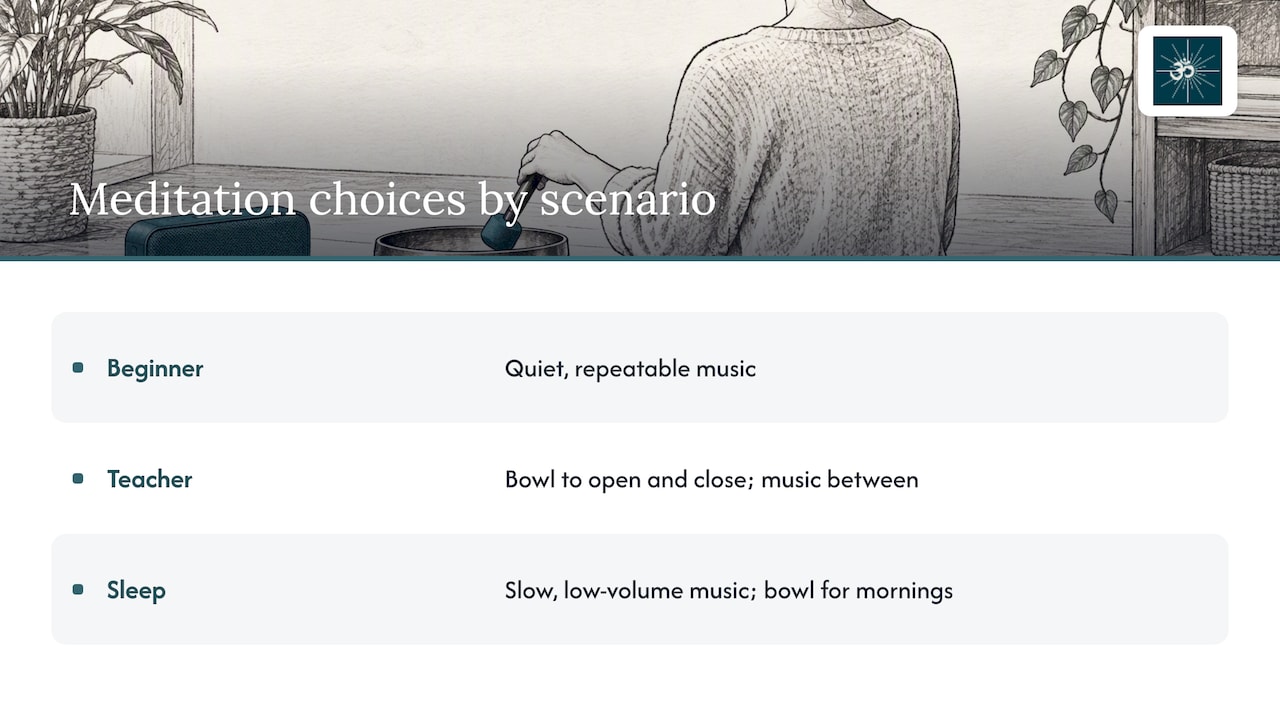
Choosing in practice: three quick scenarios
You are a complete beginner with a flat full of neighbours. Start with music. It is quiet, easy to repeat and forgiving. Add a bowl later, if you want a ritual.
You are a yoga or meditation teacher. Use a bowl to open and close your class, and music for everything between. You get the ritual and the sustained atmosphere, and your students get a consistent session.
You struggle to sleep. Reach for slow music at low volume. Remember that in the 2020 crossover study people felt less sleepy after a struck bowl, so a bowl may suit your morning practice better than your bedtime.
FAQ
Are singing bowls better than meditation music for relaxation?
Not in any proven, general sense. Studies of bowls report lower heart rate, less tension and a stronger relaxation response in some groups, and music is also supported as a relaxation method. Which works better for you depends on your preferences and routine.
Can I use a recording of a singing bowl instead of a real one?
Yes, and many people do. Cleveland Clinic says digital recordings can be used for a sound bath, although an in-person session is best because you feel the vibration through your body. A recording is a perfectly good way to start, particularly if you cannot make noise at home.
Is it a good idea to play music and a singing bowl together?
Yes, as long as the music is quiet and slow. Use the bowl as a clear opening and closing signal, and let the music hold the space between. If the two clash, choose music without strong rhythm.
Are singing bowls or meditation music safe for everyone?
For most people, yes, when kept at a low volume. Some people find the experience emotionally intense, so stop if it feels overwhelming. If you have a medical condition, are pregnant or plan to use a bowl on your body, check with your doctor first.
Sources
- What Are Sound Baths? Cleveland Clinic
- I tried a “sound bath” to feel less stressed and more productive, Fast Company
- Therapeutic effects of singing bowls: a systematic review
- Neurophysiological Effects of a Singing Bowl Massage, University Hospital Regensburg
- Acute Relaxation Response Induced by Tibetan Singing Bowl
- Effects of Singing Bowl Sound Meditation on Mood and Tension
- Effects of singing bowl exposure on Karolinska sleepiness
- A one-minute singing bowl intervention reduces subjective arousal
- Entspannungsmethoden und ihre Wirkung, gesund.bund.de
- Relaxation Induced by Vibroacoustic Stimulation, PLOS ONE
- Auswirkungen von Lärm auf die Gesundheit, gesund.bund.de
- Vibroacoustic therapy benefits backed by clinical research