You can’t safely play a commercial track at a paid retreat just because you bought or streamed it. Normally you must clear both the composition and the recording, and that includes synchronisation and master permissions. GEMA, GVL and § 52 UrhG all matter here. The fastest safe route is a professional royalty-free library from traceable rightsholders such as Orchestral Meditations, Robert Emery and Moritz Schneider.
TL;DR:
- A paid retreat generally needs clearance for both composition and recording, plus public performance permission in Germany unless the music is verified outside GEMA’s repertoire.
- Royalty free describes payment, not permission; verify written commercial, synchronization, and master rights, check GEMA registration, and save the license, receipt, and composer credits.
- Adding spoken guidance, video, or paid online content triggers synchronization clearance; existing recordings also require master and performer permissions, which platform agreements do not automatically provide.
- Audiovisual clearance can take several weeks or months, so start early and pause use when ownership is disputed rather than relying on silence.
- Use a one time license for a defined project; recurring paid sessions favor a subscription, with Orchestral Meditations listing professional access at 150 EUR monthly.
Which licences do you need to use music at a retreat?
Music is two things at once, and people forget this until a takedown email lands. There is the composition (the notes, written by a composer) and there is the recording (a specific performance, captured by a producer and performers). Each carries its own rights, and a retreat can touch several of them at the same time.
Here is what matters in plain language:
- Synchronisation rights: needed when music is combined with another medium, such as a video or spoken guidance you plan to distribute. Synchronisation rights mean the composers, lyricists or publishers must normally give written permission, even if you use the track unaltered.
- Neighbouring and master rights: these protect the recording itself and the performers on it. If you use an existing recording, you need clearance from the label or producer, and performers may have their say too.
- Public performance: playing music to a paying group is a public use. In Germany, GEMA licensing generally applies unless the music is confirmed as royalty-free and independent of any collecting society’s repertoire.
- Public domain: the 70-year rule after the author’s death sounds like a loophole, but it is rare in practice. The composition may be free, yet a modern recording of it is not, and § 52 UrhG shows how many public uses still need consent and remuneration.
If that list feels like a lot of cooks, you are right. The good news: one properly worded professional licence can cover most of it in a single document.
How do you check that a track really is royalty-free?
“Royalty-free” is a marketing phrase, not a legal guarantee. It usually means you pay once instead of per play, but it says nothing about whether the track sits inside a collecting society’s catalogue. So run a quick check before you commit.
- Read the licence wording. Look for explicit words on commercial or professional use, synchronisation and master use. If any of these is missing, treat it as not granted.
- Search the GEMA repertoire, or ask the provider directly whether the track is GEMA-registered.
- Ask for written confirmation from the rightsholder or label, and keep it. An email thread beats a vague memory every time.
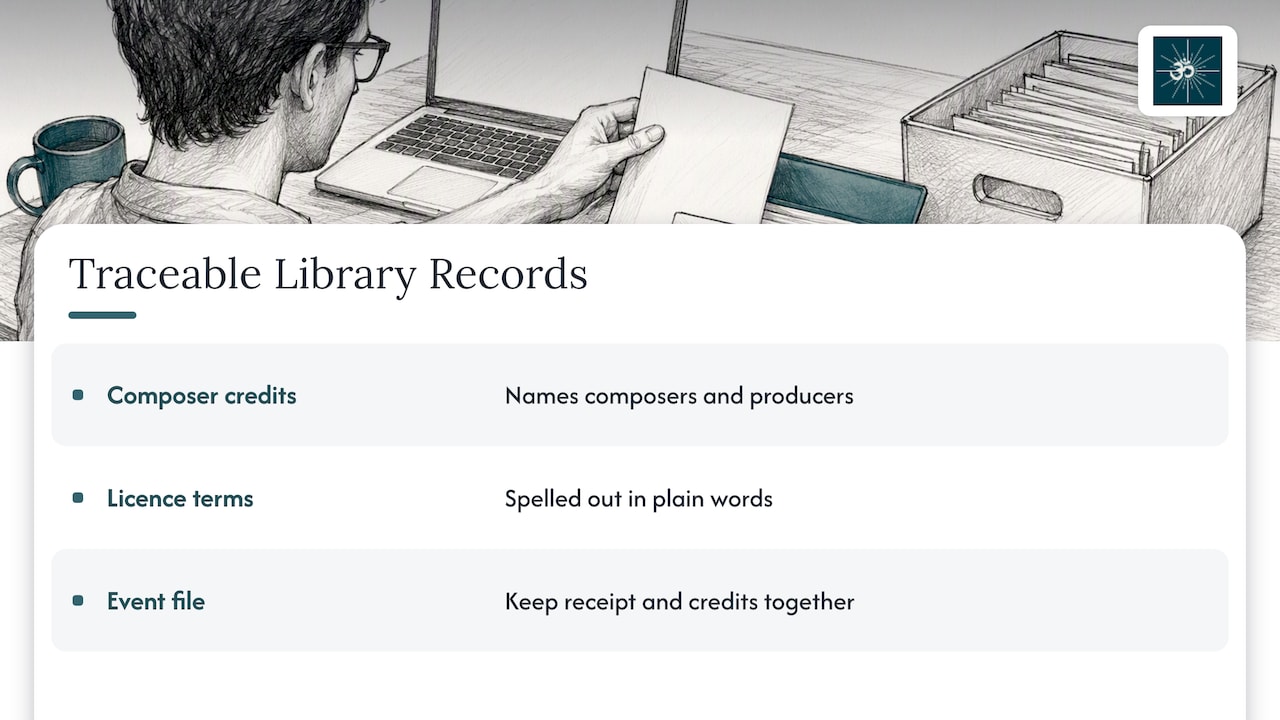
- Favour providers who name their people. Composers and producers with real names are traceable. An anonymous “stock artist” is a dead end when you need answers.
- File everything with your event paperwork: licence, receipt, composer credits.
Pro Tip: Save a PDF of the licence page on the day you buy. Web pages change, and your proof should not vanish with them.
Legal specialists note that missing synchronisation and master licences can create real infringement risk. Many standard royalty-free licences do include those rights, but each one has to be verified, not assumed.
What is the step-by-step clearance workflow?
If a track is not already cleared, you have to do the asking yourself. It is less painful than it sounds, provided you ask the right way round and in good time.
- Gather your facts first. Publishers will want the track title, how you will use it (live session, recording, video), your audience, the territory, the duration and whether the event is paid.
- Identify the rightsholders. Check the label and publisher on the release. If the composers or producers are named, you can approach them directly.
- Use the societies where they apply. GEMA handles the composition side for its members, and GVL deals with performers’ and producers’ neighbouring rights. They can point you to the right party when it is unclear.
- Send one clear enquiry. Put the data from step one in a short message, state what rights you want (synchronisation, master, public performance) and ask for terms in writing.
- Allow for the wait. For audiovisual work, clearance can take several weeks or months depending on the work and the rightsholders involved, so never promise a launch date before the licence arrives.
- Escalate when rights are murky. If two parties both claim to own a recording, or nobody replies, pause. Swap in a track with clean, documented rights rather than hoping nobody notices.
- Record the outcome. Store the signed terms, the date and the contact name.
A tip from experience: a polite, specific enquiry gets answered faster than a vague “can I use your music?”. Publishers are busy, and a complete request is a gift.
Should you choose a one-off licence or a subscription?
It depends on how often you run sessions and where the audio ends up. A single retreat with no recording is a different animal from a year-round programme with paid online classes.
- One-off licence: suits a limited use, such as one track for one defined project. Check the territory and duration, because “one project” can be narrower than you think.
- Professional licence or subscription: suits recurring retreats, paid sessions or content you keep publishing. You get ongoing coverage rather than renewing clearance for every new use.
- Clauses to read: multi-use permission, territory, synchronisation and master use. These four decide whether you are covered or just hopeful.
- Cost logic: if you stream paid sessions or release recordings regularly, a subscription tends to cost less than clearing track after track.
At Orchestral Meditations we offer a personal subscription at 21 EUR per month and a professional subscription at 150 EUR per month. We also sell royalty-free meditation music with professional licensing options for single tracks.
What changes when you add voice or video?
Playing a track quietly in a room is one thing. Once you press record, everything shifts. A guided meditation with music underneath, a retreat promo clip or a paid online class all count as combining music with another medium.
- Synchronisation applies: music joined to moving images or spoken guidance intended for distribution needs sync permission from the composition’s rightsholders.
- Master rights still matter: using an existing recording means clearing the performers and the label too, not just the composer.
- Platform deals have limits: GEMA has agreements with services such as YouTube that cover private uploads, but commercial users still have to clarify production and synchronisation rights themselves.
- Paid content is commercial: a ticketed retreat, a course or a sales video sits outside that private-upload comfort zone.
One more thing, since some retreats pair music with low-frequency or vibroacoustic work: if your sessions use that kind of sound, read the vibroacoustic contraindications from a clinical source first. Licensing keeps you legal; this keeps people safe.
Why do traceable libraries save you so much trouble?
I have spent a long time around composers and studios, and the pattern is boringly consistent: legal friction grows where nobody can say who made the music. When a library names its composers and producers and spells out licence terms in plain words, your clearance questions become easier to resolve. You know who to ask, and the paperwork already says yes.
My advice is simple. Keep the licence receipt and the composer credits in the same folder as the event file. Future you, facing a platform query late at night, will be very grateful.
Orchestral Meditations: cleared music for your retreats
If you want music for professional use, we built our library for exactly that. Our orchestral meditation recordings feature live musicians, including sessions with the National Philharmonic at Abbey Road Studios, and the composers and producers behind them, Robert Emery and Moritz Schneider, are named and reachable. Our personal subscription, professional subscription and royalty-free meditation music come with licence terms that support commercial use.
Ready to explore your options? Start with our professional subscription, or contact us with any bespoke rights question.
FAQ
Do I need a licence to play meditation music at a retreat?
Yes, for paid or public sessions you normally need permission for the composition and the recording. Music confirmed as royalty-free and outside collecting societies’ repertoires can be licensed directly from its creators, as commercial use in Germany generally requires.
Is royalty-free music automatically cleared for commercial use?
No. Royalty-free describes how you pay, not what you may do. Check that the licence explicitly grants commercial, synchronisation and master use before relying on it.
Does YouTube’s licence cover my retreat videos?
Only partly. Platform agreements cover private uploads, but commercial users still need to clear production and synchronisation rights themselves, as GEMA explains.
How long does clearing a track take?
It varies by rightsholder, and synchronisation and master clearance can take several weeks or longer. Start early, or choose a library whose licence is already in place.