
The best hypnobirthing meditation music is the music you have practised with for weeks, not the track that happens to top a playlist. Slow, soft, unhurried and, above all, familiar: that is the recipe. Your body learns to associate a particular sound with letting go, and on the day that association does some of the work for you.
We make orchestral meditation music, recorded with live musicians at Abbey Road Studios, so we have a fond (and slightly obsessive) interest in what slow music does to a listening body. Below you will find what German guidelines say about music in the birth room, what to look for in a track, how to build a practice routine, and what to pack.
TL;DR
- German obstetric guidance supports you in playing the music of your choice during labour, so your own selection beats any standard playlist.
- Look for slow, soft, even music, roughly 60 beats per minute, without sharp highs or sudden dynamic swings.
- Practise with the same pieces for several weeks before the birth, so the music becomes a cue for relaxation.
- Check with your clinic or midwife about speakers and headphones, and discuss your plans with the birth team beforehand.
- Music is a companion to breathing and relaxation, not a promise of a particular birth outcome.
What hypnobirthing meditation music actually is
Three search phrases circle the same idea: hypnobirthing music, hypnobirthing relaxation music and birth meditation music. They all mean audio that you use to settle your breathing, soften your muscles and slip into a calm, inward state while preparing for, or going through, labour.
Hypnobirthing itself is a relaxation method. The German Society for Gynaecology and Obstetrics (DGGG) describes it as a technique using autosuggestion, meaning you suggest calm to yourself until you reach a deeply relaxed, trance-like state. Autosuggestion simply means repeating a calming thought or phrase until your body follows along.
Music is the backdrop. It gives your attention something gentle to rest on, which makes the breathing and visualisation exercises easier to stick with. Some hypnobirthing courses add spoken affirmations, short positive phrases such as “my body knows what to do”. Others use instrumental pieces only. Neither is better; it depends on whether words help you relax or pull you out of it.
There is no special “hypnobirthing genre”. What matters is how a piece behaves: tempo, texture, how much it changes, and whether it makes your shoulders drop.
What the evidence says about music, relaxation and birth
It helps to know what music can reasonably do. Germany’s family planning portal familienplanung.de, in its page on pain relief during birth (January 2024), notes that the birth environment matters: a calm, pleasant room can reduce perceived pain and create a sense of safety, and some women find suitable music helpful.
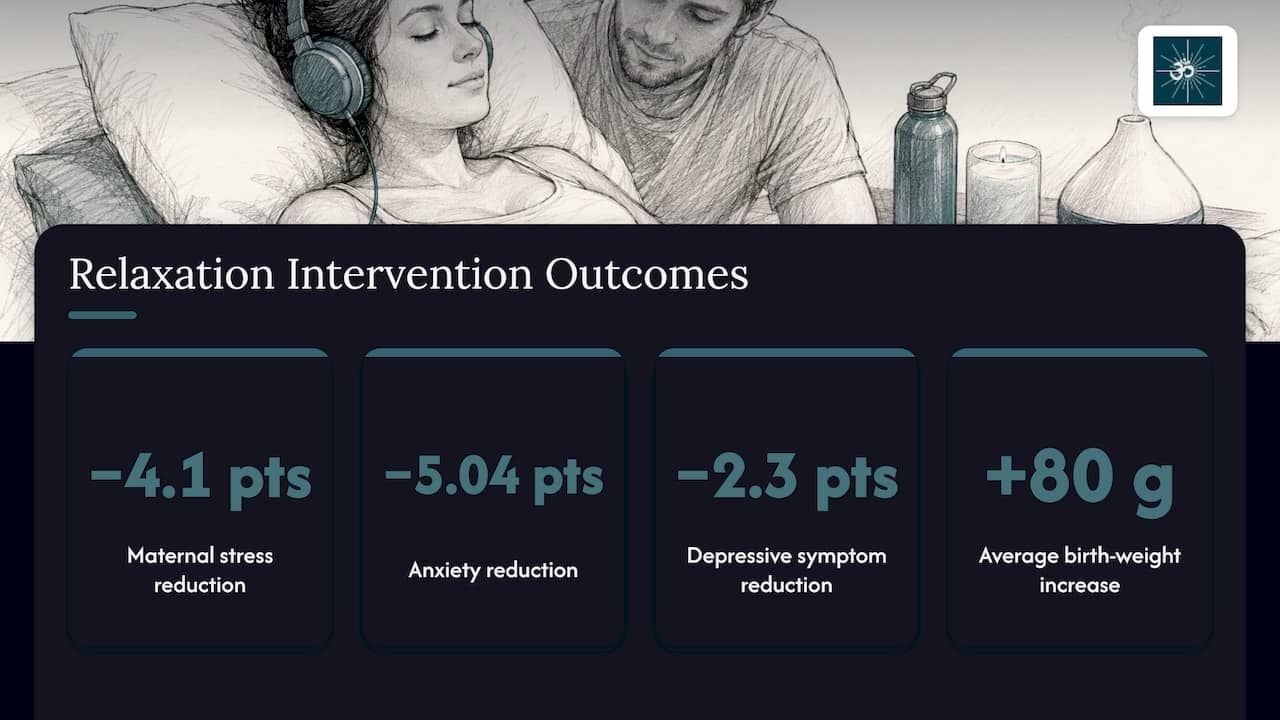
On the wider picture of pregnancy, a meta-analysis of 32 studies with 3,979 pregnant women (Abera et al., published January 2024) looked at relaxation interventions, among them yoga, music and hypnosis. Maternal stress fell by 4.1 points, anxiety by 5.04 points and depressive symptoms by 2.3 points, and babies’ birth weight was on average 80 g higher. Those figures cover relaxation approaches as a group, not music alone, so read them as encouragement for building a relaxation routine rather than as a promise from one playlist.
The fair reading, and the one the DGGG takes, is that hypnobirthing can be considered among relaxation and pain-management approaches, but experiences differ and there is no blanket recommendation. No track can guarantee a shorter labour, less pain or a particular outcome, and any seller who says otherwise is overselling. What music can do is give you a reliable, pleasant cue to return to calm.
Your music, your choice: what the German guideline says
This is the most reassuring finding for anyone building a birth playlist. The German S3 guideline on vaginal birth at term (“Vaginale Geburt am Termin”, issued by the DGGG and the DGHWi, status 22 December 2020) contains recommendation 6.7, graded A: women in labour should be supported in playing the music of their choice. A grade A recommendation is the strongest category in the guideline system.
The same guideline, in recommendation 6.8, says no adverse effects are described for hypnosis and yoga, and that a woman’s wishes for them can be met provided the person applying the technique is trained. So hypnobirthing is within the guideline’s frame when you want it.
In practice this means two things. First, you do not need to defend your playlist to anyone; the music is yours. Second, nobody can tell you what your “correct” music is, which is why the next section is about criteria rather than track titles. Your own sense of “this makes me feel safe” is the deciding factor.
One thing worth noticing: the idea that music should be the woman’s own choice is a reason to build a personal library of a few options, not to pick one “perfect” album. Moods change in labour. A piece that felt wonderful at 36 weeks may feel wrong at 6 cm. Having three or four alternatives ready is sensible.
How to choose music: tempo, texture and sound
A 2023 systematic review of randomised trials on music during pregnancy and birth (Ji et al., Journal of Obstetrics and Gynaecology) gives concrete pointers. It recommends relaxation music of around 60 beats per minute, roughly a resting heartbeat. In early pregnancy it favours an even rhythm and slow melody; in the second and third trimesters, some rhythmic elements may be added, while high frequencies and big, sweeping symphonic passages are best avoided.
A broader 2025 overview of 55 studies in Music Perception (Chrisp, Putter and Krause) found that tempi between 58 and 90 BPM were used, sometimes 60 to 75 BPM to mirror the heart rate. Its recommendations included music without extreme changes in dynamics and soft, relaxing compositions.
Put together, a practical checklist looks like this:
- Tempo: slow, around 60 BPM, or a texture with no pulse at all that simply flows.
- Dynamics: gentle. Avoid pieces that build to a loud climax, because a sudden crescendo is the last thing you want mid-contraction.
- Pitch: warm and low-to-mid. Shrill, high, piercing sounds tend to irritate rather than soothe.
- Length: long enough that you are not fumbling with a phone when a track ends. Several tracks of ten to thirty minutes beat a playlist of three-minute songs.
- Familiarity: the piece should already be linked in your mind with relaxation, which only comes from repetition.
- Mood: the Hypnobirthing-Institut suggests a simple test for a personal playlist, quoted in the research as the question “which pieces make me happy?” That is a better filter than any genre label.
If you do not want to choose at all, the same review suggests classical music, piano music and light music, and says sharp, heavy music is best avoided.
Orchestral, ambient, nature sounds or affirmations?
Each has a place. Orchestral music, especially strings and soft winds, offers warmth and slow harmonic movement. Ambient pieces give a continuous bed of sound without melody to follow. Nature sounds, such as water and light rain, are familiar to many people and can mask corridor noise in a hospital. Spoken affirmations work for those who like to hear reassurance, but they can feel intrusive for others, so keep a wordless alternative.
For pregnancy yoga sessions, which many people use as part of their preparation, slow instrumental pieces without sudden changes serve well, and they double as practice material for the birth.
A thought on why some pieces move us and others leave us cold: it is worth reading how human curators judge emotional songs, because the same instincts apply to choosing birth music that feels right to you.
A word on binaural beats and Solfeggio tracks
Our library includes binaural beats, theta frequency tracks and Solfeggio-based pieces alongside straight orchestral meditations. Binaural beats rely on stereo headphones, so they suit your practice sessions at home, where you can lie down and listen undisturbed. For the birth room itself, speaker-friendly, unhurried orchestral pieces are simpler to use, because you can play them out loud and share them with your birth partner.
Build the habit: practising before the birth
The single most useful piece of advice in the research is also the least glamorous: practise. According to familienplanung.de, self-hypnosis and hypnobirthing can be learned during pregnancy and then used independently or with your birth partner, and regular practice is what makes the techniques available when you need them (same pain-relief page).
German antenatal courses reflect this. The parent school of the Würzburg university women’s clinic (Elternschule, Universitätsklinikum Würzburg) runs a hypnobirthing course where participants design affirmation cards and take home audio files to practise with over several weeks. The course is listed at 180 euros plus 20 euros for materials, and a certificate of attendance can be submitted to your health insurer. Check the clinic’s page for the current schedule and fees.
Here is a simple routine you can adapt.
- Pick two or three pieces that meet the checklist above and that you like on a first listen.
- Practise daily for ten to twenty minutes, lying on your side or sitting supported, in the same spot if possible. Consistency matters more than length.
- Pair the music with one breathing pattern. Breathe in slowly through the nose, out longer through the mouth, and let the exhale track the music’s slow movement.
- Add visualisation once breathing is easy: a place, a colour, a sense of opening. Keep it simple and personal.
- Bring your birth partner in for some sessions, so they know the music and can cue you with a touch or a phrase.
- Rehearse the disruptions. Play the music at slightly different volumes, on a speaker as well as headphones, and in a room with some background noise, so it still works when the setting is imperfect.
- Revisit your choices around 34 to 36 weeks and swap anything that has started to irritate you.
If you want a guided approach to the meditation side of this routine, our article on step by step guided meditation techniques walks through settling the body and breath in stages.
On the day: playback, volume and the birth setting
Practical questions are easy to forget until you are packing the bag. A few worth settling in advance:
Ask your clinic what is possible. Policies differ between hospitals, birth centres and home births. The University Hospital Tübingen, for example, explicitly allows you to bring a music box or similar for relaxation into its six delivery rooms, which also offer a bath, floor mat, hanging rope, birthing bed, exercise balls and birthing stool. Independent midwives in Heidelberg likewise advise bringing familiar items and music from home to help you settle, and mention yoga, mindfulness exercises and positive affirmations as aids to inner calm.
Tell the team about your plan. The DGGG says hypnobirthing is compatible with a hospital birth and recommends discussing the method with the clinical team beforehand. Given that the guideline backs your right to choose your music, this is usually a short and friendly conversation.
Choose your playback device. Ji et al. suggest headphones or a small Bluetooth speaker, with volume set according to the mother’s comfort. In the studies surveyed by Chrisp and colleagues, 48 per cent used headphones, and 16 per cent played music at 60 to 70 dB, which is about the level of ordinary conversation. Treat that as a guide to “quiet and comfortable”, not a target. Your comfort sets the volume, and you should still be able to hear your midwife.

Pack for failure. Download everything in advance so you do not depend on hospital Wi-Fi. Charge the speaker, bring a charging cable, switch off notifications and set the phone to flight mode. Keep a backup device or a second copy of the playlist.
Keep your birth partner in the loop. Whoever is with you should know how to pause, skip and change the volume without asking you.
Sample plan for a birth playlist
There is no right shape, but many people find three moods useful:
| Phase | What you need | What to choose |
|---|---|---|
| Early labour at home | Calm, distraction, rest | Longer orchestral or ambient pieces, light affirmations if you like them |
| Active labour | Steady focus, a rhythm to breathe with | Slow, even pieces around 60 BPM, minimal changes in volume |
| Between contractions and rest | Soft landing, quiet | Very gentle, spacious pieces or nature sounds |
Build each section from music you have already practised with. Nothing new on the day.
Bringing orchestral meditation music into your preparation
If you would like long, unhurried pieces played by live musicians, our library is built around exactly that kind of listening: orchestral meditations recorded at Abbey Road Studios with the National Philharmonic, along with theta, binaural and Solfeggio-frequency tracks. Two tracks on our site suit slow, restful practice sessions at home: Hina, a theta sleep meditation, and Ratri, a theta lullaby meditation, both available with a personal or professional licence.
For ongoing use, our personal subscription costs €21 per month and gives you a growing library to practise with. If you teach antenatal classes, run hypnobirthing sessions, or work as a doula, yoga teacher or therapist, our professional subscription at €150 per month comes with professional licensing for use with clients and in guided audio. Our royalty-free meditation music range covers wellness content and apps.

The people behind the music
Behind the library are two people, Robert Emery and Moritz Schneider, a composing and producing duo who have worked together for thirteen years and, by their own account, are best friends. Robert is a conductor, composer and producer who has recorded meditation productions at Abbey Road involving more than 128 musicians and singers. Moritz has written music for feature films, album productions and musicals for over 20 years.
That background matters for birth music for a plain reason: people who write for film and stage think constantly about how sound shapes the feeling in a room. Moritz puts the idea behind the recordings simply: the power of frequencies created by a live instrument, played by a talented musician, cannot be beaten.
Our perspective
When I conduct an orchestra in a studio, the first thing I notice is how the room changes. Sixty or seventy players breathe together, and for a few minutes nobody is rushing. That shared breath is what we try to put on every recording.
Moritz and I have made music together for thirteen years, and we built our meditation library around live musicians because a living instrument carries tiny human variations that a loop cannot. It is a quality you feel before you can describe it.
For a mother preparing to give birth, what we would say is this: choose music you love, make it slow, and give it weeks. The guideline puts the choice in your hands, and we think that is exactly right. Our theta and orchestral recordings are written to invite stillness, and many people use them for sleep, yoga and quiet practice. If a piece helps you exhale and lets your jaw unclench, it has done its job.
We are not midwives, and we never present music as a medical treatment. We are musicians who care about what a well-recorded, patient piece of music can offer someone who wants to feel calm and supported. Take it into the birth room with your team’s knowledge, and let it be yours.
ROBERT
FAQ
Can hypnobirthing music make my labour shorter or less painful?
No music can promise that. The DGGG considers hypnobirthing one of several relaxation and pain-management approaches and gives no blanket recommendation, because experiences differ. What music offers is a familiar cue for calm breathing, which many women find helpful.
How early should I start practising with my music?
Start several weeks before your due date. The Würzburg course, for instance, sends participants home with audio files for practice over several weeks, and familienplanung.de stresses regular practice so techniques are available during birth. A short daily session works better than occasional long ones.
Can I play my own music in a German hospital?
The S3 guideline recommends that women in labour be supported in playing music of their choice, and some clinics, such as the University Hospital Tübingen, expressly allow a music box in the delivery room. Policies still vary, so ask your clinic or midwife in advance and mention your plans to the birth team.
Does the music have to be silent of lyrics or affirmations?
No. Some people prefer wordless instrumental pieces, others like spoken affirmations. Practise with both and keep a wordless option ready, because your preference may shift during labour.
Which tempo works best?
Research reviews point to slow music of around 60 beats per minute, within a broader range of roughly 58 to 90 BPM, soft in texture and without sudden dynamic jumps. Your own sense of comfort decides within that range.
Sources
- FAQ Hypnobirthing, DGGG
- Schmerzlinderung, familienplanung.de
- Effects of relaxation interventions during pregnancy, PubMed Central
- S3-Leitlinie Vaginale Geburt am Termin
- The role and outcomes of music therapy during pregnancy and birth, Ji et al. 2023
- How Music Listening Can Support Antepartum and Intrapartum Care, Music Perception 2025
- Elternschule, Universitätsklinikum Würzburg
- Kreißsaal, Universitätsklinikum Tübingen
- Kreißsaal A-Z, Beleghebammen Heidelberg
- How human curators select emotional songs