Here is the honest answer: “fair use” will not save you if you are making meditation content for a European audience, because it is a US legal concept with no direct equivalent in EU law. The safer, more boring, far more reliable route is verified royalty-free or properly licensed music, backed by a licence you can actually produce if someone asks. We will show you how to check that in minutes, not months.
TL;DR:
- Check the recording as well as the composition: CC0 may not clear separate recording rights, CC BY requires credit, and NC blocks commercial use.
- A no derivatives license can bar syncing music to video, while royalty free terms still need explicit synchronization and sublicensing permission.
- For EU audiences, US fair use offers no defense; even in the United States, monetized videos using a full track for atmosphere are weak cases.
- Before publishing, save the dated license and required credit, check collecting society claims such as GEMA, and obtain commercial sync clearance for paid work.
1. Quick legal checklist before you use any meditation track
Before you drop any track under your guided meditation or wellness video, run through this list. It takes five minutes and saves you the headache of a takedown notice landing in your inbox at the worst possible moment.
- Confirm the exact licence type and whether it explicitly permits commercial or synchronised use with video.
- Save the licence text or a screenshot of the licence page, with the date, as your proof.
- Check whether attribution is required and copy the exact wording the licensor asks for.
- Look for neighbouring rights or collecting-society claims (GEMA, in Germany and much of continental Europe) that might sit on top of the composer’s own licence.
- When money is involved, whether yours or a client’s, buy a commercial licence or get direct sync clearance rather than guessing.
Pro Tip: Treat every “free” track like a rental agreement: read the small print once, and keep a copy forever, because you may need it again in two years when YouTube’s Content ID flags the same file.
2. Where to find legitimately free or licensable meditation music
Not all “free” sources carry the same risk, and knowing the categories saves you from a nasty surprise six months into a project.
- Public-domain and CC0 repositories carry the lowest risk because the creator has waived rights entirely, though you should still check whether the specific recording (not just the composition) is genuinely free of separate rights.
- Creative Commons repositories, such as the Free Music Archive, host tracks under a mix of licence tags. The tag is everything here: CC0 and CC BY are usually workable, while NC and ND tags carry restrictions we cover below.
- Royalty-free stock libraries and composer-direct libraries trade a small fee for legal certainty. You pay once, you get an explicit commercial licence, and you stop worrying about the small print.
- Platform uploads on YouTube and SoundCloud, including tracks such as the one at this “no copyright” mindfulness upload, are tempting because they are plentiful and labelled invitingly. The label “no copyright” is not a legal status, though. It is an uploader’s claim, and uploader claims are not clearance. Always verify the metadata and, where possible, contact the uploader directly before building a commercial project around one of these files.
The pattern across all four categories is the same: free is rarely free of conditions, and the conditions are usually written down somewhere you have to go and read.
3. How to read common music licences without a law degree
Licence language sounds dense until you realise most of it boils down to a handful of repeating patterns.
- CC0 and public domain: effectively free to use however you like, though it is worth checking that the specific recording, not only the underlying composition, carries the same free status, and that no moral-rights claim sits in the background.
- CC BY: commercial use is generally fine, but you must credit the creator with the exact wording they specify, every time you publish.
- CC BY-NC and CC BY-NC-ND: the “NC” blocks monetised use outright, which rules out most ad-supported YouTube channels and paid courses.
- CC BY-ND: “no derivatives” is the one creators miss most often. Syncing music to a moving video is frequently treated as creating a derivative work, so an ND licence can block video use even when the music itself is free.
- “Royalty-free” commercial licences: these usually do cover commercial use, but check the sync and sublicensing clauses closely, because “royalty-free” describes the payment structure, not an unlimited permission slip.
The Creative Commons Attribution-NonCommercial-NoDerivatives 4.0 legal code spells out exactly how those NC and ND restrictions work in practice, and it is worth reading once so you recognise the pattern everywhere else. One detail trips up more creators than any other: a licence that is free of charge is not automatically free of restrictions, and the CC BY-NC-ND legal code is the clearest proof of that in writing.
4. Practical steps to use a track legally in your meditation video
Once you have found a track you like, follow this sequence rather than just hitting publish.
- Download and archive the licence page or source listing, noting the date you accessed it.
- Write the required attribution into your video description or audio credits, matching the licensor’s exact wording.
- For anything monetised or produced for a client, buy a commercial or sync licence, or choose a paid royalty-free track that states sync rights explicitly.
- For EU-targeted releases, check the relevant collecting-society database (GEMA in Germany, for instance) or consult a rights clearance service if the track’s status is unclear.
- Keep a simple rights log: file name, licence text, source URL, date accessed, and composer or producer credit.
Pro Tip: Build the rights log as a habit, not a one-off task. A spreadsheet with four columns takes two minutes per track and becomes the single document that answers every future “can you prove you licensed this?” email.
5. Why a curated, licensable library solves this problem outright
A lot of the friction above disappears when the licence is built for exactly this use from the start. That is the gap a dedicated meditation music library fills.
- We offer royalty-free orchestral meditation tracks recorded with binaural and 3D surround sound techniques, built for guided audio and wellness video.
- We provide both personal and professional licensing options to suit different use cases, rather than a one-size-fits-all permission model.
- Our tracks carry composer and producer credit, including names such as Robert Emery and Moritz Schneider, providing a documented creative lineage rather than an anonymous upload with no provenance.
- Every track comes with a single licence record for straightforward proof of licensing, instead of requiring multiple documents.
A track with a named composer, a dated licence, and explicit sync permission is worth more to a working creator than ten “no copyright” uploads with none of the three.
6. Fair use versus fair dealing: why the terms are not interchangeable
“Fair use” is a US doctrine, built around four flexible factors a court weighs case by case. It does not exist as a defence in EU law, full stop. The United Kingdom and Canada use a related but narrower concept called “fair dealing”, which lists specific permitted purposes (criticism, review, news reporting, and a few others) rather than leaving the test open-ended. Australia follows a similar fair dealing model.
For meditation music creators, the practical difference matters enormously depending on where your audience sits. A YouTuber in the US might successfully argue fair use for a short clip used in commentary. The same clip used by a creator publishing into the EU market has no equivalent doctrine to fall back on. Instead, EU law works through specific statutory exceptions and limitations, defined country by country, and Directive (EU) 2019/790 is explicit that these exceptions must strike a fair balance between rightholders and users, with Member States given discretion in how they implement them.
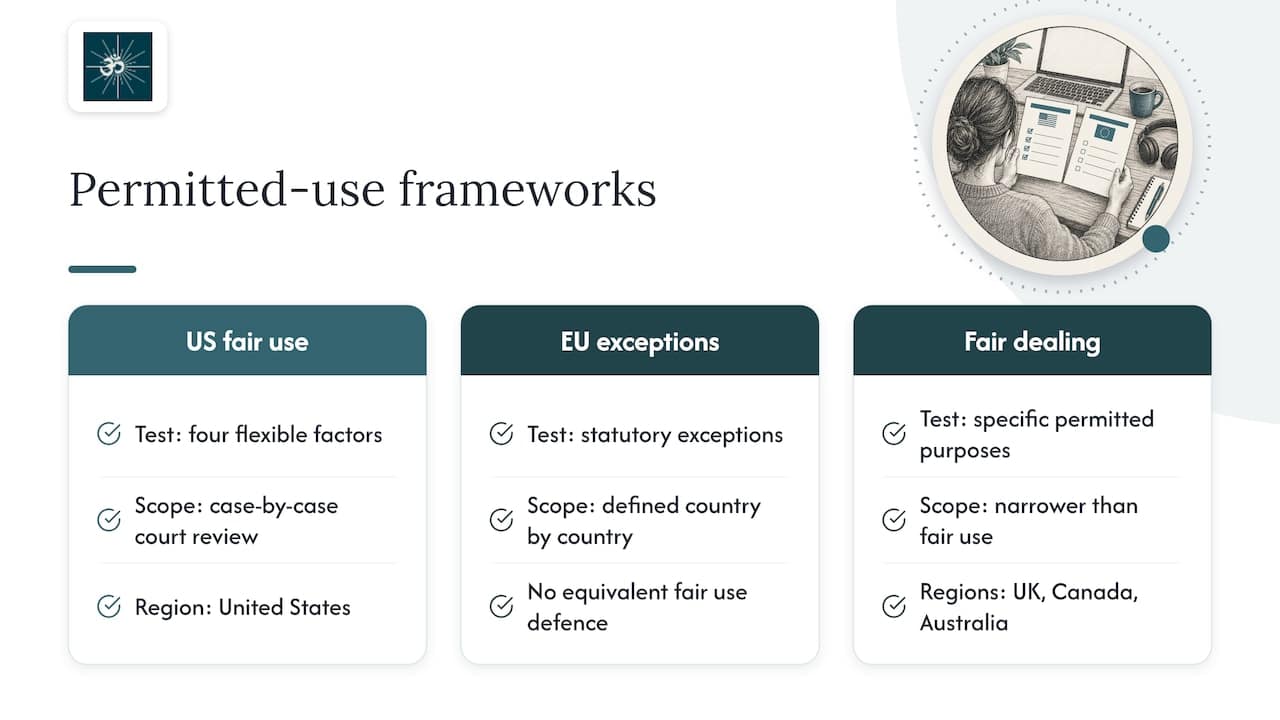
The upshot: never assume a US fair use argument travels with you across the Atlantic. If your audience, your business, or your hosting is tied to the EU, you are working inside a different and generally stricter framework, and licensing is the route that works regardless of jurisdiction.
7. Where fair use genuinely might apply to meditation content
Even within the US, fair use has a narrow lane for meditation music, and it is worth understanding so you do not overestimate it. The doctrine tends to favour transformative use: commentary, criticism, parody, or academic analysis that does something new with the material rather than simply reproducing it for enjoyment.
Using a thirty-second clip of a meditation track to illustrate a point in a documentary about sound healing, with narration analysing its composition, leans transformative. Looping an entire track underneath your own guided meditation audio does not. The second use is exactly the kind of straightforward, non-transformative reproduction that fair use was never designed to cover, because you are using the music for the same purpose the original creator intended: to soundtrack relaxation.
Commentary and critique are the clearest lane. A wellness podcast discussing why certain frequencies are marketed as calming, using short excerpts to illustrate the discussion, sits closer to fair use than any guided meditation that simply plays a full track start to finish. The distinction is purpose, not length. A ten-second clip used purely as atmosphere is weaker than a sixty-second clip used to analyse or critique the music itself.
None of this applies outside the US in the way creators hope. If your content targets EU viewers, the transformative-use argument carries no legal weight, because fair use is not part of the available toolkit there at all.
8. Where fair use stops protecting you
The boundaries matter more than the exceptions, because most meditation content falls on the wrong side of them. Fair use was never built to cover using someone else’s full composition as the backbone of your own commercial product, and that is precisely what looping a track under a guided meditation does.
Monetisation changes the calculation sharply. A video monetised through ads, a paid course, or a client-commissioned wellness app is commercial use, and commercial use weighs against a fair use finding even in the US. Add in that meditation music is typically used for its intended purpose (creating a calming backdrop) rather than transformed into something new, and the fair use argument weakens further still.
Length and prominence matter too. Using an entire track, rather than a short excerpt, removes one of the factors that might otherwise help your case. And once you step outside the US into the EU, the entire framework disappears rather than simply weakening, because there is no equivalent open-ended defence to fall back on.
The safest practical boundary is this: if your use is commercial, if you are using the whole track, and if the music is doing the job it was composed to do, fair use (where it exists at all) is not going to cover you. That is exactly the scenario licensing exists to solve.
9. Getting permission properly when fair use will not cover you
Once you accept that fair use is not a safety net for most meditation content, the path forward is straightforward: get explicit permission, in writing, before you publish.
Start with the composer or rights holder directly if the track is independently produced; many composers will grant a sync licence for a reasonable fee, particularly for smaller wellness projects. Where the track sits with a publisher or collecting society, request written sync clearance through them rather than assuming a general licence covers video use.
For EU-targeted work, check national collecting-society databases, GEMA in Germany being the most relevant example, to confirm a track is not still carrying claims even after you believe you have cleared it elsewhere. A rights clearance service can do this checking for you if the catalogue is large or the deadline is tight.
The simplest permission route for most independent creators, though, is choosing a track from a library built to grant commercial and sync rights from the outset. That removes the negotiation step entirely, because the permission is already baked into the purchase.

10. What to do if a claim or dispute lands on your content
A copyright claim, a Content ID flag, or a takedown notice is not the end of the world, but how you respond matters. First, locate your rights log: the licence text, the source URL, the date you downloaded it, and any attribution you included. This is exactly why keeping that record matters so much earlier in the process.
If your licence genuinely covers the use, submit a dispute through the platform’s process (YouTube’s Content ID dispute form, for example) with your licence documentation attached. If the claim reveals a gap, perhaps the track carried a collecting-society claim you missed, or the licence excluded commercial use, the fastest resolution is usually removing or replacing the track and licensing a cleared alternative rather than fighting a claim you are likely to lose.
For claims with real financial stakes, particularly where a client’s commercial project is involved, a brief consultation with an IP solicitor is worth the cost before you respond publicly or admit fault. Disputes resolved early, calmly, and with paperwork in hand rarely escalate; disputes handled with silence or guesswork usually do.
A licensing-aware creator’s honest take
We would rather sound overcautious than get a client’s video taken down six months after launch. If the work is monetised or made for someone else, licence it properly and keep that paperwork. And whatever track you use, keep the composer credit, Robert Emery or Moritz Schneider, attached to the file and in your description. It is a small habit that saves a large headache.
— ROBERT
How we help: subscriptions and licence pages built for this exact problem
We built our catalogue so you never have to run the checklist above from scratch. Browse the samples, check the licence terms attached to each track, and pick the tier that matches how you actually work.
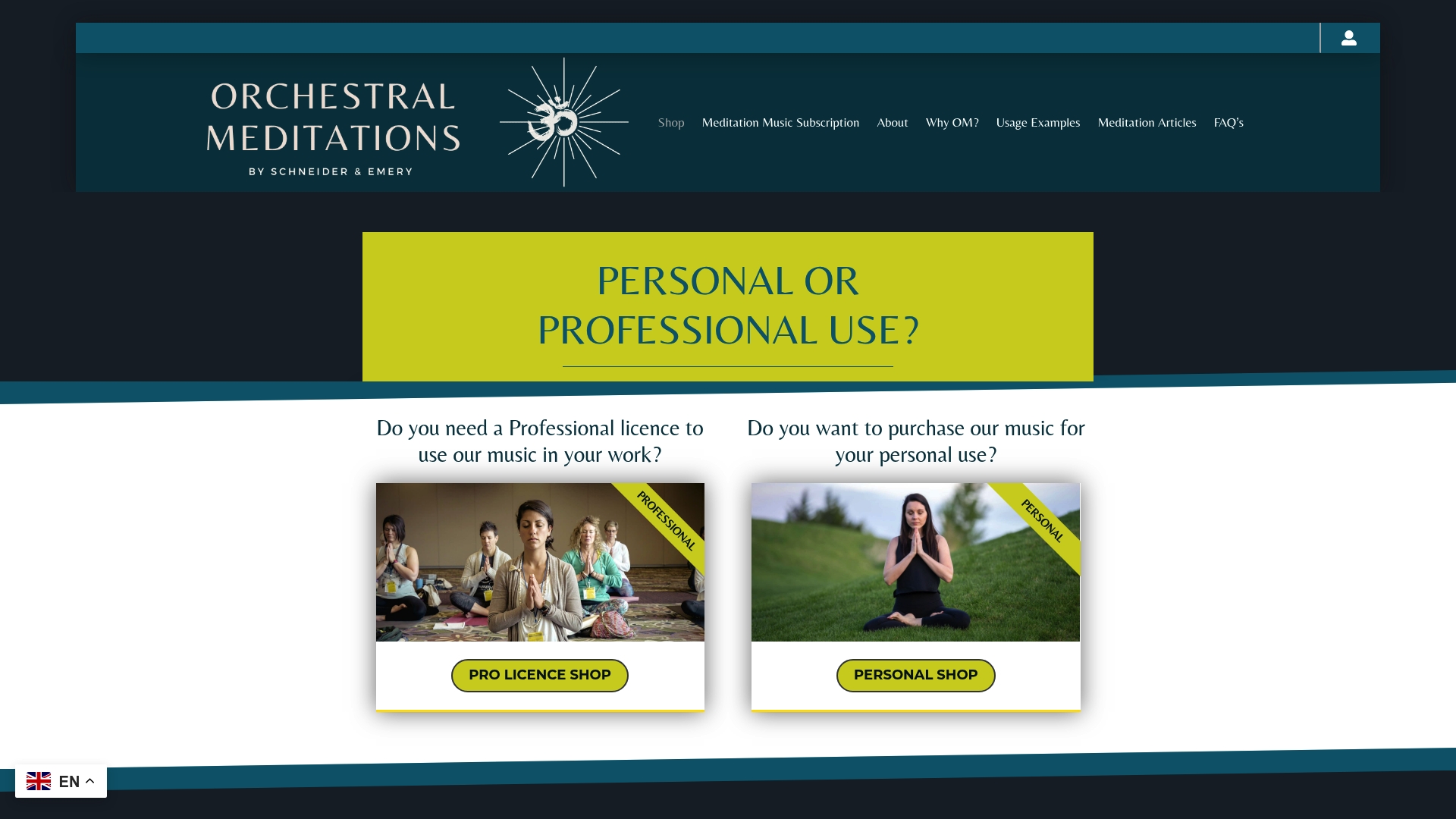
- Our Personal subscription at €21 per month suits individual practice and smaller personal content where you want licensed peace of mind without a commercial price tag.
- Our Professional subscription at €150 per month fits therapists, teachers, app developers and creators publishing content commercially, with licensing built for exactly that use.
- Our Royalty Free Meditation Music page lays out the licensing detail track by track, so you can check sync rights before you commit to anything.
If you are pairing music with other calming practices in a wellness routine, the botanical relaxation guidance from Vivazen is worth a look, and anyone exploring vibroacoustic approaches to sound and body therapy should read this clinical guidance on vibroacoustic contraindications before combining the two.
FAQ
Does fair use cover meditation music on YouTube?
Fair use is a US legal doctrine and does not apply in the EU, so it offers no reliable protection for most meditation videos, especially monetised ones. Even within the US, looping a full track under a guided meditation is unlikely to qualify because it is not transformative use.
What is the difference between royalty-free and Creative Commons music?
Royalty-free means you pay once (or subscribe) and then use the track without ongoing payments, under whatever terms the licence states. Creative Commons tracks are typically free but carry specific conditions, such as attribution or non-commercial restrictions, set out in licences like the CC BY-NC-ND legal code.
How do I check if a track has a GEMA claim in the EU?
Search the track title and composer name in the relevant national collecting society’s database, GEMA being the main one for Germany and much of continental Europe. If you cannot confirm the status, a licensed track from a library that states its clearance upfront removes the guesswork entirely.
Can I use a “no copyright” track from YouTube or SoundCloud commercially?
Not safely, because “no copyright” is an uploader’s label rather than a verified legal status. Treat uploads like the one on this SoundCloud mindfulness set as a starting point for research, not as proof of clearance, and verify directly with the uploader before any commercial use.
What does Orchestral Meditations cost for commercial projects?
Our Professional subscription, built for therapists, app developers and commercial creators, is €150 per month, while the Personal subscription for individual use is €21 per month.