
You need to clear the reproduction right (§16 UrhG) and the making-available right (§19a UrhG) for every track in your app. Contact GEMA for compositions, GVL for commercial recordings, and ICE’s Licensr if your service runs in two or more countries. Do that before launch, not after the first complaint lands in your inbox.
TL;DR:
- Bundled or downloaded audio requires a reproduction licence; streaming requires a licence to make tracks available, and published recordings may need GVL clearance.
- Use GEMA’s Online Portal for services limited to Germany, but consider ICE’s Licensr when the service operates in at least two countries.
- Royalty free music does not prove GEMA exemption, so search the repertoire database and obtain written confirmation of each composer’s status before integration.
- Tariffs depend on delivery method, and agreements covering multiple countries need lead time; budget for registration, usage reporting, and applicable VAT.
- Keep composer, publisher, performer, label, and licence details for every track, and retain confirmations, reports, and invoices for possible audits.
1. What you must clear before publishing
German copyright law, in sections 16 and 19a of the UrhG, sets out the rights you need for downloads and streams alike. In practice, vet each track against this list:
- A reproduction licence if copies of the audio are packaged in or downloaded by your app.
- A making-available licence if users stream or access tracks on demand.
- A GVL licence for performers and record producers whenever you use commercially published recordings rather than your own or commissioned ones.
- Check whether a synchronisation clearance is needed if music is timed to guided meditations, visuals or other fixed media.
- The right portal: the GEMA Online Portal for Germany only, Licensr once you serve several countries.
Pro Tip: Keep one spreadsheet row per track, with composer, publisher, performer and label next to the licence you hold. It saves a week of panic later.
2. Who issues the licences: GEMA, GVL and ICE
Think of three doors, each with a different key. GEMA handles composition and publishing rights, and its Online Portal is where uses within Germany are registered. For music-on-demand services, GEMA’s tariff overview lists tariff families such as VR-OD for streaming and downloads.
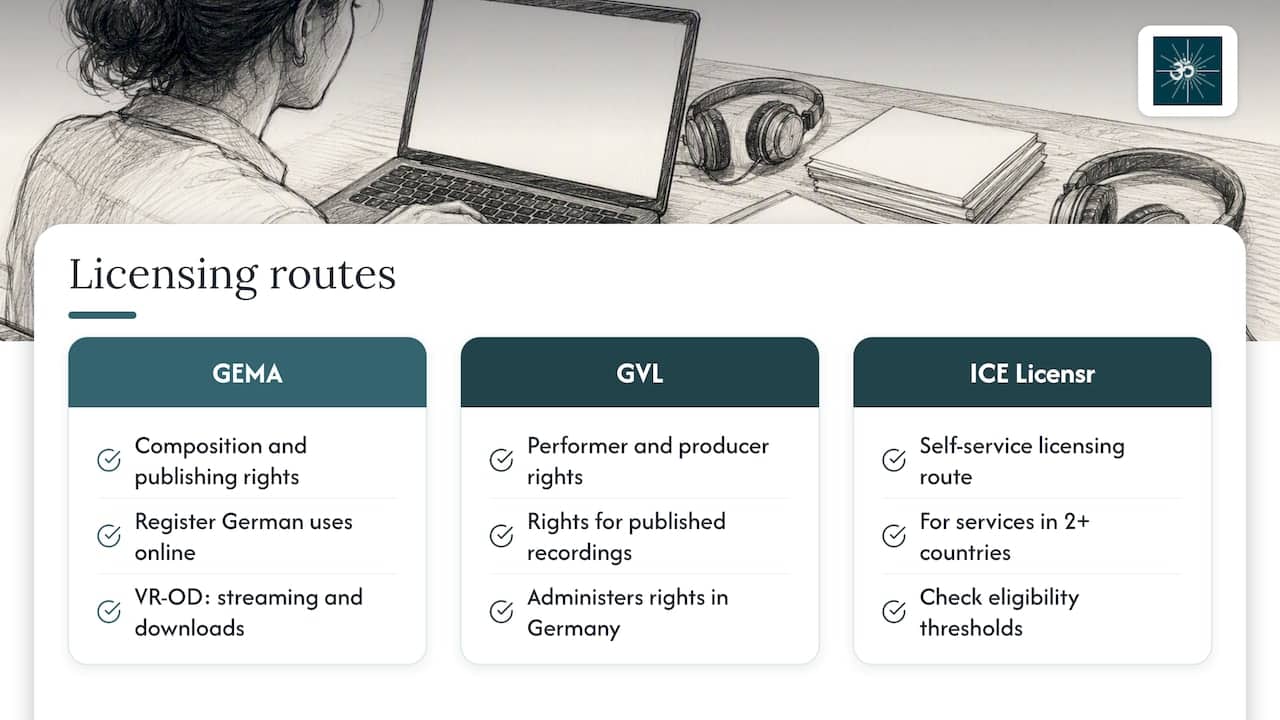
GVL looks after related rights for performers and producers. It administers performing-artist and sound-recording producer rights in Germany, which matters the moment you use a published recording. Its background website music licence shows how its terms read in practice.
ICE’s Licensr is the self-service route for services operating in at least two countries. Check its eligibility thresholds before you plan around it.
3. How to check repertoire status and composer registration
“Royalty-free” does not automatically mean “GEMA-free”, and the difference can cost you. Whether music falls under GEMA depends on whether its creators have assigned their rights, a point GEMA itself calls complex. A composer such as Robert Emery or Moritz Schneider, whose work you might license for a meditation app, needs checking like anyone else.
- Search the GEMA repertoire database for the composer and the work title.
- Ask the composer or publisher for written confirmation of their registration status.
- If a named composer or producer is not represented by GEMA or GVL, get explicit written licence terms to avoid double payment or later claims.
- Confirm the licence you buy actually transfers the rights your app distribution needs.
- File the confirmation with your licence paperwork.
4. Why your app’s architecture changes who licenses what
Developers often assume that being a mere conduit lowers their liability. GEMA tends to see it differently: its app guidance points to the party enabling technical access as the main licensee. Licensing duties therefore follow your delivery method:
- Audio bundled inside the app counts as distributed copies, so expect to need reproduction licences.
- Server-side streaming or downloads trigger making-available licences, with cross-border obligations if people outside Germany can reach the service.
- If users upload their own audio, decide early whether you or the platform is the primary licensee, and write that into your platform design and contracts.
Pro Tip: Settle bundled versus streamed before you commission or buy a single track. Changing architecture late means relicensing.
5. Typical tariffs, costs and timelines
Fees depend on your service model. GEMA groups its tariffs into families, VR-OD being the one for on-demand services, so your price follows how you deliver music, not how much you love it. GVL’s background website licence is invoiced annually in advance, with per-access fee bands set out in its terms.
On timing, here is what to expect:
- Straightforward uses registered through the GEMA Online Portal can move quickly.
- Negotiated, multi-territory or bespoke agreements need more lead time, so start them early.
- Budget for initial registration fees, ongoing usage reporting and VAT where it applies.
We do not quote a single price here, because tariffs change and depend on your exact model. Read the current tariff pages before you plan your launch date.
6. Your step-by-step workflow from track to launch
- Identify the rights holders per track: composer, publisher, performer, label or producer.
- Check the GEMA and GVL repertoires and request written status from composers or rights holders.
- Register the usage in the GEMA Online Portal for Germany, or use Licensr for multi-country needs.
- Obtain GVL licences where phonogram rights apply, and follow their operating conditions and reporting rules.
- Keep copies of licences, reports and invoices, schedule periodic reporting and expect that you may be audited.
The DPMA, which supervises these organisations, treats collective management bodies as trustees for rights holders, licensing under set tariffs and distribution rules. Treat the paperwork as part of the product.
7. Why our tracks suit app licensing
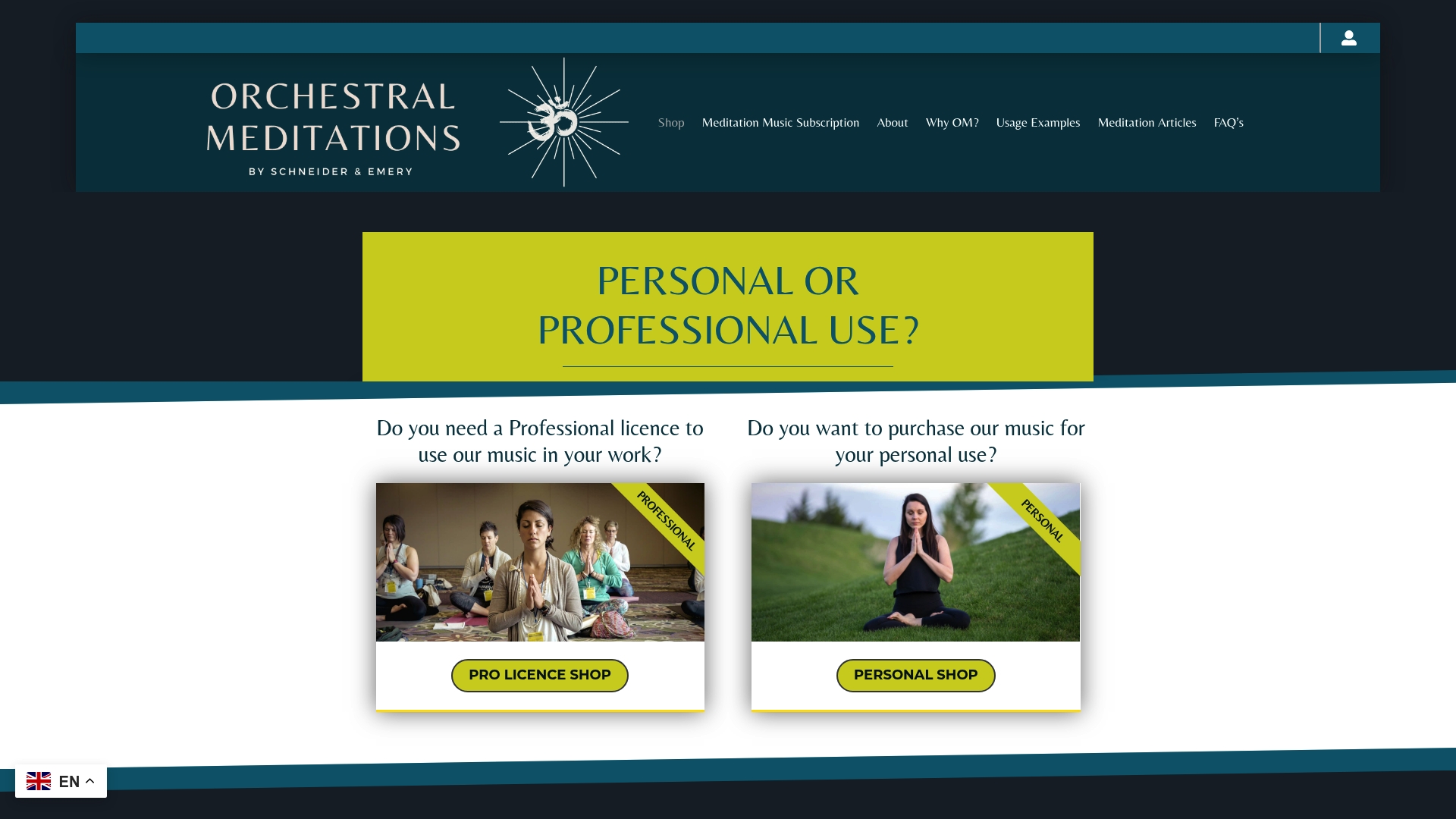
We produce royalty-free orchestral meditation music and offer personal and professional licensing options. Our catalogue is designed for immersive listening, which may suit some meditation apps.
Our composers and producers, including Robert Emery and Moritz Schneider, are credited on the music. Even so, do what we would advise with any supplier: check a track’s representation or GEMA-free status before you integrate it, and keep your records on file.
8. An editorial take: stop treating licensing as a legal chore
I have spent time around orchestras and sessions, and one thing keeps surprising me: developers agonise over tariffs and ignore provenance. A costly mistake can be the track whose rights history nobody wrote down.
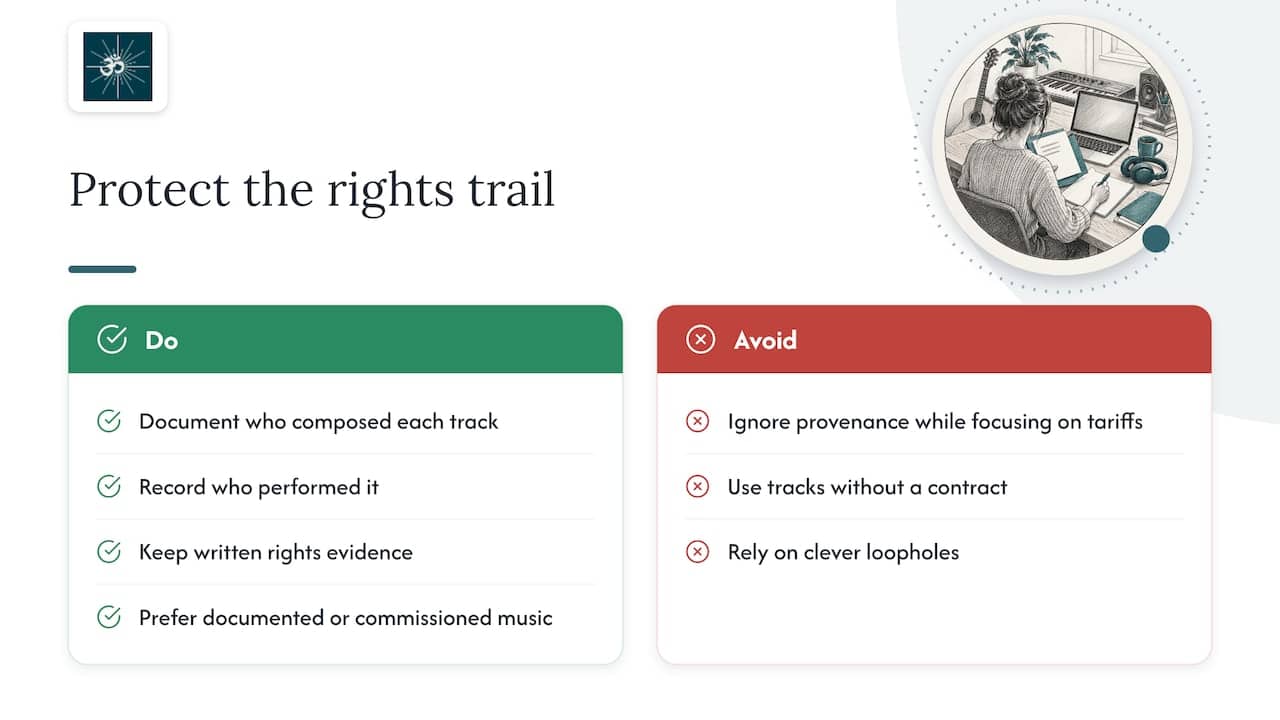
So my advice is blunt. Start with the checklist, but focus on the paper trail: who composed it, who performed it, who says so in writing. The DPMA frames licensing as a cost of operating that, handled through official channels, gives you the legal security to scale a service in Germany. I agree, with one addition: a clean, simple chain of rights beats a clever loophole every time.
Prefer music whose origin is documented, commission what you can, and refuse any track that arrives with a shrug instead of a contract.
— ROBERT
9. A compliant way to get studio-grade tracks for your app
If you want to explore our professional options, we suggest:
- Our Professional subscription, listed at 150 EUR per month, suits ongoing app use.
- Our Royalty Free Meditation Music offers professional licensing for apps.
Before you buy, confirm the licence covers reproduction, making-available and commercial use in Germany, and ask us for any extra multi-territory wording if you plan to launch abroad.
FAQ
Do I need both GEMA and GVL for my app?
Often yes, if you use commercially published recordings. GEMA covers the composition, while GVL covers the rights of performers and record producers. Music you commission or record yourself may not involve GVL, so check each track.
Which rights does an app need under German law?
You generally need the reproduction right (§16 UrhG) and the making-available right (§19a UrhG), as explained here. Which one applies depends on whether you bundle, download or stream.
When should I use Licensr instead of the GEMA portal?
Use the GEMA Online Portal for music used within Germany. If your service operates in at least two countries, ICE’s Licensr is the self-service tool for multi-territory licensing.
Is royalty-free music automatically safe to use?
Not automatically. Royalty-free describes the payment model, not the rights chain. Ask for written confirmation of composer representation before integrating any track.