
For sustained focus or a full night’s sleep, coloured noise usually wins because masking is a well-established mechanism backed by decades of psychoacoustics. For a short mental nudge when you’re already calm and want to sharpen up, binaural beats have the more interesting evidence, including a 2026 trial showing 40 Hz tones improved reading comprehension.
That’s the short version. Here’s the slightly longer version, because “it depends” isn’t much use without knowing what it depends on.
For focus: try pink or brown noise as your steady backdrop for long stretches of work, and keep binaural beats in your back pocket for a ten-minute reset when concentration is already flagging.
For relaxation: binaural beats in the alpha or theta range are worth a try if you enjoy the tone itself, though pink noise does the same calming job for people who find beats grating.
For sleep: stick with pink or brown noise as your all-night option. Binaural beats can help some people drift off, but the Sleep Foundation’s review of the evidence is clear that results are mixed and highly dependent on the individual.
Trust signals worth knowing: Orchestral Meditations produces professionally recorded binaural and orchestral tracks; a peer-reviewed PMC study found faster reaction times with beat stimulation than white noise; and independent reviews such as Neurosity’s explainer confirm masking is robust while entrainment effects vary person to person.
Key Takeaways
Masking through coloured noise is the more reliably effective approach for sustained focus and sleep, while binaural beats show the stronger evidence for short, targeted entrainment sessions.
| Point | Details |
|---|---|
| Masking is the safer default | Pink or brown noise suits long focus sessions and overnight sleep without needing headphones. |
| Beats need headphones | True binaural beats require stereo separation; monaural and isochronic tones work through speakers too. |
| 40 Hz shows real promise | A 2026 trial found 40 Hz binaural beats improved reading comprehension accuracy over a control tone. |
| Individual response varies widely | Personality, baseline arousal, and sound pleasantness all shape whether beats or noise work for you. |
| Production quality affects tolerability | Orchestral Meditations’ live orchestral recordings and 3D mixing are built for comfortable, extended listening. |
This article is general information, not a substitute for advice from a qualified doctor. Consult a qualified healthcare professional about your own circumstances before acting on anything here.
Binaural beats vs white noise: how the two mechanisms differ
White noise, pink noise, and brown noise don’t try to change your brainwaves at all. They work through auditory masking: broadband sound fills the frequency spectrum, so a sudden door slam, a colleague’s phone buzzing, or a car alarm outside no longer stands out against silence.
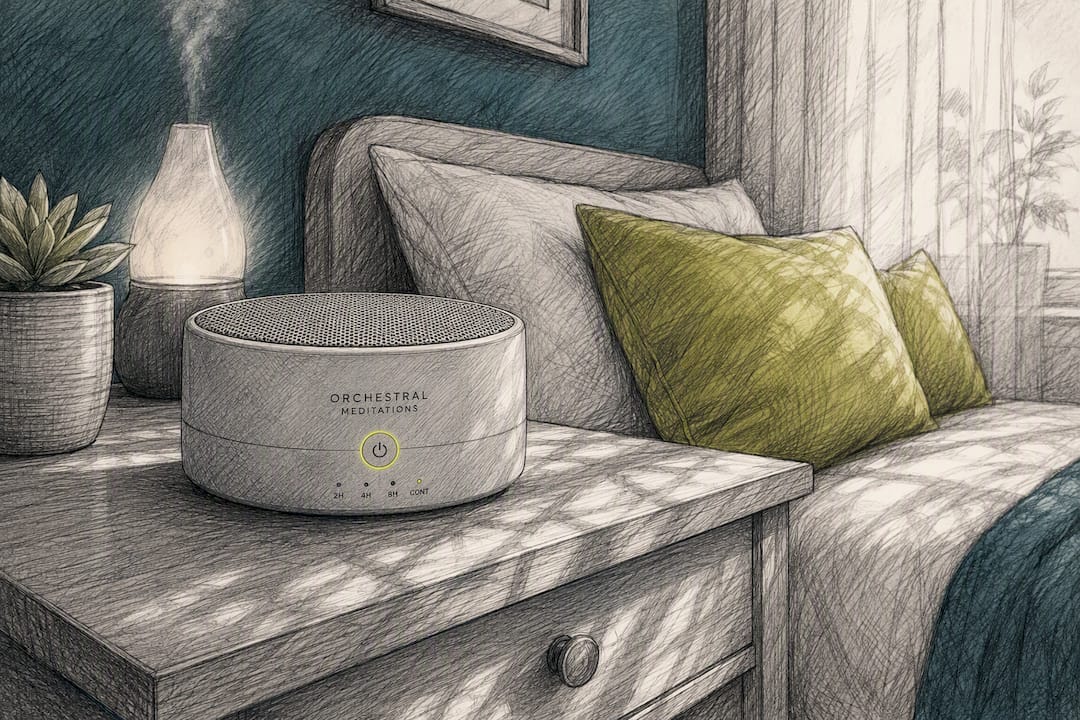
White noise contains equal energy across every audible frequency, which is why it sounds like television static or a hairdryer. It gives you maximum masking power but can feel harsh over long sessions. Pink noise reduces the intensity at higher frequencies, producing a softer, more natural “steady rain” sound that most people find easier to tolerate for hours at a time. Brown noise drops even further into the bass, giving you a deep, rumbling quality closer to a waterfall or distant thunder.
The masking mechanism is straightforward physics, not neuroscience speculation. Broadband noise raises your ambient sound floor so that attention-grabbing spikes lose their contrast against the background, which is why the effect works reliably across so many listening environments.
Matching noise colour to task makes a real difference:
- White noise suits situations demanding maximum masking, such as an open-plan office or a shared bedroom with a snorer.
- Pink noise works well for extended listening, including sleep and long reading sessions, because it’s gentler on the ears.
- Brown noise appeals to people who find higher frequencies irritating, offering warm, low-frequency cover that some describe as more soothing than pink.
Pro Tip: If you’re testing noise colours for the first time, start with pink noise. It’s the middle ground most people tolerate best, and you can move towards white (more masking, harsher tone) or brown (warmer, less masking) once you know your preference.
What are binaural, monaural, and isochronic beats?
Binaural beats aren’t a sound you can record on a single microphone. They’re an illusion your brain creates when it hears two slightly different tones, one in each ear, say 200 Hz in the left and 210 Hz in the right. Your brainstem perceives a third, phantom pulse at the difference between the two: 10 Hz in this example. That’s why binaural beats absolutely require stereo separation and headphones. Play them through a single speaker and the two tones simply blend acoustically, and the illusion disappears entirely.
Monaural beats work differently. The two tones are mixed together before playback, so the beating pattern exists in the actual sound wave rather than being constructed by your brain. This means monaural beats work through speakers as well as headphones. Isochronic tones go further still: a single tone switches on and off at a set rate, producing a distinct pulsing rhythm rather than a blended wave. Some researchers consider isochronic tones more neurologically plausible for entrainment because the on/off pulse is a sharper, more distinct signal for the brain to track.
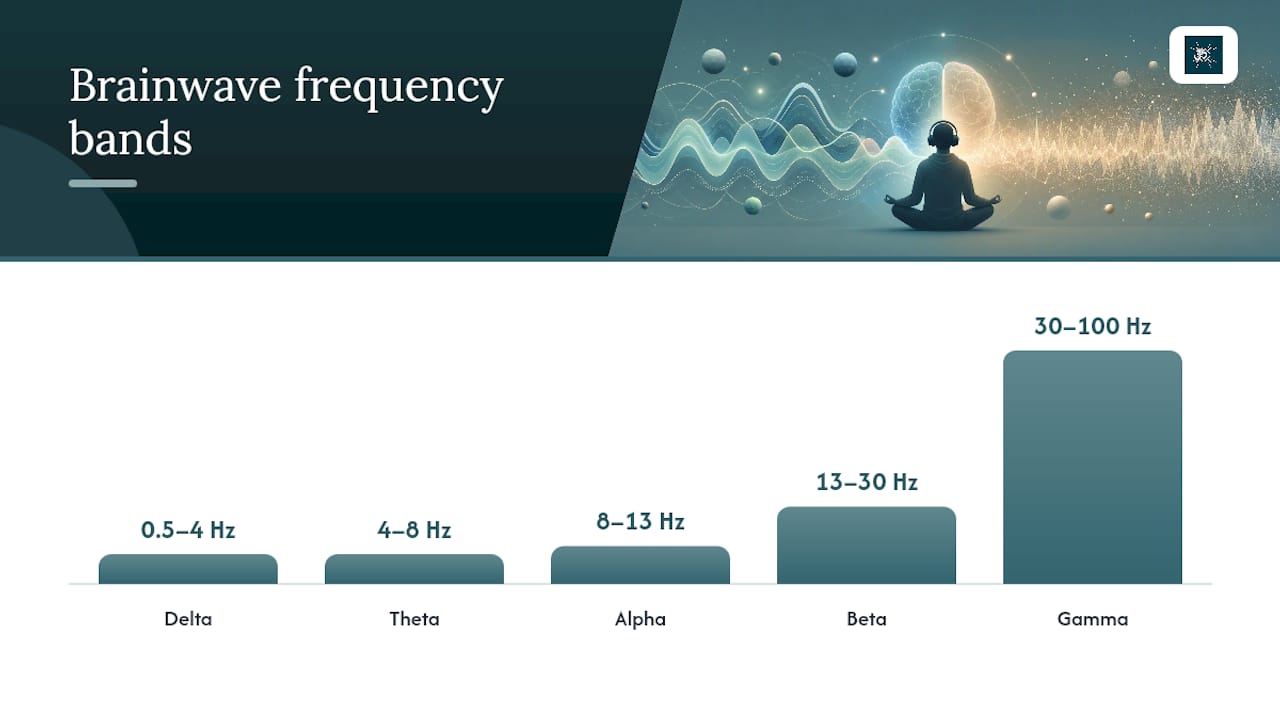
The theoretical mechanism behind all three is neural entrainment, the idea that rhythmic auditory stimulation can nudge brainwave activity towards a matching frequency. Proponents map claims onto specific bands:
- Delta (0.5–4 Hz): associated with deep, dreamless sleep.
- Theta (4–8 Hz): linked to meditation and drowsy relaxation.
- Alpha (8–13 Hz): associated with calm, wakeful relaxation.
- Beta (13–30 Hz): tied to alert, active concentration.
- Gamma (30–100 Hz): linked to heightened focus and, per the Springer 2026 trial, improved reading comprehension at 40 Hz specifically.
You’ll find beats delivered as streamed tracks, downloaded files, or embedded inside meditation apps. Whatever the source, the stereo requirement for true binaural beats doesn’t change. Our guide to binaural beats frequencies breaks down which bands pair with which goals in more detail, and our comparison of isochronic tones versus binaural beats is worth a read if headphones aren’t always practical for you.
Does the research actually support these claims?
The evidence for masking is about as solid as psychoacoustics gets. Decades of research confirm that broadband noise reduces the salience of distracting sounds, and that’s not really in dispute. The evidence for entrainment is a different story: real, but patchier, and considerably more dependent on who’s listening and how the study was designed.
A controlled study published on PMC compared binaural and monaural beats against white noise using a Flanker attention task. Reaction times were faster under both beat conditions than under white noise, with no meaningful difference between binaural and monaural beats themselves. That’s a genuinely interesting finding: it suggests the beating pattern itself, not the binaural illusion specifically, may be doing the work.
Then there’s the 2026 trial in Current Psychology, which tested 40 Hz binaural beats against a control tone in 72 participants and found a measurable improvement in reading comprehension accuracy, consistent with gamma-frequency entrainment. Mood effects, notably, didn’t show the same clear pattern, which is a useful reminder that “binaural beats help with X” claims need to specify exactly what X is.
Zoom out to the review level and the picture gets more cautious. Meta-analyses summarised by Neurosity find small but statistically real reductions in anxiety from binaural beats, with effect sizes often in the modest range, while cognitive enhancement findings vary considerably from study to study. That variability isn’t a red flag exactly, but it does mean you should treat any single study, including the two flagged above, as a data point rather than a verdict.
A rough map of where the certainty actually sits:
- Masking (white/pink/brown noise): robust, well-established, consistent across decades of research.
- Entrainment for attention/reaction time: promising, with the PMC and Springer findings both pointing the same direction.
- Entrainment for anxiety: modest but statistically present according to meta-analytic reviews.
- Entrainment for mood or general cognition: inconsistent, with meaningful disagreement between studies.
Sample sizes matter here too. Many binaural beat trials, including the 2026 reading comprehension study, run with dozens rather than hundreds of participants, which is enough to detect a real effect but not enough to rule out that some of what’s measured is expectation rather than pure neurology. Practitioner guidance also flags a technical wrinkle worth knowing: layering coloured noise directly under a binaural beat track can mask the interaural frequency difference the entrainment effect depends on, which is one reason mixed “noise plus beats” tracks don’t always deliver on either promise.
Why binaural beats work for one person and not another
Two people can listen to the identical 10 Hz alpha track and walk away with opposite verdicts, one feeling pleasantly relaxed, the other mildly annoyed. That’s not a flaw in the research; it’s the research. Individual response to both masking and entrainment varies enormously, and several factors explain why.
- Baseline arousal: someone already wired and stressed responds differently to a calming tone than someone who’s merely tired.
- Personality and emotionality: studies on emotionality suggest people who process emotion more intensely may respond more strongly to beat stimulation, for better or worse.
- Sound pleasantness: if the tone itself grates on you, no amount of theoretical entrainment will make the session feel good.
- Expectation and placebo: knowing you’re listening to a “focus” track can genuinely shift performance, independent of the frequency used.
- Hearing differences and context: a noisy room changes how effective masking feels, and mild hearing asymmetries can distort the binaural illusion.
There’s also a well-documented case where white noise helps a specific population through a different route entirely: some people with ADHD show improved task performance with background noise, a pattern researchers link to stochastic resonance, where a certain level of random noise actually helps an under-aroused nervous system reach an optimal state. Picture two colleagues in the same office: one puts on brown noise and finally finishes a report; the other finds the same track intrusive and switches to binaural beats for a quick energising sprint instead. Neither is wrong. They’re just different nervous systems.
Which should you choose: focus, relaxation, or sleep?
Match the sound to the job, not the other way round.
For focus, pink or brown noise is the steadier long-session choice, especially for reading or coding blocks that run over an hour. If you need a short burst of sharpness rather than hours of masking, a ten-minute session of 40 Hz binaural beats is the better-evidenced option, drawing on the reading comprehension findings from the Springer 2026 trial. User comparisons of brown noise against binaural beats consistently echo this pattern: noise for the long haul, beats for the kickstart.
For relaxation, binaural beats in the alpha or theta range suit people who enjoy the tonal quality and want something to actively listen to. Pink noise achieves a similar calming outcome for people who prefer to tune sound out entirely rather than engage with it. Our guide to binaural beats for meditation covers session structures if you want to go deeper here.
For sleep, pink or brown noise remains the safer all-night default, largely because it doesn’t require headphones and won’t lose effectiveness if you roll over in your sleep. Long-tone binaural beats for sleep are worth trialling, but only after you’ve tested them while awake, since the Sleep Foundation’s guidance is candid about how mixed the sleep-specific evidence is. If delta-range tracks interest you for this purpose, our delta binaural waves guide explains what to expect.
A practical caveat on overnight use: continuous coloured noise through a speaker needs no equipment maintenance and works all night without issue. Binaural beats through headphones raise real questions about comfort (sleeping in earbuds isn’t for everyone) and battery life, so weigh that against any expected benefit before committing to a full night.
How to set up a session that actually works
Getting the basics right matters more than picking the “correct” frequency, because a badly set-up session undermines even a well-evidenced approach.
- Start from a quiet baseline. Reduce obvious environmental noise before adding either coloured noise or beats; you’re topping up masking, not fighting a losing battle against a blaring television.
- Choose your sound type by task: coloured noise for anything lasting over thirty minutes, binaural beats for focused ten-to-twenty-minute sessions.
- Keep volume at a comfortable, speech-level intensity. Louder isn’t more effective; it’s just louder.
- For binaural beats specifically, start sessions at 10 to 20 minutes rather than committing to hours straight away.
- Use quality stereo headphones for beats, since separation quality directly affects whether the illusion forms cleanly.
Starting frequency ranges worth trying: 40 Hz for a short attention boost backed by the 2026 comprehension trial, around 10 Hz alpha for relaxed alertness, and delta or theta ranges for sleep experimentation, approached cautiously and tested while awake first.
Pro Tip: Headphone quality changes the experience more than most people expect. Cheap earbuds with poor stereo separation can blur the binaural illusion almost entirely, while well-produced tracks recorded with proper interaural mixing, like those from Orchestral Meditations, make the effect noticeably clearer and far more pleasant over repeated listening.
Are binaural beats or white noise safe to use?
Both are low-risk for most healthy adults, but a few sensible precautions apply.
- Never listen to binaural beats while driving or operating machinery; the entrainment claims themselves suggest an effect on alertness, which is exactly what you don’t want to gamble on behind the wheel.
- If you have a history of seizures or photosensitive epilepsy, speak to a doctor before trying rhythmic auditory stimulation of any kind, since caution with rhythmic stimuli generally extends to audio as well as visual triggers.
- Stop immediately if you notice headaches, dizziness, or unusual disorientation during or after a session.
- Keep volume at a comfortable, conversational level rather than turning tracks up to drown out surroundings, and take breaks during long listening sessions rather than running audio for hours uninterrupted.
- For any diagnosed clinical condition, particularly anxiety disorders or sleep disorders, get medical advice before relying on either approach as a primary intervention. Our safety-focused article on binaural beats goes into more detail on listening duration and volume thresholds.
How do you find out which one works for you?
Skip the theory for a moment and just run the experiment yourself. Here’s a protocol simple enough to fit around a normal week.
- Pick one goal to test: focus, relaxation, or sleep onset. Don’t test all three at once.
- Establish a baseline: one work block, relaxation period, or night’s sleep with no audio intervention, so you have something to compare against.
- Alternate sessions across several days: Session A uses coloured noise, Session B uses binaural beats, keeping volume, timing, and environment as consistent as possible.
- Repeat each condition three to five times before drawing conclusions. A single good or bad night tells you very little.
- Track a simple metric that matches your goal: time to fall asleep, pages read or lines of code written per session, or a subjective 1 to 10 relaxation rating jotted down immediately afterwards.
- Compare your averages, not your best or worst day, and build a personal rule from whichever approach shows a consistent edge across the repeated trials.
Small effects are still real effects. If coloured noise edges out beats by a modest but consistent margin across five nights, that’s a more trustworthy signal than one dramatic result from a single session.
Why production quality changes how these sounds feel
A synthetic 200 Hz sine tone generated by a free app and a binaural track recorded with live orchestral instruments and proper interaural mixing are not the same listening experience, even when the underlying frequency maths is identical. Recording technique, instrument timbre, and 3D surround processing all affect how pleasant and tolerable a track feels over a 20 or 40 minute session, and pleasantness itself is one of the moderators of whether entrainment or masking actually helps you.
Orchestral Meditations builds its library around this exact principle: live musicianship, 3D surround recording, and binaural-friendly mixing designed to make extended listening comfortable rather than fatiguing. The tracks credit composers Robert Emery and Moritz Schneider, whose approach favours immersive orchestral textures over the flat synthetic tones common in free binaural apps.
Live instrument resonance and careful head-related transfer function processing during mixing are what separate a binaural track you can happily listen to for forty minutes from one that starts to grate after five.
When choosing any track, whether from Orchestral Meditations or elsewhere, check for a few production markers:
- Genuine stereo/binaural mixing rather than a mono file relabelled as binaural.
- High sample rate and bitrate, since compression artefacts are more noticeable in sustained tones than in regular music.
- No abrupt loop points or jarring edits, which pull attention away from relaxation or focus.
- Natural instrument tone rather than harsh, purely synthetic oscillators.
What settings should you try first?
Start simple, then adjust based on what you notice.
- For focus: pink or brown noise for sessions over 30 minutes; a 40 Hz binaural track for a 10 to 20 minute reset when concentration is flagging.
- For relaxation: alpha-range binaural beats (around 10 Hz) if you enjoy an active listening experience, or pink noise if you’d rather tune out entirely.
- For sleep: pink or brown noise as your default all-night sound; delta or theta binaural tracks only after testing them while awake first.
- Headphones: essential for binaural beats, optional for coloured noise.
- Troubleshooting: if a track feels irritating rather than calming after a few minutes, switch noise colour or beat frequency before assuming the whole approach doesn’t work for you. Small changes matter more than most people expect.
The fastest way to find your answer isn’t more reading. It’s running the short A/B protocol above for a week and letting your own data settle the argument.
Author’s perspective: why both approaches deserve a fair trial
Masking and entrainment rest on genuinely different evidence bases, and treating them as interchangeable does readers a disservice. Masking is physics you can trust; entrainment is a promising but still-maturing area where individual response varies enormously, and I’d rather say that plainly than oversell it. What I’m confident about is this: production quality decides whether you’ll actually stick with either approach for long enough to know if it works. A harsh synthetic tone gets abandoned after two sessions regardless of what the underlying frequency theory promises.
Try Orchestral Meditations’ soundscapes for yourself
There’s no shortage of free binaural apps and stock noise generators out there, but most run on flat synthetic tones that get fatiguing fast, which is precisely the problem that undermines a lot of home listening experiments before they’ve had a fair chance. Orchestral Meditations takes a different route: tracks recorded with live musicians, 3D surround techniques, and binaural-friendly mixing, produced with the same attention to interaural detail that determines whether an entrainment session actually feels good over twenty minutes rather than five.
The library includes both personal-use downloads and professional licences for therapists, yoga instructors, and app developers who need soundscapes built to a higher standard than a free generator can offer. If you want to hear the difference production quality makes before committing to a full A/B test, browse the meditation music collection and sample a track for your next focus or relaxation session.
Sources
- The effects of binaural and monaural beat stimulation on cognitive functioning in subjects with different levels of emotionality – PMC
- The effects of binaural beats on attention, reading comprehension, and mood | Current Psychology | Springer Nature
- Can binaural beats help you fall asleep? | Sleep Foundation
- White Noise vs Binaural Beats: What Science Says | Neurosity
- Colored noise: white, pink & brown noise explained | DeepBliss
FAQ
What is the dark side of binaural beats?
The main downsides are mild: some listeners report headaches, dizziness, or irritation, and people with photosensitive epilepsy or a seizure history should get medical advice before trying rhythmic auditory stimulation. Beats also shouldn’t be used while driving, since they’re designed to shift alertness.
Should I listen to binaural beats all night?
It’s not the best default: overnight use requires headphones, which many people find uncomfortable for eight hours, and the Sleep Foundation notes evidence for sleep benefits is mixed. Pink or brown noise through a speaker is generally the more practical all-night choice.
What is the healthiest noise to sleep to?
Pink noise is often the best-tolerated option for sleep because it softens harsh high frequencies while still masking disruptive sounds, though brown noise suits people who prefer a deeper, warmer tone. Both work through masking rather than any claimed brainwave effect.
Do people with ADHD like white noise?
Many do: research on stochastic resonance suggests background noise can help an under-aroused nervous system reach a more optimal state for concentration, and some studies report improved task performance in people with ADHD when white noise is present. Response still varies by individual.