
A single royalty-free meditation track typically runs $10 to $50 for standard online use, bundles push that per-track cost below $10 once you buy five or ten at once, and subscriptions start in the single digits per month but pay off fastest when you need a steady supply of tracks. Orchestral Meditations sells individual downloads and professional licences alongside its subscription tiers, and marketplace examples like Artyfile’s €29.90 one-off licence show how far a fixed-fee model can stretch.
If you publish content regularly (weekly YouTube uploads, a growing course library, an app), a bundle or professional subscription almost always beats buying tracks one at a time. If you need one track for a personal playlist or a single client session, a standard personal licence does the job.
- Single tracks: roughly $10 to $50 depending on licence scope
- Bundles: often under $10 per track once you buy in volume
- Subscriptions: from a few dollars monthly, cheapest per-track when usage is high
Pro Tip: Before comparing prices, work out how many tracks you’ll actually use this year. A £15 track used once beats a £9 monthly subscription you forget to cancel.
Key Takeaways
Meditation music pricing rewards volume buyers: single tracks cost $10 to $50, but bundles and professional subscriptions cut per-track cost dramatically for regular users.
| Point | Details |
|---|---|
| Single tracks cost more per unit | Expect $10 to $50 per track for standard commercial licences on marketplaces. |
| Bundles reward volume | Ten-track bundles can bring per-track cost below $10 with providers like Purple Planet Music. |
| Match licence to distribution | Confirm YouTube, app, or paid-class rights are named explicitly before buying. |
| Certificates reduce legal risk | A written licence certificate with master rights avoids downstream disputes with rights societies. |
| Orchestral Meditations suits professionals | Its live-orchestral recordings, named composer credits, and clear professional licensing suit creators who publish regularly. |
Meditation music pricing at a glance: single tracks, bundles and subscriptions
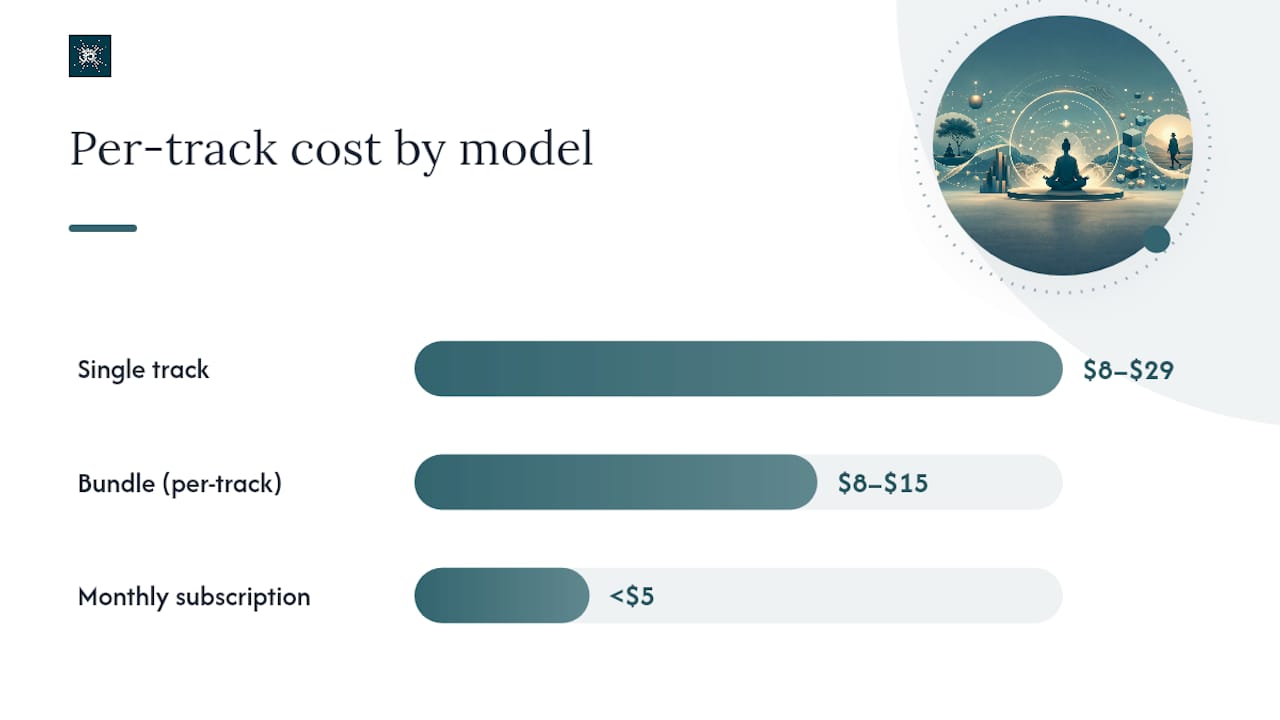
Here’s the maths that actually matters once you get past the sticker price. A single track sits at the low end around $8 to $15 for basic personal use, climbs to $29 for fuller commercial licences on marketplaces like AudioJungle, and can reach $50 or higher once broadcast or app rights are added.
Bundles change the arithmetic fast. One comparison of ten meditation-music sellers found per-track totals ranging from about $8 to $82, with providers such as Purple Planet Music pricing a ten-track bundle at $80 (that’s $8 a track) while premium orchestral sellers charge considerably more per piece for richer production. Subscriptions sit somewhere in between: a monthly plan around $10 to $30 becomes excellent value the moment you’re downloading more than two or three tracks a month, but it’s dead weight if you only need music twice a year.
| Purchase model | Typical price | Per-track cost at volume |
|---|---|---|
| Single track (standard licence) | $8 to $29 | Same as listed price |
| Bundle (5 to 10 tracks) | $29 to $138 | Often $8 to $15 |
| Monthly subscription | $10 to $30 | Falls below $5 with regular use |
One thing worth flagging: most prices you’ll see quoted are in US dollars or euros, and checkout will apply your local VAT on top. Always check the final total before you assume the advertised figure is what you’ll pay.
Licence types you’ll encounter and what each actually allows
The word “licence” hides a lot of variation, and it’s the single biggest source of buyer’s remorse in this market. Get this wrong and you could end up with a strike on a monetised YouTube video or a cease-and-desist from a rights holder you’d never heard of.
- Personal licence: covers private listening, home meditation practice, or non-monetised personal projects. It rarely covers anything you sell or publish publicly.
- Professional or commercial licence: the one most creators need. It typically permits YouTube monetisation, paid apps, in-person paid classes, and client-facing wellness work, though exact terms vary seller to seller.
- Extended or exclusive licence: removes you (and sometimes everyone else) from using that track elsewhere, usually at a much higher price. Broadcast and large-scale app distribution often sit here.
Red flags to watch for: vague wording that never mentions “sync” or “master” rights, a licence capped at a suspiciously low number of copies, or no mention of which platforms are covered. Etsy’s marketplace listings labelled “royalty-free” vary enormously in what they actually permit, so read the fine print on every individual listing rather than trusting the category label.
Pro Tip: If a licence page doesn’t explicitly mention YouTube monetisation, apps, or paid classes by name, assume it doesn’t cover them and ask before you buy.
Worked examples: what three real buyers actually pay
Numbers land better with context, so here’s how the pricing plays out for three common buyer profiles.
A YouTube creator publishing 12 meditation videos a year needs roughly 12 tracks. Buying singly at $20 each costs $240. A ten-track bundle at $80 to $138 (per the provider comparison above) covers most of that need for under half the price, with two singles topping up the rest.

A yoga teacher building one paid online course might need 6 to 8 tracks with a commercial licence covering paid distribution. Artyfile’s €29.90 one-time model covering worldwide, lifetime sync rights makes this a fixed, predictable cost rather than an ongoing one.
An app developer embedding ambient tracks across a wellness app usually needs extended licences, since app distribution often falls outside a standard commercial tier and carries its own pricing structure.
Watch for extra fees hiding in the small print: per-copy limits, territory restrictions, and required attribution can all add cost or admin later, and VAT is rarely included in the headline price.
Checklist: how to pick the right licence and vendor
Work through these steps in order before you hand over any money.
- Define your distribution first. Is this for free personal use, monetised content, client-facing work, or embedding in an app? This decides which licence tier you need.
- Check the licence scope. Does it name YouTube, apps, paid classes, or broadcast explicitly? If it’s silent, it’s not covered.
- Confirm territory and duration. Some licences are worldwide and lifetime; others are region-locked or time-limited.
- Ask about modification rights. Can you trim, loop, or layer the track under narration, or does that breach the terms?
- Look for a certificate. A written licence certificate with master-use rights removes the need to negotiate with collecting societies later, which matters enormously for professional buyers.
Questions worth sending a seller before you buy: “Does this include sync and master rights?” “Is there a per-copy or per-view limit?” “Can I use this in client-facing paid work?” A vendor who answers these clearly and quickly is usually one worth buying from.
Pro Tip: A seller with a dedicated licence page, sample previews, and named composer credits is almost always more reliable than one where licensing terms are buried in a generic FAQ, a pattern that holds true across the meditation music market.
If you teach in person, licensing rules for background music in a studio setting differ again. Studios using booking platforms like Finegym to manage classes should confirm whether their music licence covers in-person paid sessions, since that’s a separate use case from streaming or video.
Comparing the main places to buy meditation music
Here’s how the named providers stack up against each other on the things that actually affect your decision.
Orchestral Meditations offers live-musician orchestral recordings with explicit professional and personal licence tiers, plus a subscription route for buyers who need a steady supply. The production quality (recorded with a full orchestra rather than synthesised) sets it apart from most catalogue-based competitors, and its licence pages state commercial permissions clearly rather than leaving you to guess.
Sounds True operates more as an educational and wellness publisher, with meditation content bundled alongside broader mindfulness resources through the Sounds True Foundation rather than a dedicated pay-per-track music shop.
Meditation Music Library and ZENmix function as catalogue sellers, with ZENmix pricing around $21.95 for a single track scaling to $138 for a ten-track bundle, useful if you need volume from one source.
Purple Planet Music sits at the affordable end, with bundles bringing per-track costs down to around $8, a solid option for creators on a tight budget who don’t need orchestral production values.
- Best for volume buyers: ZENmix or Meditation Music Library bundles
- Best for budget projects: Purple Planet Music
- Best for professional, licence-clear purchases: Orchestral Meditations
- Best for wellness education content: Sounds True
If licence clarity and recording quality matter more to you than rock-bottom price, Orchestral Meditations’ royalty-free professional catalogue is worth starting with before you shop elsewhere.
Why composer credentials and licence clarity matter more than price alone
Price only tells half the story. Who made the music, and how clearly the licence is written, determines whether you’ll still be confident in that purchase a year from now.
Orchestral Meditations records with live musicians rather than relying purely on synthesised loops, and its catalogue carries production input from composer and producer Robert Emery, a conductor and producer known for large-scale orchestral projects and collaborations spanning film, television and classical crossover work, alongside Moritz Schneider, whose composition and production work brings a distinct textural depth to the label’s theta and Solfeggio-frequency pieces. That pairing of named, credited composers with orchestral recording is unusual in a market where most royalty-free catalogues list tracks with no producer attached at all.
- Clear licence page stating permitted commercial uses
- Sample previews for every track before purchase
- Named composer and producer credits
- Explicit royalty-free and professional-use wording
What the pricing data actually tells buyers
Most buying guides treat meditation music pricing as a simple “cheap versus expensive” question, and that’s the wrong frame. The real variable is how often you publish or perform, not how much you’re willing to spend upfront.
A creator who buys a single $20 track twice a year is making a rational choice. A creator doing the same thing while publishing weekly is quietly overpaying by hundreds of pounds a year compared with a bundle or subscription. The conventional advice to “shop around for the cheapest track” misses this entirely; the smarter question is “what’s my cost per published asset over twelve months?”
Licence clarity deserves more weight than most guides give it. A cheap track with a vague licence is a liability disguised as a bargain. Buyers should prioritise sellers who name their permitted uses explicitly, provide a certificate, and credit their composers, because that transparency is what prevents a cheap purchase from becoming an expensive legal headache later.
Where to buy meditation music with pricing you can trust
Compared with catalogue sellers where tracks are anonymous and licence wording is often thin, Orchestralmeditations gives you named composer credits, live-orchestra recordings, and licence pages that state your permitted commercial uses in plain English before you pay.
That clarity matters most if you’re a wellness practitioner, yoga teacher, or content creator who can’t afford ambiguity in a licence six months after publishing. Orchestralmeditations offers both single-track purchases and a professional subscription for buyers who need a steady stream of tracks, alongside a personal subscription for individual meditation practice. Browse the full catalogue to preview samples and check licence terms before you commit, and choose the route that matches how often you’ll actually use the music this year.
Sources
- How Much Does A Lifetime Music License Cost In 2026? Guide – Foxi Blog
- 10 Best Places For Royalty Free Meditation Music in 2026
- Meditation & Spa Music Licensing – €29.90 Once | Artyfile
- Meditation, Music | AudioJungle
FAQ
Is there a genuinely good free meditation music option?
Some marketplaces and label foundations offer limited free tracks, but most carry attribution requirements or personal-use-only restrictions, so always check the licence before using free music commercially.
Does meditation music actually work?
Meditation music, particularly pieces built around theta frequencies and binaural elements, is widely used to support relaxation and focus during practice, though individual results vary and it works best alongside an established meditation routine.
What’s the cheapest way to access meditation tracks regularly?
A monthly subscription is usually cheaper than buying singles if you need more than two or three tracks a month, with plans starting in the single digits and scaling up for professional use.
How much do meditation apps and track libraries typically cost?
Single tracks generally run $10 to $50, bundles bring per-track cost below $10 at volume, and subscriptions range from a few dollars monthly to mid-tier professional plans depending on licence scope.
Do I need a different licence for in-person yoga classes versus YouTube?
Yes. A licence covering online video monetisation doesn’t automatically cover paid in-person classes, so confirm both uses are named explicitly on the licence page before you buy.