The single document you need before shipping any orchestral track inside your app is a written royalty-free licence that explicitly covers in-app streaming, sub-licensing to end users, and distribution across every territory your app reaches. Nothing else matters until that clause exists in writing.
Two things to do right now: pull the licence PDF and invoice from your vendor, and check it against the sync, sub-licence, territory, attribution and duration terms further down this page. Providers like Orchestral Meditations issue exactly this kind of paperwork, alongside blanket options such as PPL PRS Ltd’s TheMusicLicence for public performance contexts, and recordings with clear provenance (Abbey Road Studios sessions, for instance) give you something concrete to point to if a platform ever queries your rights.
- Get the licence PDF and invoice before you commit a single track to your build.
- Verify sync, sub-licence, territory and duration against the checklist below.
- Keep a licence register so nobody on your team has to guess what’s covered six months from now.
Pro Tip: A licence with no explicit mention of “in-app streaming” or “sub-licensing” is not automatically safe to use. Silence in a contract is not permission.
Key Takeaways
A properly issued perpetual licence naming in-app streaming, sub-licensing and territory is the one document that keeps an app’s audio compliant through launch, updates and any future sale of the business.
| Point | Details |
|---|---|
| Verify sync and streaming clauses | Confirm the licence names in-app streaming explicitly, not just video sync or social use. |
| Avoid subscription-only rights | Choose perpetual licences where possible; subscription-tied rights can vanish on cancellation. |
| Request full technical delivery | Ask for lossless WAV masters, stems, and separate binaural or ambisonic renders. |
| Keep a licence register | Store the licence PDF, invoice and delivery manifest together for every track. |
| Use provenance as leverage | Orchestral Meditations’ Abbey Road recordings with named composers give verifiable proof of rights. |
What music licensing for apps actually means in practice
Royalty-free doesn’t mean free, and it doesn’t mean you own the copyright. It means you’ve paid a one-time licence fee that waives ongoing per-play royalty payments. The composer or rights holder still owns the work; you’ve simply bought permission to use it under specific conditions. That distinction trips up more app teams than any other part of this process, because royalty-free licensing varies enormously in scope from one vendor to the next.
Copyright-free and public domain are different animals entirely, and a lot of “free music” sites blur the line deliberately. Public domain means the copyright has expired or never existed; royalty-free means someone still holds the copyright but has licensed it to you on set terms. If a site can’t tell you who composed a track or when it was recorded, treat that as a warning sign rather than a bargain.
Subscription libraries introduce a separate problem. Some require an active subscription to retain commercial usage rights, which means cancelling your plan can retroactively strip rights from tracks already embedded in a shipped app. That’s a nasty surprise to discover during an app store review eighteen months after launch.
A perpetual licence purchased outright, with sync and streaming rights spelled out, survives your relationship with the vendor. A subscription-gated licence does not. If your app has any lifespan beyond a demo, that difference decides which model you can safely build on.
App use cases generally split into two scenarios: music playing as background beneath a guided voice track, and music streamed on demand as the main content. TunePocket’s guidance on licensing music for meditation and sleep apps makes this split explicit, and it matters because a licence written for one scenario doesn’t automatically cover the other.
The licence checklist to run before you buy
Read the licence document from top to bottom before you download a single file. Here’s what to check, in order:
- In-app streaming rights. Does the licence name streaming inside a mobile or web application, or does it only cover video sync and social media?
- Commercial use. Confirm the licence permits use in a paid app, not just personal or non-commercial projects.
- Sub-licensing / resale. If your app sells sessions or subscriptions to end users, the licence must allow you to sub-licence the track to those users.
- Territory. Global rights, or restricted to specific countries? An app available worldwide needs worldwide coverage.
- Duration. Perpetual, or tied to an active subscription? Perpetual is almost always the safer foundation for a shipped product.
- Attribution. Does the licence require on-screen or in-app credit, and if so, where does that obligation live in your build?
- Warranty and indemnity. Does the vendor warrant they own the rights they’re selling you, and will they indemnify you if that turns out to be false?
- Transferability. If you sell the app or the business, does the licence transfer with it, or does it need re-purchasing?
Watch for these red flags:
- Licence language that mentions video sync but never mentions apps, streaming or software at all.
- Rights explicitly tied to an active subscription with no perpetual buyout option.
- Clauses forbidding redistribution to end users, which effectively blocks any app that streams the track to listeners.
- Any reference to ongoing performance royalties or revenue shares buried in the small print.
Good licence language reads like this, paraphrased from the kind of terms you should be looking for: “licensed in perpetuity for worldwide digital distribution and in-app streaming” or “licence allows sub-licensing to end users for the purpose of streaming inside the licensee’s application.” If you see wording close to that, you’re in reasonably safe territory. If you see neither, don’t guess.
Pro Tip: Email the vendor and ask them to confirm sub-licensing and streaming rights in writing, even if their standard licence seems to imply it. A two-line email reply is worth more in a dispute than an assumption ever will be.
Premium libraries often sell tiered licences, a cheaper standard tier for web and social use, and a pricier expanded tier that actually covers apps, games, TV and film. Buying the wrong tier because it was cheaper is the single most common licensing mistake app teams make.
Technical specs your engineering team should request
Getting the licence right is only half the job. The files themselves need to meet a spec that actually works inside a mobile build, loops cleanly, and scales across devices with wildly different audio hardware.
Ask for lossless masters at WAV 24-bit/48kHz or 96kHz, not just a compressed MP3 bounce. Request stems separately so your team can adjust volume balance or panning without re-licensing anything. For binaural or ambisonic mixes, get a distinct render rather than assuming a stereo file will translate.
| File type | Why you need it | Typical use in-app |
|---|---|---|
| WAV 24-bit/48kHz+ | Preserves dynamic range for processing | Master source for all in-app encoding |
| Stems | Enables independent volume/EQ control | Adaptive mixing, custom fades |
| Binaural/ambisonic render | Delivers spatial effect correctly | Headphone-based meditation modes |
| Long-form master | Avoids obvious loop points in sleep content | Sleep and extended session modes |
| Licence PDF with embedded metadata | Proves provenance and scope | Compliance and app store disputes |
Meditation and sleep content has its own quirks. Loop points need to be genuinely clean, typically with a 5 to 10 second crossfade, or listeners will hear the seam and it breaks the entire experience. Insist on metadata that names the composer and producer (Robert Emery or Moritz Schneider, where applicable), the recording location and ensemble (Abbey Road Studios, the National Philharmonic), and an ISRC where one exists.
Pro Tip: Test both stereo and ambisonic renders on your actual target devices before launch. Spatial audio behaves differently across headphones, Android hardware and iOS, so build in a stereo fallback for devices that don’t support spatial rendering properly.
Keeping proof you own the rights
Documentation is dull until the day you need it, and then it’s the only thing that matters. Keep four things for every track: the licence PDF, the purchase invoice, a delivery manifest listing filenames and ISRCs, and any written correspondence where the vendor confirmed or modified terms.
A simple spreadsheet does the job. Structure it with:
- Track ID and filename
- Composer and producer credit
- Licence type and scope (streaming, sub-licence, territory)
- Licence PDF filename and purchase date
- Renewal or cancellation terms
- Vendor contact for follow-up
Embed a licence reference in your app’s about screen or build metadata. If a platform ever files a copyright claim against your app, the fastest resolution is producing the licence PDF, invoice and delivery manifest together as a single package. Guidance on responding to copyright claims on creator platforms applies the same logic to app store disputes.
What licensing orchestral tracks for apps typically costs
Pricing for orchestral meditation tracks generally falls into a handful of models: a one-off per-track licence, a pack or album licence covering multiple tracks at a lower per-unit cost, subscription access, and enterprise or white-label agreements for larger app platforms.
Live-recorded orchestral music, particularly anything involving a full ensemble and a named composer, costs more than synthetic or AI-generated alternatives. Costs climb further for exclusive rights, bespoke composition, long-form masters, or high-resolution stem deliveries.
- Buy in bundles or packs where possible; per-track cost drops meaningfully at volume.
- Ask for perpetual rights whenever the vendor offers a choice between perpetual and subscription pricing.
- For enterprise-scale apps, negotiate a capped flat fee rather than a per-install or per-stream royalty that scales unpredictably with your user base.
- Request a licence certificate specifically for audit purposes; it’s a small ask that saves a lot of friction later.
Pro Tip: If your app already uses a consumer streaming account like Spotify or Apple Music for background audio, stop. Those terms explicitly exclude commercial or app-based use, and a blanket licence such as TheMusicLicence, or a properly licensed catalogue, is the only compliant route.
When to commission bespoke or exclusive music
A licensed catalogue track stops being enough once your app has a large subscriber base, a brand identity that depends on distinctive audio, or a feature that lets users export or resell sessions. At that point, ownership or exclusivity becomes worth the extra cost.
Brief a composer with target length, mood, tempo, intended loop points, and how users will interact with the track (background loop versus foreground focus piece). Ask for both binaural and ambisonic renderings from the outset rather than retrofitting them later.
- Request assignment of copyright or explicit exclusive licence language, not an ambiguous “exclusive use” phrase.
- Set delivery milestones and indemnities covering any third-party samples used in the composition.
- Confirm master and session credits are documented, naming the composer or producer, such as Robert Emery or Moritz Schneider, where they’re involved.
Pro Tip: Limit exclusivity to a specific field, meaning platform, territory or time period, rather than asking for global perpetual exclusivity. Narrowing the scope keeps the cost proportionate to what you actually need.
A publisher’s take on what actually holds up
Default to perpetual licences that name in-app streaming and sub-licensing explicitly. Keep a licence register from day one; retrofitting one after launch is miserable. Test binaural and ambisonic mixes on real hardware, not just a studio monitor.
Provenance carries more weight than most developers expect. A track recorded at Abbey Road Studios with the National Philharmonic, credited to a named composer such as Robert Emery, gives you something verifiable to point to. That’s worth more in a licence negotiation than any marketing claim.
Where Orchestral Meditations fits into your licensing plan
If you’re building on royalty-free orchestral meditation tracks, the practical advantage is having provenance and paperwork sorted before you ever open a licence negotiation. Orchestral Meditations records with the National Philharmonic at Abbey Road Studios, with composer and producer credits going to Robert Emery or Moritz Schneider, and every professional purchase comes with a downloadable licence PDF and invoice ready for your compliance folder.
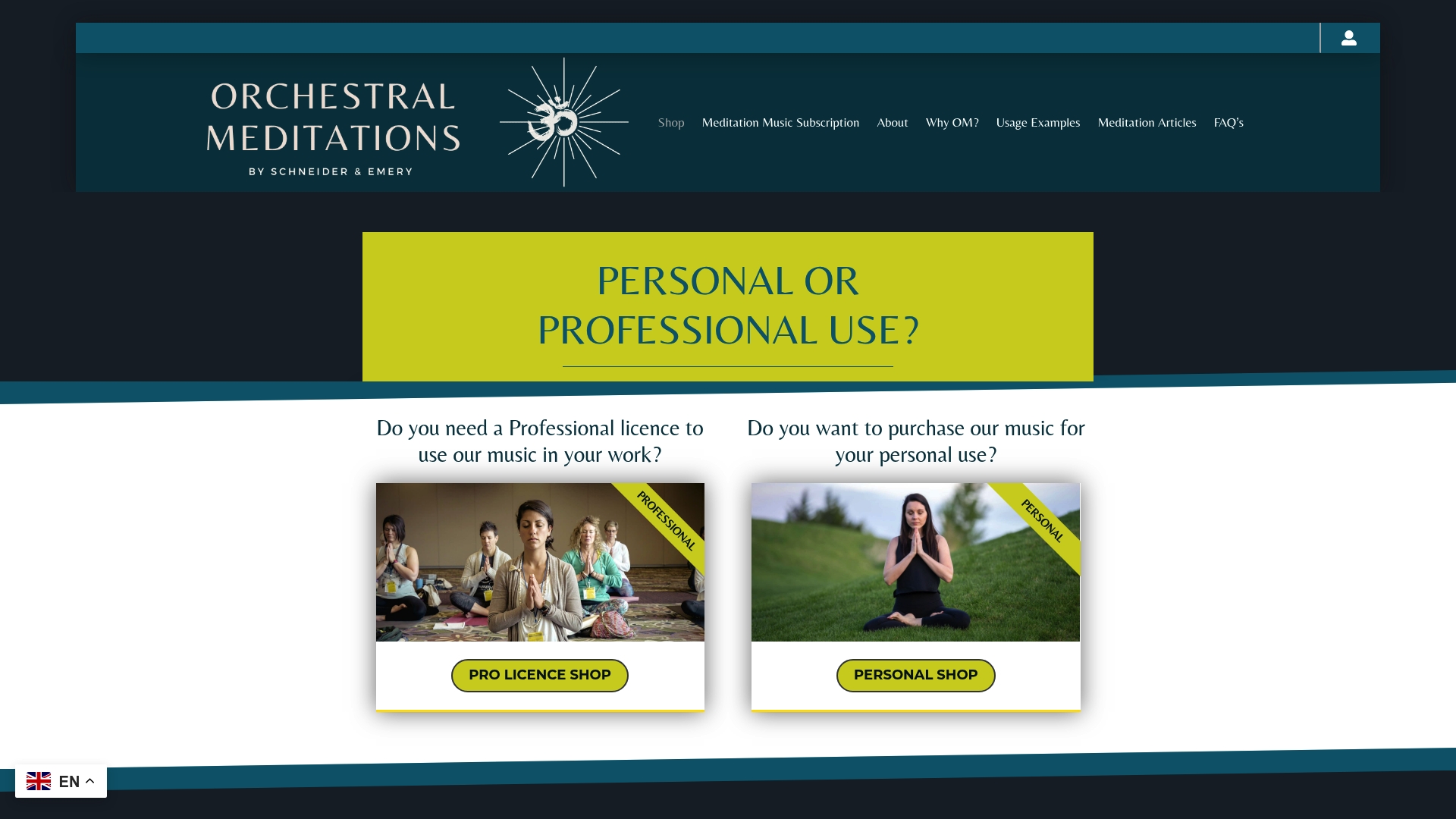
The catalogue includes binaural and ambisonic masters, stems, and long-form tracks suited to sleep and extended session modes, alongside professional licences written to explicitly permit in-app streaming and sub-licensing to your end users. That’s the exact gap most stock libraries leave open. For teams that need something beyond the catalogue, custom briefs and exclusivity requests can be raised directly with the label.
Start by sampling a track from the professional royalty-free catalogue, then request a licence certificate for your compliance file before you commit it to a build.
Sources
- Background music and streaming guidance – PPL PRS Ltd
FAQ
What Does Royalty-Free Actually Cover?
It means a one-time licence fee replaces ongoing per-play royalties, but the composer still owns the copyright, so the licence terms decide what you’re actually allowed to do with the track.
Can I Use a Spotify or Apple Music Subscription in My App?
No. Consumer streaming subscriptions are licensed for private listening only, and using them in a commercial app requires a separate commercial licence.
Do I Need a New Licence Every Time I Update My App?
Not if your original licence is perpetual and names your app by scope rather than by version; check the wording covers future updates and distribution before assuming you’re covered indefinitely.
Who Composes Orchestral Meditations’ Tracks?
Robert Emery and Moritz Schneider hold composer and producer credits on recordings made at Abbey Road Studios with the National Philharmonic, giving purchasers verifiable provenance alongside their licence documentation.
What’s the Difference Between Sync Rights and Sub-Licensing?
Sync rights cover pairing music with visual media; sub-licensing covers your right to pass streaming permission on to your app’s end users, and an app needs the second far more than the first.