Most sound healing practices hand you a singing bowl recording, tell you to breathe, and call it therapy. And look, there is nothing wrong with a singing bowl. But if you have ever sat through forty minutes of a single sustained tone and found your mind wandering to your shopping list, you already know the problem. An orchestral sound healing guide exists precisely because the full palette of strings, woodwinds, harp, and celesta does something that a single instrument simply cannot. When composers like Robert Emery and Moritz Schneider, whose work underpins Orchestralmeditations’ catalogue, pour their craft into a piece designed specifically for deep relaxation, the result is closer to an immersive acoustic environment than a track you happen to have on in the background. This guide walks you through everything: what to set up, how to run a session, and why the science backs all of it.
Key takeaways
| Point | Details |
|---|---|
| Equipment matters more than you think | High-quality headphones or a multi-channel speaker system transforms the orchestral experience from pleasant to genuinely therapeutic. |
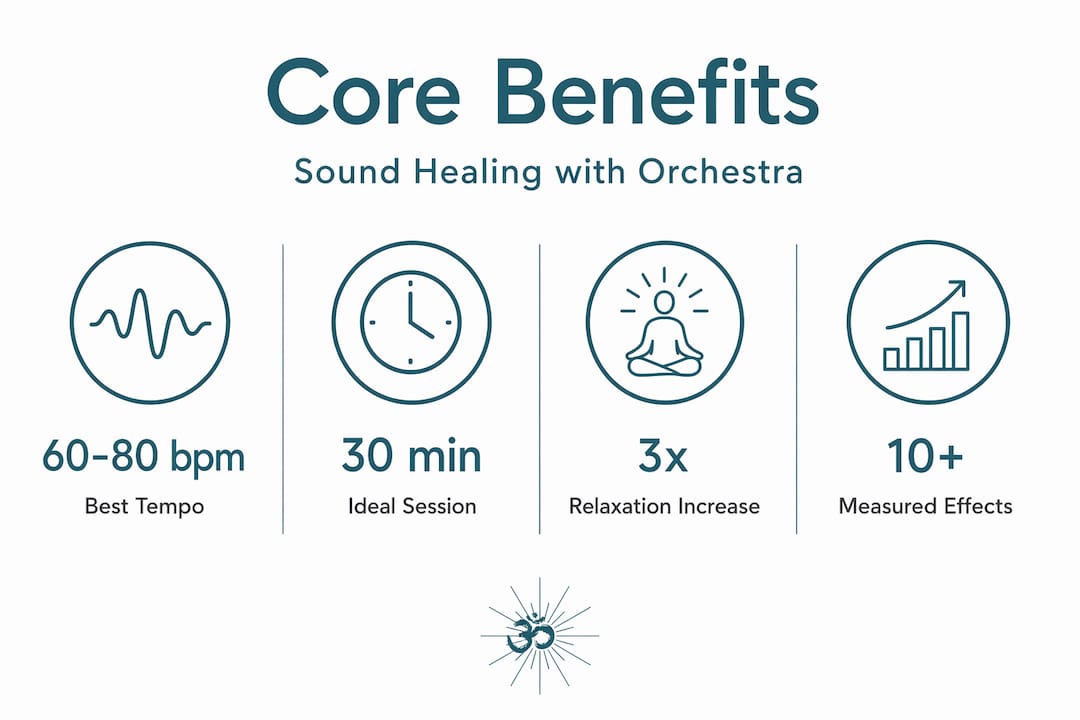
| Session length has a sweet spot | Research points to 30 to 60 minutes as the window where physiological and psychological benefits reliably appear. |
| Music selection is its own skill | Slow tempo, major key, simple harmonic structure, and live orchestral recording quality all determine whether a piece heals or merely distracts. |
| Consistent practice compounds results | A 30-day commitment to regular sessions produces measurably greater stress and anxiety reduction than occasional listening. |
| Personalised playlists outperform random listening | Matching orchestral pieces to your specific goal (sleep, stress relief, deep meditation) accelerates results. |
Setting up for orchestral sound healing
Before you press play on anything, there are decisions to make that will determine whether your session genuinely works or just feels like a nice nap soundtrack. Think of this as your orchestral meditation checklist for getting the basics right.
The instruments that do the heavy lifting
Orchestral sound healing draws on a remarkably varied instrumental palette. Strings (violin, viola, cello, double bass) provide the harmonic warmth that forms the emotional backbone of most healing compositions. Woodwinds (flute, oboe, clarinet) cut through with clarity, particularly useful for pieces aimed at focus or anxiety reduction. The harp adds a shimmering, almost tactile quality that many listeners find physically calming. The celesta, that peculiarly delicate keyboard instrument that sounds like a music box made of glass, is a favourite of both Robert Emery and Moritz Schneider for its capacity to create ethereal, space-like textures.
Robert Emery, a conductor and composer with a long history of orchestral recording, and Moritz Schneider, a producer specialising in frequency-based and meditative orchestral work, together bring a level of acoustic intentionality to Orchestralmeditations’ sessions that is genuinely rare. Their recordings, made at Abbey Road Studios with the National Philharmonic, use microphone placement and ensemble size to produce a spatial quality you can feel in your chest. That is not a metaphor. It is physics.
What to look for in orchestral healing music
The research here is surprisingly specific. Slow tempo music in the range of 60 to 80 beats per minute with a simple harmonic structure produces the most consistent improvements in sleep quality and relaxation. Major key compositions, particularly those featuring violin as a lead voice, have shown significant anxiety reduction effects. A 2025 classical music therapy study found stress reduction in over 80% of participants, which is a statistic that should make you pay close attention to what you queue up.
Here is a comparison of musical characteristics to guide your selection:
| Feature | Healing-optimised | Avoid |
|---|---|---|
| Tempo | 60 to 80 bpm | Above 100 bpm |
| Key | Major (C, G, D major work well) | Minor keys for anxious listeners |
| Instrumentation | Strings, harp, flute, celesta | Heavy brass, percussion-led pieces |
| Production | Live orchestral recording | Purely digital or synthesised |
| Dynamic range | Gentle, consistent | Sudden loud passages |
Equipment checklist
- Over-ear headphones with a flat or warm frequency response (avoid bass-heavy gaming headsets)
- Stereo speakers with good mid-range clarity, positioned at ear height
- Optional: a multi-channel or 3D spatial audio system for a significantly more immersive experience
- A device capable of high-resolution audio playback if your music files support it
- An environment you can dim, physically tidy, and temperature-control to around 19 to 21 degrees Celsius
Pro Tip: If you can access a 3D or binaural audio version of an orchestral meditation, use it over a standard stereo mix. The spatial placement of instruments around your auditory field significantly deepens the immersive quality and makes it far easier to stay present during a session. Orchestralmeditations’ 3D sound meditation recordings are specifically engineered for this effect.
Running an orchestral sound healing session
Right. You have your equipment sorted, you have chosen your music, and you are ready to actually do the thing. Here is a step-by-step orchestral meditation workflow guide for a complete session.
-
Prepare your space. Lower the lights or draw curtains to reduce visual stimulation. A consistent temperature matters more than most people realise. Put your phone on silent and, ideally, in another room. Even the sound of a vibrating phone can fracture a deep meditative state.
-
Choose your piece intentionally. This is not the moment to hit shuffle. Select a single piece or a pre-built playlist matched to your goal. If you are targeting sleep preparation, choose something in the 60 to 70 bpm range with sustained string passages. For anxiety reduction, a major-key piece featuring violin or flute tends to work well. For deep meditation, look for orchestral works that incorporate theta-frequency binaural elements.
-
Settle your body before you start. Lie down or sit in a supported, comfortable position. Take three slow breaths before the music begins. This is not just ritual. It signals to your nervous system that something intentional is about to happen, which accelerates the shift into a parasympathetic state.
-
Set a session length and commit to it. Research on sound healing interventions points to 15-session programmes over five weeks producing significant improvements in stress, mood, and sleep quality. For daily practice, 30 to 60 minutes is the target window. Shorter sessions are better than no sessions, but the physiological benefits compound with duration.
-
Choose your listening mode. Active listening means following the music consciously, noticing each section, each instrument, each dynamic shift. Passive immersion means letting the music wash over you without engagement. Guided meditation with orchestral accompaniment is a third mode where spoken guidance anchors you while the music provides the emotional and physiological lift. All three work. The best choice depends on how restless your mind tends to be on a given day.
-
Anchor your awareness. During the session, if your mind wanders (and it will, because minds do that), use the music itself as your anchor. Pick the sound of one instrument and follow it. The cello line. The flute melody. The harp arpeggios. This is functionally similar to using the breath as a meditation anchor, but many people find it more accessible because it gives the active mind something genuinely interesting to track.
-
Close the session slowly. When the music ends, do not stand up immediately. Lie still for two to three minutes. Let your awareness gradually return to the room. This transition period is where much of the integration happens, and rushing it is the most common mistake people make.
Pro Tip: The optimal time of day for most people is either early morning (before the day’s noise and demands have fully registered) or early evening (to shed accumulated stress before dinner). Late-night sessions directly before sleep are effective for insomnia but can occasionally produce very vivid dreams. Consider yourself warned.
How orchestral sound healing benefits you
This is where it gets genuinely fascinating. Sound healing is not just a nice idea. There is a growing body of research explaining the precise mechanisms at work.

The most fundamental mechanism is brainwave entrainment. Orchestral music entrains brainwaves into alpha and theta states, the frequencies associated with deep relaxation and the hypnagogic state just before sleep. This is not something you have to consciously try to achieve. It happens passively as you listen, which is partly why orchestral sound healing is so accessible compared to pure meditation techniques that require years of practice to reach equivalent states.
The complex harmonic spectrum of a live orchestra deepens meditation experiences in a way that single-tone instruments cannot replicate. When twenty violins play in unison, the micro-variations in tuning between instruments produce a beating frequency that acts directly on the nervous system. It is, in a sense, an orchestra-sized tuning fork applied to your entire body.
The physiological effects are well-documented:
- Sound-based meditative practices significantly reduce cortisol levels, blood pressure, and subjective stress within four weeks of daily sessions.
- Consistent sound healing practice over 30 days produces significant reductions in both anxiety and stress, with positive effects on participants’ sense of spiritual connection.
- Orchestral music featuring the solfeggio frequency of 528 Hz, incorporated into several of Robert Emery’s compositions, has been associated with cellular-level resonance effects that practitioners describe as a sense of physical warmth and ease.
“Music-assisted meditation shows superior improvements compared to meditation alone, enhancing emotional processing and the capacity for self-transcendence.” Psychology Today, 2025.
The parasympathetic nervous system activation triggered by carefully composed orchestral music is not a placebo. Heart rate slows. Muscle tension drops. Breathing naturally deepens. The body does this because it is receiving a coherent acoustic signal that says, with considerable authority, “everything is safe.” A full orchestra, it turns out, is quite persuasive.
For a broader perspective on orchestral healing in healthcare, the application extends well beyond personal wellness into clinical settings, which gives you a sense of how seriously the therapeutic community is beginning to take this.
Common mistakes that undermine your sessions
Even people who are genuinely committed to their practice make the same errors. Here is how to avoid the most common ones.
- Picking music by mood rather than design. Your favourite film score is not the same as a piece composed specifically for healing. Dramatic swells, sudden dynamic changes, and emotionally charged melodies can actually activate a stress response rather than calm one.
- Sessions that are too short. A ten-minute session is better than nothing, but it rarely produces the deeper physiological shifts. Think of the first fifteen minutes as the warm-up. The actual therapeutic work tends to begin around the twenty-minute mark.
- A noisy environment. Traffic, air conditioning hum, and household sounds do not just distract you. They compete with the orchestral frequencies and reduce the coherence of the acoustic signal reaching your nervous system.
- Expecting silence in your mind. New practitioners often abandon sessions because thoughts keep appearing. This is normal. The practice is not about achieving a blank mind. It is about returning your attention, again and again, to the music.
- Inconsistent practice. The benefits of regular sound healing are cumulative. A single session is pleasant. Thirty consecutive sessions produce measurable physiological change.
If you find yourself getting unexpectedly emotional during a session, that is not a sign something has gone wrong. Orchestral music has a particular capacity for surfacing feelings that have been sitting just below the threshold of awareness. Allow it. It passes, and it is part of the process.
Pro Tip: Layering very quiet ambient nature sounds (a distant stream, light rain) beneath your orchestral meditation at around 10 to 15% of the music’s volume can help listeners who struggle with silence between musical phrases. It fills the acoustic space without competing with the orchestral frequencies. Use this sparingly and only if restlessness is a genuine obstacle.
For a thorough relaxation music checklist that covers the full selection criteria in one place, that resource is worth bookmarking before you build your first playlist.
Comparing orchestral meditation music and building playlists
Not all orchestral meditation music is the same, and understanding the differences is what separates a genuinely effective orchestral meditation guide from a general playlist suggestion. Here are the key criteria for your orchestral meditation music comparison:
- Tempo and pulse. Pieces between 60 and 80 bpm synchronise with a resting heart rate and encourage physiological calm. Pieces above 90 bpm can sustain focus but are less useful for sleep or deep relaxation.
- Instrumentation. For anxiety reduction, strings and woodwinds with minimal percussion. For deep meditation, harp, celesta, and sustained string pads with embedded binaural tones.
- Production method. Live orchestral recordings carry overtones and harmonic complexity that digital equivalents lack. The Orchestralmeditations catalogue, recorded with the National Philharmonic at Abbey Road Studios, represents the higher end of this spectrum.
- Frequency elements. Works incorporating 528 Hz solfeggio frequencies or theta-range binaural beats (4 to 8 Hz) add a neurological dimension that purely melodic pieces do not provide.
| Music type | Best for | Tempo range | Key feature |
|---|---|---|---|
| Sustained strings with harp | Deep meditation, sleep | 55 to 65 bpm | Harmonic warmth, binaural elements |
| Violin-led major key pieces | Anxiety reduction, focus | 65 to 75 bpm | Emotional clarity, melodic anchor |
| Full orchestral with celesta | Spiritual practice, transcendence | 60 to 70 bpm | Textural richness, ethereal quality |
| Woodwind-led chamber pieces | Morning practice, gentle uplift | 70 to 80 bpm | Brightness, clarity of tone |
Robert Emery’s compositions tend towards the sustained, expansive end of the spectrum. Moritz Schneider’s production approach weaves in frequency layers beneath the acoustic surface. Together, these two orientations produce pieces that work on both the conscious listening level and the neurological one simultaneously.
For building personalised playlists, group your pieces by goal rather than by composer or album. A sleep playlist should move from 70 bpm down to 55 bpm over its duration, ending on the most sustained and harmonically simple piece in your collection. A stress-relief playlist can sustain 65 to 75 bpm throughout. For comparing orchestral meditation music across the full range of styles and goals, that guide covers the landscape in genuine depth.
You can find quality emotional clarity practices that pair well with orchestral sound healing sessions if you want to extend the work beyond listening alone.
My honest take on orchestral sound healing
I have experimented with most of the sound healing modalities available. Singing bowls, gong baths, binaural beats recorded in a studio flat at 2 a.m., the lot. And while each of them has something to offer, orchestral sound healing occupies a different category entirely for me. It is the difference between someone pressing a single key on a piano and a full orchestra playing in a resonant hall. One gives you a frequency. The other gives you a world to inhabit.
What I find genuinely extraordinary about the work Robert Emery and Moritz Schneider have done through Orchestralmeditations is the intentionality behind each piece. These are not wellness tracks assembled from stock loops. They are composed with specific physiological and psychological outcomes in mind, recorded with live musicians whose micro-variations in tone and timing produce exactly the harmonic complexity that the science says matters. When you listen to a piece recorded at Abbey Road with the National Philharmonic, you are receiving decades of acoustic research in a form that bypasses the analytical mind and goes directly to the nervous system.
My practical advice, honestly, is this: commit to thirty days. Not because that is a round number, but because that is where the cumulative physiological shifts actually begin to show up in your body and your sleep. The first week feels pleasant. The third week starts to feel like something you cannot imagine not doing.
— ROBERT
Explore Orchestralmeditations’ healing catalogue
If you have read this far and your instinct is “I want to hear what this actually sounds like,” that is the right next step.
Orchestralmeditations offers a curated library of orchestral meditation recordings composed by Robert Emery and Moritz Schneider, recorded with live musicians at Abbey Road Studios. The catalogue covers everything from beginner-friendly sustained string meditations to advanced theta-frequency orchestral works designed for experienced practitioners. Each piece is built around the same scientific principles this guide has covered: optimal tempo, live harmonic complexity, and frequency layers that work on the nervous system directly.
You can browse the full meditation music catalogue to find pieces matched to your specific goals, whether that is sleep, anxiety relief, or deep meditative practice. For a curated view of standout recordings, the best meditation music page is a good starting point. And if you are wondering why a live orchestral recording outperforms a digital equivalent, the orchestral versus digital comparison page explains the acoustic and neurological reasoning in plain terms.
FAQ
What is orchestral sound healing?
Orchestral sound healing uses live orchestral music, typically recorded with strings, woodwinds, harp, and other instruments, to promote relaxation, reduce stress, and support meditative states through acoustic and frequency-based mechanisms.
How long should an orchestral sound healing session be?
Research supports sessions of 30 to 60 minutes for reliable physiological benefits. Studies on sound healing interventions show significant improvements in stress, mood, and sleep quality with consistent sessions across several weeks.
Does the type of orchestral music matter for healing?
Yes, significantly. Major key pieces at 60 to 80 bpm with live orchestral instrumentation produce the most consistent relaxation and sleep improvements. Dramatic or percussion-heavy pieces can have the opposite effect.
Can orchestral sound healing help with anxiety?
Research shows classical music therapy reduces stress in the majority of participants, with major-key violin compositions showing particularly strong anxiety reduction effects. Regular practice compounds these results over time.
Do I need special equipment to benefit?
You do not need a professional audio setup. A good pair of over-ear headphones and a quiet environment are sufficient to begin. Binaural or 3D audio recordings, like those produced by Orchestralmeditations, require headphones to deliver their full spatial and neurological effect.